Literature

Fredric Jameson
Fredric Jameson is a prominent literary critic and Marxist theorist known for his influential work on postmodernism and cultural theory. He is recognized for his analysis of the relationship between literature, history, and ideology, and his concept of "cognitive mapping" as a way to understand the complexities of contemporary society. Jameson's writings have had a significant impact on literary and cultural studies.
Written by Perlego with AI-assistance
Related key terms
1 of 5
11 Key excerpts on "Fredric Jameson"
 eBook - ePub
Jameson and Literature
The Novel, History, and Contemporary Reading Practices
- Jarrad Cogle(Author)
- 2020(Publication Date)
- Palgrave Macmillan(Publisher)
5 , p. xi). Within this framework, despite extensive discussions of poetry, music, architecture and film, the novel has remained primary in his reading practice. My work will contend that Jameson’s idiosyncratic engagements with the literary canon—as well as his predilections and absences when discussing certain periods and forms—have an impact on his theoretical frameworks, particularly in his sense of historical change. If we make the concession that gaps are inevitable in any critical practice, several aspects of Jameson project nonetheless bring these questions of canonisation and textual choice to the fore: the immensity of his cultural knowledge and range of reference, his interest in generic boundaries and formulation, and his attempts to totalise and to make dialectic connections between disparate texts. By closely attending to Jameson’s literary readings, we also gain a new perspective on his overarching theoretical concepts, one that differs from many previous critical engagements. Through this work, this book seeks to articulate the tension between Jameson’s most influential work and the criticism that has surrounded it, while suggesting ways in which his literary interpretation might remain useful for contemporary reading practices. To recognise the specific nature and extent of Jameson’s engagement with literary studies, in other words, is not just to provide an account of his own literary criticism, but also to offer an alternative viewpoint of his cultural work as a whole.Major Contributions: Marxism, Symptomatic Reading and Postmodernism
Biographical information on Jameson is hard to come by. Books focusing on his career have given only summary biographical details before concentrating on his theory and achievements. In the framing of his contributions to theory as paradigmatic or foundational, however, there is often a restricted sense of Jameson’s connection to wider critical discourse. In some ways, his own publications exacerbate this impression. His major texts often engage specifically with an earlier generation of Marxist critics, with only brief references to contemporary academic discussion. As Geoffrey Galt Harpham notes: “Jameson’s works … seem to issue from a center of consciousness unconnected with … any kind of neighborly community. His first books appeared starkly without dedicatees, and, with the exception of his very first, in which he thanked his dissertation advisor, without the customary list of friends and colleagues and institutions who made it all possible” [6 , pp. 216–217]. The growing number of scholars mentioning Jameson in their own dedications and acknowledgements counteract this sense of the impersonal. Recently, former students have described Jameson as “a great teacher” [7 , p. xiii], or as a dissertation advisor with a “voracious interest in everything, keen and attentive guidance, and general good mood” [8 eBook - PDF
The Eloquence of the Vulgar
Language, Cinema and the Politics of Culture
- Colin MacCabe(Author)
- 2019(Publication Date)
- British Film Institute(Publisher)
PART THREE Readings – Intellectuals in Transit 117 8 Fredric Jameson One of the major intellectual tasks that I set myself when I became Head of Research at the British Film Institute was to try to bring leading cultural critics to the Institute in order to get them to speak specifically about film in a general intellectual context. Cornel West, John Berger and Marina Warner were among those who took up this invitation. Fredric Jame-son was one of the earliest of such visitors and his lectures on four aspects of world cinema in 1990 were so compelling that the British Film Institute decided to publish them in book form the following year. My publishing colleagues felt, however, that Jameson’s difficult style and complex intellectual allusiveness required an introduction which I should pro-vide. I was more than happy to undertake this task. Jameson is one of the few academics writing today who uses the vast array of scholarship at our disposal to address genuinely important questions. Any effort of mine that could bring his work to a wider audience, par-ticularly to an audience of film scholars, was an effort well worth undertaking. Fredric Jameson is probably the most important cultural critic writing in English today. The range of his analysis, from architecture to science fiction, from the tor-tuous thought of late Adorno to the testimonio novel of the Third World, is extra-ordinary; it can truly be said that nothing cultural is alien to him. He is one of the very few thinkers who genuinely ignores the conventional distinctions between cultural objects: he will as readily bring the same care and attention to the delib-erately complex works of high modernism as to the very different complexities of cyberpunk. As importantly, he will move between media: the analysis of a text will be followed by a social description of a building, the criticism of a mainstream film will be succeeded by an appreciation of an avant-garde video. eBook - PDF
Fredric Jameson
A Critical Reader
- D. Kellner, S. Homer, D. Kellner, S. Homer(Authors)
- 2004(Publication Date)
- Palgrave Macmillan(Publisher)
42 3 Fredric Jameson on ‘Third-World Literature’: A Qualified Defence Neil Lazarus I In 1986, Fredric Jameson published an essay entitled ‘Third-World Literature in the Era of Multinational Capitalism’ in Social Text, a left-identified, New York-based journal of cultural politics. In retrospect, I am sure he wishes that he had not. For the essay has brought him nothing but brickbats. Jameson’s work has always been marked by both its magisterial erudition and its eminent contestability. I do not mean by the term ‘contestability’ that what Jameson has written has been controversial, exactly. I mean rather that his work has demonstrated a rather remarkable ability to provoke its readers to take issue with its premises and arguments, its terms and conclusions. Jameson has always attracted a lot of readers, most of whom, from the beginning, have liked to disagree with him, in whole or in part. My sense is that this is because while he has characteristically worked with material – ideas, concepts, theories, bodies of work, modes and styles of cultural practice – that possesses, or is beginning to possess, wide academic currency, his own approach to this material has invariably been off-centre: heterodox and distinctly underivative, while remaining deeply systematic and never, I think, lapsing into mere idiosyncracy. Not only has Jameson tended to get to this material first, as it were, to think about it significantly in advance of most other scholars, he has also tended to think about it in a significantly dif- ferent way from most other scholars. eBook - ePub
Keeping Faith
Philosophy and Race in America
- Cornel West(Author)
- 2012(Publication Date)
- Routledge(Publisher)
11 Fredric Jameson's American Marxism
DOI: 10.4324/9780203472361-13Fredric Jameson is the most challenging American Marxist hermeneutic thinker on the present scene. His ingenious interpretations (prior to accessible translations) of major figures of the Frankfurt School, Russian formalism, French structuralism and poststructuralism as well as of Georg Lukács, Jean-Paul Sartre, Louis Althusser, Max Weber and Louis Marin are significant contributions to the intellectual history of twentieth-century Marxist and European thought. Jameson’s treatments of the development of the novel, the surrealist movement, of Continental writers such as Honoré de Balzac, Marcel Proust, Alessandro Manzoni and Alain Robbe-Grillet, and of American writers, including Ernest Hemingway, Kenneth Burke and Ursula Le Guin, constitute powerful political readings. Furthermore, his adamantly antiphilosophical form of Marxist hermeneutics puts forward an American Aufhebung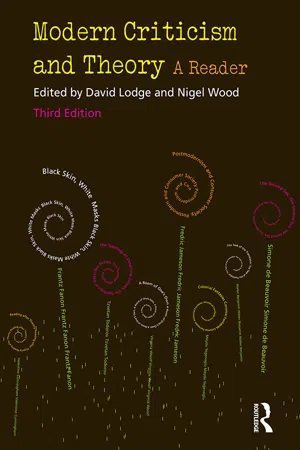 eBook - ePub
Modern Criticism and Theory
A Reader
- Nigel Wood, David Lodge(Authors)
- 2014(Publication Date)
- Routledge(Publisher)
33 Fredric Jameson
DOI: 10.4324/9781315835488-33Introductory note
Fredric Jameson (b. 1934) has taught at several American universities, including Harvard, the University of California at San Diego and Santa Cruz, and Yale. At present he is William A. Lane Professor of Comparative Literature and Romance Studies at Duke University. Since the publication of his Marxism and Form (1971) he has been generally acknowledged as the leading American exponent of marxist criticism, but his work also displays an intellectually powerful grasp of the whole range of structuralist and post-structuralist theory. The Prison House of Language: a critical account of structuralism and Russian formalism (1972) is a valuable exposition of structuralism and Russian Formalism, as well as a critique of them from the point of view of dialectical materialism. His Fables of Aggression (1979) is a study of fascist ideology in modernist writers such as Wyndham Lewis and Ezra Pound. The Political Unconscious: narrative as a socially symbolic act (1981) is a densely packed synthesis of structuralism, post-structuralism, Freudian psychoanalysis and various schools of marxism, but its main focus is on the critical and cultural lenses through which we read. We can never attain an unmediated acquaintance with any text and the hermeneutic process is essentially an allegorical one: we read through a master code, that changes, to be sure, but the pattern is largely the same. Literary or cultural texts attempt to resolve contradictions and we must be aware of the dialectic in which they are inexorably caught; we thereby return to history, not an account of events alone, but the ideologies and basic forces that always lie just off the textual map.More recently Jameson has turned his attention to the topic of postmodernism, and its socio-economic context of ‘late capitalism’. His attempts to provide a materialist explanation of its appeal do not lead to a simply antagonistic stance. ‘Postmodernism and Consumer Society’ was first published in the Hal Foster collection, Postmodern Culture (1983) and is his most succinct appreciation of postmodernist aesthetics. It was quickly followed by ‘The Politics of Theory: ideological positions in the postmodern debate’ in New German Critique, 33 (1984). A much expanded and elaborated version of this, entitled ‘Postmodernism, or the Cultural Logic of Late Capitalism’, was published in New Left Review (July/August 1984), and provided the basis for a full-length study with the same title that emerged in 1991. Casting his eyes over many artforms and media, he comes to the conclusion that the postmodern breaks away from modernism at the same time as ‘late capitalist’ forces, commodification and populist appeals to ‘choice’ and a free market, come to be felt and taken as a ‘natural’ derivation from social progress. Far from being radically unsystematic, postmodern aesthetics can be identified in terms of its typical effects and tropes – all of which strain to efface its history. Indeed, Jameson has tried to supply an optimistic vision of marxist analysis in his carefully-argued study of Brecht and Method (1998), his grasp of contemporary modernist thought in A Singular Modernity: essay on the ontology of the present (2002) and his celebration of utopian ideals in Archaeologies of the Future: the desire called Utopia and other science fictions eBook - ePub
Consciousness and the Neoliberal Subject
A Theory of Ideology via Marcuse, Jameson and Žižek
- Jon Bailes(Author)
- 2020(Publication Date)
- Routledge(Publisher)
4 Fredric Jameson A postmodern narrative Chronologically, the analysis of Fredric Jameson in this chapter and the next overlaps with the late work of Marcuse, before moving into the era of neoliberalism’s dominance. This shift to what Jameson calls ‘late capitalism’ poses new problems, but in many ways they continue from those outlined by Marcuse. We are especially interested here in the ‘postmodern’ cultural logic that Jameson theorised throughout the 1980s, and its ramifications for ideology theory, but also in his overall critical project, and the ‘historicising’ approach to cultural analysis that he clarified in the 1970s and continues to develop today. The main thrust of this project is to reinvigorate the political and the temporal within a socioeconomic form that dissolves meaning and appears too complex to comprehend. The first aim here is to affirm Jameson’s view of postmodernism as the cultural expression of a particular ‘totality’ in history, with the idea that this logic of ‘late’ or neoliberal capitalism remains dominant today. We also support Jameson’s notion of ‘the dialectic’ as a requirement to see everything at once, not only from the view of human history, but also in terms of how that relates to specific social formations and everyday politics, and maintaining the tension between synchronic and diachronic perspectives (the sense of social unevenness that remains even in attempting to define a period). In this sense, our concept of ideology can be seen as a small contribution to the impossible task of viewing all the angles at once. At the same time, our focus represents a departure from Jameson, with its own repercussions for political potentials. That is, while Jameson explains that postmodernism cannot fully erase history from culture, his theory tends to solidify around the dominant traits of fragmentation and depthlessness, rather than the details of how we relate to them eBook - ePub
- David Duff(Author)
- 2014(Publication Date)
- Routledge(Publisher)
10 Magical Narratives: On the Dialectical Use of Genre Criticism * F REDEIC J AMESON Of the many distinguished critics in the Marxist tradition who have practised what can loosely be called the sociology of genres, none has investigated more carefully the theoretical issues involved than the American critic Fredric Jameson. Acknowledging that, despite the resistance to genre theory which is part of ‘the ideology of modernism’, genre criticism ‘has always maintained a privileged relationship with historical materialism’, Jameson sets out in this essay to define the terms on which a properly ‘dialectical’ version of that criticism might be based: that is, one which would interpret literary genres in light of the historical conditions that sustain them, while simultaneously reflecting on the historicity of the act of interpretation itself. His starting point, however, is not the modern masters of dialectical thought (Adorno, Benjamin, Bloch, Lukács, and others) who were the subject of his earlier book Marxism and Form (1971), but two specifically literary theorists who between them represent what Jameson saw in 1975 as the dominant trends in modern genre criticism, Northrop Frye (cf. Chapter 6) and Vladimir Propp (cf. Chapter 3). Both of these marginalise historical considerations, Frye in the name of a universal grammar of the human imagination, Propp in pursuance of a synchronic methodology derived from structural linguistics. The purpose of Jameson’s ‘metacommentary’ (his term) is not simply to expose the theoretical confusions and blindspots that result from this suspension of history, but also – in the best dialectical manner – to reap-propriate the insights of what he calls the ‘semantic’ and ‘structural’ approaches within a genuinely historical theory of genre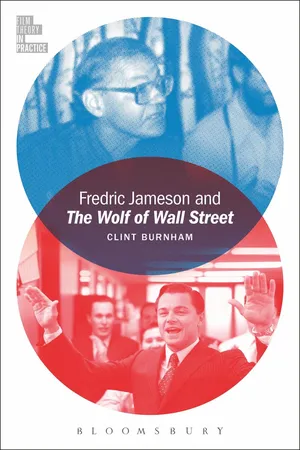 eBook - PDF
- Clint Burnham(Author)
- 2016(Publication Date)
- Bloomsbury Academic(Publisher)
As we have already seen, this is a key theoretical or methodological move intrinsic to Marxist theory, which argues that there is a relationship between the economic base of a society and its cultural superstructure. But just as important to Jameson’s work as his connection of postmodernism to late capitalism Fredric Jameson AND THE WOLF OF WALL STREET 58 is his delineation of the features of postmodernism itself— every step of the way, he not only demarcates what constitutes postmodernism, but also argues for how that is a sign of consumer society, the society of spectacle. Nonetheless, the argument can be broken down into four very clear sub-arguments or logics: first, that postmodernism is a break with modernism; second, that it necessitates an erosion of the boundaries between high and low culture; third, that it is characterized by the death of the subject and other notions of affect or personality (including the triumph of pastiche over parody); finally, that postmodernism can be thought of as the attempt to think historically when that conceptual skill is no longer available to us—trapped as we are in a society saturated with images, all we have is a “nostalgia for the present.” The argument that postmodernism is a reaction to modernism seems fairly commonsensical, and Jameson was not the first to make such a connection (the Anti-Aesthetic collection, for example, contains essays that work out that relation fairly specifically in terms of sculpture and photography). But it also reflects a historical or social ageing of modernism itself: what once was terrifying in Picasso or Joyce had, by the 1970s or 1980s, been gentrified and domesticated, canonized in the museums and in the academy (but also the marketplace, so Mondrian images were on shampoo bottles, T.S. Eliot was available in paperback, and Van Gogh’s paintings were fetching in the millions). eBook - PDF
- Ian Buchanan(Author)
- 2006(Publication Date)
- Continuum(Publisher)
But, it isn’t something one can apply then in a cut-and-dried way and this is the problem with all concepts of method. IB: Thank you. 132 Fredric Jameson: Live Theory Bibliography Works by Jameson Archaeologies of the Future: The Desire Called Utopia and Other Science Fictions (London: Verso, 2005). ‘Symptoms of Theory or Symptoms for Theory?’, Critical Inquiry 30:2 (2004) pp. 403–408. ‘On Representing Globalisation’ (unpublished paper presented at ‘Globalisation and Indigenous Cultures’ conference, Zhengzhow University, China, 2004) pp. 1–27. ‘ Dekalog as Decameron ’, in D. Kellner and S. Homer (eds) Fredric Jameson: A Critical Reader (London: Palgrave, 2004) pp. 210–22. ‘Marc Angenot, Literary History, and the Study of Culture in the Nineteenth Century’, The Yale Journal of Criticism 17:2 (2004) pp. 233–53. ‘Future City’, New Left Review 2 21 (2003) pp. 65–79. ‘The End of Temporality’, Critical Inquiry 29 (2003) pp. 695–718. A Singular Modernity: Essay on the Ontology of the Present (London: Verso, 2002). ‘From Metaphor to Allegory’, in C. Davidson (ed.), Anything (Cambridge, Mass.: The MIT Press, 2001) pp. 25–36. ‘Globalisation and Political Strategy’, New Left Review 2 4 (2000) pp. 49–68. The Cultural Turn: Selected Writings on the Postmodern, 1983–1998 (London: Verso, 1998). ‘Notes on Globalisation as a Philosophical Issue’, in F. Jameson and M. Miyoshi (eds), The Cultures of Globalisation (Durham: Duke University Press, 1998) pp. 54–77. ‘Marxism and the Historicity of Theory: An Interview with Fredric Jameson’, New Literary History 29:3 (1998) pp. 354–83. Brecht and Method (London: Verso, 1998). ‘Persistencies of the Dialectic: Three Sites’, Science and Society , 62:3 (1998) pp. 358–72. ‘Interview with Fredric Jameson’, in E. Corredor (ed.), Lukács After Communism: Interviews with Contemporary Intellectuals (London: Duke University Press, 1997). ‘Marx’s Purloined Letter’, New Left Review 209.4 (1995) pp. eBook - ePub
The Political Unconscious of Architecture
Re-opening Jameson's Narrative
- Nadir Lahiji(Author)
- 2016(Publication Date)
- Routledge(Publisher)
This debate on criticality seems a relevant entry point for the discussion of the impact of Jameson’s critique on North American architectural culture, if only because Jameson is mentioned in the dispute. In the context of this book, which proposes that Jameson’s theory could reactivate a political discourse in architecture, I want to suggest that Jameson’s work had two kinds of effect on architectural culture. The first is linked to his theory of postmodernism, in which architecture became emblematic of the ‘spatialization’ of culture in late-capitalism. As discussed below, it is significant that the work of Manfredo Tafuri was the starting point of his analysis of architectural criticism. With his commentaries on Tafuri, Jameson, already in the mid-1980s, was perceived as a formidable analyst of architectural literature by the architectural community. The second effect is found in his direct impact on architectural criticism, notably on Hays and more recently on Reinhold Martin’s revision of postmodernism.This essay proposes to examine the transactions between these authors by pointing out, in a chronologically disjointed series of soundings, some of the literary tropes that migrated from text to text. This is far from a complete survey, since texts and themes important to each protagonist are left out. Nevertheless, in identifying the mechanisms by which intellectual filiations are created, an outline of a ‘development’ emerges. Chaotic in appearance, this ‘development’ is propelled by a quasi-hypnotic fascination for the paralyzing and anguishing effects of negative dialectics and by a frenetic search for alternate justifications for a cathartic architectural avant-garde.Architecture, Criticism, Ideology
The story begins in 1982, when the Institute for Architecture and Urban Studies (IAUS) invited Fredric Jameson to participate in the symposium ‘Architecture and Ideology’. Organized by ‘Revisions ’, a study group of ‘younger’ architects brought together by Peter Eisenman at the IAUS, the symposium studied the subject of architecture and politics with the specific objective of addressing the politics of postmodernism.2 No longer available |Learn more
The Tooth That Nibbles at the Soul
Essays on Music and Poetry
- Marshall Brown(Author)
- 2014(Publication Date)
- University of Washington Press(Publisher)
For at the end of his book, Jameson propounds a “Marxist theory of plot” and a “theory of character” (397–98) that clearly grow out of his analysis of Sartre’s abstracting of plot from its embedding in a work of writing, and he prefaces these with “a Marxist stylistics” (397) that draws the most important, if in some perspectives the most controversial, implication out of his critique. “The art-sentence itself, as it has been so variously cultivated and practiced in modern times from Flaubert to Hemingway, may be seen alternatively as a type of work or mode of production, and as a type of commodity as well. . . . In modern literature, indeed, the production of the sentence becomes itself a new kind of event within the work, and generates a whole new kind of form” (397). Jameson concludes with a section entitled “Marxism and Inner Form” (401–16), establishing a vitalist response to the abstraction of plot and theme as the culmination of his reflections on where literary history might head. What Is Literature? is perfectly coherent as history, but not as a history of writing. Jameson leads to the missing element through his attention to the action of texts, which takes place continually at the micro-level. For a Marxist, production is a glamour term to apply, but Jameson subsequently warns against misunderstanding it. Insofar as the idea of textual production helps us break the reifying habit of thinking of a given narrative as an object, or as a unified whole, or as a static structure, its effect has been positive; but the active center of this idea is in reality a conception of the text as process, and the notion of productivity is a metaphorical overlay which adds little enough to the methodological suggestivity of the idea of process. 43 However different they may be in their concrete applications, Jameson’s notion of textual process is as stenographic as de Man’s, and hence closely related in spirit to de Man’s sense of the historicity of texts
Index pages curate the most relevant extracts from our library of academic textbooks. They’ve been created using an in-house natural language model (NLM), each adding context and meaning to key research topics.

