Literature

Raymond Williams
Raymond Williams was a prominent Welsh literary critic and cultural theorist known for his influential work on the relationship between literature and society. He is recognized for his concept of "cultural materialism," which emphasizes the importance of understanding culture within its historical and material context. Williams' ideas have had a lasting impact on literary and cultural studies.
Written by Perlego with AI-assistance
Related key terms
1 of 5

10 Key excerpts on "Raymond Williams"
 eBook - ePub
- Monika Seidl, Roman Horak, Lawrence Grossberg, Monika Seidl, Roman Horak, Lawrence Grossberg(Authors)
- 2009(Publication Date)
- Routledge(Publisher)
Chapter 1: Raymond Williams – towards cultural materialism: an introduction
Roman Horak and Monika Seidl
Raymond Williams is recognized as one of the founding fathers of cultural studies, on which he has had a profound influence in Britain and globally, and, even more broadly, on cultural criticism and theory around the world. Williams’ writings have effectively shaped the ways people understand the complexity of the notion of ‘culture’ and many of the ways it has been taken up in scholarly practice.The present collection endeavours to give evidence of some of the enormous breadth and originality of contemporary thinking on Raymond Williams and, at the same time, to mark the important influence of this scholar and critic. It brings together contributions from a variety of countries, disciplines, generations and traditions. Starting from Williams’ most well-known ideas and notions, the book will take the reader to the fringes of his work and to approaches that relate his concepts to ongoing debates.This introduction follows the course of Williams’ renowned and recognized arguments and achievements, which range from a literary critique of culture to cultural materialism. We interrupt our journey where our contributors took inspiration from Williams’ work. At these nodal points we insert summaries of their contributions, which present, in brief close-ups, snap-shot-like, some details of the many international perspectives on Williams’ work presented in this collection.Our journey begins in the early summer of 1970 when a remarkable meeting took place in Cambridge. Rudi Dutschke, tragic hero of the German anti-authoritarian movement, who had been living in England for a while to recover from the effects of the assassination attempt made on him on Easter Monday 1968, presented Raymond Williams, Fellow of Jesus College, with a research proposal on Georg Lukács’ History and Class Consciousness. Dutschke, a former student leader, wanted to study for a doctorate in Cambridge under the renowned economist Joan Robinson, and had to undergo the usual tedious admissions ritual – such as the presentation of references and reports and talking to representatives of the University’s governing body and important professors – before he was eventually accepted by the university that same summer.1 His meeting with Williams would probably have passed completely unnoticed had he not been expelled from the country at the beginning of 1971 on the grounds of supposedly subversive political activities, following a lengthy period of uncertainty during which figures such as Leo Löwenthal and Michael Foot intervened in his favour.2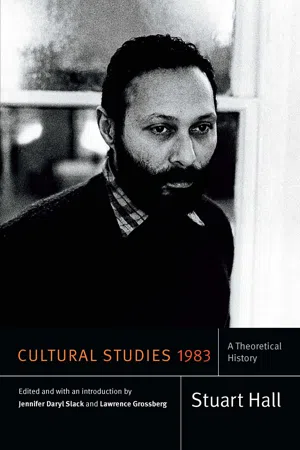 eBook - PDF
Cultural Studies 1983
A Theoretical History
- Stuart Hall, Jennifer Daryl Slack, Lawrence Grossberg(Authors)
- 2016(Publication Date)
- Duke University Press Books(Publisher)
lecture 2 Culturalism The work of Raymond Williams has been one of the most important and powerful formative influences in Cultural Studies. This remains the case despite the fact that many of his conceptualisations are flawed, many of the turns he has taken and the positions he has advocated are inad-equate, and he has been unable to follow through on many of the paths that he has opened—paths which could prove fruitful to the further de-velopment of the field. One must take his contributions into account in the spirit of critical respect, not for the truths they pronounce but as part of a serious intellectual project which offers us many useful ideas even if we reject the overall framework within which he frames them. Raymond Williams is a very “English” figure, one of many marginal in-tellectuals from the provinces—in this case Wales—who have succeeded by their own combination of tough mindedness, dedication, chance, and luck. The war and the changes after the war helped a lot of those people to come into intellectual life; they are often referred to in England as “schol-arship boys” [ sic ]. Williams is the son of a working-class family, raised in the Welsh border regions. His father was a railway signalman; his family has always had a strong labourist, trade union tradition. He was brought up as the bright young prodigy of the village, the first of his family to leave home to study, to attend university, and receive a higher education in the English context. This results in a huge cultural break in his life, one 26 | lecture 2 which many of the cultural theorists of this generation (including Rich-ard Hoggart but not E. P. Thompson) have experienced. Williams is thus the product of a very important formation at a particular moment in British history. He grew up before the war as a bright young socialist. He attended Cambridge, the apogee of the higher education system, where the ruling class, if it exists, is manufactured. eBook - ePub
Raymond Williams and Education
History, Culture, Democracy
- Ian Menter(Author)
- 2022(Publication Date)
- Bloomsbury Academic(Publisher)
1 Biography and Education – Raymond Williams’s Educational ExperiencesI wish, first, that we should recognize that education is ordinary: that it is, before everything else, the process of giving to the ordinary members of society its full common meanings, and the skills that will enable them to amend these meanings, in the light of their personal and common experience.(Williams, Culture and Society 1958/1989:14)IntroductionWhen I try to answer the question of what Raymond Williams was … my answer is that he was a thinker. When you talked with him, his thinking was almost palpable: a deceptively slow delivery allowed a tremendously impressive body of mental capital to go into action.(Barnett, 1988, cited by Eldridge and Eldridge, 1994:2)So said one of his close collaborators, Anthony Barnett, soon after Williams’s death in 1988. However, Raymond Williams described himself first and foremost as a writer. The act of committing words to paper was a self-defining process. In spite of his lasting worldwide reputation for his writings on politics, on literature, drama, television and film, his own commitment throughout his life to writing fiction was never in any doubt. Reading the extensive interviews which were published as Politics and Letters, it is clear how important to him this creative process was:It is certainly true that I have given relatively more time, in comparison with what became visible and valued, to fiction, than to any other forms of writing. In the late forties, I regarded the novels as the work which I most wanted to do. Now I feel differently about them. All along there have been certain things pressing on me, which I simply could find no alternative way of writing; today, however, fiction is something I’m prepared to work on a long time without feeling any urgency to finish quickly. eBook - ePub
Romantic Anti-capitalism and Nature
The Enchanted Garden
- Robert Sayre, Michael Löwy(Authors)
- 2019(Publication Date)
- Routledge(Publisher)
5 Raymond Williams: romantic culture and socialist ecologySon of a Welsh railway worker, Raymond Williams (1921–1988) was always something of an outsider in the British academic elite, by virtue of his double loyalty, throughout his entire life, to the working class and to Welsh culture. To be sure, he studied literature at the very elitist Cambridge University, but by joining the Communist Party at the end of the 1930s he placed himself necessarily at the margins of the academic establishment. His studies were interrupted by the Second World War, in which he fought in an armored tank unit. After the war he decided to leave Cambridge – as well as the Communist Party – and began to lecture, with his friend E.P. Thompson, at the Workers’ Educational Association, a pedagogical network linked with the British Labour movement. He only returned to Cambridge, as a lecturer, in 1961.Williams, together with Stuart Hall and their friends at the Birmingham Centre for Contemporary Cultural Studies, was one of the primary initiators – through the influence of his book Culture and Society (1958) – of “Cultural Studies,” which was destined to become one of the most important areas of Anglo-American academic research. Williams was also, along with E.P. Thompson, John Saville, Stuart Hall, Raphael Samuel, and other British Marxist intellectuals who left the Communist Party in 1956, a founder of New Left Review . A number of his works – among others Keywords: A Vocabulary of Culture and Society (1976) and Marxism and Literature (1977) – nourished the reflection of several generations of critical intellectuals on both sides of the Atlantic.His influence was considerable. It is enough to mention that at the end of the 1970s 750,000 copies of his books had been sold. His first writings dealt exclusively with British culture, but during the 1960s he discovered Western Marxism – the historicist/humanist tendency that includes Gramsci, Lukács and Lucien Goldmann – with which he felt strong affinities. His work became a bridge between the British romantic cultural tradition and Continental Marxism. A committed intellectual with strong socialist beliefs, he published, with E.P. Thompson, an influential anti-capitalist document, the May Day Manifesto eBook - ePub
- Christopher Prendergast(Author)
- 2000(Publication Date)
- Columbia University Press(Publisher)
3 Foundations and Beginnings Raymond Williams AND THE GROUNDS OF CULTURAL THEORYPeople have often commented on the quietly authoritative voice we so often hear in the writings of Raymond Williams. But alongside the directness and confidence of address, we should also remember the many hesitancies and uncertainties, along with the constant reaching for complexity. The endlessly backtracking and self-qualifying style (what Robin Blackburn has called Williams’s “characteristic mode of piling qualification upon complexity”) tells of a strategy not merely of ordinary intellectual scrupulousness but also of active unsettlement of terms and positions (from a man many of whose existential and political preferences were for settled forms of life against the huge disruptions of modernity). We need only look again at the opening paragraph of Marxism and Literature:At the very centre of a major area of modern thought and practice, which it is habitually used to describe, there is a concept, “culture,” which in itself, through variation and complication, embodies not only the issues but the contradictions through which it has developed. The concept at once fuses and confuses the radically different experiences and tendencies of its formation. It is then impossible to carry through any serious analysis without reaching towards a consciousness of the concept itself: a consciousness that must be, as we shall see, historical. This hesitation, before what seems the richness of developed theory and the fullness of achieved practice, has the awkwardness, even the gaucherie, of any radical doubt. It is, literally, a moment of crisis: a jolt in experience, a break in the sense of history; forcing us back from so much that seemed positive and available—all the ready insertions into a crucial argument, all the accessible entries into immediate practice. Yet the insight cannot be sealed over. When the most basic concepts—the concepts, as it is said, from which we begin—are suddenly seen to be not concepts but problems, not analytic problems either but historical movements that are still unresolved, there is no sense in listening to their sonorous summons or their resounding clashes. We have only, if we can, to recover the substance from which their forms were cast.1 eBook - ePub
Against Orthodoxy
Social Theory and Its Discontents
- S. Aronowitz(Author)
- 2016(Publication Date)
- Palgrave Macmillan(Publisher)
To be sure, literature does not correspond to an independent reality of which it is a (mediated) reflection. Instead, Williams’s texts and those he examines—the poetry of Goldsmith and Wordsworth no less than the novels of Jane Austen and George Eliot—are interpretive recordings which are themselves part of the historical conjunction within which they occur. Williams consistently argues, by description more than anything else, that the object of knowledge is history, of which beliefs, values, and especially “feelings” are an ineluctable component and must be studied, in conjunction with economic and political institutions, as a whole. The awkwardness of Williams’s theoretical discourse may be ascribed to his own ambivalence about “theory” as opposed to his own ethnographic criticism and historical method. Since he lacks the categories of explication for a concept of totality in which experience is not a representation, Williams gropes for a vocabulary of immanence as he treats works of art as constitutive material signs, and this is the reason that, despite the tortured expression surrounding his theoretical interventions, he continues to exert so much influence on his and succeeding generations.Williams is reading social and historical context through the text, an orientation to criticism he learned from Leavis. Compare Williams’s insistence that literature is valid social knowledge to the following passage from Leavis’s Great Tradition , perhaps his most influential work. Discussing Middlemarch , which for him is Eliot’s “only book [that] can be said to represent her mature genius,” Leavis remarks,The necessary part of great intellectual powers in such a success in Middlemarch is obvious. The subtitle of the book, A Study of Provincial Life, eBook - ePub
- Victor N. Paananen(Author)
- 2013(Publication Date)
- Routledge(Publisher)
Contemporary Approaches to English Studies, ed. Hilda Schiff. London: Heinemann, 1977, pp. 24–37.Williams’s contribution to an English Association symposium, printed here, is an accessible and brief statement of the understanding of literature that Williams presents fully in his demanding study Marxism and Literature (W79). Literature, he insists, is an activity within society and helps to shape it. The word literature has been specialized to the point that, as Williams observes with some irony, the word is now often considered to apply only to printed, serious, imaginative literature written in the past. But, as drama and broadcasting show, not all literature need be printed or even written, and Williams himself prefers a definition that emphasizes that literature is a form of communication. New Criticism turned the literary work into an object and the reader into a consumer, with the result that the active practice of literary production was ignored. Literature embodies particular structures of feeling within which, as culture and society evolve, residual and emergent elements can be recognized.W82 [Untitled] My Cambridge, ed. Ronald Hayman. London: Robson Books, 1977, pp. 55–70.Williams discusses the three periods of his life spent at Cambridge, saying that he was from the outset appalled by Cambridge bad manners in contrast to relationships he knew in a working-class community in rural Wales.Reprinted as “My Cambridge” in What I Came to Say (W169), pp. 3–14.W83 “The Social Significance of 1926.” Llafur 2:2 (1977): 5–8.This article is the text of a talk that Williams presented at a conference on “The General Strike and the Miners’ Lockout of 1926” organized by Llafur eBook - ePub
Culture and Politics
Class, Writing, Socialism
- Raymond Williams, Phil O'Brien(Authors)
- 2022(Publication Date)
- Verso(Publisher)
on Culture and Politics‘It is as if a fixed point in the landscape has suddenly dissolved’, wrote a distraught E. P. Thompson on the death of Raymond Williams in January 1988.1 Stuart Hall, who described the shock of losing Williams at the age of sixty-six as ‘irreparable’, felt illequipped to know how ‘to express or where to put our sense of the enormity of that loss’.2 The ‘our’ registered by Hall was the beleaguered British left of the late 1980s, while the intense feeling of despair indicated a temporary defeat of the political possibilities Williams, as a committed socialist, represented; it was a ‘confidence in the future’ which Williams insisted he had ‘often written to try to restore’.3 The value of his complex thinking came with a comradely and collaborative approach to intellectual and political work. ‘His presence was felt as a constructive and uniting pressure,’ wrote Thompson.4 What remains of that presence and pressure today, of that complex yet constructive position, more than three decades on? Culture and Politics: Class, Writing, Socialism brings together ten uncollected and unpublished essays, six of which are taken from public talks and lectures. They offer a compelling insight into what Terry Eagleton described as the ‘extraordinary personal liberation’ of hearing Williams speak.1 This introductory essay contextualizes and critically examines his work by adopting a biographical mode, tracking Williams’s thinking from his breakthrough year of 1958 up to his death in 1988. It is a necessary focus, given that the official biography, Raymond Williams: A Warrior’s Tale (2008) by Dai Smith, ends at 1961, while the only other biography, Raymond Williams (1995) by Fred Inglis, offers a novelistic and at times contentious account of his life.2 eBook - ePub
- Jane de Gay, Lizbeth Goodman, Jane de Gay, Lizbeth Goodman(Authors)
- 2002(Publication Date)
- Routledge(Publisher)
PART TWO Critical theories and performance Chapter 7 Stephen Regan INTRODUCTION TO PART TWO Politics and performance: the legacy of Raymond Williams Raymond Williams IS JUSTLY CREDITED WITH HAVING ESTABLISHED the critical method known as cultural materialism. In some places he is best known for his deeply felt articulation of the politics of literature and for his cogent analysis of specific works by Jane Austen, Emily Brontë, Charles Dickens, Thomas Hardy, and George Orwell. From 1974 until his retirement in 1983, however, Williams was Professor of Drama at Cambridge University, and he was also the author of several books on drama, film, and television. One of the fundamental arguments in this body of work is that drama can be fully appreciated only when it comes to be regarded as ‘writing in performance’ rather than ‘literature’. Accounts of Williams’s early work tend to stress the importance of Culture and Society 1780–1950 (1958), but the first book he wrote was Drama from Ibsen to Eliot (1952). In its revised version, Drama from Ibsen to Brecht (1968), the book formed part of a trilogy with Drama in Performance (1954) and Modern Tragedy (1966). Together, these works reveal some of the most decisive shifts in Williams’s thinking about drama, especially his determination to move from the verbal analysis of dramatic texts towards a history of dramatic form and a critical appreciation of performance issues. What also motivates his work on drama is a sustained attempt to understand the origins and directions of dramatic naturalism, hence his deep and abiding interest in the writings of Henrik Ibsen. Williams accepts the idea of naturalism as a progressive and potentially liberating movement which succeeded the farce and melodrama of nineteenth-century theatre, but all three books are concerned primarily with the limitations of naturalism as a dramatic form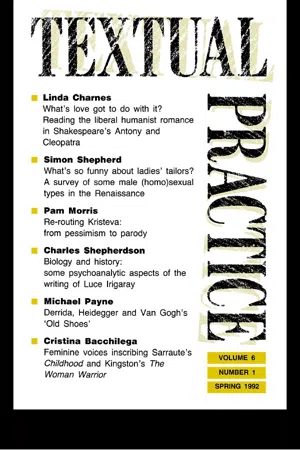 eBook - ePub
Textual Practice
Volume 6, Issue 1
- Terence Hawkes(Author)
- 2005(Publication Date)
- Routledge(Publisher)
News from Nowhere and I have intimated, Williams’s work is not without its limitations, its flaws and lacunae. But then, hagiography aside, how could it be otherwise? In the final analysis (though no analysis, as Freud reminded us, is ever final), what is remarkable is how comprehensive and complex that work is, how richly contemporary, how—dare I say it?—human, attuned as it was to those changes in production, communication, and ‘everyday life’ that are daily transforming us even as we sit watching history unfolding on the evening news.I have no doubt that this world is a poorer place without Raymond Williams. I also have no doubt that his life’s work will remain a resource of hope well into the future— until 1999 and beyond. And that, I am certain as well, is very good news indeed.Ohio University, AthensNOTES
1 John O’Connor, Raymond Williams: Writing, Culture, Politics (Oxford: Basil Blackwell, 1989), p. 30.2 Raymond Williams, Politics and Letters: Interviews with New Left Review (London: Verso, 1979), p. 388.3 Raymond Williams, ‘Hegemony’, Marxism and Literature (New York: Oxford University Press, 1985 (1977)), p. 113.4 Fredric Jameson, ‘Postmodernism, or The cultural logic of late capitalism’, New Left Review, 146 (July-August 1984), pp. 53–92.5 Fredric Jameson, ‘Postmodernism and consumer society’, in The Anti-Aesthetic, ed. Hal Foster (Port Townsend, Washington: Bay Press, 1987 (1983)), pp. 111–25.6 Paul Smith, ‘Visiting the Banana Republic’, in Universal Abandon?: The Politics of Postmodernism, ed. Andrew Ross (Minneapolis: University of Minnesota Press, 1988), p. 137.7 Jacques Derrida, ‘From restricted to general economy: a Hegelianism without reserve’, Writing and Difference, trans. Alan Bass (Chicago: University of Chicago Press, 1978), pp. 251–77.8 Raymond Williams, ‘Base and superstructure in Marxist cultural theory’, in Problems in Materialism and Culture (London: Verso, 1982 (1980)), p. 35.9 Ernesto Laclau and Chantal Mouffe, Hegemony and Socialist Strategy: Towards a Radical Democratic Politics (London: Verso, 1989 (1985)), p. 141. Though I am not wont to do so, I must bracket here a critique of Laclau and Mouffe’s radicalization of the notions of, inter alia,
Index pages curate the most relevant extracts from our library of academic textbooks. They’ve been created using an in-house natural language model (NLM), each adding context and meaning to key research topics.

