Politics & International Relations

Johann Gottfried von Herder
Johann Gottfried von Herder was a German philosopher and literary critic known for his influence on the development of nationalism and cultural identity. He emphasized the importance of language, folklore, and history in shaping a nation's character and identity. Herder's ideas laid the foundation for the Romantic movement and had a lasting impact on the study of culture and national identity.
Written by Perlego with AI-assistance
Related key terms
1 of 5
10 Key excerpts on "Johann Gottfried von Herder"
- Robert Reinhold Ergang(Author)
- 2019(Publication Date)
- Columbia University Press(Publisher)
This was perhaps the most fruitful element in Herder's political views. Secondly, Herder voiced the desire, though not always in so many words, for a unified German state. Whilst others were 1 iv, 455· 1 ν, 549-' ν, 556. 4 i, 497 ; iv, 455 ; xiv, 121 et seq. ; ix, 365. 2 4 8 HERDER AND MODERN GERMAN NATIONALISM working to strengthen their respective German states, Herder looked above the political division of his time to a Germany that would be united politically as well as cul-turally. He did not, however, present a positive plan for the building of this state. Besides stating his wish for a German national state, his work in behalf of its establish-ment consisted chiefly in his criticism of the absolute states which divided the Germany of his time. Herder was indubitably one of the first, if not the first, of the writers of modern Europe to develop a comprehensive philosophy of nationalism. Living in an age in which na-tionalities were regarded as obstacles to the development of pure humanity, Herder conceived the nationality as the essential factor in the development of humanity. He ex-pressed the idea which Ranke later restated in the words, The idea of humanity, God gave it expression in the different nationalities , 1 Again, as the eighteenth century asserted the individuality of man, and emphasized the im-portance of his separatism, so Herder, much as Mazzini did at a later time, 2 urged that only in his social context is man important. Upon the mind of his age Herder endeavored to impress the idea that the welfare of the individual is in-separably bound up with the welfare of the group, that the individual can attain his highest self-development only in the life of the group as a whole. To the individualism of the eighteenth century Herder opposed the collectivism of the nineteenth. In his philosophy of history mankind was no longer an aggregation of human beings, but a number of sharply separated national groups. eBook - ePub
The Romantic Tradition in Germany
An Anthology with Critical Essays and Commentaries
- Ronald Taylor(Author)
- 2020(Publication Date)
- Routledge(Publisher)
HerderIt is hardly possible to over-estimate the significance of Johann Gottfried Herder (1744-1803) in the emergence and the historical course of German Romanticism. Almost wherever one turns, one finds that what is brought to fruition by the Romantic literati of the early nineteenth century - the cults of creative genius, of nature, of Volkslied, of the German medieval heritage, of oriental religions and cultures, of comparative civilizational studies and universal, absolute faiths - has been sownby Herder in anhistorico-philosophical treatise, an occasional essay, or a casual fragment. Both in the nature of his personality and in the spirit of his aspirations he is one of the most completely German of all figures of influence in modern German literature and thought. Without him nineteenth-century intellectual and literary life would have taken a very different course-and some of the events in that life might never have happened.Rarely has there been a man of such far-ranging interests and of so unwaveringly universal an outlook - universal in the private world of the individual being, in his mind, his heart, his soul, and universal in the public, corporate life of nations, the life of mankind at large. Jung-Stilling, an older contemporary from Herder’s days in Strasbourg in 1770-1, the moment of his great influence on Goethe, said of him that he had but one thought in his mind: the whole world. And access to this ‘whole world’ was open only to the ‘whole man’, in whom intellect and emotion, analytical reason and sympathetic, intuitive understanding combined to give an experience of life at its truest and deepest: ‘Alle Kräfte unserer Seele sind nur Eine Kraft, wie unsere Seele nur Eine Seele’ (Über den Einfluß der schönen in die höheren Wissenschaften, 1770, SW * IX, 295). ‘Das wahre Erkennen ist Lieben, ist menschlich Fühlen’ (Vom Erkennen und Empfinden der menschlichen Seele, 1779, 1, 3; SW VIII, 200).* Sämtliche Werkt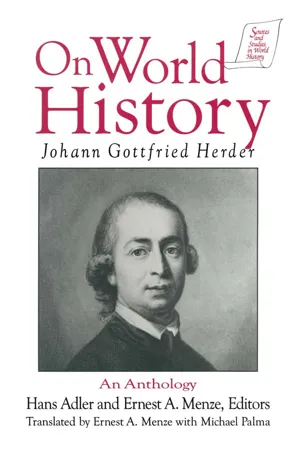 eBook - ePub
- Michael Palma, Johann Gottfried Herder, Hans Adler, Ernest A. Menze(Authors)
- 2015(Publication Date)
- Routledge(Publisher)
Introduction
On the Way to World History: Johann Gottfried Herder Adler Hans and Ernest A. Menze DOI: 10.4324/9781315703091-1This volume brings together in thirty-eight chapters a translation of texts on world history by Johann Gottfried Herder . About a third of the texts have been translated into English for the first time. The other two-thirds are a line-by-line revision of the relevant chapters of the T. Churchill translation of Herder ’s Ideen zu einer Philosophie der Geschichte der Menschheit (Reflections on the Philosophy of the History of Humankind) of the year 1800, amounting to a new translation that retains the tone and some of the phrasing of that work.The introduction that follows provides information concerning the author (Part I ), his position in the context of the historiography, philosophy of history, and theoretical assumptions of his day (Part II ), and, based on a few samples from the Ideen of his treatment of selected areas of the world, his worldview and objectives (Part III ).I.
The man whose pen produced the contributions to this collection, Johann Gottfried Herder, is not the most widely known representative of German intellectual history of the eighteenth century, but he is one of the most influential.1 He is considered the “father” of Storm and Stress (Sturm und Drang), the epoch in German thought and letters from the late 1760s to the early 1780s that, notwithstanding its brief duration, revolutionized German literature by freeing it from the compulsion of petrified form and the burden of rules. Herder is considered the father of German romanticism. Many see him as the founder of anthropology, and some even feel that, as expressed in 1940 by the prominent German anthropologist Arnold Gehlen, “Philosophical anthropology has not made the slightest progress since Herder… .”2 eBook - PDF
Herder's Hermeneutics
History, Poetry, Enlightenment
- Kristin Gjesdal(Author)
- 2017(Publication Date)
- Cambridge University Press(Publisher)
Introduction The German eighteenth-century thinker Johann Gottfried Herder has been overlooked by the philosophical tradition. It is not that Herder’s work is altogether neglected, nor that his name does not come up at all. But the full philosophical scope and potential of his work – his sustained efforts to furnish the enlightenment project with a historical consciousness, his call for emancipation through education, his critique of how modern philosophy has shaped itself around a distinctively abstract and procedural model of reasoning, and his rejection of cultural, intellectual, and political practices based on Eurocentric premises and assumptions – has hardly received the attention it deserves. Herder enthusiastically declares that education should be spread to all social classes and proceeds by the motto “get more books into women’s hands” (PW 26; W I 131). He worries that even though Europe has officially abandoned slavery (“because it has been calculated how much more these slaves would cost and how much less they would bring in than free people”), we still continue “to use as slaves, to trade, to exile into silver mines and sugar mills, three parts of the world” (PW 328; W II 73–74). And he relentlessly critiques the way in which French and German intellectuals expect that “when a storm shakes two smalls twigs in Europe . . . the whole world quakes and bleeds” (PW 325; W IV 70). Herder, it seems, is a philosopher ahead of his time. While some of these sentiments can be found in works by other philosophers in this period (Leibniz, Hume, Diderot, Lessing, and Mendelssohn all deserve mentioning), it is Herder who merges the impulses of Enlightenment thought into an anthropologically informed and critically motivated phi- losophy of understanding and interpretation. eBook - ePub
Kant, Kantianism, and Idealism
The Origins of Continental Philosophy
- Thomas Nenon(Author)
- 2014(Publication Date)
- Routledge(Publisher)
völkisch identity played a historical role in the development of European fascism.Herder does not explicitly advance a global culture:state equation, however, and his precise political prescriptions remain rather vague. He was certainly no great fan of the state, whose totalizing power he feared, and one of his criticisms of the age of reason was that it turns society into a “machine,” in which every individual has its allotted place and function (Yet Another Philosophy of History , W4, 73). Herder worries especially about the formulation of large-scale human engineering plans for this social machine. “It is a terrible thing,” he writes in the Letters , to regard mankind as just a line which one can bend, cut, extend, and shrink for some purpose quite as one pleases, in order to execute a plan, to accomplish a task” (W7, 733). Change must be organic and natural, starting with small things and building itself into something greater; when imposed from above according to a grand design, it inevitably fails (W4, 58). The measure of success here is never anything other than human happiness. With respect to the state, this means that “all state constitutions are nothing but means for human happiness” and “the sum of the individual happiness of all members is the happiness of the state” (W7, 132–3). If that happiness is variable and plural, as Herder believes it is, there can be no single and precise formula for the constitutions of good states. They can only be the product of the wishes of individuals, although these individuals must also learn from one another. Generations and nations should likewise continue to learn from one another, until they arrive at the understanding that “no people on earth is the exclusively chosen people of God; truth must be sought by all ; the garden of the common good must be built by all eBook - PDF
Herder Today
Contributions from the International Herder Conference, November 5–8, 1987, Stanford, California
- Kurt Mueller-Vollmer(Author)
- 2016(Publication Date)
- De Gruyter(Publisher)
Herder and the Formation of an American National Consciousness during the Early Republic K U R T M U E L L E R -V O L L M E R The very first issue of The Dial, the official mouth-piece for the New England Transcendentalist movement, carried a letter by George Ripley, one of the leaders of the movement, addressed to an American student of theology, in which he warmly recommends Herder's Letters Concerning the Study of Theology (Briefe das Studium der Theologie betreffend), a book that he considers worth the trouble of learning German to read. Already twenty years earlier, in 1820/21, the Reverend N. L. Frothingham of Boston, one of the earliest students of the German language in America, had translated and published portions of Herder's piece as Letters to a young Theologian in the Christian Disciple, and in 1833 Herder's Vom Geiste der Hebräischen Poesie (The Spirit of Hebrew Poetry) had appeared in an American translation. 1 Johann Gottfried Herder was one of the first important writers who became part of the canon of German authors to be adopted by the New England transcendentalists. But Herder's reception in early nineteenth-century America has to be seen in both broader and more specific terms than is suggested by his presence among the New England transcendentalist theologians and literati. For the reception of German literature and ideas played an important part in the formation of an American national and cultural identity, for which the New England transcendentalist movement provided only one, though an important, ingredient. The decades from 1815 to 1835 witnessed a general awakening of the desire for national identity in America that would soon result in the ' Octavius Brooks Frothingham, Transcendentalism in New England. A History. Introd. by S. E. Ahlstrom. New York, 1959 [1876], p. 48. Henry A. Pochmann, German Culture in America. 1600-1900. Madison, 1957, p. 110. Letters relating to the study of divinity. eBook - ePub
Savages, Romans, and Despots
Thinking about Others from Montaigne to Herder
- Robert Launay(Author)
- 2018(Publication Date)
- University of Chicago Press(Publisher)
arts” (Herder 2004:19).The aesthetic dimension was not the only facet of ancient Greece that appealed to Herder. Paradoxically, its political fragmentation was in itself a source of inspiration: “. . . the strange occasions of the division and unification from the earliest times onward, their separation into peoples, republics, colonies; and yet their spirit of community [persisted], the feeling of one nation, one fatherland, one language” (ibid.). The parallel with eighteenth-century Germany is striking: a nation divided into a myriad of states while sharing a more or less common language and a sense of national identity. For Herder the nation, rather than the state, is the fundamental unit; the distinction was even more evident in Germany than in Britain or France. Herder’s deep mistrust of the state is yet another factor that clearly separates him from his former teacher.Despite his transparent preference for Greece, Herder maintained a consciousness that the very qualities he found so endearing came at a cost. The cost in this case was a certain superficiality, even a frivolousness, especially in the religious domain: “The religion of the Orient was deprived of its holy veil, and naturally, since everything was put on display in the theater and the market and the dancing-square, is soon became ‘a fable, nicely drawn out, gossiped about, composed and composed anew—a dream of youths and a myth of maids!’ The Oriental wisdom, removed from behind the screen of mysteries, [became] pretty chatter, a teaching-construct and the squabbling of the Greek schools and markets eBook - ePub
Forming Humanity
Redeeming the German Bildung Tradition
- Jennifer A. Herdt(Author)
- 2019(Publication Date)
- University of Chicago Press(Publisher)
Herder does at times sound like an enthusiast for autocratic humanism: “I, the focal point of all, / Flow through all things and it’s I / Who filleth all things in himself!” 101 His Christology was indeed not that distant from Kant’s. But this is not the whole story. Herder did not in fact justify the sufferings and evils of the past as necessary contributions to a more glorious future. As we have seen, he insisted that no individual, no culture, may justifiably be treated as merely instrumental to some future state. 102 Herder was sharply critical of contemporaries who offered such rationalizations. 103 Barth critiques the idolatry of Herder’s anthropocentrism; contemporary critical race and postcolonial theorists are more likely to censure Herder’s recourse to humanity as a transcendent ideal as a betrayal of his pluralism. These critiques—and their limits—need to be read hand in hand. Herder’s ideal of humanity was not an assertion of autocratic humanism, not an imperialistic imposition of false universality, but rather an embodiment of concerns shared by Barth and by contemporary postcolonial and critical race-based critics of Herder who would recognize no kinship with Barth’s assertive theocentrism. For all concerned, it is critical that the concrete particularity of the fellow human be acknowledged, that the other be allowed to disturb us with her otherness, jerking us out of our complacent assumption that we ourselves, and our own, represent the ideal of humanity. Sankar Muthu rightly notes that for Herder, “the qualities that fundamentally characterize humanity and that deserve universal respect . . eBook - PDF
Paradisal Love
Johann Gottfried Herder and the Song of Songs
- John D. Baildam(Author)
- 1999(Publication Date)
- Sheffield Academic Press(Publisher)
It was in his desire to return to the most primitive, natural and therefore divinely inspired poetry known to man, that Herder turned to the poetry of the Hebrews 38. Stephen K. Land points out that the problem of translation had already been discussed in terms of linguistic relativism by John Locke, James Harris, David Hartley and Joseph Priestley. See Land's From Signs to Propositions: The Concept of Form in Eighteenth-Century Semantic Theory (Longman Linguistics Library, 16; London: Longman, 1974), pp. 69-70, and 'Universalism and Relativism: A Philo-sophical Problem of Translation in the Eighteenth Century', JHI 35 (19 74), pp. 597-610. See also Locke's An Essay Concerning Human Understanding (Lon-don: Holt, 1689), and Some Thoughts Concerning Education (London: A. and J. Churchill, 1693); Harris's Three Treatises: The First Concerning Art, the Second Concerning Music, Painting, and Poetry, the Third Concerning Happiness (L on-don: Nourse and Vaillant, 1774); Hartley's Observations on Man, his Frame, his Duty, and his Expectations (London and Bath: Leake and Frederick, 1749); and Priestley's Essay on a Course of Liberal Education (London: J. Johnson and Dav-enport, 1765), where he drew attention to the main historical sources, and Lectures on History and General Policy (London: J. Johnson, 1788), where he emphasized history rather than the classics. 3. Herder as Translator 115 as recorded in the Bible in general and the Song of Songs in particular. He argued for a return to nature in his desire to promote a German national literature, and he aimed to use the Song of Songs as a prime example of good (relative) literature. Herder thought of grammar as something which, with increasing civi-lization, was brought to bear on language from without. He tried to counter the contemporary claim—posited by Lowth, for example—that only divine intervention could account for the complex grammatical structure of even the most primitive languages, such as Hebrew.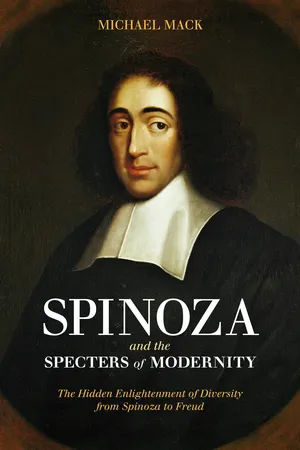 eBook - PDF
Spinoza and the Specters of Modernity
The Hidden Enlightenment of Diversity from Spinoza to Freud
- Michael Mack(Author)
- 2010(Publication Date)
- Continuum(Publisher)
Chapter 6 Universalism Contested: Herder, Kant and Race Houston Stewart Chamberlain, another forerunner of National Socialism, was even more direct. He read Kant within the context, as he saw it, of millions of bestial Blacks preparing for a race war. The alternative facing society was to enter a higher stage of culture or to fall into an unprecedented barbarism in which artificially civilized but still superstitious races— “as dreamless as so many cattle” prospered. Whether Chamberlain’s reference to cattle inten-tionally recalled “the happy cattle” to which Kant compared the Tahitians, Chamberlain shows where philosophies about the meaning of human exis-tence can lead when they are posed within a context framed by the discordant ideas of permanently unequal races and of a cosmopolitan history. Robert Bernasconi: Why do the happy inhabitants of Tahiti exist? The previous chapter has discussed how Herder incorporates into his writ-ing about temporal interdependence a plea for the conception of our particu-lar, national identities as transnational. The past complements what the present lacks and vice versa. In the same way each nation is dependent on others, so that the national is in fact transnational. The discussion of the preceding chap-ters focused on how Herder arrives at this understanding of historical and transnational interdependence via a Spinozist critique of anthropomorphic conceptions of God which serve to endow societal constructions of rank with quasi-sacerdotal status. This Spinozist critique of anthropomorphic concep-tions of divinity has political ramifications. It questions the political theology of sovereignty and hierarchy. Conversely Herder conceptualizes pluralism and democracy as forms of politics that avoid an anthropomorphic theology which equates a particular human position with God or nature.
Index pages curate the most relevant extracts from our library of academic textbooks. They’ve been created using an in-house natural language model (NLM), each adding context and meaning to key research topics.

