Literature

Walter Pater
Walter Pater was an English essayist, critic, and writer known for his influential works on art and literature. He is particularly associated with the Aesthetic movement and his belief in the importance of experiencing life through art and beauty. Pater's writing often focused on the subjective experience and the idea of "art for art's sake."
Written by Perlego with AI-assistance
Related key terms
1 of 5

8 Key excerpts on "Walter Pater"
 eBook - ePub
Spectrum of Decadence (Routledge Revivals)
The Literature of the 1890s
- Murray Pittock(Author)
- 2014(Publication Date)
- Routledge(Publisher)
Chapter 1 Walter Pater and the French connection PATER’S ACHIEVEMENTOnly be sure it is passion – that it does yield you this fruit of a quickened, multiplied consciousness. Of such wisdom, the poetic passion, the desire of beauty, the love of art for its own sake, has most. For art comes to you proposing frankly to give nothing but the highest quality to your moments as they pass, and simply for those moments’ sake.(The Renaissance)The coffin was covered with beautiful wreaths.(The Times on Pater’s funeral)1It was Walter Pater, an Oxford academic, who in the late 1860s and early 1870s began to create in England the essential premises on which a native Symbolism would base many of its manifestations. In some respects his ideas were adapted from abroad, particularly from his knowledge of French literature: in others, he was powerfully drawn to classical and seventeenth-century English authors. Above all, in an age of progress and contemporaneity, where the premises of scientific action annihilated and reconstituted themselves in the course of a single generation, the generation of Darwin, Pater’s fascination with the past, the cores of human life and development, and the constant nature of human experience, provided implicit points of departure for those wishing to distance themselves from the collective and oppressive demands of ‘the social mill, that grinds our angles down’, and follow instead the ‘last curiosity’ of mortal human life, ultimately inexplicable in science’s terms.2The importance of Walter Pater’s thought lies in its subjectivity. Pater’s vision of the human condition is one which stresses the autonomy of the human spirit: that we create ourselves, and are the measure of our own value. Spiritual or moral absolutes are marginalized in Pater’s account of human experience, which substitutes for these beauty and passion as the ultimate expressions of life-affirmation in the face of death. In The Renaissance eBook - PDF
Print in Transition
Studies in Media and Book History
- L. Brake(Author)
- 2001(Publication Date)
- Palgrave Macmillan(Publisher)
4 234 Print and Gender: Pater This question of the nature of the novel is part of a contemporary preoccupation with the nature of literature more generally. In Raymond Williams’ discussion of the changing definition of literature, in Keywords, he notes the movement of the word away from an inclu- sive definition which takes in all print culture, to one which locates lit- erature in the more elitist domain of writing to distinguish it from journalism. A preoccupation with the definition of literature is unmis- takable in Appreciations, and on the whole Pater’s conception is elitist not in terms of class per se, but in terms of education. It is elitist or, in another light, specialised, self-consciously and contingently. That is, he claims no universal, essentialist character for literature (‘Different classes of persons, at different times, make, of course, very various demands upon literature’, Pater 1889c: 14), but adumbrates a particular class of readership, author and temperament for the definition he prof- fers. The author and reader are scholarly, attentive, susceptible and grave, the work possesses ‘intellectual beauty’ (Pater 1889c: 27), and is characterised by a dearth of ornament ( pace Ruskin) which derives from a ‘tact of omission’ (Pater 1889c: 15). The analogy is with ‘fine art’ (Pater 1889c: 27) free from ‘vulgar decoration’ (Pater 1889c: 15). This structure of opposition between literary refinement and vulgarity is repeated in an image of opposition between ‘a sort of cloistral refuge’ afforded by literature from ‘a certain vulgarity in the actual world’ (Pater 1889c: 15). All of this corroborates Raymond Williams’ hypothesis of an attempt in this period to locate literature outside the commercial sphere of journalism and publishing. But Pater’s definition is tentative, con- sciously specialised, from an articulated position within higher educa- tion. eBook - ePub
- Victor N. Paananen(Author)
- 2013(Publication Date)
- Routledge(Publisher)
Walter Pater
Alick WestAlick West, “Walter Pater,” pp. 111–23 of “Walter Pater and Oscar Wilde,” The Mountain in the Sunlight: Studies in Conflict and Unity (London: Lawrence and Wishart, 1958).I
‘Dear Pater was always afraid,’ Wilde is reported to have said, ‘of my propaganda.’ He was even a little afraid of his own. From the retirement of his classical fellowship at Brasenose College, Oxford, he published in 1873—he was born in 1839—a volume of essays entitled The Renaissance, of which Wilde said, ‘It is my golden book.’ Its ‘Conclusion’ contained a passage which, until the first world war, many an Oxford student could have repeated by heart. We all, he says, lie under sentence of death with indefinite reprieve:we have an interval, and then our place knows us no more. Some spend this interval in listlessness, some in high passions, the wisest in art and song. For our one chance is in expanding that interval, in getting as many pulsations as possible into the given time. High passions give one this quickened sense of life, ecstasy and sorrow of love, political or religious enthusiasm, or the ‘enthusiasm of humanity.’ Only, be sure it is passion, that it does yield you this fruit of a quickened, multiplied consciousness. Of this wisdom, the poetic passion, the desire of beauty, the love of art for art’s sake has most; for art comes to you professing frankly to give nothing but the highest quality to your moments as they pass, and simply for those moments’ sake.These ideas were frowned upon by the Oxford authorities as dangerous hedonism, and Pater was caricatured, in a style which anticipated the Punch cartoons of Wilde, by W. H. Mallock in The New Republic. In the next edition of The Renaissance Pater suppressed the ‘Conclusion’. But in subsequent editions he restored it; for though he was timid, he was also dogged.One must ask why Pater’s immoral gospel of art, as it was considered, should have provoked so much abuse. For in The Renaissance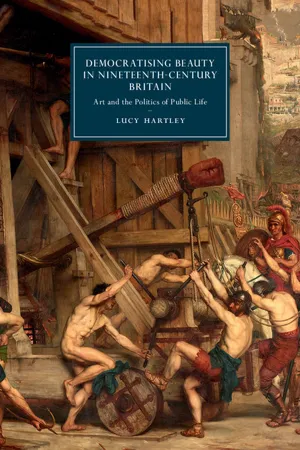 eBook - PDF
Democratising Beauty in Nineteenth-Century Britain
Art and the Politics of Public Life
- Lucy Hartley(Author)
- 2017(Publication Date)
- Cambridge University Press(Publisher)
chapter 3 The Pleasures and Perils of Self-Interest: Calculating the Passions in Walter Pater’s Essays The Hedonist, and that is what Mr. Pater must be called by those who like to affix labels . . . knows perfectly well that the commonplace virtues of honesty, industry, punctuality, and the like, are the condi- tions of material prosperity, and moral integrity . . . He takes all for granted, with or without regret that these limitations should be imposed by inexorable circumstances upon the capacity of human nature for fine delight in the passing moments. He has no design of interfering with the minor or major morals of the world, but only of dealing with what we may perhaps call the accentuating portion of life. 1 The account of ‘Mr. Pater’s Essays’ offered by John Morley, influential editor of the Fortnightly Review, places the value of Studies in the History of the Renaissance (1873) in pleasure-seeking and its potential benefits for intellectual culture in England. The terms of engagement are set with the observation that Pater ‘the Hedonist’ is not advocating reform, moral or otherwise, but that concentration on ‘the accentuating portion of life’ is a form of moral exploration, which requires a particular kind of criticism and might contribute to the diversification of culture. This leads to the striking conclusion that Pater’s essays represent the culmination of an aesthetic tradition beginning with Newman and the Oxford Movement, continuing via ‘Mr. Mill’s Logic and Grote’s Greece,’ and extending through Ruskin, the Pre-Raphaelites, Swinburne, and Morris. 2 According to Morley, Pater’s criticism is distinctive for several reasons: it raises ‘aesthetic interest to the throne lately filled by religion,’ such interest is ‘pregnant with intellectual play and expansion,’ and ‘to excite people’s interests in numerous fields, to persuade them of the worth of other activity than material and political activity, is to . eBook - PDF
Art and Life in Aestheticism
De-Humanizing and Re-Humanizing Art, the Artist and the Artistic Receptor
- Kelly Comfort(Author)
- 2008(Publication Date)
- Palgrave Macmillan(Publisher)
aestheticist mode. The Paterian impression does not merely pass through the vessel of the artistic receptor, it is in fact brought into being by the sen- sitive critic, and the process of constantly bringing different impressions into being is transformative. Moreover, there is not one single source of inspiration for the Paterian aesthetic critic, but the whole of existence is potentially stimulating: At first sight experience seems to bury us under a flood of external objects, pressing upon us with a sharp and importunate reality, calling us out of ourselves in a thousand forms of action. But when reflexion begins to play upon those objects they are dissipated under its influence; ... each object is loosed into a group of impressions—colour, odour, texture—in the mind of the observer. (151) It is not only one person who inspires us, either, but potentially every person: “Not to discriminate every moment some passionate attitude in those about us, and in the very brilliancy of their gifts some tragic dividing of forces on their ways, is, on this short day of frost and sun, to sleep before evening” (152). For Pater, it is only in “the individual mind” (151) that life can finally be comprehended and processed. Personality is the catalyst that drives aes- thetic revitalization. But in “Allegiance and Discipleship,” Gundolf rejects what he sees as this all-too-modern notion of individualism. At the center of his ideal society he places a unique individual who can lead the people, but individualism in others he sees as a stumbling block on the road to this utopia. Where individualism reigns, discipleship will be misunderstood, and a subservient posture ridiculed (Gundolf 107). He rejects the cultivation of “personalities” who “live out their lives to the fullest” (111), laments the fact that “eccentricity” has become a virtue, and wishes that self-interest had not become more important than the general interest (107). eBook - PDF
Fateful Beauty
Aesthetic Environments, Juvenile Development, and Literature, 1860-1960
- Douglas Mao(Author)
- 2010(Publication Date)
- Princeton University Press(Publisher)
Waine- wright’s case, even more fiercely than Dorian’s, seems to mock the preten- sion that loving what is beautiful means loving what is good. 18 Pater, we might notice, had even more trouble than Wilde in sustaining a narrative where the attempt to live for beauty leads to long years of contentment and virtue. The biographical Wainewright lived to be nearly sixty, but fictional exponents of aestheticism in the Paterian line tend to have much shorter life spans: not only Dorian but also Marius and virtually all of Pater’s other aesthetically responsive protagonists die before their time. Emerald Uthwart, the eponymous hero of an 1892 tale, is especially remarked for his molding by the physical environment of his school: “The very place one is in, its stonework, its empty spaces, invade you; . . . chal- lenge you . . . to make moral philosophy one of your acquirements, if you can, and to systematise your vagrant self; which however will in any case be here systematised for you” (207). But he withers away, still young, after being dismissed from military service for an act at once heroic and disobedient. The beauty-loving heroes of Pater’s four Imaginary Por- traits—Watteau, Denys L’Auxerrois, Sebastian van Storck, Duke Carl of Rosenmold—all die early too, again as if too fine for this life. And other aesthetic-decadent heroes from further afield, such as Villiers de l’Isle- Adam’s Axel (from the prose poem of that name), appear to find in death the only route to transcendence of life’s essential vulgarity. What accounts for this high mortality rate? One form of answer, clearly, lies in the sheer challenge of representing that perfection to which a suc- cessful aesthetic discipline would theoretically lead.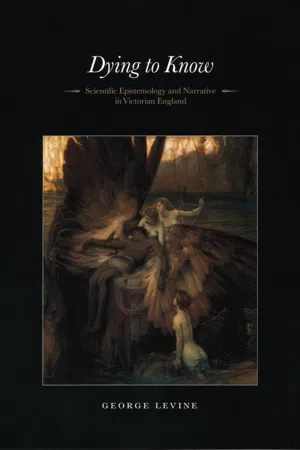 eBook - PDF
Dying to Know
Scientific Epistemology and Narrative in Victorian England
- George Levine(Author)
- 2010(Publication Date)
- University of Chicago Press(Publisher)
Pater, to take just one example, claims that “self-restraint, a skillful economy of means, ascêsis, that too has a beauty of its own.” 15 The importance of science to Pater’s thought is apparent in his essay on Coleridge, as it appears in Appreciations. There he argues that [m]odern thought is distinguished from ancient by its cultivation of the “rel-ative” spirit in place of the “absolute.” . . . To the modern spirit nothing is, or can be rightly known, except relatively and under conditions. The philo-sophical conception of the relative has been developed in modern times through the influence of the sciences of observation. Those sciences reveal types of life evanescing into each other by inexpressible refinements of change. Things pass into their opposites by accumulation of indefinable quantities. 16 The language of Darwin echoes here, particularly those moments in The Ori-gin, in which he talks of how species and subspecies “blend into each other in an insensible series.” 17 Pater has picked up Darwin’s gradualism, his de-pendence on vast accumulations of time, his obliteration of sharp divisions between species, his sense of constant transformation, his pervasive insis-tence on “imperceptible gradations.” But he also picks up the historicist im-plications of Darwin’s argument, the necessity to consider one’s location as observer in space and time, his emphasis on the context in which individu-als live, his substitution of historical for “absolute” explanation, his focus on the importance of the individual. Where Arnold had tried to separate Dar-win’s language and ideas from the language of value, Pater absorbs it with-out fuss into that language, self-consciously translating quantity into quality. He leans on the sciences of observation for the ideas that shape his views of art. 18 In his late book, Plato and Platonism, Pater associates Darwin with a Her-aclitean tradition that forms a critical part of the background of Plato’s thought. eBook - PDF
Victorian Aesthetic Conditions
Pater Across the Arts
- E. Clements, L. Higgins, E. Clements, L. Higgins(Authors)
- 2015(Publication Date)
- Palgrave Macmillan(Publisher)
Now that we have our digital pause buttons, we can all be in control of the play between still shot and moving picture; at the very least, we should become conscious of the historical wit involved in this novel capacity. In conclusion, and to put it simply: the literary history of the epiphanic moment – including Pater’s pivotal place in that history – is an important form of serial discontinuity. This connection allows us to see new signifi- cance in Pater’s ‘music-like intervals’ and ‘space[s] of fallen light’. A complex interaction of music and moving pictures is the dominant Anders-streben in the nineteenth century. Because he is its master theorist, Pater’s work pre- pares us for film, which reworks this great nineteenth-century Anders-streben for the twentieth and twenty-first. Walter Pater, Film Theorist 151 Notes 1. Pater’s enthusiasm for mixed forms and genres is notable, in contrast to critics who, like Goethe, prefer purity of mode and genre. In this respect, on Goethe, see Hill, notes to TR, p. 388. ‘Striving after otherness’ is Harold Bloom’s translation, in Bloom, ed., Selected Writings of Walter Pater (1974; reprinted New York: Columbia University Press, 1982, p. 58, n. 3), in which he links Anders-streben to Paterian askesis. 2. In the next section, I will develop this last point further. For more detailed versions of my argument that theatrical tableaux are ‘moving pictures’, see Williams (2004). 3. Pater certainly read Lessing, as ‘The School of Giorgione’ makes clear, though there is no evidence that he read Diderot. See Inman (1981b, 1990). 4. This unidentified translation is quoted in Monsman (1977, p. 4). 5. See Norman Kelvin’s essay in this volume, pp. 117–34. 6. In discussion, 29 July 2006, at the International Walter Pater Society conference, Rutgers University, New Brunswick, New Jersey. 7. In his treatment of ‘Varieties of the Modern Moment’, M.
Index pages curate the most relevant extracts from our library of academic textbooks. They’ve been created using an in-house natural language model (NLM), each adding context and meaning to key research topics.

