History

Gertrude Stein
Gertrude Stein was an influential American writer and art collector known for her avant-garde literary works and her role in the Parisian art scene during the early 20th century. She is particularly remembered for her experimental writing style, which often focused on themes of identity, language, and perception. Stein's literary salon in Paris also played a significant role in shaping modernist literature and art.
Written by Perlego with AI-assistance
Related key terms
1 of 5
8 Key excerpts on "Gertrude Stein"
 eBook - PDF
Creative Criticism
An Anthology and Guide
- Stephen Benson, Clare Connors(Authors)
- 2014(Publication Date)
- Edinburgh University Press(Publisher)
Alternatively, take a piece of creative writing and through a targeted act of cut and paste, draw out a critical edge. The key in each case is to think carefully about the choices, and also where possible to allow the process to run its own course ‘Gertrude Stein: a retrospective criticism’ 161 free of your own tweakings. It is only by deferring to rule and process that we allow the exercise a chance of revealing the unexpected. Benjamin Friedlander, ‘Gertrude Stein: A Retrospective Criticism’, from ‘Poe’s Poetics and Selected Essays’, in Simulcast: Four Experiments in Criticism (Tuscaloosa: University of Alabama Press, 2004), pp. 145–58. ‘When I was a student,’ says Prof. Schmitz, ‘no one taught Gertrude Stein. She was encountered in Hemingway, cited as an influence. She had no standing as a poet. We all led comfortable lives inside patriarchal poetry. The chairs were good, the rugs plush, the bookcases lined with Uniform Editions. The study of literature was the study of sure things.’ The sure-ness of her standing now, however, is quite apparent; and, while to many it is matter for wonder, to those who have the interest of our Literature at heart, it is, more properly, a source of bemusement and surprise. That the author in question has long enjoyed what we term ‘a cultic celebrity’ cannot be denied. She is ‘a poet’s poet,’ and in no manner is this point more strik-ingly evinced than in the choice of one of her lesser known works, by one of our most enterprising publishers, as the first volume of a series, the avowed object of which is the setting forth, in the best combination of page design, price, and pictorial embellishment, the elite of our most ‘experimental’ writers. Now this same publisher returns to Stein, in the forty-fourth volume of the same series. As an author of occasional portraits, and as a memoirist, she has long been before the public; always eliciting, from a great variety of sources, unqualified commendation. eBook - PDF
- Alex Davis, Lee M. Jenkins(Authors)
- 2015(Publication Date)
- Cambridge University Press(Publisher)
part iii chapter 12 Gertrude Stein Charles Bernstein Gertrude Stein is the most radically inventive American poet of the modernist period. Yet recognition of the scale of her achievement has been thwarted by resistance to her language-centred practice, which, paradoxically, has kept her work at the cutting edge of poetics for a century. The greater the resistance to Stein, the more radical her work becomes. Yet, inevitably, despite new flashpoints, Stein’s work has finally, in the twenty-first century, moved, as she imagined, from ‘outlaw’ to ‘classic’. 1 But is Stein even American? Since her writing is in English, with an American accent, it is hard to see her classified as anything but. And yet she was a French resident writing in English and her Americanness is a term of art, an artifice, which is, ironically, what gives her the strongest claim to be an exemplary American poet – that is, if America is under- stood more as a utopian possibility than as a nativist condition. Stein well understood this. For her, the central ontological fact of American literature was that it was written by people who are new to their world. This is what made her ‘a real American’. 2 As she wrote in ‘What Is English Literature’, the centuries-old vertical relation of names and place in the ‘island life’ of England was displaced by a newly emerging, horizontal, relation of name and place. Stein calls this American: And so the poetry of England is so much what it is, it is the poetry of the things with which any of them are shut in in their daily, completely daily island life. . . . And now think how American literature tells something. It tells something because that anything is not connected with what would be daily living if they had it. . . . Think about all persistent American writing. There is inside it as separation, a separation from what is chosen to what is that from which 255 eBook - ePub
Mama Dada
Gertrude Stein's Avant-Garde Theatre
- Sarah Bay-Cheng(Author)
- 2004(Publication Date)
- Routledge(Publisher)
Everything in the modern theater has been touched by Stein's recognition of the English language. She freed the theater in every dimension. She simply plowed everything under and allowed us a wide field to experiment with new forms. And the seeds she planted have continued to grow. (Watson 304)Yet, despite her importance and influence, Stein has been marginalized in studies of the American theater, even those concentrated on the avant-garde. Michael Vanden Heuvel comments in Performing Drama/Dramatizing Performance (1993) that "Stein's influence on [Robert] Wilson and other elements of the contemporary avant-garde has been largely neglected" (245). It was not until quite recently that Stein has been considered a significant influence on American avant-garde theater, and despite essays such as Kate Davy's "Richard Foreman's Ontological-Hysteric Theatre: The Influence of Gertrude Stein" and Randi Koppen's "Formalism and the Return to the Body: Stein and Fornes's Aesthetic of Significant Form," Stein has been predominantly represented as a personality to be adapted and replayed in American theater, rather than as a significant dramatic predecessor. (This prominence of her personality over her writing bothered her throughout her life as well.) Even recent considerations place a lopsided emphasis on Stein as the personality. In the title to her article in American Theatre , for example, Celia Wren asks the question "Why Has Gertrude Stein Become a Recurrent Character on America's Stages?" (30). Despite numerous recent productions of Stein's plays (over 20 professional productions since 1992), Wren focuses primarily on productions in which the character of Gertrude Stein appears, but largely ignores the presence of Stein's own work in American theater.Undoubtedly, part of this critical neglect can be attributed to the marginal position of drama within the Stein canon. However, the complexity of Stein's influence also prohibits a clear path of reaction in American theater. For example, Stein is a key influence for John Cage, who in turn collaborated with Merce Cunningham, the Living Theater, the Judson Church Dance Theater, and the educational experiment known as Black Mountain College. But while Stein was certainly an influence on these artists, Antonin Artaud's newly translated The Theater and Its Double eBook - PDF
Telling the Story of Translation
Writers who Translate
- Judith Woodsworth(Author)
- 2017(Publication Date)
- Bloomsbury Academic(Publisher)
At the same time, she emphasizes her own role in spearheading the modernist movement: ‘Paris was where the twentieth century was … the place that suited those of us that were to create the twentieth century and literature’ (11–12). 7 Of course they all came to France a great many to paint pictures and naturally they could not do that at home, or write they could not do that at home either, they could be dentists at home because she knew all about that even before the war, Americans were a practical people and dentistry was practical. ( Paris France , 19) Gertrude Stein and the Making of Translations 71 In benefiting from the freedom to live and write as she pleased, she resembles other expatriate women in Paris, many of them lesbian like her, such as Sylvia Beach and Adrienne Monnier, Natalie Barney, H.D. and Nancy Cunard. Far removed from a patriarchal American literary heritage, she could ‘put aside her American fathers’, as Benstock suggests, ‘assuming the authority invested in the male in order to explore the troublesome interior world of her femaleness’; she could ‘deny her predecessors’ in order to address her ‘anxiety of authorship’ (1986: 192). Stein, like other prominent women of the Left Bank, was committed to turning her exile to advantage and ‘charting new territory’ (Sloboda 2008: 4–9). An additional factor that may have influenced Stein, albeit in subtler, less overt ways, was her Jewishness. Citing such writers and thinkers as Freud, Benjamin, Adorno, Celan, and Kafka, Gluzman has pointed to a ‘three-way correlation between modernism, exile, and Jewishness’. Regarded as the ‘paradigmatic diaspora people’, Jews have ‘celebrated’ exile, presenting it as a ‘vehicle for individuality, freedom, and resistance’ (1998: 231–2). eBook - ePub
The Outside Thing
Modernist Lesbian Romance
- Hannah Roche(Author)
- 2019(Publication Date)
- Columbia University Press(Publisher)
I Gertrude SteinO n May 12, 2011, the Contemporary Jewish Museum in San Francisco unveiled a new exhibition that promised to share “an in-depth portrait of Gertrude Stein that knits together her many identities.”1 Seeing Gertrude Stein: Five Stories , as the title of the exhibition and accompanying book indicates, was presented in clearly demarcated sections, apparently leaving the visitor or reader to “knit together” the various facets of Stein’s identity. In The Making of Americans (1925), Stein articulates her inability to reconcile the various “pieces” of composite and repetitive identity:Sometimes I know and hear and feel and see all the repeating in some one, all the repeating that is the whole of some one but it always comes as pieces to me, it is never there to make a whole one to me. Some people have it in them to be in pieces in repeating the whole of them, such of them almost come never to be a whole one to me, some come almost all their living in repeating to be a succession not a whole one inside me.2Gertrude Stein has long invited interpretation as a series of paradoxes. Presenting herself as “completely and entirely american” despite a thirty-year absence from America, the provocative and often perplexing Stein has continued to attract scrutiny as a conservative lesbian, a radical stylist with reactionary politics, and “a Jew who became more and more hostile to Jews.”3 Stein’s linguistic complexity is obviously less disturbing than her friendship with Nazi collaborator Bernard Faÿ (as examined in Barbara Will’s second monograph on Stein, Unlikely Collaboration [2011]), but Sarah Posman has rightly described Stein’s language as “the American English of the daughter of German Jewish immigrants who had lived in three different countries before she turned five.”4 Stein’s intimate adult life as “Mr. Cuddlewuddle” in the rented French homes shared with Jewish partner Alice B. Toklas is somehow incompatible with the figure of “genius” presiding over her own very public salon.5 The title of Richard Bridgman’s “preliminary inventory of Gertrude Stein’s literary estate,” the most comprehensive work on Stein before the 2003 publication of Ulla E. Dydo’s The Language That Rises , supports the idea that Stein is best digested “in pieces.”6 eBook - PDF
1922
Literature, Culture, Politics
- Jean-Michel Rabaté(Author)
- 2015(Publication Date)
- Cambridge University Press(Publisher)
This is not to call these women the midwives – or worse, the muses – of men of genius. Rather, it is to note that those who abandoned what they saw as the constraints and banality of the American family were also the ones who made space for the sitting and talking, the thinking and telling, through which so much of anglophone modernism came into being. Notes 1 For a scholarly account of the modernist condition as one of exile, see Terry Eagleton, Exiles and Emigrés: Studies in Modern Literature (New York: Schocken Books, 1970). 2 Of course, Stein and Picasso only charmed each other until their rift. 3 See especially Jodie Medd’s introduction in Lesbian Scandal and the Culture of Modernism (New York: Cambridge University Press, 2012), 1–23. 4 While Stein and Toklas lived in Paris for many years, Mars and Squire returned to the United States to pursue their art. 5 There is a vast scholarship on Stein’s impact on Hemingway. Notable accounts include Michael North, Reading 1922: A Return to the Scene of the Modern (New York: Oxford University Press, 1999), 193–204; Marjorie Perloff, “‘Ninety Percent Rotarian’: Gertrude Stein’s Hemingway,” American Literature 62, no. 4 (1990): 678–83; and Daniel Pollack-Pelzner, “Swiping Stein: The Ambivalence of Hemingway Parodies,” The Hemingway Review 30, no. 1 (2010): 69–82. 6 This story first appeared in The Little Review 10 (Autumn–Winter 1924–5) before it was reprinted in In Our Time (1925). Citations refer to the latter. WORKS CITED Anderson, Sherwood. Introduction to Geography and Plays, by Gertrude Stein. Boston: The Four Seas Company, 1922. Behling, Laura. “‘more regularly gay and in a wholly new way’: Marketing a Heterosexual Cure to Gertrude Stein in Vanity Fair.” Journal of Modern Literature 21, no. 1 (1997): 151–4. Benstock, Shari. Women of the Left Bank: Paris, 1900–1940. Austin: University of Texas Press, 1986. Anglophones in Paris 103 “Gay,” Oxford English Dictionary Online, last modified 2014.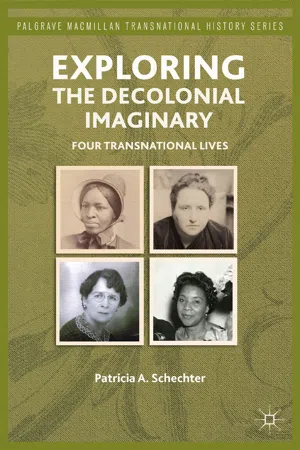 eBook - PDF
Exploring the Decolonial Imaginary
Four Transnational Lives
- P. Schechter(Author)
- 2012(Publication Date)
- Palgrave Macmillan(Publisher)
72 That Stein pointed Gertrude Stein, New Woman, Susan B. Anthony 63 to art as a guide for gender-role confusion deserves special note. A strong cur- rent of transnational opinion blamed art and literature for decay in moral and “racial” life, expounded upon at length in Max Nordau’s widely read vol- ume Degeneration (1895). 73 In his skewering of literary artists from Ibsen to Tolstoy to Zola, Nordau claimed that the “emotionalism” and “moral insan- ity” of their novels was evidence of physical and mental “stigmata,” markers of “deviation from an original type,” a definition of “degeneration” based on ideas from evolutionary theory and early criminology propounded by Cesar Lombroso (to whom the book was dedicated). 74 Nordau was roundly criticized and dismissed in the United States—“a pathological book on a pathologi- cal subject,” declared the Psychological Review—and commentary by William Dean Howells and William James happily pointed up the comparatively fresh and untested potential for American belle letters and “native” genius. 75 In 1902, Popular Science Monthly offered a cheery, upbeat answer to the by-then more general question, “Is this a degenerate age?” To those daunted by doings in Europe—either by the current crisis or past accomplishment—the writer offered encouragement: “The Shakespeares and Miltons of our day write in prose.” 76 Gertrude Stein could have used such encouragement that year. Just a few months earlier, one of her graduate instructors suggested that she make “special reference to the literary form” in revising her last scientific article intended for publication: diagrams and discussion of sections of embryo and adult brains. 77 She had performed this research in Dr. Franklin Mall’s anatomy lab at Johns Hopkins with a focus on sex differences, investigations that Gilman keenly appreciated. “The brain is not an organ of sex,” Gilman could confidently assert in Women and Economics. eBook - PDF
Breaking the Sequence
Women's Experimental Fiction
- Ellen G. Friedman, Miriam Fuchs, Ellen G. Friedman, Miriam Fuchs, Ellen Friedman, Miriam Fuchs(Authors)
- 2014(Publication Date)
- Princeton University Press(Publisher)
This neglect of women innovators is partially a legacy of modernism as interpreted through its male critics. Although Virginia Woolf and Ger- trude Stein have been credited with helping to formulate experimental fiction, the credit inadequately expresses their achievements since they are commonly described as having been second, if not secondary, to Joyce and Proust. T. S. Eliot set the pattern for such judgments in his famous declaration that with the "immense prodigy" of Ulysses, Joyce had "killed the nineteenth century," leaving nothing more to accomplish (ElI- mann 528). This judgment, almost universally taken up, left no doubt that modernism for fiction had a monarch and had the effect of diminish- ing the achievements of Joyce's contemporaries. Thereafter, Woolf and Stein appeared as after images, even imitators. In the very early study The Novel and the Modern World published in 1939, David Daiches pro- posed a minor standing for Virginia Woolf and reaffirmed this position in the "Preface" to the i960 edition. 9 In the face of such judgments, Woolf embraced the role of "outsider," a position she rationalized as liberating (Writer's Diary 292). Less resigned to a marginal position, Stein met Joyce's challenge to her reputation as "arch-experimentalist" with the 6 Contexts and Continuities futile question, "But who came first, Gertrude Stein or James Joyce? Do not forget that my first great book, Three Lives, was published in 1908. 10 That was long before Ulysses" (Ellmann 528-29). Despite their pioneering work, women were cut out or subordinated in the first assessments of early twentieth-century experimentalism, fixing the response to succeeding generations of women. However, this neglect is also partially a legacy of the last decades of feminist criticism, which has hunted subtexts and muted texts to uncover a feminine discourse while overlooking the texts by women experimentalists who may be writ- ing that discourse in deliberate, open, and varied ways.
Index pages curate the most relevant extracts from our library of academic textbooks. They’ve been created using an in-house natural language model (NLM), each adding context and meaning to key research topics.

