Literature

Modern American Poetry
Modern American poetry refers to the diverse and innovative body of poetic work produced in the United States from the early 20th century to the present day. It encompasses a wide range of styles, themes, and voices, reflecting the cultural, social, and political landscape of America. Influential poets such as T.S. Eliot, Langston Hughes, Sylvia Plath, and Allen Ginsberg have contributed to the rich tapestry of modern American poetry.
Written by Perlego with AI-assistance
Related key terms
1 of 5

11 Key excerpts on "Modern American Poetry"
 eBook - PDF
- Christopher MacGowan(Author)
- 2008(Publication Date)
- Wiley-Blackwell(Publisher)
An early and still useful attempt to place Modern American Poetry into a history going back to the Puritans. David Perkins, A History of Modern Poetry , 2 vols. (Cambridge, MA, 1976, 1987). Although now somewhat dated, a well-integrated overview of the major currents in British and American poetry. Marjorie Perloff, The Poetics of Indeterminacy: Rimbaud to Cage (Princeton, 1981). Argues for the importance of modern and contemporary poets writing outside of the Romantic/symbolist tradition. Neil Roberts, ed., A Companion to Twentieth-Century Poetry (Oxford, 2001). Essays on British, American, and Colonial poetry, organized by topics, movements, and texts. M. L. Rosenthal and Sally M. Gall, The Modern Poetic Sequence: The Genius of Modern Poetry (New York, 1983). A broad-ranging study of British and American long poems and poetic sequences. Jerome Rothenberg and Pierre Joris, Poems for the Millennium: The University of California Book of Modern and Postmodern Poetry , 2 vols. (Berkeley, 1995, 1998). An ambitious attempt to document the cultural history of modern, not just US, poetry. Louis D. Rubin, The Wary Fugitives: Four Poets and the South (Baton Rouge, 1978). Examines the careers of Ransom, Tate, Davidson, and Warren. Mark Royden Winchell, Cleanth Brooks and the Rise of Modern Criticism (Charlottesville, 1996). The first extended biography of Brooks, a leading New Critic. Documents the impact of New Criticism upon twentieth-century American poetry, and Brooks’s association with such figures as Warren, Tate, and Ransom. Gregory Woods, Articulate Flesh: Male Homo-Eroticism and Modern Poetry (New Haven, 1987). Looks at homo-erotic themes in the work of D. H. Lawrence, Crane, Auden, Ginsberg, and Gunn. Studies Focused upon Modernism and Other Movements, 1900 to the Second World War Charles Altieri, Painterly Abstraction in Modernist American Poetry (Cambridge, 1989). A difficult but important study of modernist poetry and the visual arts. eBook - ePub
- Jacob Stratman(Author)
- 2016(Publication Date)
- Research & Education Association(Publisher)
What is important to note about literary modernism is that not all of its literature sang the praises of the modern world. Although the literature’s content and form break with tradition in many ways, some writers use these new forms and taboo issues actually to attack modernity, exploring the growing tension between freedom and loss. In fact, some could assert that the modern era is one of fragments. America was changing in many wonderful ways, but its changes were also in conflict with its past; therefore, its art reflects this time of tumult and fragmentation. No longer are novels linear and chronological in nature. No longer are poems strictly narrative or lyrical. No longer are any artistic works easily interpreted. No longer is the truth of a text easily determined. Basically, modern art and literature do not directly state what they are; meaning, as stated earlier, is less important than mere existence. Modernism is laced with suggestion, metaphor, irony, ambiguity, understatement and subtlety, tone and tense shifts, and sometimes impenetrable prose.The common denominator for many of the modern poets is the literary journal Poetry: A Magazine of Verse . In 1912, Harriet Monroe founded and edited this poetry journal in Chicago that promised to introduce Americans to modern poetry. This “little magazine,” still in influential existence today, helped produce major writers through publications and reviews. Monroe single-handedly aided in the careers of Robert Frost, Carl Sandburg, Ezra Pound, T. S. Eliot, and William Carlos Williams, just to name a few.THE POETRYAmy Lowell (1874–1925)You should recognize this poet’s last name as the same as popular nineteenth-century poet James Russell Lowell. In fact, Amy grew up in a wealthy, educated, and prominent Boston family. Although she did not pursue higher education, Lowell dedicated much of her life to reading and writing poetry, culminating in her first collection of poetry in 1912. This collection was filled with traditional poetry influenced by English romantics. Soon after this publication, Lowell began reading more experimental poems by Ezra Pound and Hilda Doolittle. These writers, who had by this time immigrated to Europe, called their new form “imagism .” I will discuss this form later in the section on Pound; however, simply, imagism rejected long and elevated language in favor of crisp, clear language and precise images. After this conversion of sorts, Lowell began “preaching” the new poetry to whoever would listen. Her first collection of experimental poetry, Sword Blades and Poppy Seeds , was published in 1914. Lowell then edited several collections of imagist poetry and continued to write and publish several books of her own poetry: Men, Women, and Ghosts (1916), Can Grande Castle (1918), Pictures of the Floating World (1919), and What’s O’Clock eBook - PDF
American Poetry after Modernism
The Power of the Word
- Albert Gelpi(Author)
- 2015(Publication Date)
- Cambridge University Press(Publisher)
Twentieth-Century American Poetics: An Overview 11 of Modernism that is the constellating point of Postmodernism: “[T]he work of art is a self-referential object which is in a self-critical relation to itself, particularly to its medium.” 14 In fact, the shift in the aesthetics of the two halves of the twentieth cen- tury might be telescoped into the following formula: Modernism – Romanticism = Postmodernism A poetics of indeterminacy is what is left when Modernism is severed from its residual Romantic inclinations. But Postmodernism, I would argue, is only half of the story, because those Romantic inclinations persist in postwar American poetry alongside, and often in active contention with, Postmodernist inclinations. The issue can hardly be more fundamental: what we can know and how we can know it. The difference in conceptions of poetic form and structure discussed earlier in the chapter – whether form is autotelic and strives for coherence out of the incoherence of experience, or whether form strives to express a coherence in experience outside the poem – registers at the level of the word: whether language is self-referential or not, whether indeed “[a] poet’s words are of things that do not exist without the words,” 15 or whether a poet’s words strive, often against their own opacity, to appre- hend and express an extralinguistic truth and reality. Moreover, the power of the word – and challenges to it – were of explicit and central concern to American expression from the outset. The Puritans were a people of the word, and their conviction that the word could and would arrive at the truth about this world and the next issued not just in Scriptural commentaries, sermons, and theological tracts but also in his- tories, autobiographies – and the first American poems.
- Marston LaFrance(Author)
- 2019(Publication Date)
- University of Toronto Press(Publisher)
Eliot and his contemporaries had to point to Donne and his fellow poets as dis-coveries who had lessons the poet could learn; this necessity no longer exists. Poets write in tacit acknowledgment of them, or in active rejection of them. To prevent this essay from becoming merely an assortment of random obser-vations, I should like to point to four principal developments in contemporary verse: 1. The quietly intellectual, metaphysical poetry, which follows what has become a tradition of the new: this poetry is extremely literate, very com-petently written, sometimes very effective. While it doesn't shout its alle-giances, the line of descent from the 1920's is discernible, and the history of Modern American Poetry might (at some sacrifice) be written in terms of it. 2. The poetry of the native and the local image: the verse is in this case 193 Contemporary Poetry partly reminiscent of Robert Frost, though without his more or less obvious gleam and glimmer of message, irony, and innuendo. These are, in short, poets of scene; and, though they do vary occasionally and move into social commentary, their long suit is the simple experience. 3. Projective verse, which either is written from the force of a theory of expression, or forces the poet to offer one. The important pioneering figures here are Williams, Louis Zukofsky, and Charles Olson. The verse is free in the sense that it is used in a fight-more or less serious-against the tyranny of the iambic pentameter in English verse; but it is also quite strict, in the sense Pound intended when he said that all good verse must follow the hard line of being as close as it can to what the poet's mind conceived it as being. 4. The free-swinging verse of what is mistakenly referred to as the San Francisco group : this poetry did dominate San Francisco for a while, but it is transcontinental. eBook - ePub
- Richard Gray(Author)
- 2015(Publication Date)
- Wiley-Blackwell(Publisher)
But it is also characteristic, or rather symptomatic, of the American tradition of the new, finely poised between continuity and change: an acknowledgment of the inevitable links between poets of different generations and recognition of the equally inevitable need to (as Pound himself famously put it) make it new. In telling the tale of American poetry, there is a similar obligation on the narrator of that tale to trace connection and disruption: to catch the echoes and conversations, the intimacies of word and gesture that connect one poet with others and to measure how that same poet struggles nevertheless to forge what Williams called a new mind and a new line. American poetry is a web of words in which different poets work hard to make their own voices heard, to tell their stories precisely by attending and then responding to the voices and stories of others. In the case of poets writing prior to the establishment of the American republic and just after, trying to make their voice heard meant talking with, talking back to, and even talking against poetic voices from other, older cultures. Philip Freneau, as some lines from a poem of his quoted earlier indicate, was acutely and testily aware how the “damnable place” from which the United States had liberated itself politically still exerted a profound aesthetic influence, in effect dictating the terms of “learning and grace.” He was writing, as he sensed, in the wrong place and time. There was that, the continuing cultural impact of the Old World
- Eric L. Haralson(Author)
- 2014(Publication Date)
- Routledge(Publisher)
Understanding Poetry (1938, still in print), Robert Penn Warren and Cleanth Brooks, both New Critics, advocated study of the poem as a formal document. That meant probing its surface for all the potentialities of language. These prescripts arose in opposition to what the poem might mean in a political, cultural, or biographical context.It is impossible to overstate just how significant New Criticism has been in the development of the canon of 20th-century American poetry. Generations of scholars trained to read poems “closely” valued poems that yielded fruitfully to this type of inquiry. Poems that could be dissected, analyzed, explained, and endlessly and variously interpreted were prized more heavily than poems that had easily accessible and cogent messages. Professors became interpreters, specially trained individuals with the knowledge to decode obscure or even indecipherable passages. As Gerald Graff (1987) has pointed out, part of the success of the New Critical approach was the advantage it offered to professors. Graff explains,I remember the relief I felt as a beginning assistant professor when I realized that by concentrating on the text itself I could get a good discussion going about almost any literary work without having to know anything about its author, its circumstances of composition, or the history of its reception.Modernism, an international aesthetic movement, and New Criticism, a formal, sometimes almost scientific mode of inquiry, were not hospitable to political writers. The large number of political poems written during the early decades of the 20th century seemed to disappear as anthologists, following Modernist guidelines, banished political poems from anthologies and textbooks for almost 50 years. When a poet like Langston Hughes, an outspoken Communist and activist, was anthologized, editors included only his mildest, most apolitical poems. Indeed, the recovery and publication of Hughes’ strident political voice, as well as that of other Harlem Renaissance poets, has been a job for literary critics in the closing decades of the 20th century. Similarly, the other leftist poets of the 1930s and 1940s also began to reappear in American anthologies. The Heath Anthology of American Literature eBook - ePub
The Challenge of Periodization
Old Paradigms and New Perspectives
- Lawrence Besserman(Author)
- 2014(Publication Date)
- Routledge(Publisher)
2 —seem not to have caught on as possible modes of literary history. What has caught on is the periodizing, not of authors or even of texts, but of historians. The literary historians, as authors of literary histories, are exposed as having theological or patriotic or imperial biases, and the whole project of literary history, including the project of periodization, is cast into doubt. Nonetheless, it continues, for want of any alternative, since temporal generalization is incorrigibly necessary to discussion.Having said all this, I come to my topic, the periodization of Modem American poetry. The common periodization of American literature composes a nationalist story of manifest destiny, as I have said, in which the chains of empire are, after the colonial period, gradually cast off; a genuine indigenous literature in English arises, producing “major authors” in our “American Renaissance,” and swelling to greatness in the twentieth century, when “Modernist” novels and poems take the palm away from the parent tradition, as Eliot revolutionizes poetry and Faulkner places his unforgettable stamp on the novel. (A precisely comparable Irish story shows Yeats, Joyce, and Beckett in these supervening positions of de-colonizing power.) The fact that American literature is commonly described under only three periods (colonial and eighteenth century; the American Renaissance; and Modernism) means that the old form of periodization-by-sovereign familiar to us from English and French nomenclature has never been considered useful in the United States. It is difficult to imagine an anthology with a heading like “Literature in the Age of Millard Fillmore” or even “The Age of F.D.R.” Since we have undergone only three major historical events happening on our own soil—the American Revolution, the Civil War, and the Great Depression—we really haven’t a sufficient number of historical markers to delineate literary history with any finesse. Nor do we have a clear progression of governing ideas, or genres, though critics have made stabs at using ideas like manifest destiny, transcendentalism, and democracy to organize a narrative of literary production. The sheer size of the United States after the opening up of the West forbids any easy description of our literature: we have not had a central literary capital since Boston lost its position as “The Hub of the Universe.” New York, as the chief publishing center, has some claim to be our hub, but it is largely irrelevant to literature of the South and West, not to speak of the literatures of Puerto Rico and Hawaii. It seems as though our literary history might have to resort increasingly to periodization by space, so to speak, as well as by time; increasingly, each American geographical region sees itself as producing a regional literature. “The man in Georgia walking among pines,” as Wallace Stevens wrote in a famous passage in “The Comedian as the Letter C,” “should be pine-spokesman”:
- Stephen Fredman(Author)
- 2008(Publication Date)
- Wiley-Blackwell(Publisher)
While these develop-ments may not seem “philosophical” in the traditional sense, they imply an epistemological shift from knowledge bound by national traditions (Kant, Hegel) or formal media (Adorno, Heidegger) or ident-ity (Freud, James). They also give new meaning to the modernist truism that poetry defamiliarizes reality so that we can see it anew. If reality can no longer be described as something empirically “out there” to which the mind addresses itself, then many of the oppositions upon which modernism is based – mind/reality, singular/plural, individual/society – cease to function. The problematic of the Self – both the modernist anxiety over solipsism and the recovery of the prophetic “I” in the 1950s – is no longer as salient in an era of multiculturalism and globalization What seems the most pressing issue for a volume devoted to US poetry in the twentieth century, however, is the question of the United States as an organizing category for cultural meaning. In an age of globalization and postnational formations, the ability of national boundaries to determine literary or philosophical categories seems in question as we contemplate a postnational moment. What these changes will imply for poetry are hard to tell, although Lyn Hejinian seems to have an intuition of what they will look like: “I receive things at this address, but I don’t seem to be/ here in the usual sense” (Hejinian 2003: 55). References and Further Reading Altieri, Charles (1979). Enlarging the Temple: New Directions in American Poetry During the 1960s . Lewisburg, PA: Bucknell University Press. — (1984). Self and Sensibility in Contemporary American Poetry . Cambridge, UK: Cambridge University Press. Anzaldúa, Gloria (1987). “ La conciencia de la mestiza : Towards a New Con-sciousness.” In Borderlands: La Frontera . San Francisco: Aunt Lute Books, pp. 77–98. Baker, Houston (1987). Modernism and the Harlem Renaissance . Chicago: Uni-versity of Chicago Press.
- Christopher Caudwell(Author)
- 2020(Publication Date)
- Obscure Press(Publisher)
IIITHE DEVELOPMENT OF MODERN POETRY
1
WHEN we use the world “modern” in a general sense, we use it to describe a whole complex of culture which developed in Europe and spread beyond it from the fifteenth century to the present day. There is something “modern” in Shakespeare, Galileo, Michael Angelo, Pope, Goethe and Voltaire which we can distinguish from Homer, Thales, Chaucer and Beowulf, and compare with Valery, Cezanne, James Joyce, Bergson and Einstein. This complex rests on an economic foundation. The complex itself is changeful—no epoch of human history has been so variegated and dynamic as that from the Elizabethan age to ours. But then, the economic foundations too have changed, from feudal to “industrial”. This culture complex is the superstructure of the bourgeois revolution in production—a revolution whose nature was first analysed completely by Marx in Das Kapital Modern poetry is capitalist poetry.It is impossible to understand modern poetry unless we understand it historically—in motion. We can only bring back dead formulae from a study of poetry as static “works of art”, as something frozen and ossified. This is particularly true where poetry is the organic product of a whole society violently in motion.Yet to study the poetry of bourgeois culture as a whole during that time is a formidable task. Many nations and many languages have been caught up into the bourgeois movement, and yet it is the characteristic of poetry that it demands for its appreciation a, more intimate knowledge of the language in which it was written than any other form of literature.But as it happens, England pioneered the bourgeois revolution in economy. Italy preceded it—but its development was stifled early. America outstripped it—but only at a late date. In England alone the greater part of the bourgeois revolution unfolded itself, and from there spread to the rest of the globe.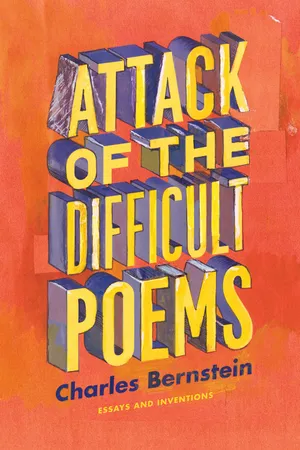 eBook - PDF
Attack of the Difficult Poems
Essays and Inventions
- Charles Bernstein(Author)
- 2011(Publication Date)
- University of Chicago Press(Publisher)
62 PROFESSING POETICS were mainstreamed in the immediate postwar period and that they under-write the allegorical unconscious of the antimodernist factions of Official Verse Culture in our time. While the postwar polemic takes a sometimes apocalyptic turn, there is nothing new about such viscerally negative responses to radical modernism. Russian futurist poets allied themselves to the 1917 revolution while Italian futurists allied themselves with the right; either way, those who rejected radical change expressed shock and dismay at the new art and the social dis-ruption to which it was symbolically, and actually, attached. The confusion as to whether radical formal innovation is leftist or rightist, ethical or ni-hilistic, persists. In the United States, during the first decades of the twen-tieth century, the modernist “revolution of the word,” and even the simple practice of free verse, were more often debunked than celebrated. Nowa-days, we take Whitman and Dickinson as canonical, but the contemporary responses to their work were chilling and pre-emptive. In “The Philosophy of Composition,” Poe located the problem as quintessentially American, as a phobia of the aesthetic; a fear that sensation undermines morality. The battle erupts on many fronts, historical and contemporary. Eugene O’Neill epitomizes the modernist-as-degenerate credo in Tyrone’s famous blast at his too-poetic son in Long Day’s Journey into Night (1942): That damned library of yours! .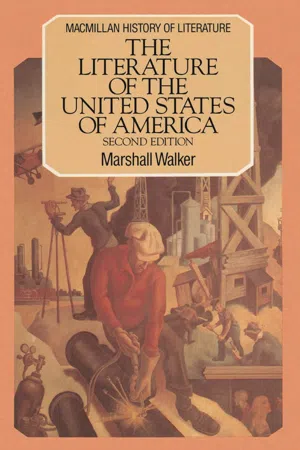 eBook - ePub
- Marshall Walker, A. Norman Jeffares(Authors)
- 1988(Publication Date)
- Bloomsbury Academic(Publisher)
7ModernismsWALT Whitman’s confident, declamatory style makes him precursor of a line in Modern American Poetry that runs through Ezra Pound (1885–1972) and Carl Sandburg to the Allen Ginsberg (b. 1926) of Howl (1956) and other ‘Beat Generation’ poets of the 1950s. In the formal proportions of his verse, its promotion of himself and its ebullient optimism, Whitman is a foil to the reserve of Frederick Goddard Tuckerman (1821–73), the miniaturist poetry of Emily Dickinson (1830–86), and the dark prophecies of Henry Adams. If by ‘modern’ is meant a historical period lasting from about 1910 to 1940, Emily Dickinson’s withdrawal and her highly individual use of imagery, off-rhyme and unconventional syntax give a foretaste of modernist emphases on impersonality and language. Henry Adams evinces a modernist sense of the massive, alienating power of science.Swinging through the variety of America, chanting his happy catalogues, Whitman makes his utterance and expects the reader to ‘yawp’ back at him in joyful accord. ‘I must have the love of all men and women’, he says. ‘If there is one left in any country who has no faith in me, I will go to that one.’ Tuckerman in his sonnets, and Emily Dickinson in most of her nearly two thousand poems, are different. They draw the world into themselves, model their perceptions into verse, and move on to their next act in a theatre empty, so far as they know or care, but for themselves.Emily DickinsonEmily Dickinson loves words: ‘A Word made Flesh is seldom/And tremblingly partook’, she begins one poem, although ‘seldom’ reflects her reverence for language rather than her practice of it. Apart from a year at Mount Holyoake Female Seminary, visits to Washington and Philadelphia and eye treatment in Boston, she lived her life in Amherst, the village of her birth. Withdrawn, she was possessed by the ‘Glee’ of an art as ‘full as Opera’ (no. 326) that kept her buoyant in obscurity:
Index pages curate the most relevant extracts from our library of academic textbooks. They’ve been created using an in-house natural language model (NLM), each adding context and meaning to key research topics.

