Literature

Modern American Drama
Modern American drama refers to the theatrical works produced in the United States from the late 19th century to the present day. It is characterized by its diverse themes, innovative storytelling techniques, and exploration of social and political issues. Playwrights such as Tennessee Williams, Arthur Miller, and August Wilson have made significant contributions to the development of modern American drama.
Written by Perlego with AI-assistance
Related key terms
1 of 5
4 Key excerpts on "Modern American Drama"
 No longer available |Learn more
- Mario Klarer(Author)
- 2013(Publication Date)
- Routledge(Publisher)
These movements dealt with social misery on a broader scale and drama regained its importance as a major genre, albeit one that is intricately interwoven with developments in fiction. George Bernard Shaw (1856–1950) and Oscar Wilde (1854–1900) were among the most important English playwrights of this period. All major developments in the theater of the twentieth century can be seen as reactions to this early movement. For instance, expressionist theater and the theater of the absurd do away with the illusion that reality can be truthfully portrayed onstage, and emphasize more abstract and stylized modes of presentation. As with the postmodernist novel, the parody of conventional forms and elements has become a striking feature in many plays of the second half of the twentieth century, such as Samuel Beckett's (1906–1989) Waiting for Godot (1952) or Tom Stoppard's (1937-) Travesties (1974) and Rosencrantz and Guildenstern Are Dead (1966). Political theater, characterized by social criticism, together with the movements that have already been mentioned, has become very influential. Important American examples are Clifford Odets's (1906–1963) Marxist workers' play Waiting for Lefty (1935) and Arthur Miller's (1915–2005) parable The Crucible (1953) about the political persecutions during the McCarthy era. Because of the element of performance, drama generally transcends the textual dimension of the other two major literary genres, fiction and poetry. Although the written word serves as the basis of drama, it is, in the end, intended to be transformed into a performance before an audience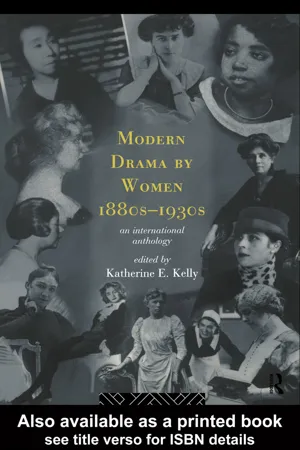 eBook - ePub
- Katherine E. Kelly(Author)
- 2002(Publication Date)
- Routledge(Publisher)
Dramatists (1912), codified the central works and cultural ambitions of “modern drama” in England. Dukes selected a total of seventeen (exclusively male) dramatists, most of whose plays had been translated and performed on English stages. Two or three playwrights from each of eight national locations served as exemplars of the “new,” the “advanced,” or the “modern” in drama.Dukes's “Modern Drama” positioned England within a larger arena of continental art-making. Like drama canons in the early nineteenth century, it was created not only to direct students and teachers to carefully selected reading exercises but also to show them models of “modern” genius, virtue, and even citizenship, taken from beyond English borders. “What is…the hall-mark of modernity?” asks Dukes, “break[ing] new paths,” creating characters who are “dynamic, developing, continually offering a criticism of [their] conditions, and so projecting themselves into the future and making history” (9). Modern Drama's contribution—to the individual and to the English nation—is to capture and activate the restless intellectual vitality of the twentieth century. Dukes associates such vitality on the English stage with only three playwrights— Bernard Shaw, Granville Barker, and John Galsworthy. In the anxious masculine arena of world drama preoccupied with representing modernity in the figure of a woman in crisis, plays by women were pointedly overlooked. Defining “world art” as the new field of play not only asserted the superiority of English as the language of world culture but also silenced women playwrights whose representation of the woman-in-crisis was markedly different from that of her male colleagues.In the same year that Dukes's study appeared, the influential English critic of “new drama” and member of the Ibsen circle, William Archer, published a practical guide to writing for the theater. Responding to what in the introduction he calls the “constant demand for text-books of the art and craft of drama,” Archer's Play-Making indirectly describes the prevailing norms of the London-based “new drama” movement and its relation to continental drama. “Thesis drama”—Eugène Brieux's Maternité, woman suffrage plays, capital and labor plays—fares badly in Archer's commentary by virtue of sacrificing illusion to assertion, humanity to abstraction (16–17). In its documentary exactness, the Trafalgar Square suffrage rally in Act II of Elizabeth Robins's Votes for Women holds the audience “spellbound.” But when the play's story is reintroduced, a fable revealing the interrelatedness of the personal and the political in the lives of two women, “the reality of the thing vanishe(s) and the interest with it” (20). Each of his chapters draws extensively on both English and continental examples— especially Ibsen's dramas—to assess the achievements of contemporary English playwriting. Like Dukes, Archer aims to position English new drama in the arena of European practice.3 eBook - ePub
The Handy Literature Answer Book
An Engaging Guide to Unraveling Symbols, Signs and Meanings in Great Works
- Daniel S. Burt, Deborah G. Felder(Authors)
- 2018(Publication Date)
- Visible Ink Press(Publisher)
Premature predictions of the death of drama were no doubt offered in Attic Greece and Elizabethan England. The history of drama is the history of imminent collapse and extinction, as well as persistence in various shapes and forms. Recall how out of the collapse of the Roman Empire and its stage tradition drama re-emerged, gratifying the same religious and moral imperatives that produced it in the first place. English drama returned after an eighteen-year ban, and a modern renaissance followed one of its most fallow periods in the nineteenth century. These instances remind us of drama’s tenacity. Despite a sense of decline, it seems as though every age gets the drama it deserves.There is no question, however, that the vitality of live drama today seems to be in serious danger, if not in critical condition. Drama, the great democratic and inclusive literary form, has become more an exclusive entertainment for the well-heeled few. Ticket prices on Broadway and the West End have turned live theater into a special occasion; the commercial theater leans heavily on spectacle rather than drama featuring existential, cultural, and political challenges. The economics of contemporary theater work against risky productions. Subsidized national theater has picked up the slack as have regional companies who can afford to take chances on new dramatic voices.If live theater’s purpose to provoke and engage is under threat, it can certainly be argued that no previous age is as saturated in drama as ours. Whether in films or on television, drama has become our preeminent literary entertainment. Far more people see literary works today than read them. With the rise of cable television and its relaxed censorship compared to broadcast television, a so-called new “Golden Age” of televised drama has emerged with such productions as The Sopranos, The Wire, Breaking Bad, Mad Men, and Game of Thrones, eBook - ePub
Twenty-First Century Drama
What Happens Now
- Siân Adiseshiah, Louise LePage, Siân Adiseshiah, Louise LePage(Authors)
- 2016(Publication Date)
- Palgrave Macmillan(Publisher)
© The Editor(s) (if applicable) and The Author(s) 2016Begin AbstractTwenty-First Century Drama 10.1057/978-1-137-48403-1_2Siân Adiseshiah andLouise LePage (eds.)2. Room for Realism?
Elaine Aston 1(1) Lancaster Institute for the Contemporary Arts, Lancaster University, Lancaster, UKKeywords Realism Feminism Neoliberalism Postfeminism Raymond Williams Royal Court TheatreEnd AbstractWith its attentions to the ‘here and now’ social realities of a recognizable world, realism endures as a dominant form on the English stage. However, its popularity on stage contrasts with the way in which there has been scant room for realism in theoretical and critical studies where the genre has been much maligned for its perceived formal and ideological conservatism. Addressing realism within a frame of literary and philosophical reference, for instance, Rachel Bowlby borrows the theatrical term ‘understudy’ in order to reflect on how the genre is ‘under-studied’, now ‘rarely play[ing] a critical part in its own right, instead serving as the simple straw man whose role is only to show up the […] critical action occurring elsewhere’ (2010 , p. xv). It would be erroneous to suppose, however, that the objections to realism Bowlby elucidates and contests are a new, twenty-first-century phenomenon, at least as far as theatre is concerned. As Raymond Williams observed, with the advent of late nineteenth-century naturalism came the idea that for those not of a ‘majority middle-class theatre’ this was a ‘mainly boring’ tradition (1987 , p. 337). At the turn of this century, it has been the relentless quest for new writers and new plays that has occasioned a renewed perception of the naturalist/realist tradition1as ‘boring’; by definition ‘the holy grail’ of new writing now means ‘a play which is contemporary in language, content and form , and provocative with it’ (Sierz 2011
Index pages curate the most relevant extracts from our library of academic textbooks. They’ve been created using an in-house natural language model (NLM), each adding context and meaning to key research topics.

