Literature

New York School Poets
The New York School Poets were a group of poets who emerged in the 1950s and 1960s in New York City. They were known for their experimental and avant-garde approach to poetry, often incorporating pop culture references and everyday language into their work. Key members of the group included Frank O'Hara, John Ashbery, and Kenneth Koch.
Written by Perlego with AI-assistance
Related key terms
1 of 5
8 Key excerpts on "New York School Poets"
 eBook - PDF
- Alfred Bendixen, Stephen Burt(Authors)
- 2014(Publication Date)
- Cambridge University Press(Publisher)
The New York School 857 When applied to New York School poems, labels such as “postmodern,” “avant-garde,” and “experimental” are, more often than not, ways of convey- ing the shock of encountering writing that treats mimesis – the imitation of reality – as only one tool, and certainly not a privileged one, within a poet’s utility kit. The sophistication of this position, and its many dizzying literary, philosophical, and political ramifications, helps explain why a small circle of friends, first brought to national attention by a countercultural anthology, has over the last half century proved to be such a spectacular success among tweedy academics and other establishment gatekeepers. Ashbery and Koch have won Bollingen Prizes; Ashbery and Schuyler have won Pulitzers; Ashbery and O’Hara have won National Book Awards; and Ashbery and Schuyler have been Fellows of the American Academy of Poets. Rafts of scholarly books and articles have appeared since 1975, and the rate of their arrival seems to be increasing, not tapering off. 22 Over the last decade there has been a sustained effort, too, to make as much of the poets’ writings as widely and easily avail- able as possible. 23 Since the Berlin Wall came down in 1989, humanists have been reevaluating the Cold War era, and, at least among poetry critics and readers of poetry, the New York School has retrospectively taken on unex- pected prominence. One could argue that the group’s reputation has also benefited to an unusual degree from the succession of trends in literary criticism over the last half cen- tury. During the 1950s and 1960s, the New York School’s radical rethinking and loosening of poetic form appealed to readers constitutionally averse to the dumbed-down New Criticism prevalent at the time in schools and uni- versities. eBook - ePub
The New York School Poets and the Neo-Avant-Garde
Between Radical Art and Radical Chic
- Mark Silverberg(Author)
- 2016(Publication Date)
- Routledge(Publisher)
Lehman notes, “The ‘New York School of Poets’ was always, on the face of it, an incongruous label. Here was a group of poets who were born elsewhere, went to college elsewhere, and contrived—all except Frank O’Hara—to abandon New York City for long stretches in Europe” (Last 19). John Ashbery lived not in New York but in Paris when his first books were published and his reputation, along with the reputation of the New York School, was formed. Ashbery himself has always been doubtful of the label, and in several interviews rejects it as a critical convenience, “a way of lumping us all together just because we happened to be living in New York for various practical reasons,” when to his mind “the differences are greater than the similarities among our work” (Poulin 252). Kenneth Koch has similar reservations: “. . . there was no school of New York poets, in the sense that the French and other European countries have schools of poetry; that is, there was no manifesto, there were no rules, there were no meetings. There was a group of friends—John Ashbery and Frank O’Hara and me at the beginning and later James Schuyler” (Tranter “Interview” 177). 2 In their mock-manifesto “How to Proceed in the Arts,” O’Hara and Rivers give us another reason to be suspicious of the “school” mentality: “If you are interested in schools, choose a school that is interested in you. . . . good or bad schools are insurance companies. Enter their offices and you are certain of a position” (AC 93). Even Myers hedges his bets. The introduction to his anthology includes this disclaimer: “Notice: I have not called these writers ‘The New York School of Poets,’ [he calls them The Poets of the New York School] but have deliberately refrained from so defining them because, properly speaking, they do not constitute a ‘school of poets’ in the old-fashioned sense” (7). All of these comments raise the difficult problem of classification eBook - PDF
Circling the Canon, Volume II
The Selected Book Reviews of Marjorie Perloff,1995-2017
- Marjorie Perloff, David Jonathan Bayot(Authors)
- 2019(Publication Date)
- UNM Press(Publisher)
Whose New American Poetry? 15 The fourth group is that of the New York poets: John Ashbery, Kenneth Koch, and Frank O’Hara, who met at Harvard and migrated to Manhattan, where they in turn met Edward Field, Barbara Guest, and James Schuyler. This is of course the group allied with abstract expressionism. And finally, Allen isolates a fifth group of somewhat younger poets that “has no geographical definition.” Snyder and Whalen, allied to the Beats, are more properly placed here, as are Stuart Perkoff, Michael McClure, Ron Loewinsohn, Ray Bremser, David Meltzer, John Wieners, Edward Marshall, Gilbert Sorrentino, and LeRoi Jones (Amiri Baraka). Again, there are overlaps: Baraka was a close friend of O’Hara’s in New York and edited Yugen ; McClure was linked to the San Francisco Renaissance, and so on. As Allen says, his groups are “for the most part more historical than actual” and “can be justified finally only as a means to give the reader some sense of milieu.” Why should the publication of this relatively small anthology, comprised of forty-four then largely unknown poets, located primarily in New York, San Francisco, or, so to speak, “on the road,” become such a historical event? First, because in the early 1960s, there really was a dominant poetic discourse—a discourse, incidentally, that, from our vantage point in the nineties, was by no means that of the Modernism of the early century. In 1960, the age demanded that a poem be self-contained, coherent, and unified: that it present, indirectly to be sure, a paradox, oblique truth or special insight, utilizing the devices of irony, concrete imagery, symbolism, and structural economy. The paradigmatic poem was John Crowe Ransom’s “The Equilibrists,” or perhaps his “Bells for John Whiteside’s Daughter.” The speaker was “dramatized”—a persona, whose relation to the poem’s author was “hidden”; the norm was show not tell , as Cleanth Brooks and Robert Penn Warren repeatedly pointed out in their Under-standing Poetry . No longer available |Learn more
Modern American Poetry
Points of Access
- Kornelia Freitag, Brian Reed(Authors)
- 2013(Publication Date)
- Universitätsverlag Winter(Publisher)
115 Heinz Ickstadt (Berlin) Frank O'Hara and the New York School: Poetry and Painting in the 1950s 1. In times of artistic upheaval, when conventions are questioned, traditions re-examined, and literary or artistic institutions perceived as bastions of the Old, the forces of rebellion tend to cooperate and interact. Boundaries are crossed: those of established forms and between genres, but also those between the different artistic media. The agents of the New, then, also become the ferment of a small yet growing audience of the New, ignored or critically rejected by a general public still dominated in its aesthetic preferences by the various institutions of Literature and Art (by criticism, academia, publishing, or the museum). This was true of the modernist rebellion in the 1910s and 1920s in Europe as well as in the United States. William Carlos Williams's cooperation with the painter Charles Demuth and his exchanges with the artists of the Alfred Stieglitz circle in New York would be one example, Gertrude Stein's fascination with the Cubists in Paris and her creative dialogue with Picasso another. Dialogue between the arts also characterizes a second wave of avant-garde experimentation during the early fifties. By then, modernism itself had become an institution via the critical opinions of T.S. Eliot (the period's literary Pope) and the aesthetics of the New Criticism, which had become academic doctrine. A new generation of artistic rebels thus found itself in a situation comparable to that of its modernist forebears: When we all arrived in New York or emerged as poets in the mid 50s or late 50s, Frank O'Hara remembers, painters were the only ones who were interested in any kind of experimental poetry and the general literary scene was not. Oh, we were published in certain magazines 115 116 and so on, but nobody was really very enthusiastic except the painters (Allen 3). eBook - PDF
- Bart Eeckhout, Gül Bilge Han(Authors)
- 2021(Publication Date)
- Cambridge University Press(Publisher)
On Stevens’s side of the equa- tion, this neglect reinforces the distorted image of Stevens as a stuffy, backward-looking aesthete, devoted solely to abstraction and imagination, disdainful of the concrete, everyday realities so dear to the New York School, and perpetuates the notion that he has been of minimal import- ance to the avant-garde strain in American poetry. In what follows, I trace some of the reasons why Stevens’s influence on the New York School has been overlooked and misconceived and examine his importance not only to Ashbery but also to O’Hara, Schuyler, Guest, Koch, and members of the New York School’s second generation, like Ted Berrigan. Ultimately, this chapter will suggest that, for all their differences, Stevens and the New York School Poets share a great deal: an obsession with painting and a passion for all things French; a delight in wordplay and the sensuous surfaces of language; an anti-foundational skepticism toward fixity in self, language, or idea; and, perhaps most of all, an embrace of the imagination and deep attraction to the surreal combined with a devotion to the ordinary and everyday. *** As I have suggested, most general assessments of the New York School stress that these young poets, like other New American poets, felt stifled by the poetic doctrines of Eliot and New Critical orthodoxy at mid-century Poetic Responses 163 and defiantly turned elsewhere, to alternative sources of inspiration – in their case, to the European avant-garde (Cubism, Dada, Surrealism, French, and Russian poetry); Abstract Expressionist painting; the vitality and absurdity of popular culture; and a lineage of American poets outside of the Eliotic canon, especially Whitman, Williams, Stevens, Stein, and Moore, along with early Auden. 4 While Stevens is mentioned in such tallies of influence, his importance is usually downplayed, except in the case of Ashbery.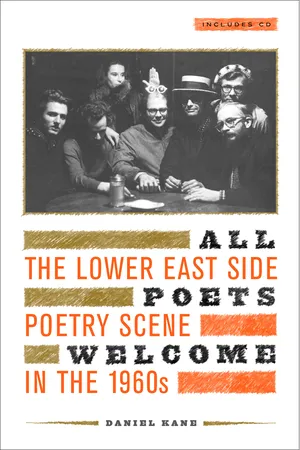 eBook - PDF
All Poets Welcome
The Lower East Side Poetry Scene in the 1960s
- Daniel Kane(Author)
- 2003(Publication Date)
- University of California Press(Publisher)
in an ever diminishing ability to imagine oneself in some corner other than the one one’s been painted into.” 14 Other poets associated with the Second-Generation New York School found language writers unnecessarily obscure, academic, and didactic. This at-titude toward language poetry, which very often slipped into outright anti-intellectualism, was to find its most hilarious if ferocious expression in Tom Clark’s essay “Stalin as Linguist,” which was printed in various versions in the magazine Poetry Flash as well as The Partisan Review: “[The language school writers] are as long on critical theory as they are (relatively, and I think also ab-solutely) short on poems. Their criticism is mostly written in a pretentious in-tellectual argot that sounds a little like an assistant professor who took a wrong turn on the way to the Derrida Cookout and ended up at the poetry reading.” 15 Nevertheless, such opposition was necessary if there was to be progress within the Poetry Project scene, which had by the early 1970s served as a base for the production of an enormous number of poems through various mimeo-graphed magazines while remaining uninterested in providing a clear, self-critiquing mechanism that would continue to interrogate the process whereby poetry—and poetic communities—was produced. Language writers were de-termined as much to write innovative poetry as they were to examine how poetic reception was defined by the various circulating discourses of politics, both on a coterie and a geopolitical level. In this sense, language writers in-troduced a far more inquisitive and theoretically determined conversation into a community that had perhaps become complicit and complacent in the face of its own nascent and self-enclosed mythology. eBook - PDF
- Mary McAleer Balkun, Jeffrey Gray, Paul Jaussen, Mary McAleer Balkun, Jeffrey H. Gray, Paul Jaussen, Jeffrey Gray, Mary McAleer Balkun, Jeffrey H. Gray, Paul Jaussen(Authors)
- 2022(Publication Date)
- Wiley-Blackwell(Publisher)
Olson’s confidence in the significance of a new poetics was quickly amplified in the years following as poetics has become more and more common both in academia and in innovative poetry contexts, as well as in the culture at large. Today (December 14, 2020) when I typed “the poetics of” into the University of Pennsylvania Libraries search engine, the first five entries were: The Poetics of Space (Gaston Bachelard, 1964); The Poetics of Sight (John Harvey, 2015); The Poetics of DNA (Judith Roof, 2007); The Poetics of Golf (Andy Brumer, 2007); The Poetics of Childhood (Roni Natov, 2003). The total number of entries was 6,964. Over the last half century plus, “poetics” has become a fashionable word. “Poetics” in such titles does hint at something creative, surprising, aesthetically arousing, promising that there is something poetic about sight, golf, and childhood. But the defining phrase is “the poetics of,” which overrides any potential inspired unruliness by indicating that there will be something systematic if not science-like in what follows, that we’ll be presented with a set of coherent aspects that can be stated clearly and learned. Even in such cases as these, the tension between patterned knowledge and open exploration can be detected. Now to turn to my first generalization: the modernists reinventing poetics. To go back to an early moment, here is the young Ezra Pound in 1913, reporting the news from London back to the readers of the new US magazine, Poetry : “The youngest school here that has the nerve to call itself a school is that of the Imagistes . To belong to a school does not in the least mean that one writes poetry to a theory. One writes poetry, where, because, and as one feels like writing it. A school exists when two or three young men agree, more or less, to call certain things good: when they prefer such of their verses which have certain qualities to such of their verses as do not have them” (Pound 1913, 126). eBook - ePub
Wallace Stevens among Others
Diva-Dames, Deleuze, and American Culture
- David R. Jarraway(Author)
- 2015(Publication Date)
- McGill-Queen's University Press(Publisher)
5
Stevens and New York School Poetry
in the Distance
The poet enters the poem with a hood over the poet’s eyes. The poet has arrived from a distance from the real world.Barbara Guest, Forces of ImaginationThe subjects of one’s poems are the symbols of one’s self or of one of one’s selves.Wallace Stevens, Collected Poetry and ProseThe self is only a threshold, a door, a becoming between… multiplicities…Deleuze and Guattari, A Thousand PlateausIn a searching meditation on “New York School” poets Frank O’Hara, John Ashbery, and “The Paradoxes of Friendship,” Andrew Epstein pauses over “an intriguing wrinkle” of their early relationship in the final chapter of his magisterial Beautiful Enemies: namely, “O’Hara, always assumed by critics to be so distant from Stevens and his influence, actually began his friendship with Ashbery with a shared mutual passion for the poet” (237). “Stevens was a more important poet to them than Eliot,” O’Hara and Ashbery would apparently divulge to novelist Harold Brodkey while at Harvard together with them in the late 1940s – “a daring and provocative attitude in those Eliotic, New Critical days in Cambridge,” as Epstein observes – and in abandoning Eliot for Stevens, “they wanted [Brodkey] to go along with them” (237). In this chapter, I continue to enlarge that “other” context that, except in rare instances like Epstein’s, often becomes overlooked by readers of Stevens who prefer to view the poet very much in the terms by which Stevens himself concludes his “Examination of the Hero in a Time of War,” namely, “that familiar/ Man [as] the veritable man… the large, the solitary figure” (Collected Poetry and Prose 250; CPP hereafter). In prying open this context even further, however, I come at the important influence of Wallace Stevens on the New York School writers via another often overlooked relationship also confederated under Stevens’s distant mentorship: that between Frank O’Hara and Barbara Guest. And while only able to attend to the early years of their enthusiasm for Stevens in the first part of this chapter, an enthusiasm that I can only speculate about in the case of the confederate James Schuyler in a turn to Deleuze once again at chapter’s end, nonetheless I hope to show that the “distant” alluded to by Epstein will prove to be far more parturient than protective as assumed by all those “critics” he references above.1
Index pages curate the most relevant extracts from our library of academic textbooks. They’ve been created using an in-house natural language model (NLM), each adding context and meaning to key research topics.

