Literature

Confessional Poetry
Confessional poetry is a genre characterized by the intimate and personal nature of the subject matter, often delving into the poet's own experiences, emotions, and inner struggles. It emerged in the mid-20th century and is associated with poets like Sylvia Plath, Anne Sexton, and Robert Lowell. Confessional poets often use their work as a form of self-expression and exploration of their own lives.
Written by Perlego with AI-assistance
Related key terms
1 of 5
7 Key excerpts on "Confessional Poetry"
 No longer available |Learn more
Modern American Poetry
Points of Access
- Kornelia Freitag, Brian Reed(Authors)
- 2013(Publication Date)
- Universitätsverlag Winter(Publisher)
The confessional poets occupy a curious place in the history of twentieth-century American poetry. While their verse might not fit perfectly the definitions of postmodernism offered by theorists such 99 100 as David Harvey, Fredric Jameson, and François Lyotard, it none-theless clearly positions itself as coming after, and even super-seding, literary modernism. More specifically, in their best-known and most representative lyrics the confessional poets tend to reject the impersonal elevated style characteristic of Anglo-American modernism. In contrast to the obscurity and erudition of High Modernist poetry, Rita Horváth explains, Confessional poems seek immediate apprehension […]. The syntax of Confessional poems is rarely convoluted; their patterns of allusion are not excessively cryptic; the poems tend to be less condensed and more repetitive than High Modernist poems (13). The confessional poets are also understood as introducing a mode of composition that has had widespread impact on subsequent generations of American writers. Literary critics in fact frequently use the word confessional somewhat loosely to refer to any con-temporary verse that stylistically or thematically recalls such volumes as Lowell's Life Studies , Berryman's Dream Songs (1969), Plath's Ariel (1965), Sexton's Live or Die (1966), and W.D. Snodgrass's Heart's Needle (1959). In this expanded sense, confessional often possesses negative connotations that echo Rosenthal's review. That is, the term can imply the desire to make self-indulgent, lurid revelations instead of attending to matters of craft. Marjorie Perloff's Differentials (2004), for example, takes great pains to show that poets can write well about autobiographical subjects without making talk-show-like histrionic confessions to prove their authenticity (133). eBook - ePub
- David McCooey, Maria Takolander(Authors)
- 2019(Publication Date)
- Routledge(Publisher)
They also comply with the cultural expectations of confession (religious and psychoanalytic) in conveying intimacy and, by offering their private selves for public consumption, conscientiously embrace the frisson of transgression. Nevertheless, confessional poems, as Lerner puts it, have ‘an aesthetic reason’ for being written (66). They are composed from a rich, institutionally acquired knowledge of the domain, and often in direct response to the work of fellow poets in the confessional school. 7 The poetry is also motivated by professional ambition for success and recognition from the gatekeepers in their domain – for publication and acclaim, and even monetary reward. As Hughes poetically confesses of his and Plath’s use of life in their work as young poets, ‘we still weren’t sure we wanted to own / Anything. Mainly we were hungry / To convert everything to profit’ (1125). 8 Such points are all germane to a theory of creativity that shifts the emphasis from individual psychology to what Glăveneau calls ‘cultural psychology’ (Distributed Creativity 8) – from a ‘He-paradigm’ or masculine ‘paradigm of … the exceptional creator’ (7) to a ‘We-paradigm’ (8), which understands creativity as a ‘ distributed, dynamic, socio-cultural and developmental phenomenon ’ (2, original emphasis). However, what I want to bring into focus here is how every creative act is also shaped by its materials, drawing attention to how the self that materialises through the autobiographical artefact is always other than itself. In what follows, I examine how Confessional Poetry emerges as a result of the writer making ‘a more or less conscious decision to share agency with the object and follow its lead at different moments within the process’ (Glăveneau Distributed Creativity 60, original emphasis)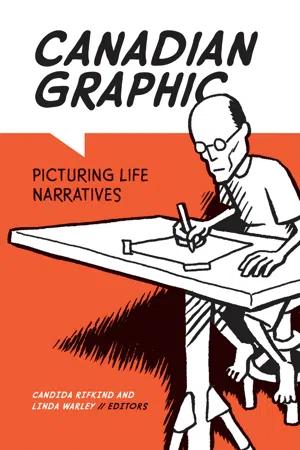 eBook - PDF
Canadian Graphic
Picturing Life Narratives
- Candida Rifkind, Linda Warley, Candida Rifkind, Linda Warley(Authors)
- 2016(Publication Date)
- Wilfrid Laurier University Press(Publisher)
( 24 ) CON FESSION A N D T HE R EL ATIONA L SELF life narratives I study position the reader in the imagined role of an inti-mate confidant. They create interactive accounts of the past that align with the desires for dependency and appeasement that exist along the continuum of affective exchange. I Confession’s Troubling Transparency I FOCUS ON the concept of confession in a literary context, but it bears mentioning at the outset that it is widespread in its appearances. It sur-faces in a variety of different scenarios: “The confessional mode has been associated with ecclesiastical, judicial, medical and psychological dis-courses, as well as with literature” (Radstone 27). For example, the con-cept of confession serves a specific role in a psychological context, which shares some similarities with its role in a medical context, but it would be a mistake to conflate these two situations because each has such separate aims and goals. A clear way of understanding confession, in the broadest terms, is to treat it as a set of cultural discourses operating in a wide vari-ety of different scenarios. In a literary context, confessional writing may be understood as a collection of distinctive genres that makes extensive use of confessional discourses. In his survey of the Canadian novel, David Williams suggests that certain Canadian authors draw inspiration from confessional discourses because they want to transfer into their fictions the textures of everyday life (8). Williams avoids describing confession as an act that records an author’s observations with perfect accuracy. A confession is at once an act of revela-tion and an act of obfuscation (32, 83–84). As Jo Gill convincingly argues in her introduction to Modern Confessional Writing , confession is not a means of expressing the irrepressible truth of prior lived experience, but a ritualized technique for producing truth. Confessional writing is poietic not mimetic.thinspace.thinspace.thinspace. eBook - PDF
Staging America, Staging the Self
Figurations of Loss in John Berryman's Dream Songs
- Anna Warso, Agnieszka Pantuchowicz(Authors)
- 2022(Publication Date)
- Peter Lang Group(Publisher)
between the increasing demand and supply of information concerning the private lives of confessional poets, augmented by their presence in the media, was reflected also in the partic- ular character of their popularity: With intense concern for tragedy, pathology and the unconscious, Confessional Poetry developed into an unusually participatory form of verse, one in which readers became fans and writers became stars� Sexton lovingly recalled the devo- tion of one New Yorker who yelled from the audience as she struggled through a difficult performance: “Whatever you do, Annie, baby, we are with you!” (Blake 717) eBook - PDF
- Eleanor Spencer-Regan(Author)
- 2017(Publication Date)
- Red Globe Press(Publisher)
The paranoia and insularity that accom-panied the country’s emergence as the dominant economic global force find a corollary in confessionalism’s swaggering vulnerability and theatrical narcissism. If ‘Confessional Poetry’ is a problematic label, ‘post-Confessional Poetry’ risks adding a further layer of vagueness, as it must be defined 152 Paul Batchelor as ‘a tendency formed in response to the confessional tendency’. The range of styles that can now be said to have derived something from confessionalism is vast, and would include the work of such diverse poets as Ai, Frank Bidart, Philip Levine, Sharon Olds, Adrienne Rich, and James Wright. To reflect this range, while also providing a more specific focus, this essay will look at some of the ways in which three poets – C. K. Williams, Robert Pinsky and Louise Glück – qualify and develop aspects of the confessional legacy. It will then con-sider Language poetry, particularly the work of Lyn Hejinian, Bob Perelman, and Rae Armantrout, and the extent to which such work is defined by its rejection of confessionalism. C. K. Williams’ often histrionic and formally sloppy early poetry, collected in Lies (1969) and I Am the Bitter Name (1972), displays many of the excesses associated with confessionalism at its most self- indulgent. The breakthrough Williams achieved in With Ignorance (1977) coincides with his adoption of a long, flexible line that sometimes runs to more than twenty syllables. His poems are now written in complete, punctuated sentences, and alongside newfound syntactical strategies he develops narrative skills, such as how to observe whilst acknowledging the observing self. His tone quietens and intensifies, and a great variety of subject matter becomes available to him. eBook - ePub
- Richard Gray(Author)
- 2015(Publication Date)
- Wiley-Blackwell(Publisher)
This is not so much Confessional Poetry, in fact, as pure confession: moving, sometimes, in the way that the confidences of any stranger might be, but not something in which we can begin to share. The Confessional “I” as Prophet “I’ve been very excited by what is the new breakthrough that came with, say, Robert Lowell’s Life Studies,” said Sylvia Plath. “This intense breakthrough into very serious, very personal emotional experience, which I feel has been partly taboo.” “Peculiar and private taboo subjects I feel have been explored in recent American poetry,” she went on, “– I think particularly of the poetess Anne Sexton … her poems are wonderfully craftsmanlike … and yet they have a kind of emotional and psychological depth which I think is something perhaps quite new and exciting.” Plath’s excitement grew, of course, from a sense of kinship. Even her earlier poems are marked by extremism of feeling and melodic cunning of expression, as these lines from “Lorelei” indicate: O river, I see drifting Deep in your flux of silver Those great goddesses of peace. Stone, stone, ferry me down there. 72 The compulsion to go inward and downward – to immerse oneself in “the great depths,” perhaps of death – is powerfully articulated here; and it is rendered at once piercing and mournful by the verbal pattern of thin “i” (“drifting,” “in,” “silver”) and tolling “o” (“O,” “Stone, stone,” “down”) sounds. But it was in the poems published after Plath’s suicide, in Ariel, that the impulse towards oblivion, and the pain that generated that impulse, were rendered in inimitably brutal ways: in terms, at once daring and deliberate, that compel the reader to participate in the poet’s despair. The suffering at the heart of her work has received ample attention; however, the craft that draws us into that suffering is sometimes ignored. Fortunately, Plath did not ignore it eBook - PDF
Lad Trouble
Masculinity and Identity in the British Male Confessional Novel of the 1990s
- Andrea Ochsner(Author)
- 2015(Publication Date)
- transcript Verlag(Publisher)
When he was com-posing his autobiography, Rousseau believed it to be a book without many imitators. He has long been proved wrong because since the 18 th century, the confessional mode has become an established genre with quite a few influential representatives, the most famous probably be-ing Thomas De Quincey ( Confessions of an English Opium Eater ). 35 But the novels by Charles Dickens and Charlotte Brontë may also be counted among the great English confessional novels. But what exactly is it that constitutes the confessional mode in narrative fiction? According to Les Smith, confession in the novel is achieved in three steps, the first of which is self-scrutiny in the shape of a self-account. The protagonist usually provides some shortcomings on which he hinges the problems he is currently facing. This may in-volve the inability to have taken a different choice at a certain point in his life. The second step follows in a shift from the self to a transcen-dental being “in hopes that justification will come from outside” (1996: 33f). The protagonist becomes aware of the fact that he cannot resolve his problems without ‘the other’. The latter may be another person or circumstances that ultimately turn his fate. By becoming aware of the fact that ‘the other’ is needed, the protagonist, or the self, at the same time realises the limits of self-expression. In essence, we might conclude from this observation that all fiction becomes confes-sional to some degree (ibid: 37). This claim follows in recognition of two aspects characteristic to the novel. First, most narratives are, to some degree at least, some kind of life stories; at least this holds true for first person narratives. Secondly, since the self is constituted through language whose limits we are aware of in the light of post-structuralist thought, self-expression is possible only to the degree language is able to signify. As it never quite refers to what it is meant to refer to, i.e.
Index pages curate the most relevant extracts from our library of academic textbooks. They’ve been created using an in-house natural language model (NLM), each adding context and meaning to key research topics.

