Literature

Dramatic Monologue
A dramatic monologue is a type of poem in which a single character speaks to a silent listener, revealing their thoughts and feelings. The speaker often addresses a specific situation or audience, providing insight into their personality and motivations. This form of poetry allows for a deep exploration of the speaker's inner world and can create a sense of intimacy and immediacy for the reader.
Written by Perlego with AI-assistance
Related key terms
1 of 5
8 Key excerpts on "Dramatic Monologue"
 eBook - PDF
The Contemporary American Monologue
Performance and Politics
- Eddie Paterson, Enoch Brater, Mark Taylor-Batty, Enoch Brater, Mark Taylor-Batty(Authors)
- 2015(Publication Date)
- Methuen Drama(Publisher)
Monologue in Western Drama 23 the early nineteenth century, by authors such as Alfred, Lord Tennyson and Robert Browning. As Clare Wallace explains, Dramatic Monologue enables the poet to inhabit a range of personae that may, as opposed to the confidential, earnest lyric ‘I’, open a space for doubt and ambivalence around the speaker. 34 Two important strategies emerge from this technique. The first is that the use of multiple personae unsettles the notion of stable self by providing various, often conflicting, points of view within a single work. The second is that these multiple viewpoints allow the poet to draw in broader historical and social material. Browning’s My Last Duchess (1842), for example, reveals the historical role of gender in determining power relations through the Dramatic Monologue of the Duke, a character who demonstrates his male superiority by keeping a painting of his late wife concealed behind a curtain on a palace wall. Dramatic Monologue can thus be read as expressions of self that are, in the words of Glennis Byron, ‘not autonomous, unified or stable, but rather the unfixed, fragmented product of various social and historical forces’. 35 Similar innovations are frequently associated with modern dramatic works and such notions also remain important to analysis of contemporary works of monologue solo performance. Indeed, Wallace suggests that the prose interior monologue is also an important forerunner to the modern monologue in drama. In novels, interior monologues commonly take the form of unspoken soliloquies and prose narratives also contain monologues of exposition, reportage and stream of consciousness narratives that reveal the inner lives of characters. 36 Thus, the monologue used in modern drama arguably draws much of its inspiration from developments in literary history and this back-and-forth flow of influences between genres continues to this day. eBook - PDF
- Michael H. Whitworth(Author)
- 2010(Publication Date)
- Wiley-Blackwell(Publisher)
The Victorian Dramatic Monologue provided a ready-made solution to several problems that vexed modernist poets. First, it allows for the imper-sonality that Eliot demanded in “Tradition and the Individual Talent” and elsewhere. In the Dramatic Monologue, the poet is not to be identified with the speaker. At the same time, however, it sustained an identification of the poem with speech and with an idea of psychological depth: the poem was something more than play with a verbal medium. Only for a later generation of modernists – notably Louis Zukofsky in “Poem Begin -ning ‘The’ ” – does the verbal medium become detached from speech and the quotation-poem become a valid form. Secondly, as Isobel Armstrong has argued, building on Robert Langbaum, the Dramatic Monologue dramatized the relativity of knowledge. We see the speaker both from inside and from outside; what appears to be the absolute truth from the speaking subject’s point of view turns out to be only a relative truth when seen from outside. 3 These two advantages of the form combine in Alan Sinfield’s insight that the Dramatic Monologue frees the poet from making his or her own experience stand for that of the typical humanist subject: what, Sinfield asks, “could be more hampering for a writer than to feel that he must express ‘what God sees’ or be ‘the voice of the human race’?” 4 In the conventional lyric, “Whenever the poet says ‘I’ the reader expects a personal truth which is also a truth about humanity.” In the first instance, the Dramatic Monologue records the truth about an individual. It does not foreswear truths about humanity, but they are embodied in the form of the poem, in the combination of speaker, auditor, and situation, not in the words themselves. If the Dramatic Monologue solved some problems for modernists, its Victorian form also presented some new problems. eBook - PDF
- Jiří Veltruský(Author)
- 2014(Publication Date)
- Masarykova univerzita(Publisher)
The second characteristic of dramatic dialogue is that, like other literary forms, it freely uses all sorts of language, whether monologic or dialogic. We mentioned this earlier, when we noted that both lyric and narrative make use of dialogue, though each employs it to its own ends. We should now add that monologic language is used in dramatic dialogue in a virtually countless number of forms, and contributes to its construction in a great variety of ways (Veltruský 1977: 49–53). Moreover, just as passages of true dialogue, or even dramatic dialogue, sometimes appear in a lyric poem or a narrative, one variant of dramatic dialogue consists of an uninterrupted speech of a certain length, delivered by a single speaker: it is called Dramatic Monologue (Mukařovský 1940c). This may be a latent dialogue with an absent interlocutor; a dialogue between different ideas, attitudes or feelings between which the speaker is torn; a soliloquy with implications for other characters which arouse the reader’s concern while escaping the speaker’s own notice; a semblance of a soliloquy pronounced by a speaker while he is performing some action and designed to mask the real sense of what he is doing; and so forth. In short, a Dramatic Monologue is a continuous discourse which has the semantic construction of a dialogue because it is dominated by a competition between two or more differ- ent contexts (Veltruský 1977: 53–59). The third and perhaps the most important characteristic is that in dramatic dialogue all the alternating and interpenetrating contexts form part of a single context, that of the playwright’s communication to the reader. Obviously, the reader is not an eavesdropper who overhears a discussion between characters 36 Theatre and literature unaware of his presence; he is the recipient of a message which the author con- veys to him by means of the dialogue he places in the mouths of the characters he creates. eBook - ePub
New Playwriting Strategies
Language and Media in the 21st Century
- Paul Castagno, Paul C. Castagno(Authors)
- 2012(Publication Date)
- Routledge(Publisher)
Monologue’s contrived aspect is featured on stage. Real-life, intense emotions actually trigger a lack of clearly articulated speech, but that is not usually the case in drama. The convention in which intense character emotions trigger the articulation of carefully composed language is at the heart of the contrivance. Most monologues use selective repetition and figures of speech, as well as negative space—clarified through pauses, silences, or ellipses. The monologue is composed, orchestrated for effect, and marked by a heightened, often formal level of language. Often used to establish the “reality of the character,” monologue may theatricalize what Dorrit Cohn has described as the transparent mind, allowing audiences entry into the characters’ consciousness: their motivations, history, or point of view. As Cohn posits:If the real world becomes fiction only by revealing the hidden side of human beings, the reverse is equally true: the most real, the ‘roundest’ characters of fiction are those we know most intimately, precisely in ways we could never know people in real life.(Cohn 1978 , 5)This psychological “rounding” provided by monologue serves to texture the dramatized action. The Aristotelian action expands to include the articulation of thought processes, emotional states, visual metaphors, and so on. Who can think of William Shakespeare’s greatest play, Hamlet, bereft of the soliloquies?Before a live audience, heightened by lighting and staging effects supporting the force of the actor, the monologue’s impact can be powerful. The theatricalized baring of the one before the many rivets an audience’s attention to this character’s inner struggles, moment of epiphany or intimate revelation. This convention of monologue remains one of the most tried and true elements of dramaturgy, and its effectiveness is reserved for the stage. Because of their essentially visual, image-oriented basis, neither film nor television suffer long speeches gladly. In film, monologue is invariably formatted as a voice-over: a vocal narrative track that underscores a series of visual images. If direct address to the audience from the stage can represent a powerful dramaturgy, it is not without its critics. The New York Times eBook - ePub
Victorian Poets
A Critical Reader
- Valentine Cunningham(Author)
- 2014(Publication Date)
- Wiley-Blackwell(Publisher)
It represents modern character as a quotient, a ratio of history and desire, a function of the division of the modern mind against itself. Our apprehension of character as thus constituted is a Romantic affair; in Jerome Christensen’s apt phrase for the processing of the “lyrical drama” in Romanticism, it is a matter of learning to “read the differentials.” As a sampling of the dozens of poetry textbooks published in recent decades will confirm, the Dramatic Monologue is our genre of genres for training in how to read between the lines – a hackneyed but valuable phrase that deserves a fresh hearing. 8 In the reading of a Dramatic Monologue we do not so much scrutinize the ellipses and blank spaces of the text as we people those openings by attending to the overtones of the different discourses that flank them. Between the lines, we read in a no-man’s-land the notes whose intervals engender character. Perhaps the poet of the Dramatic Monologue gave a thought to the generic framing of his own art when he had the musician Abt Vogler (1864) marvel “That out of three sounds he frame, not a fourth sound, but a star” (l. 52). The quantum leap from text to fictive persona (the dramatic “star” of a monologue) is no less miraculous for being, like Abt Vogler’s structured improvisation, “framed,” defined and sustained as a put-up job. That such a process of character-construction tends to elude our received means of exegesis is a contributing cause for the depression of Browning’s stock among the New Critics. But one way to begin explicating a Dramatic Monologue in the Browning tradition is to identify a discursive shift, a moment at which either of the genre’s constitutive modes – historical line or punctual lyric spot – breaks into the other. III Since the premier writer of Dramatic Monologues was, as usual in such matters, the most ingenious, it is difficult to find uncomplicated instances in Browning that are also representative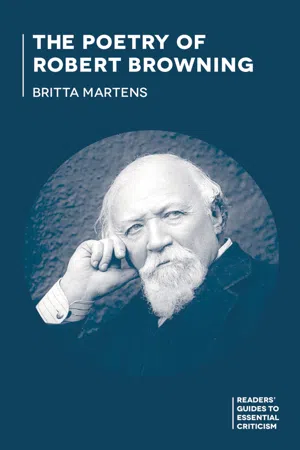 eBook - PDF
- Britta Martens(Author)
- 2016(Publication Date)
- Bloomsbury Academic(Publisher)
In his search for poems which are not in the poet’s own voice and which can therefore be seen as antecedents of the Dramatic Monologue, Fuson goes back as 67 far as the Heroides , epistolary poems in the voices of Greek and Roman mythological heroines by the Roman poet Ovid (43 BC to AD 17/18). 1 Taking the same broad definition of the genre, Alan Sinfield, in his Dra-matic Monologue (1977), goes back even further, to the complaints in the voices of fictional speakers by the Greek pastoral poet Theocritus (third century BC ). 2 A. Dwight Culler, in ‘Monodrama and the Dramatic Monologue’ (1975), considers the Dramatic Monologue as a develop-ment of the rhetorical exercise of prosopopoeia, in which a historical or imaginary character is impersonated, and which still featured in the education of nineteenth-century British boys. 3 At the same time, Culler also argues for the debt of the Dramatic Monologue to the Romantic genre of the monodrama, a dramatic piece in a single voice, whose invention he credits to Jean-Jacques Rousseau (1712–78). 4 Other Romantic genres which can be argued to have facili-tated the development of the Dramatic Monologue are the self-expressive lyric, which the Dramatic Monologue is seen either as rejecting and sub-verting or as developing (as in Langbaum’s analysis in Chapter 3 ) and the lyrical drama, which is not intended to be acted on stage (see again Langbaum). 5 W. David Shaw, in Origins of the Monologue: The Hidden God (1999), adds another two Romantic sources to the list. Firstly, the con-versation poems of Samuel Taylor Coleridge such as ‘Frost at Midnight’ (1798), with their addresses to real people, anticipate the silent auditor of the Dramatic Monologue, as they are ‘poems which naturalize the ode and lyric by substituting, for formal apostrophes to the seasons, places, and natural phenomena, the Dramatic Monologue’s vocatives of direct address to a person’. eBook - PDF
Sincerity’s Shadow
Self-Consciousness in British Romantic and Mid-Twentieth-Century American Poetry
- Deborah Forbes, Deborah FORBES(Authors)
- 2009(Publication Date)
- Harvard University Press(Publisher)
But critics have long main-tained that the Dramatic Monologue is, or at least can be, a radically open-ended form. Most influentially, Robert Langbaum argues that this genre serves the needs of a society that is questioning and testing new val-ues. 58 He believes that the Dramatic Monologue is defined by a tension be-tween sympathy and judgment, and that this tension provides a method by which Romantic and Victorian writers “find and justify new values” in the wake of the Enlightenment. 59 In his reading of “My Last Duchess,” then, Langbaum argues that we sympathize with the Duke more strongly than we judge him: “What interests us more than the duke’s wickedness is his immense attractiveness . . . We suspend moral judgment because we prefer to participate in the duke’s power and freedom, in his hard core of character fiercely loyal to itself.” 60 Langbaum’s reading, whether we rat-ify it or not, points to a source of instability within the dramatic mono-logue form—an instability that is multiplied when we cannot be certain whether the poet believes his or her speaker’s statements are condem-nable. This question of moral value is one of the central factors that distin-guishes the would-be sincere lyric from the Dramatic Monologue. When faced with a poem spoken in an “I” voice that may or may not be sepa-rate from the voice of the poet, one way for the reader to determine the genre of the poem is to measure the distance of the speaker’s implied val-ues from what can be assumed about the poet’s values. This measurement is not always easily taken; in fact, it is not always clear when such a dis-tance exists. For example, Robert Lowell says of Anne Sexton: “Many of her most embarrassing poems would have been fascinating if someone 1 0 8 S I N C E R I T Y ’ S S H A D O W At this point, it is not hard to see where this strange taciturnity might come from. As we saw earlier, ‘absolute’ drama is narrative with no narrator, showing that is not allowed to tell. The charged silence in the middle of it, then, is a trace of the voices that have been silenced in the process of establishing its formal integrity. Drama is monologic not automatically (no use of language is monologic automatically), but because its coherence is sustained by the vigilant suppression of other voices which would cut across or complicate or dialogise it. It is ‘pure’ drama in the sense that its impurities are actively excluded: it is time to enquire what these might be.
IMPURITIES OF THE THEATRE
To recapitulate: pure drama consists of characters interacting in the medium of spoken dialogue while the dramatist, though omnipresent, is silent. From our account of this form, we can pick out four negative propositions which sustain Bakhtin's contention that drama is inherently monologic.(1) Not all staged verbal performances count as ‘drama’ in the strict sense. Some kinds of comic and popular theatre are half outside the category. Drama is wholly monologic only if it excludes these marginal elements.(2) In a play, each line of dialogue is intelligible as the verbal action of the individual character who utters it. Consequently, the dramatic word is single-voiced; double-voiced speech is impracticable.(3) Drama is primarily a representation of action, and the dialogue is subordinated to this project. Consequently, different speakers cannot represent different worlds, only different attitudes within the single world that is represented by the play as a whole.(4) Drama is the opposite of narrative: it is present as opposed to past, enacted as opposed to recounted, showing as opposed to telling. Consequently, dramatic characters, if they are truly dramatic, do not narrate themselves; they behave, and we observe them.
Index pages curate the most relevant extracts from our library of academic textbooks. They’ve been created using an in-house natural language model (NLM), each adding context and meaning to key research topics.

