History

Georgia O Keeffe
Georgia O'Keeffe was an influential American artist known for her unique and innovative style, particularly her large-scale paintings of flowers, New York skyscrapers, and landscapes of the American Southwest. She played a significant role in the development of American modernism and is celebrated for her contributions to 20th-century art. O'Keeffe's work continues to inspire and captivate audiences around the world.
Written by Perlego with AI-assistance
Related key terms
1 of 5
6 Key excerpts on "Georgia O Keeffe"
 No longer available |Learn more
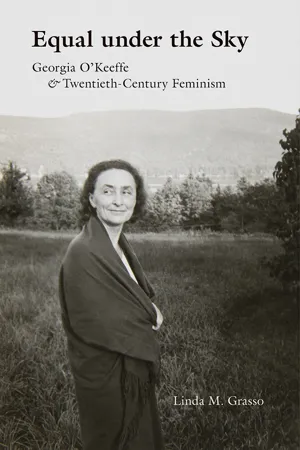
Equal under the Sky
Georgia O'Keeffe and Twentieth-Century Feminism
- Linda M. Grasso(Author)
- 2017(Publication Date)
- UNM Press(Publisher)
INTRODUCTION Georgia O’Keeffe and FeminismGEORGIA O ’KEEFFE IS an “ardent feminist,” proclaimed Robert Coates in a 1929 New Yorker profile. “Miss O’Keeffe, Noted Artist is a Feminist” declared a 1945 New York World-Telegram headline. “The feminist artist’s wide-ranging influence” is a “reminder of why her paintings resonate today,” asserted a reviewer in a 2007 O: The Oprah Magazine article. “You must remember to say O’Keeffe was a staunch feminist,” an O’Keeffe scholar told a journalist who was writing a book about O’Keeffe that was published in 2012. “Even the ultra-feminist O’Keeffe” would marvel at how makeup products can create artful eyelid designs inspired by her “iconic” floral paintings, contended a reporter for Bustle, a new media site “for and by women” in 2015.1 Does the label “feminist” have the same meanings for each of these speakers? And is the feminist Georgia O’Keeffe the same artist who allegedly slammed the door in Gloria Steinem’s face, made disparaging remarks about women who identified as women artists, and refused to cooperate with feminist artists, critics, and scholars who were creating female-centered artistic theories, practices, and histories in the 1970s?2 What accounts for these contradictions and the reasons they are—and are not—part of US culture’s collective memories? In this book I question assumptions about O’Keeffe guided by the principle that feminism is a historical phenomenon that needs to be understood in context.Feminism is an enduring influence on O’Keeffe’s legacy. Whether the artist is considered an insider or an outsider, a supporter or a detractor, she and feminism are inextricably entwined. Understanding why necessitates grounding O’Keeffe in US feminist history. Born in 1887 and dying in 1986, O’Keeffe lived during the flourishing of two twentieth-century feminist movements—first in the 1910s and then again in the 1970s. Embracing the first movement and disdaining the second, O’Keeffe sustained a relationship to feminism that was long, complicated, and ambivalent. In this study, I explore what feminism meant to O’Keeffe and how it influenced her self-creations, life choices, and art making. Concomitantly, I examine the culture’s relationship to feminism as it is revealed through discourses about O’Keeffe from the 1920s to the 1980s. Foregrounding feminist questions and employing feminist reading practices, in this book I dislodge O’Keeffe from art history contexts and reassess her art, life, letters, and reputation in a historical feminist framework. Feminism, I propose, is akin to a canvas upon which O’Keeffe, her contemporaries, and her commentators created art and opinions.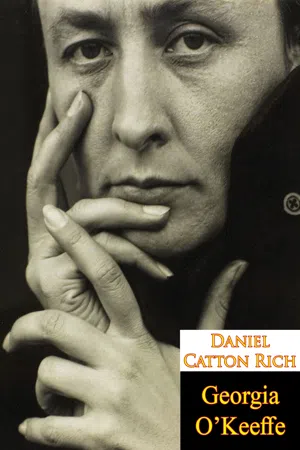 eBook - ePub
- Daniel Catton Rich(Author)
- 2016(Publication Date)
- Golden Springs Publishing(Publisher)
GEORGIA O’KEEFFE
THE ART OF GEORGIA O’KEEFFE is a record of intense emotional states resolved into crystalline form. Her ability to charge abstract elements of line, color, and mass with passionate meanings is as notable as her fastidious and immaculate craftsmanship.O’Keeffe’s deepest experiences occur with nature. Not nature as most of us see it, through the windshield of an automobile or on a casual walk in the woods. She is sharply and deeply aware of the forces which lie behind nature. In conversation, it is only in describing the green hilts of Canada or the lush flowers of Hawaii or more often, the barren and luminous New Mexican landscape that O’Keeffe grows excited. Her eyes shine, she sits forward on her chair, the words pour forth and that full, creative electricity which for twenty-five years has animated her art becomes suddenly apparent.The farm country round Sun Prairie, Wisconsin, where she was born in 1887, gave her a love of landscape. Her ancestry was Irish on her father’s side, Hungarian and Dutch on the maternal. At ten years of age, Georgia copied pansies and roses and calmly told a friend that she was going to be an artist. There followed a convent school. For her first drawing lesson a Sister set her at copying the plaster cast of a child’s hand. She made a tiny, careful sketch and was scolded for drawing it so small. Then and there she made up her mind never to make anything small again. The memory of that resolve came back to her years later when she began her series of prodigious flowers. Later the family moved to Virginia. “As a youngster,” she once wrote, “I lived in an old-fashioned house in the south—open fires and a lot of brothers and sisters—and horses and trees.”At The Art Institute of Chicago, where she enrolled as a student, it was John Vanderpoel, a famous teacher of drawing, who impressed her. Vanderpoel taught anatomy and structure and though she soon went on to the Art Students League in New York to paint under William Merritt Chase and F. Luis Mora, the Chicagoan’s clear emphasis on line remained beneath the clever brushwork and summary form of these later teachers. O’Keeffe was a gifted student. In Chase’s class she dutifully won a first prize for still life. Chase, she recalls, was forever stressing the beauty of oil paint. Pigment he adored and this love of the medium, infinitely refined and subtilized, still characterizes every painting she makes.
- Gina Sigillito(Author)
- 2012(Publication Date)
- Citadel Press(Publisher)
22. GEORGIA O’KEEFFE 1887–1986ARTISTFrom the time I was small, I was always doing things that people don’t do. —Georgia O’Keeffe When so few people ever think at all, isn’t it all right for one to think for them and then get them to do what I want? —Georgia O’KeeffeW idely regarded as one of the greatest painters of the twentieth century, Georgia O’Keeffe was a major figure in American art since the 1920s, paving the way for female artists with her revolutionary vision, her sexual daring, and her powerful abstract images.Georgia Totto O’Keeffe was born in 1887 on a farm in Sun Prairie, Wisconsin. She was the second child born to Frank O’Keeffe and Ida Totto. Her older brother, Frank, was born soon after their parents were married and Georgia followed a few years later. Her parents then had five more children. Georgia’s father, Frank, was born in a log cabin on a farm in Sun Prairie to Irish Catholic farmers. His parents came to Wisconsin in 1848 during the Irish Potato Famine. When his father died, his mother, Kate, took over the farm. Kate was always a religious and frugal woman and ran the farm with the help of her sons. She was also a strong, independent woman who loaned money to others in the area. Frank tried to assert his independence by leaving the farm to homestead in the Dakota Territory. However, Kate convinced him to come back to Wisconsin by renting a neighboring farm for him. Kate also negotiated a business deal with the owner of the farm, Isabella Totto, which resulted in an arranged, loveless marriage between Frank and Ida, one of Isabella’s daughters. Ida’s mother was Dutch and English while her father was a Hungarian playboy who abandoned the family. Frank and Ida moved into the family mansion on the Totto farm, where they had seven children. Ida insisted that Frank leave the Catholic Church and raise the children as Protestants. It was a troubled marriage that would suffer many tragedies and have a profound effect on Georgia and her siblings. eBook - ePub
The Expanding Discourse
Feminism And Art History
- Norma Broude, Mary Garrard(Authors)
- 2018(Publication Date)
- Routledge(Publisher)
25Georgia O’Keeffe and Feminism:A Problem of PositionBARBARA BUHLER LYNESAfter Frances O’Brien interviewed Georgia O’Keeffe in 1927, she made the following observations:1. Georgia O’Keeffe, Black Iris III , 1926. New York, Metropolitan Museum of Art, The Alfred Stieglitz Collection,If Georgia O’Keeffe has any passion other than her work it is her interest and faith in her own sex. You must not, if you value being in her good graces, call her “Mrs. Stieglitz.” She believes ardently in woman as an individual—an individual not merely with the rights and privileges of man but, what is to her more important, with the same responsibilities. And chief among these is the responsibility of self-realization. O’Keeffe is the epitomization of this faith.1To the end, O’Keeffe epitomized the self-realized woman and artist; and thus, when certain feminist artists in the 1970s sought a similar self-realization, they naturally viewed her—then in her eighties—as a kindred spirit, a mentor. They actively praised her achievements as a woman artist and, furthermore, defined certain aspects of her paintings as among the first manifestations of an iconography they believed was specifically representative of the female. They were particularly drawn to centralized forms in her work that, to them, closely resembled parts of a woman’s sexual anatomy. eBook - ePub
American Culture
An Anthology
- Anders Breidlid, Fredrik Chr. Brøgger, Oyvind T. Gulliksen, Torbjorn Sirevag, Anders Breidlid, Fredrik Chr. Brøgger, Oyvind T. Gulliksen, Torbjorn Sirevag(Authors)
- 2013(Publication Date)
- Routledge(Publisher)
8 Art, Film, Music, and Popular CultureIntroductionTo Alfred Stieglitz (1916)71 Georgia O’Keeffe“Empty Bed Blues” (1928)72 Bessie Smith“This Land Is Your Land” (1944)73 Woody GuthrieThe Testimony of Walter E. Disney Before the House Committee on Un-American Activities (1947)74 Walt Disney“As the Spirit Moves Mahalia” (1964)75 Ralph Ellison76 Stanley Kauffmann“Little Big Man” (1970)“Georgia O’Keeffe” (1979)77 Joan Didion78 Studs TerkelFROM “Jill Robertson: Fantasia” (1982)79 Mikal GilmoreFROM “Bruce Springsteen” (1987)80 Martin Scorsese, Paul Schrader, and Robert De NiroFROM “Taxi Driver” (1992)IntroductionFigure 8 Jack in the Pulpit by Georgia O’Keeffe, 1930. Image © Geoffrey Clements/CORBIS Artwork © The Georgia O Keeffe Foundation / Artists Rights Society (ARS), New YorkAmerican art, film, music, and popular culture have all had a profound effect upon cultural expressions throughout the western world. For a long time American painting, sculpture, and architecture were basically regarded as mediocre copies of European art but that is no longer the case. In the 1950s American abstract expressionism became a major school of painting and New York became one of the prime art centers in the world. Earlier on American architecture received world attention through radically new edifices conceived and constructed by Louis Sullivan (1856–1927) and Frank Lloyd Wright (1867–1959). Film originated as an American cultural form and the modern film industry is unthinkable without Hollywood, whether seen as a stronghold of film traditions which should be emulated or regarded as a place where serious film no longer stands a chance. Music and popular culture have been the major cultural exports of the United States, from the blues and jazz to rock and roll and rap music.Georgia O’Keeffe (1887–1986) remains one of the truly original voices in American painting. Born in the Midwest, she became famous for her watercolors and oil paintings of nature, especially her close-ups of leaves and flowers. She married the American photographer Alfred Stieglitz (1864–1946), who admired her work and took several pictures of her, which he exhibited (see text 71). After his death O’Keeffe lived and worked mostly in New Mexico. She lived to be almost a hundred years old. In her essay on Georgia O’Keeffe, writer Joan Didion pays tribute to her as “a woman clean of received wisdom and open to what she sees” (text 77). eBook - PDF
At Home in the Studio
The Professionalization of Women Artists in America
- Laura R. Prieto(Author)
- 2001(Publication Date)
- Harvard University Press(Publisher)
Women artists in the early twentieth century thus celebrated sexuality and redefined womanhood to a degree formerly unthinkable, yet could at the same time insist that their sex was only one aspect of their identity among many that deserved expression. That is, even when gender was sig- nificant to the piece being produced, it was only one component of the art- ist’s self. As Georgia O’Keeffe wrote to Michael Gold, editor of New Masses, in 1930, “I would hear men saying, ‘She is pretty good for a woman; she paints like a man.’ That upset me . . . I am trying with all my skill to do painting that is all of a woman, as well as all of me.” 66 Unlike the more realist, even narrative, traditions that shaped nineteenth-century American art, modern- ist principles pushed artists away from the local and specific, toward the uni- versal and abstract. Abstraction may have appealed to modernist women precisely as an escape from issues of sex and gender. “I, for one, didn’t feel my art had to reflect my political point of view,” Lee Krasner recalled about her work in the 1930s. “No, I was just going about my business and my busi- ness seemed to be in the direction of abstraction.” 67 O’Keeffe too recognized that as a woman she faced special impediments. “I can’t live where I want to—I can’t go where I want to—I can’t even say what I want to,” she wrote 194 Making the Modern Woman Artist in conjunction with her first major exhibition in 1923. “[But] I found that I could say things with colors and shapes that I couldn’t say in any other way—things that I had no words for.” 68 Believing that great art was truly universal, O’Keeffe, Anita Pollitzer, and other modernist women did not then consider themselves excluded by the maleness of the pantheon of Great Artists. “Picasso, Bach & Wagner are my Gods,” Pollitzer declared. 69 But these gods were inspirations, not gatekeep- ers.
Index pages curate the most relevant extracts from our library of academic textbooks. They’ve been created using an in-house natural language model (NLM), each adding context and meaning to key research topics.

