History

American Photography
American photography encompasses a rich and diverse tradition that has evolved over time. From the early documentary work of photographers like Dorothea Lange and Walker Evans to the innovative experimentation of contemporary artists, American photography has played a significant role in shaping visual culture. It has captured pivotal moments in history, reflected societal changes, and pushed the boundaries of artistic expression.
Written by Perlego with AI-assistance
Related key terms
1 of 5

9 Key excerpts on "American Photography"
 eBook - PDF
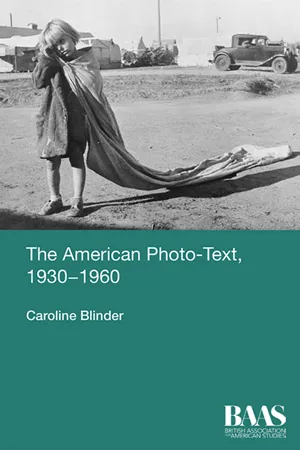
- Caroline Blinder(Author)
- 2019(Publication Date)
- Edinburgh University Press(Publisher)
1 Introduction: The American Photo-Text The moment our discourse rises above the ground of familiar facts and is inflamed by passion or exalted by thought, it clothes itself in images. Ralph Waldo Emerson, ‘On Nature’ ( 1836 ) 1 When asked in a 1964 interview whether he considered himself a doc-umentary artist, the American photographer Walker Evans replied, ‘My thought is that the term documentary is inexact, vague, and even grammatically weak . . . what I believe is really good in the so-called documentary approach to photography is the addition of lyricism.’ For Evans, this lyricism was definable through a ‘purity, a certain severity, rigor, simplicity, directness’ and, above all, ‘clarity’. 2 The idea of clarity, simplicity and directness as the definition of a particular form of photographic endeavour has become a mainstay in how we look at those objects, faces, artefacts and circumstances representative of twentieth-century American life, so much so that documentary photography – from Dorothea Lange’s Depression era ‘Migrant Mother’ to Lewis Hine’s construction workers – has largely determined what we perceive to be the true face of America in the first half of the twentieth century. This confluence of a personal and collective vision of American life, rural and urban, working and middle-class, was not the sole provenance of the pho-tographer, however, as became manifest in a series of photo-textual collaborations from the 1930 s, 1940 s and 1950 s. In these books, published and marketed mostly as collaborations between estab-lished photographers and writers, the call for a renewed lyricism within American Photography was heard as much through a variety of textual forms as through the images themselves. As the context for what Evans called ‘the circumstances native to American life’ 2 the american photo-text, 1930–1960 became increasingly complex and manifold, so did the interaction between image and writing.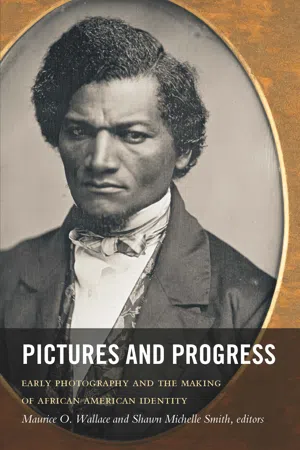 eBook - PDF
Pictures and Progress
Early Photography and the Making of African American Identity
- Maurice O. Wallace, Shawn Michelle Smith, Maurice O. Wallace, Shawn Michelle Smith(Authors)
- 2012(Publication Date)
- Duke University Press Books(Publisher)
INTRODUCTION Pictures and Progress Maurice O. Wallace and Shawn Michelle Smith No other means of representing human likeness has been used more systematically to describe and formulate American identity than photography. Envisioning and exhibiting the American self has been a photographic venture since the inception of the medium. It is an ongoing social, cultural, and political project. —Coco Fusco, “Racial Time, Racial Marks, Racial Metaphors” Perhaps only now, at the dawn of our digital age, with our witness to the dramatic transformations wrought by this revolution still ongoing, has the comparable impact of photography’s magic on the nineteenth century begun to be fully appreciated. With the mechanical and electronic repro-duction of images in the modern mass media animating so much of our cultural lives and prepossessing so much scholarly thought, serious atten-tion cannot but return to the material beginnings of our visual dispensa-tion. Today, owing to historians, cultural critics, and theorists as vital to the study of early photographic practices as Alan Trachtenberg, Laura Wexler, Deborah Willis, Allan Sekula, and the late Susan Sontag,1 what Walter Benjamin portrayed as “the fog which obscures the beginnings of photog-raphy” seems, at last, to be dissipating.2 The signal importance of photog-raphy’s advent to modernity’s hold on history is now clearly in view. To be sure, photography was a watershed invention. So profound was the influence of photography upon antebellum and postbellum Ameri-can life and thought that, like today’s digital technology, early photog- 2 MAURICE O. WALLACE AND SHAWN MICHELLE SMITH raphy shifted the very ground upon which the production and circulation of knowledges, scientific and philosophical, had set only a half century earlier. eBook - ePub
Photography
A Critical Introduction
- Liz Wells(Author)
- 2021(Publication Date)
- Routledge(Publisher)
The credit for discovering practical chemical processes lies with no single person, nor, indeed, with any particular nation, although the ascription of credit has always had nationalistic overtones with, for example, the French, keen to downgrade British claims (1839 was within a generation of the Battle of Trafalgar). Likewise, strenuous rewritings of history allowed the German photohistorian, Stenger, writing in the 1930s during the ascendance of Hitler, to claim German experiments of the eighteenth century as fundamental for photography. Re-examining the prehistory, Mary Warner Marien urges caution in two respects: first, she warns against too uncritical an acceptance of the work of early photohistorians. She notes the extent to which the burgeoning of research in the field since the Second World War has both uncovered new findings and suggested new ways of thinking about previously known facts within the history of photography; recent research represents only the beginning of a much-needed archaeology of early photography. In addition, she emphasises the broader historical context of political, technological and cultural change within which photography developed. The overall point is that, in considering the origins of photography, a stance which is both cautious and critical should be adopted (Warner Marien 1991). Geoffrey Batchen offers a more detailed discussion which points to the complexities involved in reappraising early photography in terms of who founded it, where and for what purposes (Batchen 1997).The photograph as image
While earlier writing on photography had not exclusively focused on technology and techniques, since the Second World War art-historical concerns have become more central, together with a new stress on connoisseurship of the photograph as a privileged object analogous to a painting. A number of the books which we now take as key texts on the history of photography were first written as exhibition catalogues for works collected and shown in institutions. For instance, Beaumont Newhall’s The History of Photography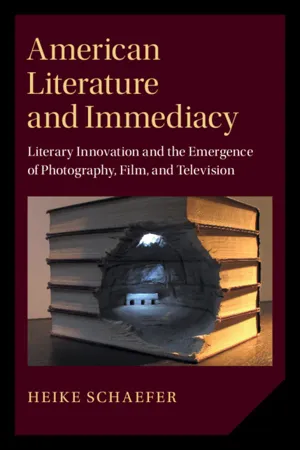 eBook - PDF
American Literature and Immediacy
Literary Innovation and the Emergence of Photography, Film, and Television
- Heike Schaefer(Author)
- 2020(Publication Date)
- Cambridge University Press(Publisher)
When Emerson published his essay gallery of Representative Men in 1850, the exhibition and marketing of celebrity photographs had become common practice in the United States (Marien, Photography 68; Taft 80–81). 9 Between 1840 and 1860, 108 daguerreotypists set up shop in Boston alone (cf. Newhall 37). 10 At mid-century, around two thousand American photo- graphers were practicing the trade professionally, producing three million daguerreotypes annually (Taft 60, 76). Emerson recognized the new med- ium’s transformative impact on American culture and ranked photography in importance with the railroad and the telegraph, two other nineteenth- century inventions that dramatically changed the perception of space and time (Journals 10: 174). 11 In its early years, photography was considered a natural medium, as the very names attributed to the new photographic technologies indicate: “photography” or light writing, “heliography” or sun writing, “the pencil of nature.” 12 The terms were used interchangeably. The first American book-length treatise on photography as an art form by Marcus Aurelius Root, for instance, carries the title The Camera and the Pencil, or the Heliographic Art (1864). Its early users regarded photography as the result of nature’s collaboration with technology: it was sunlight falling through the camera’s lens onto a chemically treated plate that initiated the chemical reactions that created the photographic image. Since photography was chemical and mechanical in character, it seemed to offer a record of reality that was independent of human vision and cognition. “With Daguerre’s method, man is replaced by a machine that allows nature to record itself without human interference,” Marcy J. Dinius points out (13). 13 Although there was of course a photographer who placed the camera and arranged the sitters, who framed the shot and developed the plate, people did not think of him as the artist who created the images. eBook - PDF
Popular History Now and Then
International Perspectives
- Barbara Korte, Sylvia Paletschek, Barbara Korte, Sylvia Paletschek(Authors)
- 2014(Publication Date)
- transcript Verlag(Publisher)
Seeing the Past 1800 – 1900 – 2000 History as a Photo Album S USAN A. C RANE Popular enthusiasm for history is a distinctively modern phenomenon. Not coincidentally, technologies of vision have developed rapidly over the past 200 years, particularly photography. But even as photography offered a novel means to preserve the presence of the passing present, it challenged the nature of historical experience by ›freezing‹ the past, no longer allowing it to decay or fade away. The paradoxical quality of photography’s rela-tionship to historical consciousness deserves closer analysis – as preserver of the past, producer of presence and resister of historical time. Modernity’s peculiar ability to ›see the past‹ through photography enabled a new mode of historical visualization which left traces in historiography as well as in the popular culture of memory. As a result, popular conceptions of history have become visually motivated, visually mediated and visually experi-enced in ways which have transformed the meanings of the past and the nature of historical consciousness. As historians, we always begin our work in medias res , that is, ›from the middle‹: If we were entirely ignorant of the past, we would not rec-ognize what we encounter as having existed before our perception of it; we would have no historical consciousness. But we also begin in medias res in another sense: We are always already in the midst of media which mediate our relationships to the past. And when we respond to these traces of the past interactively, the common metaphor we use to express the sense of distance between past and present is that we hear it ›speak to us‹. But the 264 | S USAN A. C RANE language the past uses is not universal. Before we can read a text or view an object, it requires interpretation and contextualization, which the historian must already have some sense of before s/he can begin. eBook - ePub
The Concise Focal Encyclopedia of Photography
From the First Photo on Paper to the Digital Revolution
- Michael Peres, Michael R. Peres, Michael Peres, Michael R. Peres(Authors)
- 2014(Publication Date)
- Routledge(Publisher)
The photography industry subsequently grew. More people became enabled to make more photographs. Cameras were freed from the tripod. Color and motion picture photography became possible. The applications of photography steadily multiplied and increasingly benefited society. “Masters” of the medium, in every era, created photographs that transformed how we see and what we know. The developments of the last decade now make it necessary to deconstruct and reassemble that history of photography to include the origins, progress, and transformation of electronic imaging as well as that of other recording, reproduction, and information technologies. For instance, Becquerel’s observation of the photovoltaic efiect in 1839 must be placed along with Daguerre and Talbot’s discovery of principle of the latent image as a primal moment in the history of photography. Every purchase of a digital camera adds to the historical importance of the discovery of the conversion of light into electricity. With the convergence of imaging and information technology, it is now quite legitimate to trace the history of photography within many contexts other than that of the progress of optics and chemistry. Photography is now seen as a part, not the all, of imaging technology. The very definitions of photography and photograph are in transition along with the technology and industry of photography. Thus the history of photography must also change as silver is replaced by silicon. A new generation of photographers will soon know nothing directly of the thrill and mystery of the development of the latent image, which has long been the initiatory experience and bond among serious photographers. The digital revolution, like all revolutions, is in the process of disrupting and destroying an old order eBook - PDF
Photographs of Environmental Phenomena
Scientific Images in the Wake of Environmental Awareness, USA 1860s-1970s
- Gisela Parak(Author)
- 2015(Publication Date)
- transcript Verlag(Publisher)
In the American context, this euphoria over technology and the apprecia-tion of the photographic medium emerged at a moment in history in which naturalists were busily pressing forward, under the pressure of the Europe-an model, with the exploration and research of the North American conti-nent. In this respect too, photography promised to enter into symbiosis with the work of up and coming scientists and, in particular, with the advances in geology made as a result of the geological surveys during the 1860s. As these expeditions continued and, in the process, the geological surveys became a state institution, they generated a massive volume of photograph-ic documentation. Indeed, the medium had accompanied the surveys from the outset, when the initiators of these scientific endeavors were private persons. Photography, in which naturalists in Europe and the United States had invested considerable hope, was initially to prove itself first and fore-most a carrier of geological knowledge. In an emotionally charged nationalist atmosphere, American landscape photography blossomed, linked to the names of Carleton Watkins, Henry William Jackson, Timothy O'Sullivan, and John K. Hillers. All of which are today considered precursors of modernism, 12 although in 1982, Rosalind 12 For the beginning of this narrative see John Szarkowski, Introduction, in ibid. (ed.), The Photographer and the American Landscape (New York: Museum of Modern Art, 1963): 3; Weston Naef attributes the first desire to succeed as an artist to Carleton Watkins, see Weston J. Naef, Era of Exploration. The Rise of Landscape Photography in the American West, 1860-1885 (Boston: New York Graphic Society 1975): 27; in his introduction, Page Stegner praises Timothy eBook - PDF
- Martin Halliwell(Author)
- 2007(Publication Date)
- EUP(Publisher)
As this discussion has suggested, if 1950s photographers had learnt their craft by fusing ideas drawn from the documentary trad-ition of the 1930s with the formal aesthetic concerns of 1920s mod-ernism, then the end results were not always easy to predict. ‘The Family of Man’ exhibition can be seen as the triumph of American freedom recast within an international context, but other photogra-phers like Richard Bagley and Mark Sufrin, who collaborated with director Lionel Rogosin in the experimental New York film On the Bowery (1956), were interested in exploring the underbelly of 1950s consumerism. The automobile might have been the most pho-tographed image of the decade and a symbol of middle-class aspira-tion, but that did not prevent isolation and frustration arising as by-products of an economic machine geared to promoting middle-class aspiration. One photographer who epitomized this alternative focus on social fallout was Swiss émigré Robert Frank. 210 American Culture in the 1950s The Visual Arts beyond Modernism 211 The Americans (1958) Arguably the most important photographic document of mid-century America was not published in the United States until a year after its first release in 1958, because according to artist Robert Frank it was deemed to be un-American, ‘dirty, overexposed, crooked’. 68 The Americans was compiled from a series of pictures that Frank took during his journey across the country between 1954 and 1956 in his desire to study the outlying and overlooked corners of the United States. Although photographers were responding to a different set of concerns to painters in the 1950s, Frank shared with Jasper Johns and Robert Rauschenberg a desire to work in the gap between art and life. Rather than seeing photography as a simple record of social habits or a special sphere sealed off from contemporary culture, Frank wanted to create photographs that glimpsed underlying forces beyond the aesthetic frame. eBook - PDF
- François Brunet(Author)
- 2009(Publication Date)
- Reaktion Books(Publisher)
6 My approach in this chapter is at the same time more limited and broader. It is more limited in the sense that I do not attempt to describe the vast spectrum of modern literary practices that reflect, incorporate, register or deconstruct the social impact or the poetic force of photographs, but concentrate on representations of literature (and writers) through photography. It is broader, however, in that at the same time I am trying, in this final chapter, to bring to a conclusion the discus-sion opened in the previous ones about the large-scale reshuffling of cultural functions between literature and photography. As we shall see, the increasing theatricality and declining eloquence of photography in the late twentieth century have been matched by the increasing penchant of literature for photography; perhaps the main achievement of the contemporary period is the successful hybridization of the two mediums. The advent of photography must not be considered merely an external or a late circumstance in an evolution process of literature construed as independent and already consolidated by 1840 ; on the contrary, from a socio-historical viewpoint, the invention of photography was largely con-current with the emergence of literature as a commodity and a cultural 115 language of modernity, reflected by the fashioning of the writer figure as cultural value. If photography contributed to a larger trend of publiciza-tion and visualization of the private, the emergence of the writer’s cultural and commercial value from the mid-nineteenth century on was in partic-ular supported by the spread of his/her public image. The circulation of authors’ portraits in the era of mass (engraved) illustration and then the carte-de-visite played an important part in this development. Writers (and artists) from the 1840 s to the 1900 s thus witnessed, with varying reactions, the relatively sudden accession to visibility of their faces and bodies through photography and engraving.
Index pages curate the most relevant extracts from our library of academic textbooks. They’ve been created using an in-house natural language model (NLM), each adding context and meaning to key research topics.

