History

Michelangelo
Michelangelo was a renowned Italian Renaissance artist known for his masterful works in sculpture, painting, and architecture. His most famous works include the statue of David and the ceiling of the Sistine Chapel in the Vatican. Michelangelo's contributions to art and his influence on subsequent generations have solidified his legacy as one of the greatest artists in history.
Written by Perlego with AI-assistance
Related key terms
1 of 5
8 Key excerpts on "Michelangelo"
 eBook - PDF
Gardner's Art through the Ages
A Concise Western History
- Fred Kleiner(Author)
- 2016(Publication Date)
- Cengage Learning EMEA(Publisher)
This assertion of the artist’s authority was typical of Michelangelo and anticipated the modern concept of the right to a self-expression of talent limited only by the artist’s own judgment. The artistic license to aspire far beyond the “rules” was, in part, a manifestation of the pursuit of fame and success that humanism fostered. In this context, Michelangelo created works in architec- ture, sculpture, and painting that departed from High Renaissance regularity. He put in its stead a style of vast, expressive strength con- veyed through complex, eccentric, and often titanic forms that loom before the viewer in tragic grandeur. PIETÀ Michelangelo began his career in Florence, but when the Medici fell in 1494 (see page 244), he fled to Bologna and then moved to Rome. There, still in his early 20s, he produced his first Michelangelo Although Michelangelo is most famous today as the painter of the Sistine Chapel (fig. 9-1), he was also an architect, engineer, poet, and, first and foremost, a sculptor. Michelangelo considered sculp- ture superior to painting because the sculptor shares in the divine power to “make man” (see “Leonardo and Michelangelo on Painting versus Sculpture” ). Drawing a conceptual parallel to Plato’s ideas, Michelangelo believed that the image which the artist’s hand pro- duces must come from the idea in the artist’s mind. The idea, then, is the reality that the artist’s genius has to bring forth. But artists are not the creators of the ideas they conceive. Rather, they find their ideas in the natural world, reflecting the absolute idea, which, for the artist, is beauty. One of Michelangelo’s best-known obser- vations about sculpture is that the artist must proceed by finding the idea—the image—locked in the stone. By removing the excess stone, the sculptor releases the idea from the block (fig. I-14). No longer available |Learn more
Gardner's Art through the Ages
A Global History, Volume II
- Fred Kleiner(Author)
- 2015(Publication Date)
- Cengage Learning EMEA(Publisher)
None achieved greater fame than Leonardo da Vinci, Raphael, and Michelangelo, the three greatest masters of the High Renaissance, although even they could not create totally freely but had to satisfy the wishes of their patrons (see “Michelangelo in the Service of Julius II,” page 623). Leonardo da Vinci Born in the small town of Vinci, near Florence, Leonardo da Vinci (1452–1519) trained in the studio of Andrea del Verrocchio (figs. 21-12 and 21-16). The quintessential “Renaissance man,” Leonardo possessed unequaled talent and an unbridled imagination. Art was but one of his innumerable interests, the scope and depth of which were without precedent. His unquenchable curiosity is evident in the voluminous notes he interspersed with sketches in his notebooks dealing with botany, geology, geography, cartography, zoology, military engineering, animal lore, anatomy, and aspects of physi-cal science, including hydraulics and mechanics. Leonardo stated repeatedly that his scientific investigations made him a better painter. That is undoubtedly the case. For example, Leonardo’s in-depth exploration of optics provided him with a thorough understanding of perspective, light, and color. Leonardo was a true artist-scientist. Indeed, his scientific drawings (fig. 22-6) are themselves artworks. eBook - PDF
Gardner's Art through the Ages
A Global History, Volume II
- Fred Kleiner(Author)
- 2018(Publication Date)
- Cengage Learning EMEA(Publisher)
635 635 RENAISSANCE AND MANNERISM IN CINQUECENTO ITALY 22 Michelangelo, Pope Julius II, and the Sistine Chapel The first artist in history whose exceptional talent and brooding personality matched today’s image of the temperamental artistic genius was Michelangelo Buonarroti (1475–1564). The Florentine art- ist’s self-imposed isolation, creative furies, proud independence, and daring innovations led Italians of his era to speak of the charismatic personality of the man and the expressive character of his works in one word—terribilità (“awe-inspiring”). Yet, unlike most modern artists, who create works in their stu- dios and offer them for sale later, Michelangelo and his contemporaries produced most of their paint- ings and sculptures under contract for wealthy patrons who dictated the content—and sometimes the form—of their artworks. In Italy in the 1500s—the Cinquecento—the greatest art patron was the Catholic Church headed by the pope in Rome. Michelangelo’s most famous work today—the ceiling of the Sistine Chapel (fig. 22-1) in the Vatican—was, in fact, a commission that he did not want. His patron was Julius II (r. 1503–1513), an immensely ambitious man who, like some other medieval and Renaissance popes, sought to extend his spiritual authority into the temporal realm. Indeed, Julius selected his name to associate himself with Julius Caesar and found inspiration in ancient Rome. His enthusiasm for engag- ing in battle earned Julius the epithet “the warrior-pope,” but his 10-year papacy was most notable for his patronage of the arts. Julius fully appreciated the propagandistic value of visual imagery and, upon his election, immediately commissioned artworks that would present an authoritative image of his rule and reinforce the primacy of the Catholic Church. eBook - PDF
Michelangelo's Painting
Selected Essays
- Leo Steinberg, Sheila Schwartz(Authors)
- 2019(Publication Date)
- University of Chicago Press(Publisher)
At the mid-sixteenth century, Michel- angelo’s fame is such as even religious founders achieve only in retrospect. He is the uomo divino, the omnificent artist whose genius surpasses the capacities of the human species. His presence in the world seems to give a dis- cernible shape to time itself—and to his contemporaries a sense of living at its point of climax. So Aretino thanks the Lord for having been born in Michelangelo’s day; and Vasari calls Paul III “most happy and fortunate” in that God consented to confer “the marvel of our century”— the fresco of the Last Judgment—under his rule. 42 “The world has many kings,” writes Aretino elsewhere, “but only one Michelangelo.” For Antonio Francesco Doni of the Florentine Academy, Michelangelo is “the world or- acle.” The sculptor Vincenzo Danti proclaims that he is to be “followed eternally.” Claudio Tolomei reports that “all painters worship him as master, as prince, even as the god of design.” 43 To men in a worshipful mood a failing god is an em- barrassment, and the Paolina frescoes were felt to be failures—void of grace, dissonant in composition and color. Of the two paintings, one seemed too strident, the other too rigid, and both equally uninviting and bleak. Even Vasari, though his account of the frescoes is en- thusiastic, betrays ambivalence when he tries to condone their austerities: “Michelangelo . . . only devoted himself to perfection in art, for we have here no trees, buildings, landscapes, or any variations or charms of art, because he never cared for such things, not wishing, perhaps, to lower his great mind to them.” 44 Twenty years later, the painter- theorist Giovan Paolo Lomazzo ascribed to the pictures a “fearsome aspect . . . intimidating to the beholder.” He divided Michelangelo’s production in fresco into three phases, with the Conversion of Paul and the Crucifixion of Peter at the nadir of a progressive decline. eBook - ePub
The Florentines
From Dante to Galileo: The Transformation of Western Civilization
- Paul Strathern(Author)
- 2021(Publication Date)
- Pegasus Books(Publisher)
MichelangeloM ACHIAVELLI’S PRINCE COULD BE said to have taken Renaissance humanist thought to its logical conclusion. This was the ultimate individualism – but it was only for the ruler. In this way, it is ironically anti-humanist.Michelangelo would achieve much the same in his art. What can be more human than Michelangelo’s statue of David? Here is the ultimate symbol of humanity. He is strong, larger than life, yet naked and thus vulnerable. He is biblical, yet he is utterly a product of his humanistic era. He carries the sling which vanquished the Philistine giant Goliath. (What resonance in that simple fact!) And the Florentine people came to see him as a symbol of their struggle against their enemies – from the Medici to the overwhelming power of Rome.Like Machiavelli, Michelangelo’s formative years would be spent during the period when Savonarola held sway in Florence. Yet if this was the common heritage out of which they grew, which nurtured them both, their reactions to it could not have been more disparate. As personalities, Machiavelli and Michelangelo would prove almost polar opposites. Michelangelo was earnest, proud, irascible and obsessively hard-working. He also had a profound belief in God, and it is from Michelangelo that we learn something of Savonarola’s bewitching powers.As a young man, Michelangelo was in the habit of honing his sculpture skills in the gardens set up by Cosimo de’ Medici close by the monastery of San Marco. In the midst of his labours, he frequently heard Savonarola preaching to his fellow friars beneath the damask rose tree in the monastery garden across the road – an experience he would never forget. Michelangelo’s character had been imbued with a deep spirituality from the earliest years of his childhood, and he soon found himself listening intently to what Savonarola was saying. But more than this, Michelangelo found himself so enchanted by the manner in which the ‘little friar’ spoke that more than sixty years later he would confide to his favourite pupil, Ascanio Condivi, that ‘he could still hear [Savonarola’s] living voice ringing out in his mind’. eBook - PDF
Renaissance
Studies of Art and Poetry
- (Author)
- 2010(Publication Date)
- The Floating Press(Publisher)
I have dwelt on the thought of Michelangelo as thus lingering beyond his time in a world not his own, because, if one is to distinguish the peculiar savour of his work, he must be approached, not through his followers, but through his predecessors; not through the marbles of Saint Peter's, but through the work of the sculptors of the fifteenth century over the tombs and altars of Tuscany. He is the last of the Florentines, of those on whom the peculiar sentiment of the Florence of Dante and Giotto descended: he is the consummate representative of the form that sentiment took in the fifteenth century with men like Luca Signorelli and Mino da Fiesole. Up to him the tradition of sentiment is unbroken, the progress towards surer and more mature methods of expressing that sentiment continuous. But his professed disciples did not share this temper; they are in love with his strength only, and seem not to feel his grave and temperate sweetness. Theatricality is their chief characteristic; and that is a quality as little 90 attributable to Michelangelo as to Mino or Luca Signorelli. With him, as with them, all Is serious, passionate, impulsive. This discipleship of Michelangelo, this dependence of his on the tradition of the Florentine schools, is nowhere seen more clearly than in his treatment of the Creation. The Creation of Man had haunted the mind of the middle age like a dream; and weaving it into a hundred carved ornaments of capital or doorway, the Italian sculptors had early impressed upon it that pregnancy of expression which seems to give it many veiled meanings. As with other artistic conceptions of the middle age, its treatment became almost conventional, handed on from artist to artist, with slight changes, till it came to have almost an independent, abstract existence of its own.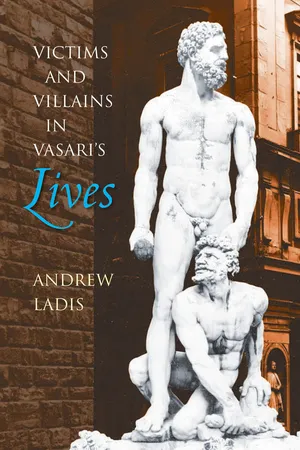 eBook - PDF
- Andrew Ladis(Author)
- 2015(Publication Date)
- The University of North Carolina Press(Publisher)
Francis, saying that the sculptor was born near the cleft in the mountain of La Vernia, where Francis had received the stigmata, the very heaven-sent signs that were to identify him as alter Christus , another Christ, as indeed Michelangelo was to be in Vasari’s story. The moral dimension of Michelangelo’s mission is, in fact, reflected by his Christlike being: The Creator, Vasari says, “was pleased, in addition, to endow” Michelangelo “with the true moral philosophy and with the ornament of sweet poesy, to the end that the world might choose him and admire him as its highest exem-plar in the life, works, saintliness of character, and every action of human creatures, and that he might be acclaimed by us as a being rather divine than human.” The notions of volition and judgment are even suggested by Michelangelo’s name, for it is the angel Michael who will eventually FIGURE 44. Michelangelo, The Creation of Adam , Sistine Ceiling, Vatican. Erich Lessing/Art Resource, NY. 96 In the Shadow of Michelangelo weigh good against evil on the Day of Wrath, even as ultimate judg-ment, namely, the ultimate judgment of the arts, is the essential end of Vasari’s book, the gospel according to Giorgio. Judgment, in fact, frames the Lives as a whole. The frontispiece to the first volume reappears at the end of the second volume of the 1568 edition (fig. 45). In it, a triple trumpet—an instrument that is, like the divinity, three in one—awakens the dead, who emerge from their graves and prepare to render account before three seated allegorical figures, the three arts, whose chosen instrument was Michelangelo. More than a singular prodigy, Michelangelo is an abiding presence from beginning to end of the Lives , in which the dead are brought to life, and in his person Vasari telescopes yet another trinity of ideas: cre-ation, salvation, and judgment, manifested at the moment of his birth. eBook - PDF
Giorgio Vasari
The Man and the Book
- Thomas Sherrer Ross Boase(Author)
- 2023(Publication Date)
- Princeton University Press(Publisher)
X 8 Raphael and Michelangelo "IN a word, for all Vasari commends him to the skies, Michel Angelo was a better Sculptor than Painter: One may say of Raphael and of him, that their characters were opposite, and both great Designers; the one endeavouring to show the Difficulties of the Art, and the other aiming at Easiness; in which, perhaps, there is as much Difficulty." So it seemed to William Aglionby at the end of the seventeenth cen- tury. "Raffaelle," wrote Sir Joshua Reynolds in his fifth discourse, "had more taste and fancy, Michelangelo more genius and imagination." Every period of art criticism uses its terms with different inflections of meaning; here are echoes of the Vasarian problem of assessing these two great figure's: the dark-eyed, languorous young man, who looks out so romantically from the much re-painted Uffizi self-portrait' [150], and the rugged, tortured face, so often rendered by his devoted followers, of Buonarroti [151]. The brilliant, attractive youth, who charmed everyone with his graziata affabilitd, was in vivid contrast with the withdrawn but pungent "divine old man." It was not only in his art that he triumphed, but also in his behavior ("dall'arte e dai cos- tumi insieme"). Giorgio well understood the prestige Raphael had given to the artificers of design; compared with him many of his prede- cessors seemed uncouth and unbalanced. He stands forth in a new status, the possessor of such rare gifts that he seemed a mortal god. Vasari knew that his own deep prejudice made him critical and a little jealous of Raphael's fame. The revisions in the second edition include minor stylistic changes, a nicety which elsewhere he rarely troubled to carry out. It shows how closely he pondered over this par- ticular Vita, which itself is only a part of what he wrote about "the miraculous Raffaello Sanzio da Urbino," a name that recurs pervasively throughout the whole work.
Index pages curate the most relevant extracts from our library of academic textbooks. They’ve been created using an in-house natural language model (NLM), each adding context and meaning to key research topics.

