History

Leonardo Da Vinci
Leonardo da Vinci was a renowned Italian polymath of the Renaissance era, known for his expertise in various fields including painting, science, engineering, and anatomy. He is celebrated for iconic works such as the Mona Lisa and The Last Supper, as well as his innovative designs and scientific observations. Da Vinci's legacy continues to inspire and influence art, science, and innovation.
Written by Perlego with AI-assistance
Related key terms
1 of 5

10 Key excerpts on "Leonardo Da Vinci"
 No longer available |Learn more
- (Author)
- 2014(Publication Date)
- Learning Press(Publisher)
________________________ WORLD TECHNOLOGIES ________________________ Chapter- 7 Leonardo Da Vinci (Famous Artist and Mathematician) Leonardo Da Vinci Self-portrait in red chalk, circa 1512 to 1515. ________________________ WORLD TECHNOLOGIES ________________________ Royal Library of Turin Birth name Leonardo di Ser Piero Born April 15, 1452 Vinci, in the present day Province of Florence, Italy Died May 2, 1519 (aged 67) Amboise, Touraine (in present-day Indre-et-Loire, France) Nationality Italian Field Many and diverse fields of arts and sciences Movement High Renaissance Works Mona Lisa , The Last Supper , The Vitruvian Man Leonardo di ser Piero da Vinci (April 15, 1452 – May 2, 1519) was an Italian polymath: painter, sculptor, architect, musician, scientist, mathematician, engineer, inventor, anatomist, geologist, cartographer, botanist and writer. Leonardo has often been described as the archetype of the Renaissance man, a man whose unquenchable curiosity was equaled only by his powers of invention. He is widely considered to be one of the greatest painters of all time and perhaps the most diversely talented person ever to have lived. According to art historian Helen Gardner, the scope and depth of his interests were without precedent and his mind and personality seem to us superhuman, the man himself mysterious and remote. Marco Rosci points out, however, that while there is much speculation about Leonardo, his vision of the world is essentially logical rather than mysterious, and that the empirical methods he employed were unusual for his time. Born the illegitimate son of a notary, Piero da Vinci, and a peasant woman, Caterina, at Vinci in the region of Florence, Leonardo was educated in the studio of the renowned Florentine painter, Verrocchio. Much of his earlier working life was spent in the service of Ludovico il Moro in Milan. He later worked in Rome, Bologna and Venice and spent his last years in France, at the home awarded him by Francis I. eBook - PDF
- D. Petsch(Author)
- 2015(Publication Date)
- De Gruyter Mouton(Publisher)
126 THE YEAR 1500 2. The Aesthetics of Leonardo Da Vinci 1. THE WRITINGS OF LEONARDO. Leonardo Da Vinci (1452-1519; Dl. 11), scholar, engineer, inventor, writer and theorist of art, was one of those who initiated the classical era of the Renaissance. His akme falls in fact within the 15th century, but towards its very end. He was born in Tuscany, but lived there (in Florence) only until 1482 and then between 1499 and 1506; in the years 1482-1499 and 1507-1513, he was at the court of the Sforzas in Milan; on the invitation of Francis I he went to France in 1516 and spent his last years there. An unquestionable phenomenon of many-sided intellect, unequalled in many different spheres, Leonardo always combined art and science, giving more attention to art in his earlier years and to science in the latter part of his career. His most well-known paintings were produced in the years around 1500: The Last Supper dates from 1495-1497, Mona Lisa from around 1503. Above all, he was a painter, but his architectural projects have been preserved; it is also known that he sculptured. Rare natural gifts, favourable conditions of work, and the recognition which surrounded him did not ensure him a completely smooth life and in fact his later years were marked by frustration: literary works that were unfinished, ideas that were unrealized, artistic works left incomplete. The influence of his art and ideas was minimal for a long time; the history and theory of art followed other paths. His theory of art was unpublished during his lifetime, and there was really nothing to publish: it was all in the form of loose notes and aphorisms, with remarks on art scattered among other kinds of reflections on quite unconnected subjects. The Treatise on Painting, the main source for our knowledge of his artistic views, is not his own composition, but a compilation made by pupils. eBook - ePub
- Klaus H. Carl, Joseph Manca, Megan McShane(Authors)
- 2016(Publication Date)
- Parkstone International(Publisher)
s extraordinary perception of dramatic effect. The Saviour has just uttered the fateful words: “One of you shall betray me,“ with sublime resignation. In a moment, as by an electric shock, he has excited the most diverse emotions among the disciples, according to the character of each. Sadly, Leonardo painted in oil and tempera on a dry wall, such a defective process that three-quarters of the work may be said to have been destroyed by the middle of the sixteenth century. The skill and the knowledge necessary in order not to destroy their balance, to vary the lines without detracting from their harmony, and finally to connect the various groups, were so tremendous that neither reasoning nor calculation could have solved a problem so intricate; but for a sort of divine inspiration, the most gifted artist would have failed.Leonardo Da Vinci (1452 VINCI – 1519 LE CLOS-LUCÉ) Leonardo ’ s early life was spent in Florence, his maturity in Milan, and the last three years of his life in France. Leonardo ’s teacher was Verrocchio. First he was a goldsmith, then a painter and sculptor: as a painter, representative of the very scientific school of draughtsmanship; more famous as a sculptor, being the creator of the Colleoni statue at Venice, Leonardo was a man of striking physical attractiveness, great charm of manner and conversation, and mental accomplishment. He was well grounded in the sciences and mathematics of the day, as well as a gifted musician. His skill in draughtsmanship was extraordinary; shown by his numerous drawings as well as by his comparatively few paintings. His skill of hand is at the service of most minute observation and analytical research into the character and structure of form.Leonardo is the first in date of the great men who had the desire to create in a picture a kind of mystic unity brought about by the fusion of matter and spirit. Now that the Primitives had concluded their experiments, ceaselessly pursued during two centuries, by the conquest of the methods of painting, he was able to pronounce the words which served as a password to all later artists worthy of the name: painting is a spiritual thing, eBook - ePub
Lives of the Most Eminent Painters Sculptors and Architects, Vol. 04 (of 10)
Filippino Lippi to Domenico Puligo
- Giorgio Vasari(Author)
- 2009(Publication Date)
- Perlego(Publisher)
But the fact that they have to grapple more with famine than with fame, keeps our hapless intellects submerged, and, to the shame and disgrace of those who could raise them up but give no thought to it, prevents them from becoming known. And let this be enough to have said on this subject; for it is now time to return to the Lives, and to treat in detail of all those who have executed famous works in this third manner, the creator of which was Leonardo Da Vinci, with whom we will now begin. Leonardo Da Vinci LIFE OF Leonardo Da Vinci [10] PAINTER AND SCULPTOR OF FLORENCE The greatest gifts are often seen, in the course of nature, rained by celestial influences on human creatures; and sometimes, in supernatural fashion, beauty, grace, and talent are united beyond measure in one single person, in a manner that to whatever such an one turns his attention, his every action is so divine, that, surpassing all other men, it makes itself clearly known as a thing bestowed by God (as it is), and not acquired by human art. This was seen by all mankind in Leonardo Da Vinci, in whom, besides a beauty of body never sufficiently extolled, there was an infinite grace in all his actions; and so great was his genius, and such its growth, that to whatever difficulties he turned his mind, he solved them with ease. In him was great bodily strength, joined to dexterity, with a spirit and courage ever royal and magnanimous; and the fame of his name so increased, that not only in his lifetime was he held in esteem, but his reputation became even greater among posterity after his death. Truly marvellous and celestial was Leonardo, the son of Ser Piero da Vinci; and in learning and in the rudiments of letters he would have made great proficience, if he had not been so variable and unstable, for he set himself to learn many things, and then, after having begun them, abandoned them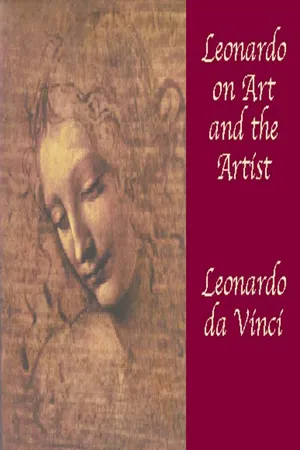 eBook - ePub
- Leonardo da Vinci(Author)
- 2012(Publication Date)
- Dover Publications(Publisher)
Three Biographies of Leonardo
Vasari’s Life of Leonardo Da Vinci is one of that famous Florentine historian’s finest biographies. First published in 1550 (the second edition of 1568 has important corrections and variations), it has by now achieved a position of authority and contrasts favorably with the innumerable romanticized biographies Leonardo’s personality inspired during the last one hundred years. Nonetheless, it is worthwhile to consider two shorter texts in conjunction with it. One was written about 1527 by the humanist Paolo Giovio (1483-1552).The other is included in the lives of illustrious men compiled by the so-called Anonimo Gaddiano, an unidentified Tuscan who, despite some errors and a particularly confused chronology, does supply valuable additions to Leonardo’s oeuvre. These three works, at times inexact and even contradictory, constitute the early record of the artist and as such it is well to keep them in mind.THE LIFE OF Leonardo Da Vinci BY PAOLO GIOVIO *
Leonardo, born in the little Tuscan village of Vinci, added greatly to the glory of the art of painting for he established that this art could only be practiced successfully by those conversant with the sciences and the higher disciplines, which he considered its indispensable aids. He placed modeling before brush work as the order to follow in the development of a painting. According to him, nothing is of greater importance than the rules of optics for they permit him to distribute light and to utilize the laws of shade with great care down to the smallest detail. Furthermore, he learned to dissect the corpses of criminals in the schools of medicine, despite the inhuman and disgusting nature of this work, in order to paint the bending and stretching of the different members according to the action of the muscles and the natural articulation of the joints. That is why, with admirable care, he recorded the shapes of all the elements down to the smallest vein and the insides of the bones on metal so that by means of prints the product of many years’ work should become known through innumerable copies for the benefit of art. eBook - PDF
Renaissance
Studies of Art and Poetry
- (Author)
- 2010(Publication Date)
- The Floating Press(Publisher)
elements of Leonardo's genius. The legend, corrected and enlarged by its critics, may now and then intervene to support the results of this analysis. His life has three divisions—thirty years at Florence, nearly twenty years at Milan, then nineteen years of wandering, till he sinks to rest under the protection of Francis the First at the Chateau de Clou. The dishonour of illegitimacy hangs over his birth. Piero Antonio, his father, was of a noble Florentine house, of Vinci in the Val d'Arno, and Leonardo, brought up delicately among the true children of that house, was the love-child of his youth, with the keen, puissant nature such children often have. We see him in his youth fascinating all men by his beauty, improvising music and songs, buying the caged birds and setting them free, as he walked the streets of Florence, fond of odd bright dresses and spirited horses. From his earliest years he designed many objects, and constructed models in relief, of which Vasari mentions some of women smiling. His father, pondering over this promise in the child, took him to the workshop of Andrea del Verrocchio, then the most famous artist in Florence. Beautiful objects lay about there—reliquaries, pyxes, silver images for the pope's chapel at Rome, strange fancy-work of the middle age, keeping odd company with fragments of antiquity, then but lately discovered. Another student Leonardo may have seen there—a boy into whose soul the level light and aerial illusions of Italian sunsets had passed, in after days famous as Perugino. 99 Verrocchio was an artist of the earlier Florentine type, carver, painter, and worker in metals, in one; designer, not of pictures only, but of all things for sacred or household use, drinking-vessels, ambries, instruments of music, making them all fair to look upon, filling the common ways of life with the reflexion of some far-off brightness; and years of patience had refined his hand till his work was now sought after from distant places. eBook - PDF
Art and Scientific Thought
Historical Studies Towards a Modern Revision of Their Antagonism
- Martin Johnson(Author)
- 2019(Publication Date)
- Columbia University Press(Publisher)
Leonardo's Scientific Mind from observation. In this, apart from any technical skill wherein his pre-eminence is expounded to us by the art critics, lies his distinction from the contemporaries in Florence and Milan and elsewhere. It is therefore in this sense that one of his greatest artistic individualities is due to the habit developed in his researches. This habit arose from being not only a scientist among artists but the constantly and persistently investigating scientist; for of course he was not the only painter in fifteenth-century Italy with more or less scientific leanings. The anatomy of the Pollaiuoli and Luca Signorelli, the zoology of Pisanello, and the reasoned naturalism and balance in Verrocchio, differ in intensity and depth rather than in essence from the work of Leonardo, while perspective geometry was studied widely among contemporary artists, such as Uccello and Piero della Francesca. But since I have enumerated some of the subjects of his investigations, and recollect Berenson's analysis of his medium of expression, quoted in an earlier chapter, one may recognise that in no one but Leonardo is found this habit of using a draughtsman's technique as a constant recording device over so wide a range of his experience. In science even more than in art it might be said that he accepted technique from teachers but utilised it in a spirit which went beyond them in its universality of application and modernity of intellectual freedom. But in science he had fewer disciples than in art. Artistic technique proved easier to communicate, or his generation readier to desire the communication, than in the case of scientific technique. Compared with the considerable array of Milanese painters whose best work is an imitation of his style if not of his spirit, the scientific world took little notice of him after his death until modern times, when the discovery of his anticipations of later work became startling. eBook - ePub
Italian Renaissance Art
Understanding its Meaning
- Christiane L. Joost-Gaugier(Author)
- 2012(Publication Date)
- Wiley-Blackwell(Publisher)
fig. 6.5 ). In this work, not only did he borrow from nature, but he condensed and extrapolated from what he borrowed so as to be able to re-create a new kind of nature, one that might not actually exist but be within the realm of possibility. This work was the result of endless studies of movement, atmosphere, smoke, hydraulics, and natural forms; hence its scientific basis. Its aesthetic core depends on the fundamental structure of three figures who are indissolubly related in a unity of form so simple that the spectator sees them all at once, and yet so complex that all the endless vicissitudes of the world of nature which affect their form in its setting are apparent and active at the same time. Though distinct, the spirits of each figure are so interrelated and interlocked that it is impossible to view them separately – despite the fact that in Leonardo’s contemporary world most paintings contained agglomerations of separate figures brought together through the artifice of horizontal side-by-side arrangements. In this painting the figure can no longer be isolated from or attached to its environment; it is now deeply embedded in a world that is fluid and dynamic. Just as it is impossible to view the figures separately from each other, so is it impossible to view the figures separately from the landscape, for they belong in it. The haziness which overlays the whole is full of suggestion and of possibility. Nature is everywhere, it is vast, and it can do anything, including behave in a calm or active way. In this world, the figures are at the same time so natural and so touchable that – ironically – their very perfection makes them remote. With Leonardo, intellectual vision merges with optical vision, both of which are seen in terms of the endless results that light obtains.Figure 6.5 Leonardo Da Vinci, Madonna and Child with Saint Anne , Paris, Louvre.(Photo credit: Réunion des Musées Nationaux/Art Resource, NY.)Despite or perhaps because of the tremendous amount of bad writings about it, the portrait of the Mona Lisa (fig. 6.6 ), painted in about 1505, remains the most well known of his paintings. The picture we see today has been cut on all sides (because it was cut out of its original frame by a vandal in 1911), essentially eliminating the chair in which the figure once sat and the porch that once disciplined her space. Further, it is buried under centuries of yellow varnish (applied to paintings in recent centuries to make them look old and romantic). Despite these handicaps, we can imagine the true picture – seeing the figure slightly turned, with her dramatic orange sleeves through a framed porch opening, set against a mountainous landscape that fades to a smoky blueness in the distance, a sky that is grey, and white, and hazy.3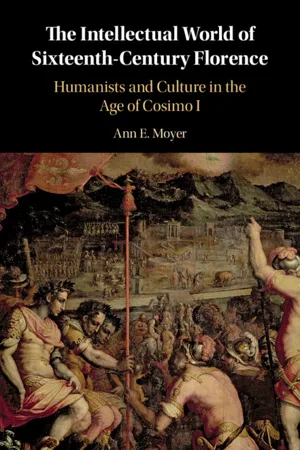 eBook - PDF
The Intellectual World of Sixteenth-Century Florence
Humanists and Culture in the Age of Cosimo I
- Ann E. Moyer(Author)
- 2020(Publication Date)
- Cambridge University Press(Publisher)
Commissions for major artistic projects had come increasingly to include allegories, historical or classical references, or sets of symbols and programs sufficiently complex that humanists were often called in as consultants. The social distinctions did not disappear, but certainly became more blurry by the sixteenth century. Alberti, a man of learning from a major family, had not only written books on painting and architecture but also designed buildings; so did some sixteenth-century men of let- ters, among them Cosimo Bartoli. A number of sixteenth-century artists came from well-established families and were related to men of letters. Fra Giovann’Angolo Montorsoli, a key figure in the founding of the Accademia del Disegno, was the nephew of Giovanni Norchiati. Michelangelo took pride in his noble ancestry and distant kinship with the Medici. Mastery of perspective and of human anatomy called for a level of learning among artists once reserved for those who studied at universities. Leonardo Da Vinci, himself the son of a notary, as well as other artists, had attended and undertaken anatomical dissections, and it had become a more gen- eral practice and expectation. Some practicing artists acquired both skill and reputations in letters, particularly as vernacular poets. Several joined the Accademia Fiorentina. Michelangelo was sufficiently esteemed as a poet that Varchi lectured there on one of his poems in 1547. His literary skill was also celebrated at his death in 1564. The artists who designed 236 Writing about the Arts his catafalque included personifications not only the three visual arts of painting, sculpture, and architecture, but also poetry.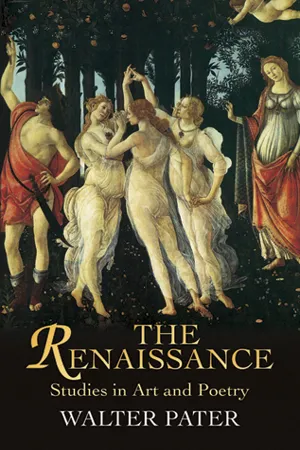 eBook - ePub
The Renaissance
Studies in Art and Poetry
- Walter Pater(Author)
- 2013(Publication Date)
- Dover Publications(Publisher)
Leonardo Da Vinci [Homo Minister et Interpres Naturæ] I N Vasari’s life of Leonardo Da Vinci as we now read it there are some variations from the first edition. There, the painter who has fixed the outward type of Christ for succeeding centuries was a bold speculator, holding lightly by other men’s beliefs, setting philosophy above Christianity. Words of his, trenchant enough to justify this impression, are not recorded, and would have been out of keeping with a genius of which one characteristic is the tendency to lose itself in a refined and graceful mystery. The suspicion was but the time-honoured mode in which the world stamps its appreciation of one who has thoughts for himself alone, his high indifference, his intolerance of the common forms of things; and in the second edition the image was changed into something fainter and more conventional. But it is still by a certain mystery in his work, and something enigmatical beyond the usual measure of great men, that he fascinates, or perhaps half repels. His life is one of sudden revolts, with intervals in which he works not at all, or apart from the main scope of his work. By a strange fortune the pictures on which his more popular fame rested disappeared early from the world, like the Battle of the Standard; or are mixed obscurely with the product of meaner hands, like the Last Supper. His type of beauty is so exotic that it fascinates a larger number than it delights, and seems more than that of any other artist to reflect ideas and views and some scheme of the world within; so that he seemed to his contemporaries to be the possessor of some unsanctified and sacred wisdom; as to Michelet and others to have anticipated modern ideas
Index pages curate the most relevant extracts from our library of academic textbooks. They’ve been created using an in-house natural language model (NLM), each adding context and meaning to key research topics.

