Languages & Linguistics

Typographical Features
Typographical features refer to the visual aspects of written language, including font styles, sizes, and spacing. These features play a crucial role in conveying meaning, emphasis, and tone in written communication. Examples of typographical features include bold, italics, underlining, and different font families.
Written by Perlego with AI-assistance
Related key terms
1 of 5

6 Key excerpts on "Typographical Features"
 eBook - PDF
Advanced Typography
From Knowledge to Mastery
- Richard Hunt(Author)
- 2020(Publication Date)
- Bloomsbury Visual Arts(Publisher)
Whether it is a few words on a billboard or advertisement, or a hundred thousand words in a novel, if typogra- phy does not communicated language it is simply form. Emphatic The representation of language in type has none of the prosodic elements of speech. It may have it in handwriting, but the nature of type is that all characters of the same typeface are identical. Emphasis must be done visually through choice of typeface, size, or other relationship. Affective The affective aspect of typography is the degree to which it commu- nicates and evokes emotion. While emphasis, beside ordering information in terms of hierarchy, is analogous to the sound of speech, affect relates to the underlying emotions that are interpreted by the listener, and so is less in the control of the author and designer. Nevertheless, there are intrinsic and culturally agreed upon signifiers of emotion that can be represented typographically. TYPES OF TYPO GRAPHIC COMMU NICATION The linguistic, emphatic, and affective dimensions of typography are intertwined. However, it is useful, in the interests of analysis, to tease them apart when making typographic decisions when doing communication design. LINGUISTIC Typography and letterforms have the original and prin- cipal purpose of expressing language. Whether it is a few words on a billboard or advertisement, or a hundred thousand words in a novel, if typography does not communicated language it is simply form. EMPHATIC The representation of language in type has none of the prosodic elements of speech. It may have it in handwriting, but the nature of type is that all characters of the same typeface are identical. Emphasis must be done visually through choice of typeface, size, or other relationship. AFFECTIVE The affective aspect of typography is the degree to which it communicates and evokes emotion. eBook - PDF
Layout Workbook: Revised and Updated
A real-world guide to building pages in graphic design
- Dennis Puhalla, Kristin Cullen(Authors)
- 2018(Publication Date)
- Rockport Publishers(Publisher)
shaping language Typography is visible language. Representing human thoughts, it fosters exchange and preserves intellect through sight, speech, and sound. It is the foundation of visual communication. Typography delivers an array of information from insignificant memos to life-sustaining facts that is essential to daily function and understanding. It is beautiful and ugly, engaging and irritating, meaningful and trivial. Indelibly linked to everyday experience, it is ubiquitous. Typography enlivens communication. It is a voice that resonates on the surface of the page, setting the tone of the design. TYPOGRAPHY 95 96 Typography unifies the design through its complementary and contrasting juxtaposition with all the visual elements. The designer composes type to invite the viewer into—and cultivate their relationship with—the design. A decisive, well-planned system encourages readability and comprehension. Type is the leading factor (the conductor of the orchestra) that controls the activity of the page (the symphony) and enables sequential flow. Nurturing order and structural harmony, typography aesthetically invigorates text with meaning. It is the framework for the exchange of ideas. Designing with type is an artful, detail-oriented activity that demands competence and patience. Nothing can be over-looked—from the overall composition to all of its subtleties. Whether type exists as letters, words, lines, and paragraphs, or image, texture, and graphic form, typographic expression is unlimited. Any text, in any form and environment, can be made meaningful through intelligent application. Working with typography is a delicate balance of understanding and intuition, conformity and rebellion. The designer is limited only by his or her imagination. | no.parking | The cover and title page of di ( e ) verse , a book of poetry, presents a subtle shift in the baseline that drops the ‘(e)’ from alignment with the rest of the title. eBook - PDF
Building Science Graphics
An Illustrated Guide to Communicating Science through Diagrams and Visualizations
- Jen Christiansen(Author)
- 2022(Publication Date)
- A K Peters/CRC Press(Publisher)
Guidelines lead to consistency. Typography—like color—is a variable that can be efficiently standardized and imposed across content types. If you have a style guide to refer to, your primary decisions with regards to typography are likely already in-hand, like what fonts to install and what size to use. But that doesn’t mean you don’t need to think about it further. How these elements might work within specific graphics isn’t always prescribed, and should really be considered on a case-by-case basis. Legibility and Readability Above all else, text in a graphic should be clear enough to read. Style, size, color, position, and orientation should all be considered with this in mind. Two measures come into play in this regard: legibility and 2 Michelle A. Borkin et al., “Beyond Memorability: Visualization Recognition and Recall,” IEEE Transactions on Visualization and Computer Graphics, Vol. 22 (January 2016) 3 Amanda Cox, “Shaping Data for News,” Eyeo Festival presentation (2011) https://vimeo. com/29391942 115 CHAPTER 9 Typography A CLOSER LOOK Why do I use the word “typeface” more often than “font” in this chapter? Strictly speaking, “typeface” refers to the letterform design.”Font” is the delivery mechanism, such as a metal cast for printing presses, or the software package used to install a typeface on your computer. Here’s a potentially useful analogy: Typeface is to a note as a font is to an email or paper greeting card. The same note (typeface) can be delivered in a few different ways (font). With apologies to purists, I often get sloppy and use them interchangeably. Typography Jargon, Translated Intrinsic Characteristics These variables are inherent to a given font. T racking refers to universally adjusting the letter spacing across a group of letters. Extrinsic Characteristics These variables can be modified, and they relate to decisions you make when using a particular typeface in a graphic. eBook - PDF
Typography, Referenced
A Comprehensive Visual Guide to the Language, History, and Practice of Typography
- Jason Tselentis, Allan Haley, Richard Poulin, Tony Seddon, Gerry Leonidas, Ina Saltz, Kathryn Henderson, Tyler Alterman(Authors)
- 2012(Publication Date)
- Rockport Publishers(Publisher)
320 Typography, Referenced 320 Typography, Referenced M ost professions develop their own terminology to facilitate communication of thoughts and ideas, and typography is no exception. It is important for all design practitioners to be well-versed in the language of type so they can communicate clearly with one another, especially with others who work with and design type or lettering. Designers also often need to explain their creative choices to those who do not have an expertise in type, and being able to champion and explain their design choices is an important part of that process. Fluency in the language of typography indicates a knowledge of the field, an ability to educate clients, and a capacity to help others appreciate the work of a type designer. For those reasons, here’s a glossary of common typogra-phy terms and language. Typography Terminology and Language By Tony Seddon, with Ina Saltz 321 Typography Terminology and Language A Accent See Diacritic Adaptable fractions Fractions made up of three separate characters, where the height of the diagonal equals the height of the numerals on either side. These are also known as built fractions. Some fonts contain adaptable fractions as glyphs, but these also can be created using a font’s existing characters. Alignment The positioning of text within a text block, where the type lines up along an invisible axis, normally horizontal or vertical. Alignment can be flush left (all lines start at the same left-hand vertical axis, also referred to as left-justified or ragged right), flush right (all lines end at the same right-hand vertical axis, also called right-justified or ragged left), justified (aligned on left and right sides of the text block), centered (all lines have the same central vertical axis no matter their length) or asymmetrical (226) (free-form). Alley See Column gutter Alphanumeric A set of alphabetic characters or a run of text that consists of or uses numbers and letters. eBook - PDF
Punctuation as a Means of Medium-Dependent Presentation Structure in English
Exploring the Guide Functions of Punctuation
- Sebastian Patt(Author)
- 2013(Publication Date)
- Narr Francke Attempto(Publisher)
Due to the traditionally preferential treatment of vocal and kinesic non-verbal properties, this classification has been hardly considered with regard to the description of graphic properties, cf. sec. 2.3.2 above. One of the few exceptions is Pickering (1995). He (ib.: 439) attempts to fill the theoretical void and regards any “[…] intentional modulation of the writing system in co-ordination with the meaning and message of a text” as paralinguistic non-verbal information. More specifically, and going beyond the field of punctu-ation, he (ib.) writes: Typeface is one part of a paralinguistic device, or typographically expressed semiotic subsystem of writing, a system which makes its own contribution to textual meaning. The system, in fact, includes not only the points (stop, comma etc.), but also special fonts, special typefaces, as well as type size, density, tone, colour and arrangement on the page. It has been surprisingly little studied in linguistics, yet it not only has an important bearing on the relation between the spoken and written language, but also upon organization in text. Pickering clearly adduces that specific qualities of the written expression system, which come along with the graphic patterns of verbal messages, have the same status as have features like voice qualities, loudness and tempo in speech. Such a reappraisal of the applicability of the concept of paralinguistics, ex-ceeding the fields of spoken and body language, complies fully with the the-oretical framework within which the present study is conducted. Besides, a widened scope of ‘paralanguage’ follows through an earlier, yet sparsely re-ceived approach by Bolinger/Sears (1981 [1968]) to get a grip on language structure and its material embodiment; they distinguish terminologically between ‘paralinguistics’ (covering spoken and kinesic features) and ‘para-graphology’ (referring to written nonverbal properties, including punctua-tion), cf.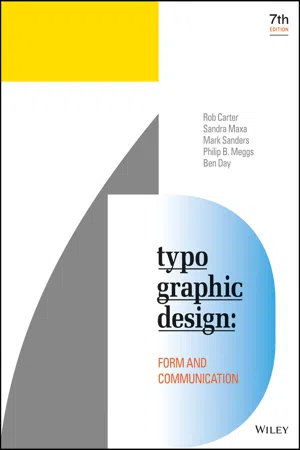 eBook - PDF
Typographic Design
Form and Communication
- Rob Carter, Sandra Maxa, Mark Sanders, Philip B. Meggs, Ben Day(Authors)
- 2017(Publication Date)
- Wiley(Publisher)
And the whole duty of beautiful typography is Punctuation Visual 5-54 In these typographic exercises, rules and space intervals are used as visual punctuation. (Designers: Bryan Leister and Rebecca Lantz) 5-55 In this poster, the system of shapes and colors provides visual punctuation and suggests the idea that multiple solutions can spring from the same parts. (Designer: Erik Brandt) SYNTAX AND COMMUNICATION 117 5-56 This symbol demonstrates visual accentuation. Striking visual contrast is achieved through the opposition of straight and curved edges and shapes. (Designer: Nick Schrenk) 5-58 In this signage for NASA, viewing context determines the visual hierarchy. For example, the size and position of the arrow in the interior directional signage are quite different from the size and position of the roadside signage. (Designer: Danne and Blackburn) 5-57 A mark’s unity is dramatically enhanced as typographic joinery becomes more refined. (Designer: Paul Rand) Typographic joinery is the visual linking and connecting of elements in a typographic composition through structural relationships and form repetition. The assembly of separate typographic elements to form a unified sign is seen in the logotype for ABC (Fig. 5-57 ). The pronounced geometry and emphasis given to the circular forms joins the forms using repetition. The shape of the circle is common to every part of this mark. The three letterforms and their circular container are blended to become one sign. Some typographic designs are seen from different distances (far, middle, close). The viewer’s perceptions are greatly influenced by shifts in the viewing experience. Attention to visual hierarchy and the perceptual environment is vital in graphic media (signage, posters, and exhibitions) where the viewing experience is in constant flux (Fig. 5-58 ). Typography’s hierarchical order derives from the basic process of pattern-forming found in nature, in verbal and written language, the arts, and computers.
Index pages curate the most relevant extracts from our library of academic textbooks. They’ve been created using an in-house natural language model (NLM), each adding context and meaning to key research topics.

