Law

US Constitutional Law
US Constitutional Law refers to the body of law derived from the United States Constitution, which outlines the structure of the federal government, the rights of individuals, and the relationship between the government and its citizens. It encompasses the interpretation and application of constitutional provisions by the judiciary, as well as the principles and precedents established through landmark court decisions.
Written by Perlego with AI-assistance
Related key terms
1 of 5

12 Key excerpts on "US Constitutional Law"
 eBook - ePub
- John Nockleby, John T. Nockleby, John Nockleby, John T. Nockleby(Authors)
- 2013(Publication Date)
- Routledge(Publisher)
2Constitutional LawKarl M. ManheimProfessor of Law, Loyola Law SchoolIntroduction What is Constitutional Law?The United States has a written Constitution that serves as the highest legal authority in our system of government. The Constitution itself, as interpreted by the Supreme Court of the United States, supersedes all other sources of law—statutes, state law, and even international law. Not all democracies have the benefit of written constitutions. Great Britain, for instance, has a number of distinct instruments (starting with the Magna Charta), as well as decisions from monarchial, executive, legislative, and judicial bodies that form its “constitution.” But we have a single authoritative document, amended from time to time, that serves as the “supreme law of the land.”Upon adoption in 1789, the Constitution of the United States created the present federal government and delegated power to its various parts. As a rule, the federal government has only those powers stated in the Constitution, which is why it is said that we have a government of limited powers. There is another sense in which federal powers are limited. The Bill of Rights, adopted in 1791, took away some of the powers granted just a few years earlier. State governments, on the other hand, do not derive their powers from the U.S. Constitution, but rather from their respective state constitutions. Similarly, the individual rights found in the federal Constitution did not apply to the states until the Fourteenth Amendment was adopted following the Civil War.Constitutional law thus consists both of the powers granted to the federal government and the limits on those powers, plus the limits imposed on state and local governments. When official actions at any level of government and by any branch (legislative, executive, or judicial) conflict with the Constitution, they are said to be unconstitutional and invalid. No longer available |Learn more
- David L Hudson(Author)
- 2010(Publication Date)
- Visible Ink Press(Publisher)
THE U.S. CONSTITUTION
What is the primary source of law in the United States?
The primary source of law is the U.S. Constitution, which serves as the blueprint for the country’s legal system. It is the highest form of law. States also have their own constitutions, which serve as their highest forms of legal documents. If a law does not comport with the Constitution, the law is declared unconstitutional or void.What this means is that other forms of law must comport with the Constitution. In other words, a common legal claim asserted by a party challenging a law is that the law is unconstitutional. This means that the law violates a provision of the Constitution and is unenforceable.What exactly does the U.S. Constitution do?
This most fundamental of all legal documents defines and limits the powers of the federal government. It also separates and defines the powers of this federal government into three branches of government—the legislative, executive, and judicial branches. The Constitution also establishes the baseline between the federal government and various state governments.How is the U.S. Constitution composed?
The U.S. Constitution is composed of seven articles. The first three articles are the longest and arguably the most important. These three articles explain the powers of the three branches of government—legislative, executive, and judicial. Article I of the Constitution outlines the powers of the U.S. Congress. Article II outlines the power of the president—the chief officer of the executive branch. Article III outlines the powers of the judicial branch.The U.S. Constitution is the fundamental document that establishes a balance of power between the branches of the federal government, as well as for indicating what powers are under state or federal control (iStock).Article IV deals with the states and how the laws of one state are treated in other states. It also deals with how to admit a state to the union. Article V describes the amendment process. Article VI—a very short part of the Constitution—contains the Supremacy Clause, which ensures that federal law and the Constitution are the highest law of the land. Article VII consists of a single sentence explaining that it would take nine states to ratify the Constitution. eBook - PDF
Law and Language
Effective Symbols of Community
- Harold J. Berman, John Witte, Jr(Authors)
- 2013(Publication Date)
- Cambridge University Press(Publisher)
15 The fact that the Constitution is written, coupled with the fact that its language is relatively broad, makes it not only possible but also inevitable that those who are called on to interpret it will, in the course of time, give it new meanings. 16 It is characteristic of law in general that it grows by giv- ing new meanings to old words. But this proposition has a special signifi- cance in America, where, for the first time in history, a government was founded on a written constitution directly binding on all citizens, and on all branches of government. The survival of the American Constitution by successive adaptations of its language to new circumstances is central to the particular style of American legal discourse. Faith in the Constitution as the highest law – in the words of Article VI of the Constitution, “the supreme law of the land” – is the founda- tion of the American doctrine that a court must refuse to enforce a statute that violates the Constitution. Such a doctrine seems anomalous to both English and French lawyers: to English because of the belief in Parliamentary supremacy, to French because of the belief in a strict sep- aration of powers (in contrast to the more flexible American concept of “checks and balances”). Since the end of World War II, under American influence, Germany and Italy have adopted the doctrine of judicial review of the constitutionality of legislative acts. But it was first made a lasting feature of constitutional law in the United States during the period from the Revolution to the Civil War.
- Carl J. Franklin(Author)
- 1999(Publication Date)
- Routledge(Publisher)
Why is the Constitution So Important? 5 other sources of ordinary law. In theory the individual constitutions were supreme to other state law, but in practice they rarely were applied in that manner. Over time, the constitutions, and specifically our federal Constitution, took on greater authority when popularly elected conventions wrote them and the people ratified them. From the standpoint of a political mechanism, our Constitution holds three important principles. First, the Constitution establishes the basic principles of our government itself; that is, the Constitution creates a supreme federal government with precisely mandated and separate units of government. As we will see in the coming chapters, without these provisions there is little doubt that the new country would have splintered into at least 13 separate, not-so-powerful countries. Even today, there are those who maintain that without a constitution our country would simply fall apart. Second, the Constitution establishes clear rights for the citizens. The rights, contained mostly in the first eight amendments, are supreme to any law created by Congress or any of the state legislatures. These immutable rights guarantee us, as citizens of a national body, fair treatment no matter where in the country we are. Although application of these principles is not always as consistent as might be expected, it is the Constitution that allows us to correct these mistakes when they do occur. Third, the Constitution provides for us a means of change and evolution. It is true that we have a living constitution in the broadest sense of use. The Constitution itself provides for a means of change through action of the people and through interpretation of the Constitution by the judicial branch of the government. This ability, often seen as a part of the ever-important system of checks and balances, guarantees that we can adapt our Constitution to meet the needs of our society. eBook - PDF
Duelling for Supremacy
International Law vs. National Fundamental Principles
- Fulvio Maria Palombino(Author)
- 2019(Publication Date)
- Cambridge University Press(Publisher)
The federal Constitution ranks highest, followed by federal statutes, and then state law (i.e., sub-national law). Accordingly, the next three sections address conflicts: (1) between international law and federal constitutional law; (2) between interna- tional law and state law; and (3) between international law and federal statutes. 2 the us constitution and international law: a short primer The United States Constitution divides power between one national government and 50 state governments. Consequently, judicial power is divided between one 378 system of federal courts and 50 independent state judiciaries. Although the national government has primary responsibility for the conduct of international relations, state courts in the United States have applied international law for more than two centuries. Originally written in 1787, the US Constitution has been amended several times, but the textual provisions related to international law remain unchanged. The document mentions the law of nations only once. Article I, section 8 grants Congress the power “to define and punish [. . .] offenses against the Law of Nations.” 1 The Constitution does not specify whether courts should apply customary international law (CIL). However, US courts applied CIL even before the Constitution was written and continued to do so after its adoption. 2 In contrast to CIL, the text of the Constitution specifically directs courts to apply treaties. Article II grants the President the power to make treaties “by and with the advice and consent of the Senate.” 3 Article I makes clear that the treaty power is a national power; states may not enter into “any treaty” with a foreign government. 4 Article III grants federal courts jurisdiction over cases “arising under” treaties. 5 Whereas Article III addresses federal courts, the Supremacy Clause in Article VI addresses state courts.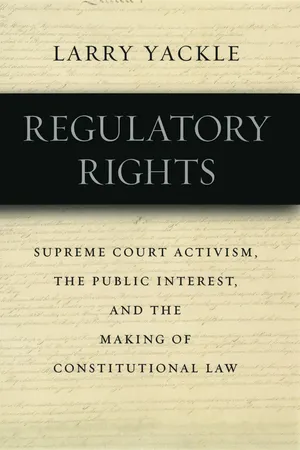 eBook - PDF
Regulatory Rights
Supreme Court Activism, the Public Interest, and the Making of Constitutional Law
- Larry Yackle(Author)
- 2008(Publication Date)
- University of Chicago Press(Publisher)
Constitutional Law Academicians have a way of defusing tension by drawing nice distinc- tions. In this instance , the common strategy is to bow to the popular equation of the document with the Constitution, but then to distinguish the Constitution , in turn , from constitutional law. 8 Only constitutional law is said to bear any genuine operational consequences in the world. That law flows from judicial decisions owing very little , if anything , to the Constitution itself. 9 Nevertheless , and however much exegesis is re- quired to move from the text of the Constitution to judicial decisions about the text , theorists insist that the warp and woof of constitutional law is still traceable to the written document-and must be , given that the document and only the document counts as the Constitution . 10 But this is sophistry and a pernicious brand of sophistry in that it gen- erates misunderstanding and distrust. Ordinary people accustomed to the ordinary use of language expect , naturally enough , that if the docu- ment is the Constitution , it must fairly control any constitutional law the Supreme Court announces . And if it doesn 't, something is amiss . The justices must be dishonest. They must fashion law on their own with- out warrant in the authentic Constitution and perhaps in defiance of it. The charge of duplicity is unwarranted . The Supreme Court do es make up constitutional law. That law is not illegitimate but rather forms the only genuine Constitution we have . The popular obsession with the text of the document conceals this fundamental fact of life . Better to apply more discipline to the exercise , to recognize that the writing typically called the Constitution is not what it's cracked up to be , and to put it in its proper place. The document has enormous cultural significance as a symbol ; its existence helps to perpetuate the United States as a continu- ous political entity.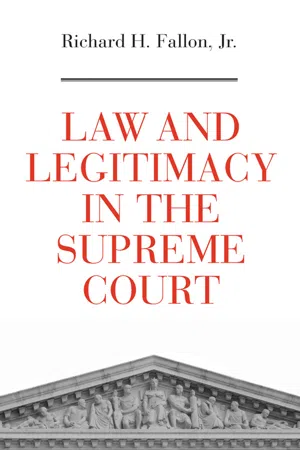 eBook - PDF
- Richard H. Fallon Jr., Richard H. Fallon(Authors)
- 2018(Publication Date)
- Belknap Press(Publisher)
83 4 Law in the Supreme Court Jurisprudential Foundations T his chapter explores the nature and foundations of law in rea-sonably contestable cases in the Supreme Court. Where do the legal norms that apply to the Court come from, and how do they acquire their legitimate authority? These questions apply fully as much to the Constitution as to second-order norms of constitutional interpretation. In addressing this topic, I begin with—but only in order to de-bunk—a picture of law and legitimacy in the Supreme Court that many people find intuitively compelling. According to this model, the Constitution was lawfully adopted and, having been lawfully adopted, applies in the ways in which the Framers understood or ex-pected it to apply, unless and until the American people lawfully amend it. (The amendment process laid out in Article V normally requires votes by two-thirds majorities in both houses of Congress and ratification by three-fourths of the states. 1 Due to the extreme difficulty of this process—under which just thirteen states, poten-tially constituting less than 5 percent of the population, could block an amendment—formal amendment has rarely occurred.) Today, no major scholar may endorse the model of the Constitution as the Framers’ lawful and therefore binding commands in all of the particu-lars in which I shall present it. Nevertheless, decades of experience 84 LAW IN THE SUPREME COURT with students leave me convinced that this way of thinking exerts a continuing grip on many minds. Views that identify legitimate constitutional authority with the dictates of those who wrote and lawfully ratified the Constitution reflect a number of misunderstandings, some hidden in unarticulated premises. But we can start by noticing the shakiness of the intuitive model’s historical assumptions. On that front, it is doubtful that the Constitution actually was adopted lawfully under the law as it stood in 1787 and 1788.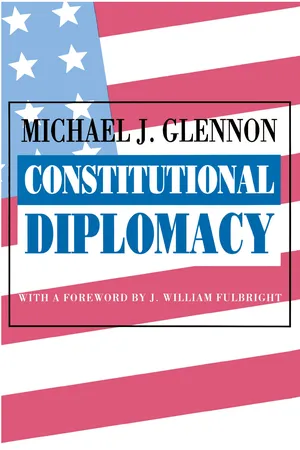 eBook - PDF
- Michael J. Glennon(Author)
- 2020(Publication Date)
- Princeton University Press(Publisher)
It is bound to the faithful execution of these as of all other laws, internal and external, by the nature of its trust and the sanction of its oath. . . . m The Supremacy Clause. The word supreme may appear unqualified, but in the evolved lexicon of American constitutionalists, some supreme laws of the land are more supreme than others. The Constitution is the most supreme law, prevailing over all treaties, federal and state statutes, and principles of federal and state common law. Next come federal statutes and treaties, which are of 125 U.S. Const, art. II, § 3. 126 B. Poore, The Federal and State Constitutions, Colonial Charters and Other Organic Laws of the United States 1335 (2d ed. 1878) ( T h a t it shall be the duty of the governor . . . to take care that the laws are faithfully executed to the best of his a b i l i t y . ) . 127 See id. at 1521, 1528, 1545, 1863, 1871 (setting forth parallel provisions of Pennsylvania and Vermont constitutions). 128 2 Farrand, supra note 121, at 158. 129 Id. at 171. 130 H. Syrett, ed., 15 The Papers of Alexander Hamilton 38 (1961-79). 131 2 Writings of James Madison 107 (G. Hunt ed. 1906). 248 CHAPTER 7 equal status domestically, 132 then federal common law, 133 and finally state stat-utory and common law. 134 This hierarchy is generally accepted today, but in 1789, it was hardly manifest. The supremacy clause itself gives no hint of any hierarchy; even the Constitution is given no primacy. It is not surprising, therefore, that the hierarchical position of international law is somewhat ob-scure. Yet the concept of supreme law of the land traces to the Magna Carta 135 and was familiar to the colonists and the Framers. For example, the colonial charters made English statutory and common law the supreme law of the col-onies. 136 In structuring the Constitution, however, the Framers devoted their attention to the notion of supremacy primarily in the context of federal-state relations.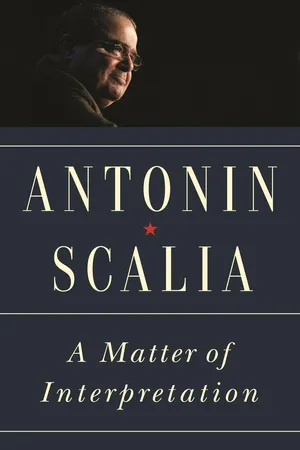 eBook - ePub
A Matter of Interpretation
Federal Courts and the Law - New Edition
- Antonin Scalia, Amy Gutmann(Authors)
- 2018(Publication Date)
- Princeton University Press(Publisher)
Common-Law Courts in a Civil-Law System: The Role of United States Federal Courts in Interpreting the Constitution and LawsANTONIN SCALIATHE FOLLOWING essay attempts to explain the current neglected state of the science of construing legal texts, and offers a few suggestions for improvement. It is addressed not just to lawyers but to all thoughtful Americans who share our national obsession with the law.THE COMMON LAWThe first year of law school makes an enormous impact upon the mind. Many students remark upon the phenomenon. They experience a sort of intellectual rebirth, the acquisition of a whole new mode of perceiving and thinking. Thereafter, even if they do not yet know much law, they do—as the expression goes—“think like a lawyer.”The overwhelming majority of the courses taught in that first year, and surely the ones that have the most profound effect, teach the substance, and the methodology, of the common law—torts, for example; contracts; property; criminal law. American lawyers cut their teeth upon the common law. To understand what an effect that must have, you must appreciate that the common law is not really common law, except insofar as judges can be regarded as common. That is to say, it is not “customary law,” or a reflection of the people’s practices, but is rather law developed by the judges. Perhaps in the very infancy of Anglo-Saxon law it could have been thought that the courts were mere expositors of generally accepted social practices; and certainly, even in the full maturity of the common law, a well-established commercial or social practice could form the basis for a court’s decision. But from an early time—as early as the Year Books, which record English judicial decisions from the end of the thirteenth century to the beginning of the sixteenth—any equivalence between custom and common law had ceased to exist, except in the sense that the doctrine of stare decisis eBook - PDF
The Tea Party
Three Principles
- Elizabeth Price Foley(Author)
- 2012(Publication Date)
- Cambridge University Press(Publisher)
Whatever the case may be, it’s patent that obtaining the direct consent of the people of Europe was viewed as something that 88 U.S. Sovereignty needed to be avoided at all costs, evidence of a deep disdain for democracy on critically important European legal reforms. A. The Role of International Law in U.S. Constitutional Law Could the same thing happening in Europe happen in the United States? Could the United States cede its sovereignty to some pan-American or global sovereign in the same way? To answer these questions, we have to look closely at both international law and the U.S. Constitution. There are several provisions in the U.S. Constitution that relate to international law. In Article I, section 8, Congress is given the power to “define and punish . . . offenses against the law of nations.” The “law of nations” refers to what is loosely called international law today, although at the time, the law of nations was much narrower in scope than modern international law. Specifically, the law of nations related to a code of conduct between nations, in which each sovereign was considered a coequal with other sovereigns, entitled to respect. Sovereigns were bound by a harm principle, or golden rule, by which they couldn’t commit acts of aggression against other sovereigns unless in self-defense. Sovereigns could also enter into contracts with one another – called treaties – in which they agreed to abide by certain rules regarding one another’s citizens, businesses (e.g., commerce, trade), or other external affairs. In addition to this brief recognition of a power to legislate to punish offenses against the law of nations, the Constitu- tion contains two additional important provisions relating to the power to make and enforce treaties. Article II, section 2, 89 eBook - PDF
- Ellen Frankel Paul, Fred D. Miller, Jr, Jeffrey Paul(Authors)
- 2011(Publication Date)
- Cambridge University Press(Publisher)
Once more, the issue for me is not one of democratic right but rather one of wise political design. 47 See Mitchell N. Berman, “Constitutional Decision Rules,” Virginia Law Review 90 (2004): 1; and Kermit Roosevelt, “Constitutional Calcification: How the Law Becomes What the Court Does,” Virginia Law Review 91 (2005): 1649. 48 An issue of great importance, not to my knowledge discussed anywhere in the litera- ture, is how to constrain courts from crafting implementing doctrines that undermine con- stitutional rules with which they disagree. For if courts must resort to moral reasoning in crafting implementing doctrines, and if courts believe the constitutional rules they are implementing offend morality, then they will be prone to craft doctrines that make appli- cation of such rules extremely difficult. For example, they may impose a very high burden of proof on litigants claiming that those constitutional rules have been violated. The lesson here is that constitutional authors would do well to protect their constitutional rules by also authoring implementing doctrines, thereby giving unfriendly courts less room to maneuver. WHAT ARE CONSTITUTIONS? 21 VI. Constitutional Change, Organic or Otherwise Constitutions usually provide for their own amendment. When they are amended, we can describe that as an organic change in the constitu- tion, a change authorized by the constitution itself. Constitutions change in ways other than organic ones. One of the most obvious of these is through decisions by the highest legal authority —in the United States, the U.S. Supreme Court —that misinterpret some con- stitutional provisions. Because law’s function is to settle what we are obligated to do —or so I have claimed —when there is disagreement over the law’s meaning, it is important that the law provide a means of settling that dispute. eBook - ePub
- Jules L. Coleman(Author)
- 2013(Publication Date)
- Routledge(Publisher)
5 which is mercifully short:This Constitution, and the Laws of the United States which shall be made in Pursuance thereof; and all Treaties made, or which shall be made, under the Authority of the United States, shall be the supreme Law of the Land; and the Judges in every State shall be bound thereby, any Thing in the Constitution or Laws of any State to the Contrary notwithstanding.Judge Hand concedes that under this clause "state courts would at times have to decide whether state laws and constitutions, or even a federal statute, were in conflict with the federal constitution" but he adds that "the fact that this jurisdiction was confined to such occasions, and that it was thought necessary specifically to provide such a limited jurisdiction, looks rather against than in favor of a general jurisdiction." 6Are you satisfied, however, to view the supremacy clause in this way, as a grant of jurisdiction to state courts, implying a denial of the power and the duty to all others? This certainly is not its necessary meaning; it may be construed as a mandate to all of officialdom including courts, with a special and emphatic admonition that it binds the judges of the previously independent states. That the latter is the proper reading seems to me persuasive when the other relevant provisions of the Constitution are brought into view.
Index pages curate the most relevant extracts from our library of academic textbooks. They’ve been created using an in-house natural language model (NLM), each adding context and meaning to key research topics.

