Literature

Derrick Bell
Derrick Bell was an American lawyer, professor, and civil rights activist who is known for his contributions to critical race theory. He argued that racism is a permanent feature of American society and that the legal system is inherently biased against people of color. Bell's work has had a significant impact on the study of race and racism in the United States.
Written by Perlego with AI-assistance
Related key terms
1 of 5


3 Key excerpts on "Derrick Bell"
 eBook - PDF
«Covenant Keeper»
Derrick Bells Enduring Education Legacy
- Gloria Ladson-Billings, William Tate(Authors)
- 2016(Publication Date)
In the U.S., the freedom to live, thrive, and flourish is integrally connected to the sociocultural context that fashions the everyday fervor of life. Race stands at the forefront of this context. There is no denying that one must have a critical racial literacy to both understand and engage issues of race and racism as well as aspire to live in accordance with the nation’s highest ideals. Cultivating a critical racial literacy is necessary for all who seek to live humanely and in true community with others. This is not an overstatement, given that the notion of human freedom, as shaped by the contours of U.S. statehood, has proven untenable for peoples of color since the country’s founding. Derrick Bell’s incisive critique of race and its integral, permanent place in U.S. society provides clarity to a concept that is both slippery and elusive. Through his careful reading of the history of political and legal intervention in the U.S., Bell illuminated the function and role of race as a tool utilized to divest Blacks of their rights and even humanity, while simultaneously investing Whites with sociopo- litical, economic, and symbolic power and privilege. This, Bell argued, is not done unintentionally or from ignorance. Rather, this symbiotic relationship is enacted as part of a larger project of Whiteness and anti-Blackness in the name of sacrificing Black life, livelihood, and liberty for White interests. IN PURSUIT OF CRITICAL RACIAL LITERACY | 153 In considering the pervasive hegemonic discourse of race and racism as his- toric and implicated generally in the individual actions of aberrant others, what does Derrick Bell tell us about deciphering and developing a critical understand- ing of race and racism? In an article adapted from the book, Faces at the Bottom of the Well, Bell (1992–1993) theorized the Three Is as a framework to understand the role, function, and lasting significance of race and racism in the U.S.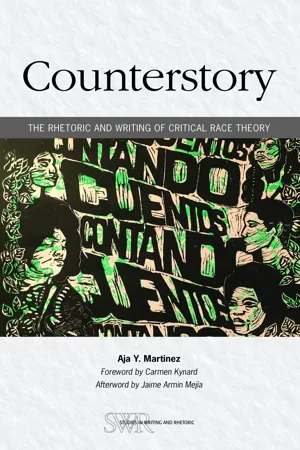 eBook - ePub
Counterstory
The Rhetoric and Writing of Critical Race Theory
- Aja Y. Martinez(Author)
- 2020(Publication Date)
3 Derrick Bell and Counterstory as Allegory/FantasyI am not sure who coined the phrase “critical race theory” to describe this form of writing, and I have received more credit than I deserve for the movement's origins. I rather think that this writing is the response to a need for expressing views that cannot be communicated effectively through existing techniques. In my case, I prefer using stories as a means of communicating views to those who hold very different views on the emotionally charged subject of race. People enjoy stories and will often suspend their beliefs, listen to the story, and then compare their views, not with mine, but with those expressed in the story.— Derrick BellBORN IN 1930, DERRICK ALBERT BELL JR. was raised in a black Pittsburgh neighborhood known as “the Hill.” Bell credits his parents for instilling in him a steadfast work ethic and the will to push against discriminatory and prejudiced authority, and for providing a strategy to navigate a “white man's world … of racial discrimination [in which] black people had to be twice as good to get half as much” (Delgado and Stefancic, introduction to The Derrick Bell Reader 3). Much of the foundation and many of the major events associated with CRT and counterstory are attributable to Bell, so his biography is as much a history of the development of CRT's tenets as it is a demonstration of his career in and of itself.Graduating from the University of Pittsburgh Law School in 1957, Bell was the only black student in a class of 120. Embarking on a career defined by professional acts of protest, defiance, and refusal concerning issues of institutional racism (an inspiration and blueprint for CRT as a movement), Bell gained his first professional appointment in 1959 in the Justice Department's Civil Rights Division. Considering Bell's participation in the NAACP a conflict of interest, his superiors demanded he cede membership. Bell refused. Bell was as a result moved off race cases, assigned mundane tasks, and soon resigned (Goldberg 56; Delgado and Stefancic 4). This would not be the last time Bell gave up a prized position for principle. Hired subsequently by Thurgood Marshall, Bell worked from 1960 to 1966 for the NAACP Legal Defense Fund. During this time as a civil rights lawyer, Bell spent a night in a Jackson, Mississippi, jail for refusing to leave a train station's “whites-only” waiting room (Goldberg 56; Delgado and Stefancic 5). In 1969 Bell became Harvard Law School's first tenured African American faculty member, but in 1981 he left over the lack of any black women on the faculty. Bell then became dean of the University of Oregon Law School, but here as well resigned in protest four years later, when the school refused to support his decision to hire an Asian American woman.1 eBook - ePub
Does the U.S. Need a Truth and Reconciliation Commission?
A Philosophical Investigation
- Olúfẹ́mi Táíwò(Author)
- 2023(Publication Date)
- Routledge(Publisher)
In our own time, the path that Du Bois charted, Derrick Bell cultivated and expanded in ever so creative and insightful ways. Bell shared Du Bois’s insistence that to understand the situation of Americans of African descent in the American homeland and worldview, we must be good students of American history. He, too, was in no doubt that black people could not be accused of authoring the racist texts that define America’s narrative. What is more, as victims of this narrative, it is completely unacceptable to look in the direction of African Americans for its eradication. Certainly, having been defined by their difference and continually forced to make peace with and live that difference in their daily lives, regardless of their personal and collective preferences, it is not unexpected that there would be African Americans who embrace this dubious idea of difference and make it a constitutive part of their identity. But the preponderance of the historical evidence points in the direction of African Americans just wanting to be simply human and American, at liberty like other Americans to manifest their Americanness however they want.Bell is a particularly pertinent witness for our case. Although my recommendations and the optimism that is at the base of this work could not be more different from Bell’s skepticism respecting the eradicability of racism from this country and the attainability of full citizenship for black Americans, his diagnosis could not have been more apt. I would not know now whether he ever felt that the TRC model might offer a way out of the conundrum he described so well and strove while he lived to explain to his fellow Americans and the world at large. And the only time that I was privileged to meet him in person and have the opportunity of asking him questions at close quarters, my thinking about the present work had not even begun to coalesce in a way that might have enabled me to poll him on the TRC model as an appropriate or even relevant one for the problem of racism in the United States.A stalwart of the civil rights struggles of our time, an erudite legal scholar, an original thinker of no mean repute—he was a founder of what we now know as Critical Race Theory in jurisprudence—few surpass him when it comes to a keen awareness of the possibilities and limits of the law and its applications, Derrick Bell did not come to his pessimism about law lightly. He was another thinker who, from the vantage point of a lawyer, legal scholar and jurist, was acutely aware of the double-edgedness of law and why law could not be the effective weapon to end black America’s exclusion from full citizenship. Nor did he ever allow his pessimism to disable him from persistently struggling to secure a better place in the world for all
Index pages curate the most relevant extracts from our library of academic textbooks. They’ve been created using an in-house natural language model (NLM), each adding context and meaning to key research topics.

