Literature

Historical Fiction
Historical fiction is a genre of literature that blends fictional elements with real historical events, settings, or figures. It allows authors to explore and reimagine the past while providing readers with a sense of historical context and insight into different time periods. Through compelling storytelling, historical fiction often sheds light on the human experience within specific historical contexts.
Written by Perlego with AI-assistance
Related key terms
1 of 5
10 Key excerpts on "Historical Fiction"
 eBook - PDF
- Lee Galda, , Lauren Liang, Bernice Cullinan, Lee Galda, Lauren Liang, Bernice Cullinan(Authors)
- 2016(Publication Date)
- Cengage Learning EMEA(Publisher)
Students such as those reading Revolution are lucky; through Historical Fiction they can connect with history in a way no textbook can offer them. 285 Copyright 2017 Cengage Learning. All Rights Reserved. May not be copied, scanned, or duplicated, in whole or in part. Due to electronic rights, some third party content may be suppressed from the eBook and/or eChapter(s). Editorial review has deemed that any suppressed content does not materially affect the overall learning experience. Cengage Learning reserves the right to remove additional content at any time if subsequent rights restrictions require it. 286 CHAPTER 9 H I S T O R I C A L F I C T I O N As you read this chapter, you will learn how to recognize and define Historical Fiction and how it has evolved to what it is today. You will understand how to use criteria to select excellent historical fic-tion and how to select books in varied formats to explore human history with young readers. Finally, you will come to understand how Historical Fiction can enrich the lives of young readers. 9-1 Defining Historical Fiction History is a story, the story of the world and its peo-ple and of cultures that rise and fall across time. His-torical fiction tells the stories of history; as a distinct genre, it consists of imaginative narratives deliber-ately grounded in the facts of our past. It is not biog-raphy (see Chapter 10), which focuses on the life of an actual person, or nonfiction (see Chapter 5), which focuses on factual material, but rather uses facts to re-create a time and place grounded in facts but within a fictional framework. Outstanding authors weave his-torical facts into the fabric of a fictional story about people both real and imagined. Historical Fiction is realistic—the events did or could have occurred, and the people portrayed could have lived (and sometimes really did)—but it differs from contemporary realistic fiction in that the stories are set in the past rather than the present. eBook - PDF
The Contemporary British Historical Novel
Representation, Nation, Empire
- M. Boccardi(Author)
- 2009(Publication Date)
- Palgrave Macmillan(Publisher)
In other words, if it is in the nature of the historical novel, like all fiction, to rely on inven- tion, that process is always embarked on in relation to contiguous textual engagements, academic as much as fictional, with the same Introduction 5 historical setting. As Ann Rigney points out, what defines the historical novel as a genre is precisely the inter- play between invented story elements and historical ones. As novels, they are written under the aegis of the fictionality con- vention whereby the individual writer enjoys the freedom to invent ... a world “uncommitted to reality.” As historical novels, however, they also link up with the ongoing collective attempts to represent the past and invite comparison with what is already known about the historical world from other sources. [...] They are not “free-standing fictions” ..., they also call upon prior his- torical knowledge, echoing and/or disputing other discourses about the past. (2001: 19) Scanlan is certainly aware of this productive interaction between history and fiction, so that the novels she examines perform the role of commentaries on historical situations at the same time as reimag- ining them. However, her emphasis on the novel’s function as a self- conscious contribution to the historical record leads Scanlan to extend the definition of historical novel to works whose setting is the very recent past and which indeed depict events whose outcome and consequences are still indecipherable (most notably, in her case, the fate of Northern Ireland in relation to the Union and the Republic). This approach deprives the historical novel of its key for- mal feature, retrospection, and with it of the dual temporal dimen- sion in which the genre operates, the time of the writing (the present) and the time of the setting (the past). It is precisely this double frame of reference that permits the historical novel its claim to be ‘both an entry into the past ... eBook - PDF
Educating about Social Issues in the 20th and 21st Centuries
A Critical Annotated Bibliography
- Samuel Totten, Jon Pedersen, Samuel Totten, Jon Pedersen(Authors)
- 2013(Publication Date)
- Information Age Publishing(Publisher)
(p. 1) It is within this conception of teaching history that advocacy of Historical Fiction seems to flourish. Historical Fiction allows students to get closer to history by reading stories of people who could have lived during the period of study. It provides a fascinating entry point for what is too often a list of facts that seem devoid of life and unimportant to the present day. Verifying the accuracy of different works, getting to the hearts of the stories that are the gristle of history, undertaking critical literary approaches, and testing new knowledge against multiple sources is, after all, the work of profes- sional historians. Such an approach can support students in finding their own connections to history. NOTE 1. Other Historical Fiction ideal for use in either U.S. history or world his- tory classrooms are as follows (the information in parentheses following each title suggests the major topic/issue most relevant to the focus of the fictional work): Charles Dickens’ A Tale of Two Cities (French Revolution); Nathaniel Hawthorne’s The Scarlet Letter (the early colonies in the United States, and the Salem witch trials); Michael Shaara’s Pulitzer Prize-winning The Killer Angels (Civil War); Leon Uris’ Exodus (the establishment of the State of Israel); J. Dash’s We Shall Not Be Moved: The Women’s Factory Strike of 1909 (workers’ rights and women’s rights); Leon Uris’ Mila 18 (the plight and fate of the Jews in the Warsaw Ghetto during the Holocaust), Leon Uris’ Armageddon: A Novel Of Berlin (post World War II Berlin and Germany, including the Berlin Blockade in 1949); Leon Uris’ Trinity (Irish national- ism); Chinua Achebe’s Things Fall Apart (set in pre-colonial Nigeria in the 1890s, highlighting the clash between colonialism and traditional culture of eBook - ePub
- Jerome De Groot, Jerome de Groot(Authors)
- 2009(Publication Date)
- Routledge(Publisher)
chapter 2 ). And finally, the innate alienness of Historical Fiction serves to suggest that having any prior awareness is of little consequence.LITERARY FICTION AND HISTORY
For the moment, though, let us focus our discussion on British and what has been termed Anglophone writing. In 1984 when the influential literary journal Granta published their first ‘Best of Young British Novelists’ list Historical Fiction writing was generally absent, as it similarly was in 1994 when the second list appeared, but in 2004 many of the young writers featured took history as their subject. Similarly, since the nomination of Rose Tremain's Restoration and Kazuo Ishiguro's The Remains of the Day (the eventual winner) in 1989, the Booker prize has frequently recognised Anglophone Historical Fiction. Booker judge Natasha Walter noted the upsurge of interest in historical settings, particularly in novels by women, in a 1999 essay that lamented how these new fictions were over-researched and inert: ‘can all this pretty detail substitute for the vigour of real imaginative engagement with a novelist's own times?’ (Walter 1999).Writing historical novels is no longer something to be considered vulgar, the preserve of romance writers, or guaranteed to tie one to a particular type of genre. ‘That recent British and anglophone fiction has taken a historical turn has become an axiom of critical commentary,’ writes Suzanne Keen (Keen 2006: 167), and she argues that, of all the sub-genres of the novel, the historical is the only one that has been widely, successfully and respectfully used by contemporary literary writers. Keen quotes Linda Duguid's judgement that Historical Fiction has ‘become respectable, even intellectual’ (cited in Keen 2006: 168). Of course, it might be argued that the literary turn to the historical form of the 1990s was merely a return; aschapter 2 eBook - PDF
Child-Sized History
Fictions of the Past in U.S. Classrooms
- Sara L. Schwebel, Sara Schwebel(Authors)
- 2011(Publication Date)
- Vanderbilt University Press(Publisher)
As a genre, then, Historical Fiction straddles the history-fiction divide. This makes the standard reader-response approach employed in class- 142 Child-Sized History rooms especially difficult. Students’ efforts to connect a work of Historical Fiction to themselves, their (contemporary) world, and realistic fiction almost inevitably result in ahistorical, presentist thinking. When teachers ask students to respond to Historical Fiction (and oc-casionally nonfiction) by making text-to-self comparisons, both teacher and student conceptualize the narratives as primarily literature, not his-tory. Students seize on the similarities between themselves and the his-torical actors depicted. When they find gaps between their lives and those of the historical actors, they fall back on familiar narratives of progress (e.g., we’re smarter now than people were in the nineteenth cen-tury) and nationalism (e.g., such practices would never take place here, in the United States) to explain them away. The educational philosophy behind text-to-self connections is that students need encouragement to see themselves in a text, to empathize with characters. As works of his-torical interpretation, however, historical novels caution against this very identification. Sam Wineburg, a researcher interested in the intersection of cognition, pedagogy, and historical study, explains: “ ‘Presentism’— the act of viewing the past through the lens of the present—is not some bad habit we’ve fallen into. It is, instead, our psychological condition at rest, a way of thinking that requires little effort and comes quite natu-rally.”26 This perspective—widely shared by historians—challenges the logic articulated in educational literature. It suggests that students don’t need help finding themselves in historical novels or nonfictional histo-ries; rather, they need help understanding just how foreign the world depicted therein is. eBook - PDF
Literary Fiction
The Ways We Read Narrative Literature
- Geir Farner(Author)
- 2014(Publication Date)
- Bloomsbury Academic(Publisher)
History is constructed discourse, and this discourse may “lapse” into fictionalizing tendencies, for instance by inventing items based on a construction of sequentiality unwarranted by documentary evidence. However, in so far as historical prose attempts to write “history” and not “specific human experience,” it will tend to remain non-fictional in the framework that I have outlined. History, by definition, is that area of study which interprets, orders, analyses and attempts to explain human experience, but it does not set out to represent such experience. Fludernik’s definition of fiction seems pulled in two directions at once, because on the one hand, she regards all narrative fiction and non-fiction as a fictive construct that ‘cannot reproduce “reality” in any mimetic fashion’, and on the other, she pulls the rug out from under her own definition, warning us against exposing all historiography as fiction without any criteria for the distinction other than mere cautiousness. It is difficult to see how ‘handling with care’ can prevent ‘an indiscriminate equation of historical and novelistic texts’. To confront this problem, Fludernik 1996 (39) proposes discarding the concept of fictionality altogether. She makes good on this proposal in Fludernik 2009 (59–60), where she contends that there is no distinction between fictional and non-fictional narrative: ‘Narrative is fictional per se, not because it is “made up” or deals with fantastic occurrences, but because it is based on the representation of psychological states and mental perceptions’. In other words, instead of the What is Literary Fiction? 7 distinction between fiction and non-fiction, she settles for one between narrative and analytical texts. eBook - PDF
- A. Stevens(Author)
- 2010(Publication Date)
- Palgrave Macmillan(Publisher)
The Historical Novel in the Reviews 133 and often improve upon the ‘sordid and disgusting facts’ of history. If, as Johnson contends, literature should portray humanity not as it is but as it should be, what should a novelist do when confronted with the sometimes troubling stuff of British history? In the end, the reviewer seems to suggest that historical novels should function as novels, not as history, by improving upon the raw materials of real life to ‘exercise the more exalted energies of the human mind.’ Perhaps naively the reviewer relies on readers to discriminate between fact and fiction. While this reviewer promotes fiction as a way to improve upon reality, other reviewers were much more wary about readers confusing fact and fiction, as can be seen in the Monthly’s review of White’s Earl Strongbow: ‘To blend [history and fable] together, is to poison the sources of infor- mation to young readers; who, after feasting on history embellished with these meretricious ornaments, will not easily relish the dry details of truth’ (414). The reviewer’s concern for young readers is here meta- phorized as a concern in spoiling their appetites. While the reviewer admits that the broccoli of history will be more appealing to children if smothered in the cheese sauce of fiction, this practice is ultimately harmful. History will seem ‘dry’ by comparison to novels and will ruin children’s appetites for more wholesome materials. The Monthly’s review of Knight’s Marcus Flaminius makes a similar point about the dangers of mixing fact and fiction: To mix fictitious incidents with real facts so evidently tends to con- found the reader’s conceptions, that it may, without hesitation, be pronounced an injudicious method of communicating historical information to young persons. eBook - ePub
W.G. Sebald’s Hybrid Poetics
Literature as Historiography
- Lynn L. Wolff(Author)
- 2014(Publication Date)
- De Gruyter(Publisher)
Chapter 1Literature as Historiography in Context
The first part of this chapter traces the sustained contact between historiography and literature from Aristotle’s differentiation of two distinct discourses to the discursive fusion in twentieth- and twenty-first-century fictional forms. Since this is both a long and well-documented relationship, I aim to highlight select moments in order to focus on a new literary form that emerges from the close connection between history and literature. I explore the tension inherent in the simultaneous in- and co-dependence of these two discourses, arguing that their sustained contact is rooted in the fact that neither history nor fiction is a stable concept. Furthermore, the discursive difference – whether reinforced in narrative historiography of the eighteenth and nineteenth centuries or destabilized by the “linguistic turn” of structuralism and postmodernism – remains an organizing principle for both literature and historiography across the ages. Despite and precisely because of the instability of both history and fiction, made most acute in theories of postmodernism, truth and authenticity persist as core values to both.109 The parallels between and overlapping of literature and history will be discussed here, that is, the literary dimension of historiography and the historicity of literature.110The second part of this chapter takes a closer look at the way in which Sebald’s literary texts bring history and literature into dialogue with one another and the ethical dimensions of such a practice. The authenticity or feeling of authenticity in Sebald’s texts, that is, an authenticity based on emotional connection rather than rational reflection or factual reference,111 suggests that literature not only possesses a truth value in itself but can also be a means of accessing and transmitting historical truth. In considering the relationship between historiography and literary discourse from a diachronic perspective, this chapter responds to the question of the sustainability of traditional concepts and the emergence of new ones. Furthermore, I articulate this book’s central claim that Sebald’s œuvre forges a new discourse of literary historiography, a new type of historiography that comes into being only in the literary mode and that reveals literature’s privileged position for exploring, preserving, and understanding the past.112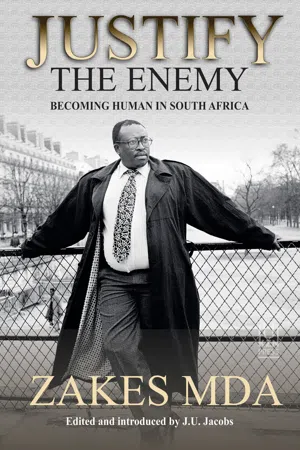 eBook - PDF
Justify the Enemy
Becoming Human in South Africa
- Zakes Mda, J.U. Jacobs(Authors)
- 2017(Publication Date)
- University of KwaZulu-Natal Press(Publisher)
Fiction is therefore an effective tool for interrogating and challenging hegemonic historical narratives and drawing from the periphery to the centre those that were previously marginalised. It is what Chinua Achebe did with the narrative of the Igbo in Things Fall Apart and Arrow of God and Toni Morrison with slave narratives, particularly in Beloved . Plaatje does it in Mhudi too. For instance, one of the things he achieves in this novel is the decentring of the Great Trek (1835–46). Couzens says: ‘To Plaatje the Great Trek was not the central event in South African history, but merely another episode in the movement of South African tribes.’ 6 History falls short in that it only tells us what happened – the same function that journalism serves in a contemporary setting. Fiction, on the other hand, demonstrates to us what it was like to be in what happened. This has nothing to do with authenticity, for I do not believe that anyone can authentically capture the voice, the experience and the ambience of the past. The rendering can only be a contemporary interpretation of that period influenced by the interpreter’s own biases and ideologies. The writer’s shaping of the material will always be subjective, even in instances where the writer recognises and respects his or her responsibility to historical evidence. The very act of selection – the decision about what to include or exclude – cannot but be subjective.You may defend yourself and say it is controlled by what the story needs. But it is your story, authored by you, and you determine its needs. The question ‘What was it like to be in what happened?’ takes us ‘inside’ the historical experience, right into the interiorities of the players, be they fictional or historical. History would not have given us the vivid interior monologues of the six Bakwena messengers sent by their Chief Sechele to sue for peace as they stand before Mzilikazi shaking and shivering, imagining how they are going to be ‘eviscerated at eBook - PDF
European Vistas
History, Ethics and Identity in the Works of Claudio Magris
- Remko Smid(Author)
- 2019(Publication Date)
- Peter Lang Group(Publisher)
Linda Hutcheon, furthermore, contends that postmodernist fiction addresses both epistemological and ontological questions, whereas modernist novels are more concerned with the former (1988: 50). I will return to this distinction later in this chapter when discussing unreliability. Instead of formulating a workable definition demonstrating the differ- ence between modernist and postmodernist fiction, I will focus on the char- acteristics that both modernist and postmodernist novels introduced. In this respect, I follow Jerome de Groot and especially Elisabeth Wesseling, who has written about the modernist and postmodernist innovations in the genre of the historical novel (1991). The historical novel was born in the nineteenth century; an epoch during which history as a discipline was also invented. Sir Walter Scott is commonly seen as the founding father of the historical novel, with the publication of his novel Waverley in 1814 (De Groot, 2010: 13), although antecedents existed long before that. 4 In the nineteenth cen- tury novels were in a mass medium, widely available, popular and influential (2010: 17). The traditional historical novel already was a contradictory, hybrid genre concerned with the indeterminacy of history (De Groot, 2010: 8), in which fact and invention were not clearly distinguishable (Manzoni, 1997: 5). However, contrary to later forms of Historical Fiction, the nineteenth- century version is also characterized by a linear narrative and a realist mode of representation. Georg Lukács, one of the most influential thinkers on the historical novel, sees the genre indeed as a form of Bildungsroman able 4 De Groot mentions in this respect, for instance, Homer and Virgil (2010: 16). Indeed, de Groot indicates that Scott is rather ‘a great synthesizer of what everyone before him had done’ (18). ‘Writing a historical novel means throwing oneself into the chaos of history’ 19 to capture historical progress (De Groot, 2010: 29).
Index pages curate the most relevant extracts from our library of academic textbooks. They’ve been created using an in-house natural language model (NLM), each adding context and meaning to key research topics.

