Literature

Speculative Fiction
Speculative fiction is a genre that encompasses imaginative and futuristic elements, often exploring alternative realities, futuristic technology, and societal changes. It includes subgenres such as science fiction, fantasy, and horror, and is characterized by its departure from the present reality. Speculative fiction allows authors to explore complex ideas and themes through the lens of imagined worlds and scenarios.
Written by Perlego with AI-assistance
Related key terms
1 of 5
11 Key excerpts on "Speculative Fiction"
 eBook - PDF
Science Fiction Criticism
An Anthology of Essential Writings
- Rob Latham(Author)
- 2017(Publication Date)
- Bloomsbury Academic(Publisher)
And let me point out again (rather more enthusiastically than before) that some first-rate writing has emerged from this sort of forced marriage. (Perhaps the differ-ence between the work of a marriage broker and a shotgun wedding?) Stapledon’s Starmaker falls into this group, as well as Ray Bradbury’s (specifically) science fiction and a large proportion of both Utopian and anti-Utopian novels up through the turn of the century. 3. Speculative Fiction: stories whose objective is to explore, to discover, to learn , by means of projection, extrapolation, analogue, hypothesis-and-paper-experimenta-tion, something about the nature of the universe, of man, of “reality.” Obviously, all fiction worth considering is “speculative” in the sense that it endeavors to reach, or to expose, some aspect of Truth. But it is equally true—and irrelevant—to say that all fiction is imaginative or all fiction is fantasy. I use the term “Speculative Fiction” here specifically to describe the mode which makes use of the traditional “scientific method” (observation, hypothesis, experimentation) to examine some postulated approximation of reality, by introducing a given set of changes—imaginary or invent-ive—into the common background of “known facts,” creating an environment in which the responses and perceptions of the characters will reveal something about the inventions, the characters, or both. It is in this last area that the essence of science fiction resides; it covers a great deal of territory, shading at either end into the first two categories. Clearly, there is hybridization all through the groups—as for instance in satire (such as The Child Buyer , or Player Piano ) whose main devil actually is some specific aspect of science or technology. For purposes of this discussion, I am not considering the space adventure story, the transplanted western or historical, as science fiction at all. eBook - PDF
- Brian Baker(Author)
- 2017(Publication Date)
- Red Globe Press(Publisher)
CHAPTER ONE Definitions: What is Science Fiction? W hat is science fiction? That seems to be an easy question to answer. Science fiction (SF) is a literary mode that deals with spaceships. Or aliens. It’s about the future. Or, it’s about technology. There might be some science in it. (Or there might not.) Wait. What is science fiction? That seems to be an impossible ques- tion to answer. We might know it when we see it, but what makes it different from fantasy? Or from the Gothic? Or from satire? ‘What is sci- ence fiction?’ is an impossible question, impossible because unanswer- able, though many have tried, critics, writers and readers alike. A genre, a mode, a collection of different sub-genres, a thought-experiment, a way of conceptualising the future of human beings themselves, a waste of time, or just ‘pulp’, cultural trash? I have often asked my own stu- dents to define science fiction, at the beginning of a course on the genre, and they have produced many thoughtful responses: New and strange points of view, imaginatively created, containing poten- tial or impossible scientific theories. A genre concerned with ideas of technology and imagined visions of the future, set in an unknown or alien environment, and often serving an allegorical purpose, commenting upon the society in which it was created. A rationally extrapolated genre where imaginary worlds and realities are creatively constructed in order to explore abstract concepts. These are all reasonable definitions. They tend to contain elements that emphasise science or reason; the imagination; alternative worlds or soci- eties; and a definite relationship between the imagined world and ‘our’ own, the world that produced it. eBook - PDF
- Aleksandra Mochocka(Author)
- 2019(Publication Date)
- Peter Lang Group(Publisher)
Although these assumptions seem to be fairly reason- able, James (1994) rightfully admits that his comparison is not precise enough. Nonetheless, motifs, characters, and gadgets are characterised as ‘science fictional’ and their presence explains the classification of a given text. James (1994) mentions the speculative quality of science fiction (pp. 71–72). Science fiction could be also presented as literature concerned with social crit- icism or, in a more general sense, as extrapolative literature (Mochocka, 2007, p. 6). Sullivan (1999) notes that In the best sense, then, to paraphrase Heinlein, science fiction is the literature of the present that can best prepare readers for the future by exposing them to a variety of pos- sible futures and by giving them some fictional experience in dealing with the new, the unusual, and the challenging. (p. 3). Here come definitions (or attempts at defining science fiction) by Isaac Asimov, Kim Stanley Robinson, Brian Aldiss, Michel Butor, Patrick Parrinder, and Barry Malzberg (ibid.). Yet, another category of definitions sets science fiction in the context of the literary history. Patrick Parrinder, for example, distinguishes science fiction as the literature that combines elements of romance, fable, epic, and parody, Brian Aldiss traces its beginnings to Mary Shelley and the budding industrial revolution, while others situate it as early in history as in the times of ancient Mesopotamian empires by means of categorising The Gilgamesh Epic as science fiction (Mochocka, 2007, p. 7). For Parrinder, science fiction is “a mutation of romance, the genre par excellence marked by its readers’ hunger for pleasurable repetition. […] operates also in the shadow of fable, the literature of knowledge and power […], and epic, a cognitive form linked with the dimension of history and change […]” (Broderick, 1995, p. 39). eBook - PDF
Books and Beyond
The Greenwood Encyclopedia of New American Reading [4 volumes]
- Kenneth Womack(Author)
- 2008(Publication Date)
- Greenwood(Publisher)
It is natural for science fiction authors to speculate about life on other planets, contact between humans and alien life forms, and the possibility of human expansion beyond the confines of planet Earth. It is equally natural for them to imagine travel in time and space—whether to the historical or prehistoric past or to the near or far future. Science fiction’s canvas spreads even further to include entirely different realities. These may be rationalized in various ways—for example, there may be mathemat- ical spaces beyond our own, as in Rudy Rucker’s novel of supermathematics, Mathematicians in Love (2006), whose main characters travel through a variety of alternative realities. In other cases, alternative histories or realities may be presented SCIENCE FICTION 815 as purely imaginary constructs with no explanation as to how they relate to our own world in a physical or metaphysical—rather than thematic—sense. In principle, science fiction assumes the contingency and mutability of current technologies, economic arrangements, and social forms. The technological and other novelties that it depicts enable its characters to act within constraints— physical, biological, technological, or cultural—that differ from those applying to human beings in historical and contemporary societies. This alteration of expected constraints can be deployed for a wide range of literary effects. In some cases, it enables the exploration of specific aspects of human behaviour, life, or the universe. It also enables authors to speculate about the future or to comment on the customs and values of existing societies by extrapolating their worst tendencies or by viewing a real society from the perspective of an imaginary one with different assumptions. Thus, the genre has lent itself to the purposes of utopian or visionary speculation, and to various kinds of satire. eBook - PDF
- A. Sawyer, P. Wright, A. Sawyer, P. Wright(Authors)
- 2011(Publication Date)
- Palgrave Macmillan(Publisher)
Any single definition seemed to imply an entire conceptual history of the field, and as a result a number of scholars found themselves trying to parse the term, arguing for example (as Roger Luckhurst and Adam Roberts have recently done 14 ) that at least some vaguely contemporary notion of ‘science’ was a precondition for anything that could be called science fiction. These same critics recognize that ‘science fiction’ itself is a somewhat arbitrary label, however, and that the phrase evolved as a term of convenience rather than as a manifesto. In fact, when one looks at a great many of the definitions offered through the past century or so, it becomes apparent that the nature of the definition depends almost entirely on its purpose and its audience – some are purely func- tional, some rhetorical and some theoretical– and that trying to adapt a definition intended for one purpose to the service of another can lead to misprision and confusion. Functional definitions are entirely practical in nature. When, in 1926, editor Hugo Gernsback described the characteristic story of his pioneer- ing pulp magazine Amazing Stories as a ‘charming romance intermingled with scientific fact and prophetic vision’, 15 he was in all likelihood merely trying to differentiate his magazine from other pulps for the benefit of readers and potential contributors – in other words, he was at least in part staking out his market. When a later editor, John W. Campbell Jr, described the field as ‘the literature of speculation as to what changes may come’, 16 and argued that a good science fiction story should read like a realistic tale to a hypothetical reader in its implied setting, he was similarly differentiating his magazine, Astounding Science Fiction, from earlier adventure-oriented pulps like Gernsback’s.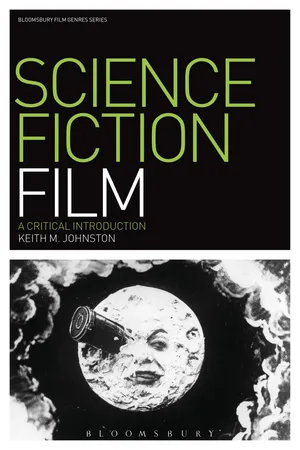 eBook - PDF
Science Fiction Film
A Critical Introduction
- Keith M. Johnston(Author)
- 2013(Publication Date)
- Berg Publishers(Publisher)
Part I What is Science Fiction? This page intentionally left blank 7 –1– Genre, Theory and Science Fiction A definition of the science fiction genre from an academic perspective might focus on thematic areas around technology, science, futurism or the figure of ‘the Other’. An equally valid definition might come from popular identification of iconographic elements such as flying saucers, robots, ray guns and aliens. A third discussion of the term, from an industrial perspective, might focus on special effects or spectacle. Any attempt to understand the genre must engage with all three and accept that further viewpoints would be equally valid. However, academic and popular criticism, as well as individual audience groups, often desires limitations on genre, a set of rules or conventions within which films are, or are not, contained. Yet genres do not exist a priori ; they are not a natural phenomenon that can be precisely catalogued and labelled. Rather than pre-existing forms, genres are cultural creations that are formed and reformed on a regular basis, prone to shifts in emphasis and meaning. A genre definition such as ‘science fiction’ can be used regularly in film production (directors, producers or actors might refer to their project in generic terms); by film audiences (discussing whether they want to see a specific genre); within advertising materials (promoting elements that are seen as intrinsic to the genre); or by critics or academics reviewing or writing on the film or genre. In each instance, the exact definition of what each individual means by the term ‘science fiction’ is more fluid than traditional genre boundaries allow. Equally, their definition will be different from what a producer, audience member or critic might have meant by the term ‘science fiction’ ten, thirty or fifty years ago. eBook - PDF
Exploring the Fantastic
Genre, Ideology, and Popular Culture
- Ina Batzke, Eric C. Erbacher, Linda M. Heß, Corinna Lenhardt, Ina Batzke, Eric C. Erbacher, Linda M. Heß, Corinna Lenhardt(Authors)
- 2018(Publication Date)
- transcript Verlag(Publisher)
What we consider “real” diverges, often starkly, according to cultural, geographical, and, especially pertinently to this study, religious positions. M APPING THE F ANTASTIC | 23 res of fantasy, science fiction, fairy tale, myth, historical fiction and many other kinds of writing that one would subsume under the fantastic umbrella. Amongst the scholarly attempts to define these subcategories is John Tim-merman’s Other Worlds: The Fantasy Genre (1983). In differentiating fantasy and science fiction (Timmerman 1983: 15-21), Timmerman delineates three core elements of science fiction: (a) the dependence on technical instruments; (b) a suspension of disbelief in the sense that the science fiction world is considered attainable and (c) a sense of extrapolation in that a science fiction world is deemed to be a possible future of our own, unlike fantasy, which Timmerman sees as a juxtaposition to our real world in the same tradition as Rabkin and Manlove (ibid: 49-50). Whereas these points are somewhat superficial, (b) and (c) highlight varying modalities in the science fiction and fantasy genres which Todorov’s system did not account for, namely juxtaposition vs. extrapolation. By defining science fiction and fantasy as opposing modes of dealing with the non-real (or supernatural, as Todorov would have it) in fiction, Timmerman also cir-cumvents the problem of too wide definitions which Attebery criticizes. eBook - PDF
- Steven Earnshaw(Author)
- 2014(Publication Date)
- Edinburgh University Press(Publisher)
12 Writing Science Fiction and Fantasy Crawford Kilian Science fiction and fantasy seem unlikely partners. SF, after all, is about what could happen, given what we currently know about the universe. Fantasy is about what could never happen, because science has shown it to be impossible. But science itself uses fantasy to make its points, and fantasy tries to work out its own implications in a consistent manner. Science imagines elevators that fall forever, and spaceships that display clocks running slower and slower as the ships near the speed of light. Fantasy imagines the logical consequences of a spell, and the ecological niche of dragons. These are all ‘thought experiments’, ways of using fantasy to look at the world and ourselves outside the limits of ordinary experience. Whether you write SF or fantasy, you are conducting such a thought experiment: could a human love a robot, and could the robot requite that love? If magic worked, what would it cost? In both genres, you are really exploring the human mind under conditions that reveal something new – or something old, familiar and ingrained that we have taken for granted until you make us look at it again. Just as some rocks and flowers reveal unexpected colours under ultraviolet light, human nature looks different in the light of a distant star, or of a sorcerer’s glowing staff. In this chapter I want to throw some light on the similarities of the two genres as well as their differences. This will involve their history, their conventions, and their future. But mine is just one writer’s view; I hope that your own vision of your genre will be far more imaginative and original than mine. Origins of Science Fiction and Fantasy Fantasy arises from myth, folk tale, and fairy story. It began as an effort to personify the mys-terious forces that rule our world: lightning, rain, sunlight, ice, and earthquake. eBook - PDF
American Science Fiction TV
Star Trek, Stargate and Beyond
- Jan Johnson-Smith(Author)
- 2004(Publication Date)
- I.B. Tauris(Publisher)
C R E A T I N G W O R L D S A more practical approach is to simply ask what it is that helps us identify a story as ‘science fiction’. Every text has a fundamental need: regardless of its medium, it must quickly and efficiently establish a convincing and sustainable reality. Science fiction’s alternative realities are created both in and through visual or verbal language: its imaginary worlds are initially formed in a manner identical to those of other genres. The difference is that in sf these worlds must also distinguish themselves from the realities of our everyday world by creating new or different rules by which their realities function. As Broderick reminds us, at the heart of reading is an act that helps to: create a world, built out of words and memories and the fruitfulness of the imagination. Usually, we miss the complexity of this process. Like poetry and postmodern fiction, sf tests the textual transparency we take for granted, contorting habits of grammar and lexicon with unexpected words strung together in strange ways. 19 This process is normally missed because the artifice involved in the means of relaying the message is concealed in many texts: the story takes priority over the style of the telling; the realist tendency means that the signifier is effectively effaced. The ambitions and lexicon of sf are in contrast with the central objectives of most other genres. For Delany, ‘mundane’ fiction generally proceeds: as a series of selections from a theoretically fixed, societally extant lexicon of objects, actions and incidents. In the s-f tale, a series of possible objects, possible actions, possible A M E R I C A N S C I E N C E F I C T I O N T V 2 0 incidents (whose possibility is limited, finally, only by what is sayable, rather than what is societal) fixes a more or less probable range of contexts for a new lexicon. eBook - PDF
- Lee Galda, , Lauren Liang, Bernice Cullinan, Lee Galda, Lauren Liang, Bernice Cullinan(Authors)
- 2016(Publication Date)
- Cengage Learning EMEA(Publisher)
In both genres we find many excellent stories that are well written, present multidimensional charac-ters engaging in exciting plots, and contain profound Summary 243 Copyright 2017 Cengage Learning. All Rights Reserved. May not be copied, scanned, or duplicated, in whole or in part. Due to electronic rights, some third party content may be suppressed from the eBook and/or eChapter(s). Editorial review has deemed that any suppressed content does not materially affect the overall learning experience. Cengage Learning reserves the right to remove additional content at any time if subsequent rights restrictions require it. 244 CHAPTER 7 F A N T A S T I C L I T E R A T U R E : F A N T A S Y A N D S C I E N C E F I C T I O N themes. Fantasy often presents heroes on a quest to achieve a goal as well as discover personal identity. It may contain fully developed fantasy worlds and magic. It may be set in our world and include magic realism. Often, animal characters act as humans or miniature beings reflect human activity. Science fic-tion is set in the future with characters who must learn to live in difficult circumstances, situations brought about by the results of scientific advance-ments. Fantastic literature offers young readers the opportunity to think about choices, actions, and con-sequences at a profound level. The following Booklist contains both fantasy and science fiction titles that represent both the older, “clas-sic” stories and those newer works that are popular with today’s young readers. With few exceptions, we have listed only one book per author; many have multi-ple books and extensive series. Most of the books men-tioned within the body of this chapter are not listed in the Booklist, which is meant as a supplement to those titles. The Booklist is not marked for diversity because most books go beyond the boundaries of the way we think about diversity and, for the most part, consider themes that relate to diverse cultures and people. eBook - PDF
Practices of Speculation
Modeling, Embodiment, Figuration
- Jeanne Cortiel, Christine Hanke, Jan Simon Hutta, Colin Milburn, Jeanne Cortiel, Christine Hanke, Jan Simon Hutta, Colin Milburn(Authors)
- 2020(Publication Date)
- transcript Verlag(Publisher)
Figuration: Speculating with Fiction Chapter 8: Scale and Speculative Futures in Russell Hoban’s Riddley Walker and Kim Stanley Robinson’s 2312 Matthew Hannah and Sylvia Mayer Any fictional text can be regarded as speculative—in the sense that all fiction invents alternative realities and thus engages with questions of how we under-stand our present worlds and ourselves, our knowledge of the past, and our con-ceptualizations of the future. As readers we enjoy the “cognitive provisionality” fictional texts provide us with, the opportunity to suspend disbelief, engage in “imaginative play” (Gallagher 2006: 347), and speculate about the (im)probable, the (im)possible, the (un)desirable of proposed realities. Some genres, however, have lent themselves particularly well to speculation about possible futures. Whether labeled “utopia,” “dystopia,” “science fiction,” “Speculative Fiction,” or “post-apoc -alyptic fiction,” future-oriented fictional texts all engage in the imagination of possible future worlds, thereby responding to the political, social, economic, or cultural challenges of the times in which they are written. In some way or another, these genres all share the qualities that Fitting (2010) regards as characteristic for modern science fiction. They represent “a response to the ef fects of the scientific transformation of the world beginning around the end of the eighteenth century: in the European awareness of history and the future, and in the increasing impact of the scientific method and of technological change on people’s lives” (136). 1 This essay addresses two novels that create speculative future worlds as re -sponses to the economic, scientific, and technological challenges that marked the times of their writing: Russell Hoban’s Riddley Walker and Kim Stanley Robinson’s 2312 . Each of these novels responds very dif ferently to “the terrors and delights of technological modernity” (Luckhurst 2005: 170) that science fiction explores.
Index pages curate the most relevant extracts from our library of academic textbooks. They’ve been created using an in-house natural language model (NLM), each adding context and meaning to key research topics.

