Literature

Native American Literature
Native American literature encompasses the oral traditions, storytelling, and written works of the indigenous peoples of North America. It reflects the diverse cultures, histories, and experiences of Native American communities, often addressing themes of identity, tradition, and the impact of colonization. This literature includes a wide range of genres, from traditional myths and legends to contemporary novels and poetry.
Written by Perlego with AI-assistance
Related key terms
1 of 5
11 Key excerpts on "Native American Literature"
- Melanie Benson Taylor(Author)
- 2020(Publication Date)
- Cambridge University Press(Publisher)
Above all, their texts are a site of political struggle, shifting to meet expecta- tions both mainstream and traditional, and are thus beset permanently by paradox: simultaneously primordial and postmodern; oral and inscribed; outmoded and novel; quixotic and quotidian. In truth, there is no such thing as “Native American Literature.” This Cambridge History thus takes up the daunting task of surveying the long tradition and enduring possibilities of Indigenous literature in a settler-colonial context, even as it questions the ideological integrity and future of a field so named. In setting the contours and selecting the topics that follow, I have thus been guided by the conviction that Indigenous literatures cannot be defined melanie benson taylor 2 in any simplistic, static, or sovereign way, nor can they be removed from the fluid and often messy dynamics of their imbrication in US national politics and polities. For this reason, the title elects the term “Native American” over the timelier “Indigenous” – although the chapters themselves adopt various iterations to describe this oceanic soup of identities, and I have purposefully chosen not to standardize them. As a whole, though, the collection of perspectives here acknowledges a specifically Native American field of experi- ence. The use of “Indigenous” as a signifier throughout expands our gaze to consider the motley Native communities worldwide, brought into political focus in part by the 2007 United Nations Declaration on the Rights of Indigenous Peoples. Accordingly, this volume embraces the prospects of comparativist, transnational, and “trans-Indigenous” methodologies, particu- larly in chapters by Chadwick Allen, Eric Cheyfitz, James Cox, and Sophie McCall. eBook - PDF
The Native American in American Literature
A Selectively Annotated Bibliography
- Roger Rock(Author)
- 1985(Publication Date)
- Greenwood(Publisher)
Native American Literature The purpose of this section is to list works by and about Indian authors and their literary products. It includes Native American works edited, translated, or retold by non-Indians. This list includes novels, story collections, single stories, myths, legends, tales, some poetry and some drama, as well as critical works about the literature, both oral and written, of Native Americans. Where it has been determined that a work is aimed at a particular age level or type of reader this distinction has been noted. If the work is about or is aimed at a particular tribe, cultural group, or geographical region, this, too, has been noted, usually, unless the title provides this information. This section might have been much larger, but other books are available which list Native American works much more comprehensively and/or specifically than this one can. To avoid needless duplication of information commonly available, I have tried to include in this collection only titles that are not, in most cases, to be found in what I believe to be the most thorough bibliographies—at least not to be found exactly as I have listed them. In some cases I have added a brief description; in other cases all I have added is a bit of bibliographic information such as the name of an additional publisher or a title variation. Of course, I have endeavored to list all works published since the publication of the major bibliograhies I am about to mention. There is some overlap between this work and these others, but consider this section as a supplement to them, to be used in conjunction with them, and not as an alternat i ve. Perhaps the most comprehensive gatherings of Indian literary materials are Jack W. Marken's The American Indian: Lanouaoe and Literature (180) and Daniel F. Littlefield and James W. Parins's A Bibliooraphy of Native American Writers.
- M. Stewart, Y. Atkinson, M. Stewart, Y. Atkinson(Authors)
- 2009(Publication Date)
- Palgrave Macmillan(Publisher)
Yet American Indian writings have also been subject to historical transfor- mations that have come with European contact: writing, translation, English language expression. Resisting colonialism and the imposition of stereotypes is also a literary technique of survival. Additionally, American Indian literary traditions have been concerned with the particularity of individual tribal experience. American Indian writ- ers exist in complex relation to multiple traditions: the mainstream Western literary canon, the particular oral traditions of their peoples, the political discourses of the time in which they live, and, as Robert Warrior (Osage) has pointed out in Tribal Secrets (1993), an indigenous intellectual tradition that has taken shape around both the spoken and the written word, while preserving and creating a distinctive tribal discourse of survival. Naming Nomenclature for indigenous peoples has developed since the first European contact. As an objective body, Native people were seen by Europeans as redskins, uncivilized, savages, and, due to Columbus’s navigational error, Indians, later distinguished as American Indians. Naming indicates power. As individual tribal peoples, most native peoples refer to themselves by their particular tribal identifications: I am Taos Pueblo, N. Scott Momaday is 18 ● P. Jane Hafen Kiowa, James Welch is Blackfeet, Joy Harjo is Muscogee Creek. Luci Tapahonso is Navajo, but also referred to as Diné, the name that tribe calls itself. “Native American” became politically apt during the 1970s, but as Sherman Alexie (Spokane/Cour d’Alene) says in “The Unauthorized Autobiography of Me,” I have never met a Native American. Thesis repeated: I have met thousands of Indians. November 1994, Manhattan: PEN American panel on Indian Literature. N. Scott Momaday, James Welch, Gloria Miguel, Joy Harjo, me. Two or three hundred people in the audience. Mostly non-Indians, an Indian or three.
- Paul Lauter(Author)
- 2010(Publication Date)
- Wiley-Blackwell(Publisher)
But contemporary Native American Literature, fiction in particular, may also be considered as part of a global literature working to resist European colonialism, as part a global body of writing usually referred to as “post-colonial literature.” This affinity exists in spite of the fact that there is no “post-” as yet to the colonial situation of the indigenous nations of the United States. Native peoples continue to live in a condition that Thomas Biolsi and Larry Zimmerman have called the “late imperial” (Biolsi and Zimmerman, 1997: 4); they remain, that is, “domestic dependent nations,” the appellation invented for them by Chief Justice John Marshall, in Cherokee Nation v. Georgia (1831). To undo their par-adoxical or oxymoronic status as “dependent sovereigns” – to resist colonial limitations on their sovereign rights as nations – is the foremost aim of Native nations today. Thus it is that Native American writers who seek to advance this goal often find their work taking forms that bring them as near to some African novels as to African-American ovels, to South American fiction as well as to Chicano/a fiction as a consequence of colonial histories and legacies. By briefly treating the work of three contemporary authors – Leslie Marmon Silko, Linda Hogan, and Gerald Vizenor – we hope to demonstrate the force of the anti-colonial imagination at work in Native American fiction, as well as the different forms that this imagination may take. Space constraints require us to work with a few texts as representative examples – metonyms, perhaps – of larger bodies of work; the accounts we offer below might, with some adjustments, stand in for accounts of other Native fiction of the period. 1 In this chapter, we will try to understand resistance to colonial-ism as being articulated through three overlapping, and potentially complementary perspectives – perspectives we call nationalist , indigenist , and cosmopolitan . eBook - PDF
Books and Beyond
The Greenwood Encyclopedia of New American Reading [4 volumes]
- Kenneth Womack(Author)
- 2008(Publication Date)
- Greenwood(Publisher)
Native American poets address many of the same issues Native American Literature 671 as novelists, and often even more directly borrow from traditional oral genres such as song, prayer, and chant. A major contemporary writer, Joy Harjo transforms many of her poems into lyrics, which she and her bands, Poetic Justice, and later, Arrow Dynamics, in turn have set to a multicultural pastiche of musical styles. Her most recent works include A Map to the Next World (2000), and How We Became Human: New and Selected Poems (2002). Louise Erdrich is also well known for her poetry. Like her novels, many of her poems deal with cultural and spiritual experi- ences of people attempting to preserve indigenous lifeways and values within an unreceptive, sometimes hostile, dominant society. One of her most frequently anthologized poems, “Jacklight” (1984) and several of her recent ones in Original Fire: Selected and New Poems (2003), deal directly with bicultural individuals and situations in the lyrical style typical of her narrative works. “Captivity” (1984) is a fascinating poem in which the speaker assumes the voice of Mary Rowlandson, author of the famous colonial narrative of Indian captivity, but tells a somewhat different story. Other widely published, post-1968 poets (many of whom also write novels, short stories, and nonfiction) are Hogan, Ortîz, Blue Cloud, Mary Tall Mountain (Athabascan, 1918–1994), Jim Barnes (Choctaw, 1933–), Lance Henson (Cheyenne, 1944–), Geary Hobson (Cherokee-Quapaw-Chickasaw, 1941–), Maurice Kenny (Mohawk, 1929–), Roberta Hill Whiteman (Oneida, 1947–), Allison Hedge Coke (Cherokee, 1958–), Wendy Rose (Hopi/ Miwok, 1948–), Diane Glancy (Cherokee, 1941–), Ray Young Bear (Mesquakie, 1950–), Luci Tapahonso (Navajo, 1953–), Armand Garnet Ruffo (Ojibway, 1955–), and Gloria Bird (Spokane, 1951–). Like poetry, Native American theatre does not enjoy as high a profile as fiction. Nevertheless, it has developed steadily alongside other genres since the 1970s.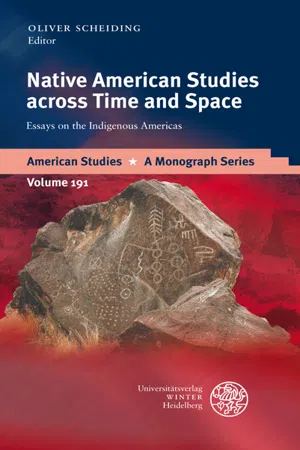 No longer available |Learn more
Native American Studies across Time and Space
Essays on the Indigenous Americas
- Oliver Scheiding(Author)
- 2012(Publication Date)
- Universitätsverlag Winter(Publisher)
We read these novels as anti-colonial resistance literature and discussed them in relation to the overlapping perspectives of nationalism, indigenism, and / or cosmopolitanism. In the section on poetry in that same volume, Kimberley Blaeser, in parallel fashion, observed that 13 14 Arnold Krupat [t]he colonization of literature cannot be extracted from the history of coloni-zation of land or people, nor can the ongoing attempts at literary decoloniza-tion among the indigenous American writers be viewed in any amber-encased “pure” academic discipline. The poetry of indigenous America has both liter-ary and supraliterary intentions. (2006, 184) Also worth mentioning in these regards is Maureen Konkle’s study, Writing Indian Nations: Native Intellectuals and the Politics of Histori-ography, 1827-1863 (2004). Konkle’s particular discontent with cultural-ism had to do with her concern that a critical focus on culture in Native writing could serve to “incorporate Native peoples into the United States politically by making them representatives of one of the many ethnic cul-tures that constitute the multicultural United States” (2004, 32). Native use of culture in writing, as she saw it, had clear political aims, aims con-sistent with those we have traced in a body of nationalist criticism and oriented toward sovereignty. Warrior’s The People and the Word: Reading Native Nonfiction (2005) further developed these and other positions. In this line of nation-alist criticism as well, Daniel Heath Justice’s recent Our Fire Survives the Storm: A Cherokee Literary History (2006) is worth mentioning. With reference to Craig Womack, Justice calls his study specifically “a work of tribal nationalism” (2006, 8). He cites Warrior’s conceptualization of “‘intellectual sovereignty,’” along with Jace Weaver’s “communitism,” adding that he is also indebted to Mary Churchill’s definition of “a ‘Cherokee-centric hermeneutic’” (9). eBook - ePub
- Daniel G. (Daniel Garrison) Brinton(Author)
- 2005(Publication Date)
- Perlego(Publisher)
Brinton was aware of the 19th century racism of many who wrote about the American Indian and reacted against it in his writings by taking a stance which in some ways anticipates Ruth Benedict's involvement in similar questions half a century later. Aboriginal American Authors is written as an early attempt at placing the literature of the American Indian with the other great literary traditions of the world; that is why its usefulness endures.John Hobgood Social Science Department Chicago State College 1970PREFACE.
The present memoir is an enlargement of a paper which I laid before the Congres International des Americanistes, when acting as a delegate to its recent session in Copenhagen, August, 1883. The changes are material, the whole of the text having been re-written and the notes added.It does not pretend to be an exhaustive bibliographical essay, but was designed merely to point out to an intelligent and sympathetic audience a number of relics of Aboriginal American Literature, and to bespeak the aid and influence of that learned body in the preservation and publication of these rare documents.Philadelphia, Nov. 1883.CONTENTS.
Section 1. Introductory
Section 2. The Literary Faculty in the Native Mind
Vivid imagination of the Indians. Love of story telling. Appreciation of style. Power and resources of their languages. Facility in acquiring foreign languages. Native writers in the English tongue. In Latin. In Spanish. Ancient books of Aztecs. Of Mayas, etc. Peruvian Quipus.Section 3. Narrative Literature
Desire of preserving national history. Eskimo legends and narratives. The Walum Olum of the Delawares. The Iroquois Book of Rites. Kaondinoketc's Narrative. The National Legend of the Creeks. Cherokee writings. Destruction of Ancient Literature. Boturini's collection. Historians in Nahuatl. The Maya Books of Chilan Balam. Other Maya documents. Writings in Cakchiquel. The Memorial de Tecpan Atitlan. Authors in Cakchiquel and Kiche. The Popol Vuh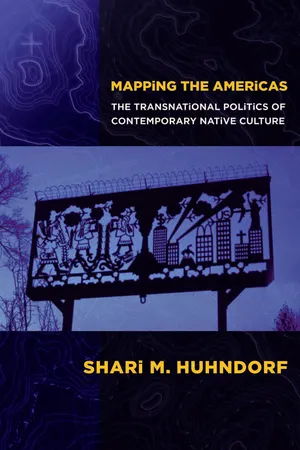 eBook - PDF
Mapping the Americas
The Transnational Politics of Contemporary Native Culture
- Shari M. Huhndorf(Author)
- 2010(Publication Date)
- Cornell University Press(Publisher)
They mark a shift away from the national-ist orientation that has dominated critical work in Native literary studies, toward a more “transnational” perspective. Nationalist literature and criti-cism are primarily concerned with the cultural distinctiveness and politi-cal autonomy of individual tribes and with the redrawing of community boundaries after colonization. Although Native art and literature since the 1980s similarly engage issues of landownership and political control, they do so in a context that has been increasingly shaped by global— that is, transnational—movements of capital and empire which have re-fashioned indigenous cultural expression along with social and political structures. In Mapping the Americas: The Transnational Politics of Contemporary Na-tive Culture I show how continuities and contradictions between these two orientations—the national and the transnational—have shaped Native cul-tural production, first historically, then with a focus on fiction, performance, photography, and film of the 1980s and 1990s. Specifically, I examine both the possibilities and the limits of indigenous nationalism and transnation-alism first in cultural events surrounding the acquisition of Alaska by the United States, then in the Arctic films of Igloolik Isuma Productions, feminist performances by indigenous women, and Leslie Marmon Silko’s monumental novel Almanac of the Dead. Transnationalism, as I use the term here, refers to alliances among tribes and the social structures and practices that transcend their boundaries, as well as processes on a global scale such as colonialism and capitalism. Concentrating on the connections that tie indigenous communities together rather than on the boundaries that separate them allows me to raise questions about gender, imperialism, class, and the worldwide circulation of culture which have garnered little sustained attention in Native literary studies.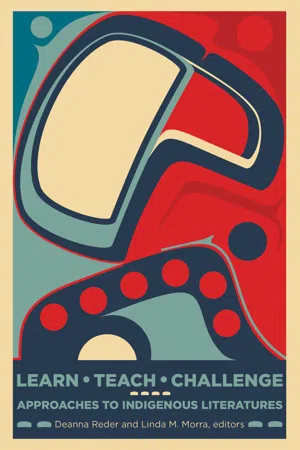 eBook - PDF
Learn, Teach, Challenge
Approaching Indigenous Literatures
- Deanna Reder, Linda M. Morra, Deanna Reder, Linda M. Morra(Authors)
- 2016(Publication Date)
- Wilfrid Laurier University Press(Publisher)
Written primarily in English by authors possessing a con-sistently high level of education, these works are already heteroglot by nature— even as they rely heavily on elements from Native epistemologies, specifically the reality of myth and ceremony as embodied in traditional oral literatures. Novels such as Silko’s Ceremony , Momaday’s House Made of Dawn , Welch’s Winter in the Blood , Carr’s Eye Killers, Owens’ The Sharpest Sight , and Vizenor’s Bearheart , to mention but a few, brilliantly convey this richly hybridized dia-logue—or “meditational” strategy—connecting two different worlds and worldviews. The same could be said for the poetry of Luci Tapahonso, Simon Ortiz, and Joy Harjo—and, in fact, for all the literary genres that have contrib-uted in the past few years to the development of Native American Literature. Within this context, charges of assimilationism against a theory that relies on the same hybridized strategies and discursive modes utilized by the texts that it sets out to interpret seem, in the long run, an ironic contradiction. How could a Native American theory aim at a “pure” form of (Native) discourse, untouched by the strategies of Western tradition, when Native American Literature itself a product of a crosscultural encounter, what Thomas King labels “interfusional literature, blending the oral and the written” (xii)? How could Native American Introduction 263 theorists aim at developing a separatist form of discourse when they are heavily and inevitably implicated in the discourse of the metropolitan centre? As I will point out in my discussion, while such separatist sentiments appear legitimate to fervent representatives of nationalist approaches, they become all the more dangerous as they continue to ossify Native American literary production, as well as Native identity, into a sort of museum culture. Equally important for my study is the relation that a Native American critical theory bears to current postcolonial discursive modes. eBook - PDF
- William Bright(Author)
- 2014(Publication Date)
- De Gruyter Mouton(Publisher)
The matched sets of grammars, dictionaries, and texts which were thus produced over several decades have quite regularly been issued in the University of California publication series in linguistics, continuing the Boasian tradition manifested in publications of the Smithsonian Institution and else-where. So the reality of languages as consisting of connected discourse remained part of the consciousness of many American linguists for years; yet all those volumes of native American texts on our library shelves, though consulted by the occasional anthropologist or folklorist, have tended to be neglected by linguists—and even more so by scholars of literature. But now things are 8o Studies in American Indian Oral L,iteratures changing. Owing in particular to the efforts of Dell Hymes and of Dennis Tedlock, the study of American Indian narrative is having a revival, from both linguistic and literary viewpoints. 2 However, much work remains to be done, not the least of which is that of terminological clarification. How should we define the differences between formal and informal language, written and spoken language, literary and colloquial language (cf. Tannen 1980)? How do we define the term 'literature' itself? Is it appropriate to speak of 'oral literature'? If so, what are its distinctive characteristics? Within the framework of 'literature', how can we define 'poetry'? And what about 'oral poetry': how is it to be distinguished from song or chant on the one hand, and from prose on the other? I touch on these problems only briefly, and then go on to a more specific question, raised specifically by the work of Hymes—namely, what are the distinctive charac-teristics of Native American oral narrative as poetry? I would like first of all to remove from discussion the words 'formal' and 'informal'. I prefer to use these to refer to contrasting sociolinguistic registers—or as poles on a sociolinguistic continuum—described by Ferguson (1959) under the rubic of'Diglossia'. eBook - ePub
- Andrew Wiget(Author)
- 1994(Publication Date)
- Routledge(Publisher)
New Perspectives on the Pueblos. Ed. Alfonso Ortiz. A School of American Research Book. Albuquerque: U of New Mexico P, 1972.——. The Spoken Word and the Work of Interpretation. Philadelphia: U of Pennsylvania P, 1983.Toelken, Barre. “The ‘Pretty Languages’ of Yellowman: Genre, Mode and Texture in Navajo Coyote Stories.” Genre 2 (1969): 211–35.Vizenor, Gerald, ed. Narrative Chance: Postmodern Discourse on Native American Literatures. Albuquerque: U of New Mexico P, 1989.Wiget, Andrew. Native American Literature. Boston: Twayne, 1985.——.“Telling the Tale: A Performance Analysis of a Hopi Coyote Story.” In Swann and Krupat, 1987. 297–338.——, ed. Critical Essays on Native American Literature. Boston: G.K.Hall, 1985.Witherspoon, Gary. Language and Art in the Navajo Universe. Ann Arbor: U of Michigan P, 1977. Passage contains an image
Oral Literature of the Alaskan Arctic
In many respects, the oral literatures of Alaskan Yupik and Inupiaq peoples are thematically and structurally varied, yet the range of variation is consistent. Alaskan traditions are clearly related to the verbal art of Inuit peoples in Canada, Greenland, and Siberia, and many elements are also shared with other Native North American groups. 1 Rather than considering the distribution of specific forms and motifs, however, the following concentrates on features of genre, performance, transmission, function, and content specific to Alaskan Inuit oral literature.Native Genre Distinctions
A basic, although not rigid, distinction is made between two categories of narratives. The first of these consists of narratives considered to be of great antiquity and importance. Traditional tales which are not ultimately attributable to any known storyteller, and which include stock characters, rather than named persons who are known to have existed, are among those included in this genre. Etiological stories, detailing origins of celestial and geographic features, human customs and ceremonies, and animal characteristics; accounts of the legendary exploits of culture heroes; and ancient tales of animals in their human forms and of human/animal transformations are usually in this class. In most areas, the terms for this genre are cognate: Central Siberian Yupik unigpaghaq; Alaskan Inupiaq unipkaaq/ unipchaaq/ulipkaaq; Naukanski Siberian Yupik unikparaq; Norton Sound univkaraq; Alutiiq unigkuaq (Fortescue and Kaplan 1989). Although univkaraq is used by some Central Alaskan Yupik speakers, the divergent form quliraq is more common. Here, the designation unipkaaq/quliraq
Index pages curate the most relevant extracts from our library of academic textbooks. They’ve been created using an in-house natural language model (NLM), each adding context and meaning to key research topics.

