Literature

Puritan Literature
Puritan literature refers to the body of writings produced by the Puritans, a religious group that emerged in the 16th and 17th centuries in England and later settled in America. Their literature often focused on religious themes, moral instruction, and the exploration of the individual's relationship with God. Puritan writers sought to convey their beliefs and values through sermons, diaries, poetry, and historical accounts.
Written by Perlego with AI-assistance
Related key terms
1 of 5
6 Key excerpts on "Puritan Literature"
 eBook - ePub
Jeremiah's Scribes
Creating Sermon Literature in Puritan New England
- Meredith Marie Neuman(Author)
- 2013(Publication Date)
- University of Pennsylvania Press(Publisher)
Rather, as Lori Anne Ferrell and Peter Mc-Cullough point out in their introduction to The English Sermon Revised, studies of English Puritanism throughout the twentieth century served primarily to contextualize John Milton as the Poetic Puritan, on the one hand, and John Donne as the Metaphysical Poet Preacher (in opposition to plain style), on the other. The result has disproportionately featured, in their words, “the history of English prose style, antiquarian literary history, and a preoccupation with ‘the Metaphysical.’” 7 For the past few decades, English scholarship has usefully blurred old theological and stylistic lines of distinction between the Anglican and the Puritan, and every new book, it seems, must begin by worrying the question, What is a Puritan? That question is perhaps easier to answer in New England, where one could argue that a Puritan is anyone who felt strongly enough about the current situation to get on a boat. 8 Nevertheless, American scholarship could benefit from more regard to the ambiguities of doctrine and style. On either side of the Atlantic, however, a plausible claim to “the Literary” continues to elude the study of the Puritan sermon. We talk about experience, about mourning, about social control and transgression, about piety and resistance. We speak about the many phenomena of Puritanism. Conveniently, then, we can remind ourselves that literature might consist of not only a poem or a play but a controversial pamphlet or a catechism or a report on missionary activity, as well. We can turn almost anything—from a visual image, to a historical event, to a devotional practice—into a text to read. Yet none of these necessary and illuminating expansions of Puritan Literature has addressed recalcitrant resistance to that more traditional literary genre of the sermon for modern readers. Most of us still hate to read sermons—and Puritan sermons in particular eBook - ePub
The Puritans
A Sourcebook of Their Writings
- Perry Miller, Perry Miller, Thomas H. Johnson(Authors)
- 2014(Publication Date)
- Dover Publications(Publisher)
Chapter VIILITERARY THEORY
T HOUGH it is evident that the Puritans as a group never developed a lively aesthetic sense in their appreciation of music, painting, and sculpture, yet they left on record a great number of brief comments upon the art of writing, as well as a few extended essays. In each instance the writer is concerned with the question: How can prose or verse be made more useful to the preacher, historian, poet, or controversialist? Usually the remarks are incidental to some broader aim. The motive behind Puritan writing was utilitarian: the author might chronicle the story of his times, attack unwelcome schools of thought, discourse upon man’s duties, narrate the lives of famous men, or hymn praises to God, but the end he purposed was never merely an enjoyment of belles-lettres or of literature for its own sake. This is not to say that he was devoid of literary sensibilities. On the contrary, Michael Wiggles-worth’s college declamation praises eloquence because it is an art which “gives new luster and bewty, new strength new vigour, new life unto trueth” (see p. 674). The interest is utilitarian in the finest sense, for it does not limit eloquence to the service of one type or class of men; it is conceived rather as the art behind which other arts are hidden.The early Puritan authors in this country were almost without exception college graduates who could look back upon a classical training acquired by seven years of grammar school study, concluded by four college years wherein the students were intensively drilled in rhetoric. They were, to begin with, inheritors of such Elizabethan training and rhetorical theory as had been in vogue at the English universities; they knew what Erasmus, Peacham, and Florio had to say on the art of writing well,—they further studied apophthegms culled from the rhetoric texts of Famaby, Dugard, Draxe, and Buchler. Rapin’s works, especially his Reflections upon the Eloquence of these Times; particularly of the Ban and Pulpit (London, 1672), and the usual artes concionandi1 of Keckermann, Chappell, and others were the standard texts for divinity students. The consciousness of literary style was clearly a matter not left to chance; the gentlemen who came to establish a “Plantation Religious” eBook - ePub
Doctrine and Difference
Essays in the Literature of New England
- Michael J. Colacurcio(Author)
- 2013(Publication Date)
- Routledge(Publisher)
Puritans in SpiteA MOMENT or two before the most recent, well advertised paradigm shift in the study of American literature, an argument about “Puritan Influences” flared up, just briefly, in the pages of a journal soberly devoted to the study of earlier American literature as such. Not the old-time question of whether Perry Miller ever had found a way to get from the seventeenth to the nineteenth century, or whether his speculations about the transition “From the Covenant to the Revival” or, again, “From Edwards to Emerson” were merely thin and putative imitations of his account of the intellectual evolution of New England “From Colony to Province.” Not even the livelier question of whether the emergent, more properly political system of Sacvan Bercovitch seemed more likely to capture the later course of American ideology for explanation in terms of a rhetoric that began with the invention of the New England Jeremiad. But much more radically: were there, in fact, any Puritan influences of significance? or was the premise of some puritanic continuity in American literature merely the fabrication of a naive desire to totalize American literary history in its own nativist terms?1 eBook - ePub
- Russell J. Reising(Author)
- 2013(Publication Date)
- Routledge(Publisher)
2 The problem of Puritan origins in literary history and theoryTheorists of American literature have consistently viewed the influence of Puritanism on American thought as a critical issue, but they have sharply debated the precise nature of that influence. As early as 1891, Barrett Wendell, one of the founders of American literary studies, wrote, ‘To understand the America of to-day, we must know the New England of the fathers’ (Wendell 1891, 305). But as Henry May documents, ‘young radicals’ such as Emma Goldman, H. L. Mencken, and others in the first decades of the twentieth century denounced Puritanism ‘for every crime from prostitution to the American Sunday’ (May 1957, 308). The search for the ‘Puritan origins’ of American culture and of the American Self gained momentum during the twenties, receiving a kind of official recognition in 1928 when Norman Foerster’s The Reinterpretation of American Literature specified Puritanism, along with the frontier spirit, romanticism, and realism, as one of the determining influences on American writing. The debate over the significance of Puritanism, however, had been raging since the turn of the century, when Puritanism became a touchstone for discussions of the merits and defects of American culture. Early versions of Puritan origins scholarship by writers such as Paul Elmer More, H. L. Mencken, Stuart Sherman, and William Carlos Williams demonstrated that Puritanism could be appropriated as the root of any number of different American traditions. These critics and others used Puritanism, however, more than they sought to understand it. They simplified it in order to make it serve as the source of everything right or wrong with twentieth-century America, typecasting the Puritans as heroes or villains in the drama of American history and identity.Puritan origins scholarship has progressed far beyond the simplified, polarized views of the early theorists. Nevertheless, scholars have continued to simplify Puritanism, reflecting different critical paradigms rather than depicting Puritan culture with historical accuracy. My main purpose here is to explore theories of more recent and sophisticated literary historians and critics, including Perry Miller, Yvor Winters, and Sacvan Bercovitch, and more briefly some works of Richard Chase, Harry Levin, and Leslie Fiedler. Understanding their works, however, requires a review of some early Puritan origins theories. In addition to the colorful polemic that characterizes their writing on Puritanism, the most striking feature of works by early critics such as More, Babbitt, Sherman, and Williams is their fervid disagreement over what Puritanism actually was. None of these thinkers pursued an adequate historical understanding of Puritanism; instead they contented themselves with selective views supporting an a priori interpretation of American culture. As Richard Ruland has demonstrated in his analysis of the Stuart Sherman/H. L. Mencken debate over Puritanism, many of the early arguments were never resolved because the antagonists worked at cross purposes, failing to grasp either the other’s points or the historical reality of Puritanism.1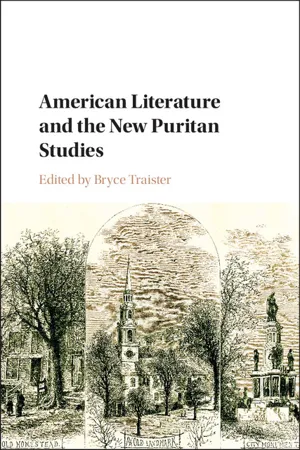
- Bryce Traister(Author)
- 2017(Publication Date)
- Cambridge University Press(Publisher)
chapter 1 Introduction: The New Puritan Studies Bryce Traister Tombstones. Statues. A portrait of an overdressed Divine. Pirates. Laughter. An adolescent Algonquian trickster. Linguistics. Antiquarianism. Salvation and sovereignty. Mexico. Constantinople. Rome. These are not the usual suspects of “American Puritanism,” and we are not finding them in the usual places these days. Scholars are also reading them now in a variety of non-literary media, and from multiple and unconventional perspectives that challenge us to reconsider our received knowledge about New England Puritanism’s formative place within a United States national culture. Taken together, they constitute the New Puritan Studies, and offer potential new narratives of American literary and cultural history. Welcome to American Literature and the New Puritan Studies. This book contains twelve original essays about Puritan culture in colonial New England. Written by both established and emerging scholars, the chapters range broadly in terms of object, disciplinary method, and historical scope. Viewed as a whole, they reflect and sharpen the terrain we have historically labeled “American Puritanism,” even as each of these chapters complicates our conventional wisdom about such matters. For professional readers of this cultural history, both Puritanism and the other term of our title, “American Literature,” have served for many years now as the straw argument opener for countless articles and books about the United States seeking to declare something new, bold, or critical about the country and its academic study. 1 In many of these accounts, the settlement culture of New England still remains the “New England Mind” of Perry Miller, or the “American Jeremiad” of Sacvan Bercovitch, an apparently monological and self-provincializing historical fiction of an everlastingly white, mostly male, narrowly nationalist, and broadly Protestant America.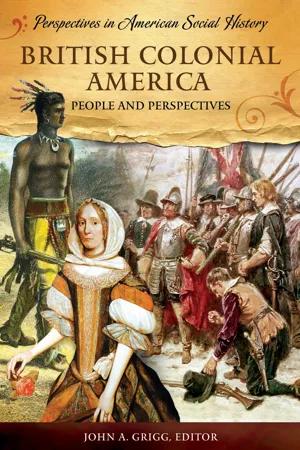 eBook - PDF
British Colonial America
People and Perspectives
- John A. Grigg(Author)
- 2008(Publication Date)
- ABC-CLIO(Publisher)
Puritan Life Michael S. Carter 3 he image of dour, black-clad Puritans forging a new civilization on the rocky shores of New England early in the 17th century is one of the most familiar and cherished in the mythology of American national origins. T But who in fact were these people called Puritans, and do these familiar im- ages of them correspond to historical reality? Why have they received so much attention? Why do they occupy such a prominent place in conven- tional narratives about colonial British North America? It is widely acknowledged by historians that colonial America was among the most religiously diverse, complicated regions in what is known as the early modern era (ca. 1400s–1700s). But before the rise of social history in the 1960s and 1970s, when a wider variety of popular folk traditions and less formal religious practices began to attract the attention of historians, Puri- tans dominated the category of religious history within the broader spectrum of writing about the colonies. The intellectual traditions of the Puritans and their theology—and the vast amount of writing, from sermons to poetry, produced by its leading lights—was brilliantly explored by Perry Miller (1905–1963) beginning in the 1930s. Miller, a Harvard English professor, can be described as the founder of modern Puritan studies. His examination of covenant theology sparked a renaissance of interest in Puritan intellectual history, and led to a greater appreciation for the role of religion in the poli- tics, economics, and culture of colonial America. He also helped to correct perceptions of Puritans as a sour, unhappy people that had been prevalent since 19th-century author Nathaniel Hawthorne wrote his classic fiction based on them, including The Scarlet Letter (1850) and The House of the Seven Gables (1851).
Index pages curate the most relevant extracts from our library of academic textbooks. They’ve been created using an in-house natural language model (NLM), each adding context and meaning to key research topics.

