Literature

Truman Capote
Truman Capote was an American writer known for his works of fiction and non-fiction. He is best known for his novel "Breakfast at Tiffany's" and his true crime novel "In Cold Blood". Capote was a pioneer of the literary genre known as the non-fiction novel.
Written by Perlego with AI-assistance
Related key terms
1 of 5
3 Key excerpts on "Truman Capote"
 eBook - ePub
- Thomas Fahy, Linda Wagner-Martin(Authors)
- 2014(Publication Date)
- University of South Carolina Press(Publisher)
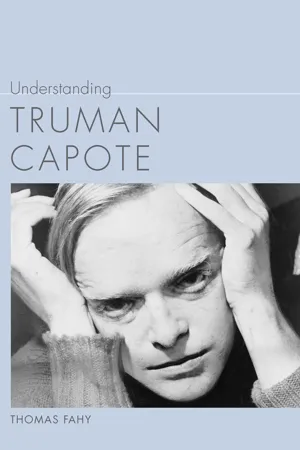
There is an attempt in this work to provide a new direction for Capote studies that can bring him back into the classroom and the literary canon. 11 Reading his works in their historical context reveals the politics shaping Capote’s writing. Such an approach aligns with Linda Wagner-Martin’s assertions about the “new fiction” of this period: “Such writers as Truman Capote, Gore Vidal, Carson McCullers, and other southerners . . . during the 1940s and 1950s created a new category of American letters—that of the minority viewpoint (though white), the literature of the anti-dream. Expressing themselves in nonrealistic, or at least unconventionally structured, works, these newer writers insisted on the dreamlike (or, sometimes, hallucinatory) quality of much human experience. At their most ephemeral, novels by these visionary if fragile writers were written to disguise the narratives being conveyed” (83–84, my emphasis). Though Wagner-Martin discusses only Capote’s Other Voices, Other Rooms here, the bogeyman figure in his short fiction, the tree house setting in The Grass Harp, mythmaking/propaganda in The Muses Are Heard, Holly Golightly’s reveries, and the haunting aftermath of the Clutter murders endow the respective works with dreamlike qualities that mask sociopolitical narratives. My emphasis on the field of American Studies offers a way to reclaim these disguised narratives. It refutes the notion of Capote as disconnected from the political. Instead Understanding Truman Capote positions him as a writer deeply engaged with the social anxieties surrounding race relations, gender, sexuality, communism, capitalist culture, the atomic age, poverty, and delinquency in the 1940s and 1950s. His writing captures the isolation, marginalization, and persecution of those who deviated from or failed to achieve white middle-class ideals. His works highlight the artificiality of mainstream idealizations about American culture eBook - ePub
Precious Perversions
Humor, Homosexuality, and the Southern Literary Canon
- Tison Pugh(Author)
- 2016(Publication Date)
- LSU Press(Publisher)
LAUGHING WITH Truman Capote Insult, Camp, and Gothic ExcessD espite their mixed critical reception, Truman Capote’s literary achievements should assure him enduring acclaim as one of the preeminent figures of the southern renaissance. Notable accomplishments include his prize-winning debut with the short story “Miriam,” breakout success with the gothic bildungsroman Other Voices, Other Rooms, popular recognition with Breakfast at Tiffany’s, and critical and commercial triumph with In Cold Blood. His range was wide, as shown by Observations, a coffee-table book collaboration with photographer Richard Avedon, and Indiscretion of an American Wife, his first Hollywood screenplay. While mostly withholding his humor from his literary efforts, Capote unleashed his sharp wit in his personal life and through his public persona. As an acerbic commentator on celebrity culture, he brashly insulted those whom he perceived to be pretenders, charlatans, or outright enemies. Most funny people recognize the need to temper their wits according to the rhetorical circumstances at hand, and various comics have lamented the expectations of their fans, and sometimes of their friends as well, that they should be perpetually amusing—no matter how taxing the creation of such endless levity might be. Capote staked his reputation as a serious literary artist, and the overarching gravity of his corpus reflects this ambition. As E. B. White explains, “The world likes humor, but treats it patronizingly. It decorates its serious artists with laurel, and its wags with Brussels sprouts.”1 In Capote’s quest for respect as a literary artist, an excessively comic voice might have undercut his efforts.Against the currents of his serious literary efforts, however, run countercurrents of camp, excess, and submerged levity. Whereas his witty, acerbic public persona places him in the company of such figures as Oscar Wilde and Dorothy Parker, Capote’s literary work appears markedly dissimilar from theirs in breadth and tone. Capote vented his sense of humor most flagrantly in his screenplay of John Huston’s 1953 film Beat the Devil—a cinematic camp classic often celebrated as the first of its genre but mostly overlooked in critical assessments of Capote’s literary career.2 Capote’s camp humor infiltrates Huston’s otherwise “straight” caper flick, sneaking a queer sensibility into the film’s plotline of winsome adulterers outwitting four nefarious criminals. Given Capote’s appreciation of humor in his life and in this film, it is not surprising that his comic sensibility would flavor his more serious works. The submerged camp humor of Other Voices, Other Rooms illuminates his unique voice as a member of the southern renaissance, for its outré qualities, which contemporary critics found appalling, evince his interest in reformulating the codes of gothicism to depict the trials and pleasures of gay southern life. In complementary contrast, the failures of camp in his unfinished novel Answered Prayers eBook - PDF
Syncopations
Beats, New Yorkers, and Writers in the Dark
- James Campbell(Author)
- 2008(Publication Date)
- University of California Press(Publisher)
Persons. It requires an effort to recall Capote’s eminence in the 1960s and early 70s, when he was regarded as a bright star in the constellation that included James Baldwin, Norman Mailer, Mary McCarthy, James Jones, William Styron, and Gore Vidal. Mailer called him “the most perfect writer” of the lot, although he worried over Capote’s reluctance or inabil-ity to explore “the deep resources of the novel.” All of the above writers were friends of Capote, with the exception of McCarthy, whom he dis-liked, but little in Too Brief a Treat beside a handful of letters to Styron tes-tifies to the connections. Vidal, who formed a sparkling triangle with Capote and Williams in the early part of their careers, receives fewer mentions in the index than Audrey Hepburn. Capote plugged the gap left by the dissolution of his family with a for-midable force of friends. His companion for most of his life was Jack Dunphy, a once-married man who was also a writer. There are many let-ters to Capote’s former lover Newton Arvin, author of an acclaimed biography of Herman Melville; to the aspiring writers Andrew Lyndon L o v e , T r u m a n 35 and Donald Windham; and to older-sister or mother figures such as Mary Louise Aswell, the estranged wife of the Harper & Brothers editor Edward Aswell. There is a chronic addiction to name-dropping, a juve-nile habit that was to develop into a middle-aged passion for the super-rich. Agnellis, Niarchoses, and Kennedys routinely spice up a dull mis-sive. The parade of notables is so dense that the reader starts to wonder if Capote is joking. “Next week—Peggy Guggenheim,” he writes in October 1950, a month after his twenty-sixth birthday. “During a rash moment in Venice I said come on down to Sicily, dear.” There was “no one” in Taormina, where he was living with Dunphy, “except Orson Welles”; within a day or two of that news, “Welles asked me to play a part in a movie he is going to make here.
Index pages curate the most relevant extracts from our library of academic textbooks. They’ve been created using an in-house natural language model (NLM), each adding context and meaning to key research topics.

