Physics

Diode Model
The diode model is a simplified representation of the behavior of a diode in an electronic circuit. It typically includes the diode's forward and reverse bias characteristics, such as the voltage-current relationship and the diode's resistance. This model is essential for analyzing and designing electronic circuits that incorporate diodes.
Written by Perlego with AI-assistance
Related key terms
1 of 5
11 Key excerpts on "Diode Model"
 eBook - PDF
- J. David Irwin, R. Mark Nelms(Authors)
- 2022(Publication Date)
- Wiley(Publisher)
In previous chapters, we introduced models for circuit elements such as resistors, capacitors, inductors, voltage sources, and current sources. Diodes can be modeled using two distinct approaches: a nonlinear model based on Eq. (16.1) or a linear approximation to the current–voltage characteristics of the device. There are three popular linear models for the diode: the ideal model, the constant-voltage model, and the piecewise-linear model. In the ideal model, with the diode symbol and i-υ curve illustrated in Figs. 16.6a and b, the device is treated as a simple switch. When acting like a closed switch, as shown in Fig. 16.6c, the diode is said to be forward-biased with υ D zero and i D positive. Alternatively, when reverse-biased, the condition in Fig. 16.6d, i D is zero, υ D is negative, and the “switch” is open. Thus, the ideal diode passes current from anode to cathode and blocks current in the opposite direction. The constant-voltage model, a modification of the ideal model, is a very popular model for pen-and-paper analysis. Here, the diode is modeled as a dc voltage source in series with an ide- al diode, as shown in Fig. 16.7a. The resulting i-υ characteristic is shown in Fig. 16.7b. When forward-biased, υ D = V on and is typically chosen at 0.6 or 0.7 V. Note that υ D values below V on produce no current. Therefore, the diode is reverse-biased for υ D < V on . Neither the ideal nor the constant-voltage model treats the finite slope of the i-υ curve in forward-bias. The piecewise-linear model does so by adding a series resistance to the con- stant-voltage model, as shown in Fig. 16.8a. Figure 16.8b shows the resulting i-υ characteris- tic where the slope is 1/R d . The diode is reverse-biased with no current until υ D reaches V F . At that point, the diode is forward-biased and current increases linearly with υ D . A comparison of the i-υ characteristics of these four models is shown in Fig. 16.9.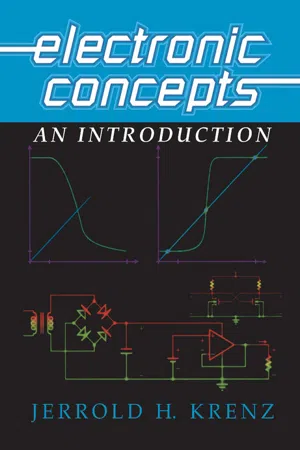 eBook - PDF
Electronic Concepts
An Introduction
- Jerrold H. Krenz(Author)
- 2000(Publication Date)
- Cambridge University Press(Publisher)
In addition, the design of diode circuits relies on one's ability to conceptualize the behavior of diodes. THE IDEAL DIODE SWITCH MODEL An approximate Diode Model, suitable for some applications, is that of a circuit element generally referred to as an ideal diode. It has the idealized characteristic of Figure 2.37. The voltage across an ideal diode, when it is forward biased (*D > 0), is zero, and its current, when reverse biased (VE> < 0), is zero. This model can be used to replace an actual semiconductor diode in a circuit when the voltages of the circuit are large compared with the small forward voltage of an actual diode. Because either the voltage or current of an ideal diode is zero, the diode may be treated as the ideal switch of Figure 2.38. The switch is either open, Figure 2.37: Actual and idealized characteristics of a diode. b i b + X i D = J v D = actual diode idealized diode 92 THE SEMICONDUCTOR JUNCTION DIODE D . . D Ideal open switch for v D <0 closed switch for i D > 0 Figure 2.38: Simulating the behavior of an ideal diode with a switch. corresponding to a reverse-biased condition, or closed, corresponding to a for-ward-biased condition. The condition of the switch depends on its voltage or cur-rent which, in turn, depends on the other elements of the circuit. It is necessary to make a binary logic decision as to the condition of the switch (decide if it is open or closed). The difficulty is that of ascertaining the correct condition. For some circuits, the choice may be obvious, whereas for others, especially if a circuit has several diodes, the choice may not be so obvious. If the decision is not obvious, it is necessary to guess and proceed using a trial-and-error solution. One solves the circuit for the initial decision; a simple analytic solution is generally possible if there are no other nonlinear elements. If it was assumed that the diode was reverse biased (an open switch), its resultant voltage must be negative.
- J. David Irwin, David V. Kerns, Jr.(Authors)
- 2022(Publication Date)
- Wiley(Publisher)
In the case of the ideal diode, the diode is a two-terminal, nonlinear device that passes current without any resistance in one direction and blocks the current with infinite resistance in the oppo- site direction. While this model does not give perfectly accurate results when used in analyzing circuits, it does provide generally an excellent estimate of the actual results. The actual diode structure and the symbolic representation of the model are repeated in Figure 9.7 where the p-type material is called the anode and the n-type material is referred to as the cathode. The V–I curve for the ideal diode is shown in Figure 9.8. This curve is a graphical display of the diode’s operation in which a voltage applied to the diode, positive at the anode and negative at the cathode, will cause infinite current to flow since the diode has zero resistance in this forward-biased direction. Correspondingly, in the reverse-biased direction, a negative voltage applied in the same manner results in zero current because the device has infinite resistance in p n I D I D V D V D FIGURE 9.7 Actual diode and symbolic representation structure I D V D FIGURE 9.8 V–I curve for ideal diode 278 CHAPTER 9 Diodes, Semiconductors and Applications FIGURE 9.9 Ideal diode and circuit models I D V D + – V D Ideal Diode Forward Biased Ideal Diode Reverse Biased Diode Symbol + – V D – + this situation. Because the diode has zero resistance in one direction and infinite resistance in the other, the diode acts essentially as a voltage-controlled switch, as indicated in Figure 9.9. While we have described the operation of the diode in isolation using the ideal model, the real issue is how do we describe the diode when it is in a circuit. The problem then becomes one of determining the voltage polarity the network is trying to place on the terminals of the diode.
- John Okyere Attia(Author)
- 2018(Publication Date)
- CRC Press(Publisher)
213 9 Diodes In this chapter, the characteristics of diodes are presented. Diode circuit analysis techniques will be discussed. Problems involving diode circuits are solved using MATLAB. 9.1 Diode Characteristics A diode is a two-terminal device. The electronic symbol of a diode is shown in Figure 9.1(a). Ideally, the diode conducts current in one direction. The current vs. voltage characteristics of an ideal diode are shown in Figure 9.1(b). The current-voltage (I-V) characteristic of a semiconductor junction diode is shown in Figure 9.2. The characteristic is divided into three regions: for-ward-biased, reversed-biased, and the breakdown. In the forward-biased and reversed-biased regions, the current, i , and the voltage, v , of a semiconductor diode are related by the diode equation (9.1) where I S is reverse saturation current or leakage current n is an empirical constant between 1 and 2 V T is thermal voltage, given by (9.2) and k is Boltzmann’s constant = 1.38 ¥ 10 –23 J/K q is the electronic charge = 1.6 ¥ 10 –19 C T is the absolute temperature in K At room temperature (25˚C), the thermal voltage is about 25.7 mV. i I e S v nV T = -[ ] ( / ) 1 V kT q T = 214 Electronics and Circuit Analysis Using MATLAB 9.1.1 Forward-Biased Region In the forward-biased region, the voltage across the diode is positive. If we assume that the voltage across the diode is greater than 0.1 V at room temperature, then Equation (9.1) simplifies to (9.3) For a particular operating point of the diode ( i = I D and v = V D ), we have (9.4) To obtain the dynamic resistance of the diode at a specified operating point, we differentiate Equation (9.3) with respect to v , and we have (a) (b) FIGURE 9.1 Ideal diode. (a) Electronic symbol; (b) I-V characteristics. FIGURE 9.2 I-V characteristics of a semiconductor junction diode. cathode anode i + V − i v forward-biased i 0 v reversed-biased breakdown i I e S v nV T = ( / ) i I e D S v nV D T = ( / ) di dv I e nV s v nV T T = ( / ) eBook - PDF
Fundamentals of Electronics
Book 1 Electronic Devices and Circuit Applications
- Thomas F. Schubert, Ernest M. Kim(Authors)
- 2022(Publication Date)
- Springer(Publisher)
While at first it is not always obvious which model will accurately predict the state of a diode in an electronic circuit, analysis using one model will produce results consistent with model assumptions: the other model will produce a result that contradicts the assumptions upon which that model is based. Example 2.1 For the simple ideal diode circuit shown, determine the current in the diode if: (a) V S D 1V (b) V S D 1V C NUL V S Ê I Solution: a) V S D 1 Choosing the short circuit model to replace the diode, the current, I , is found to be: I D 1=100 D 10 mA If the open circuit model is used to replace the diode, the current is found to be: I D 1=.100 C 1/ D 0 mA In the first case (the short circuit) the diode current (here, the same as I ) is within the restrictions of the model assumptions (I 0) and there is no contradiction to that model’s assumptions. In the second case the diode voltage violates the second model assumptions (V D 1 violates the model assumption, V < 0). us, the diode appears to act as a short circuit and the true value of the current given by: I D 10 mA: b) If the diode is replaced by its short-circuit model, the current is calculated to be: I D 1=100 D 10 mA is result violates the defining constraint for the model (I > 0). erefore, the open circuit model must apply: I D 1=.100 C 1/ D 0 mA: 66 2. DIODE CHARACTERISTICS AND CIRCUITS Here the voltage across the diode is 1 V which fulfills the defining assumption for the model. Consequently, the diode current is zero valued. While the studying the action of an ideal diode often provides useful insight into the op- eration of many electronic circuits, real diodes have a more complex V-I relationship. e funda- mental operation of a real semiconductor diode in its conducting and the non-conducting regions is discussed in Section 2.2.
- Dennis L. Eggleston(Author)
- 2011(Publication Date)
- Cambridge University Press(Publisher)
If these new pairs are produced in significant numbers, they can significantly alter the ability of the junction to conduct electricity. 80 Band theory and diode circuits This is the basis of the photo-diode , which is used in many applications as a light detector. 3.2 Diode circuits 3.2.1 Basic diode circuit analysis The semiconductor diode introduced in the last section has an unusual I–V char-acteristic: it conducts readily for forward bias but does not conduct very much for reverse bias (assuming the reverse bias is less than the breakdown voltage). As we will see, this unusual behavior allows us to use the diode for many purposes, but it also complicates the analysis of diode circuits. To see why this is true, consider the simple diode circuit shown in Fig. 3.16 . Applying KVL to this circuit we obtain V 0 − IR L − V d = 0 (3.11) where V d is the voltage across the diode. We also know the relationship between the current through the diode and the voltage across the diode: I = I 0 e eV d / kT − 1 . (3.12) Solving Eq. (3.11) for I and combining with Eq. (3.12) yields I = V 0 − V d R L = I 0 e eV d / kT − 1 . (3.13) In this last equation, the only unknown is V d . If we knew this, we could plug into any of the other equations and obtain I and we would be done. But Eq. (3.13) is a transcendental equation and cannot be solved analytically for V d , and herein is the complicating factor in the analysis of diode circuits. There are two standard ways of dealing with transcendental equations. One is to solve the equation numerically using a technique such as Newton’s Method. V 0 R L V d I Figure 3.16 Simple diode circuit. 3.2 Diode circuits 81 I V d V 0 V 0 R L Figure 3.17 Diode I – V characteristic and load line for the circuit of Fig. 3.16 . A second way is to solve the equation graphically, and this will help us to see some of the key features of the solution. eBook - ePub
- Muhammad H. Rashid(Author)
- 2017(Publication Date)
- CRC Press(Publisher)
7 Diode Rectifiers After completing this chapter, students should be able to do the following: • Model a diode in SPICE and specify its model parameters. • Perform transient analysis of diode rectifiers. • Evaluate the performance of diode rectifiers. • Perform worst-case analysis of diode rectifiers for parametric variations of model parameters and tolerances. 7.1 INTRODUCTIONA semiconductor diode may be modeled in SPICE by a diode statement in conjunction with a model statement. The diode statement specifies the diode name, the nodes to which the diode is connected, and its model name. The model incorporates an extensive range of diode characteristics such as DC and small-signal behavior, temperature dependency, and noise generation. The model parameters take into account temperature effects, various capacitances, and physical properties of semiconductors.7.2 Diode ModelThe SPICE model for a reverse-biased diode is shown in Figure 7.1 [1 ,2 ,3 ]. The small-signal and static models that are generated by SPICE are shown in Figures 7.2 and 7.3 , respectively. In the static model, the diode current, which depends on its voltage, is represented by a current source. The small-signal parameters are generated by SPICE from the operating point. SPICE generates a complex model for diodes. The model equations that are used by SPICE are described in Refs. [1 ,2 ]. In many cases, especially the level at which this book is aimed, such complex models are not necessary. Many model parameters can be ignored by the users, and SPICE assigns default values to the parameters.FIGURE 7.1 SPICE Diode Model with reverse-biased condition.FIGURE 7.2 SPICE small-signal Diode Model.FIGURE 7.3 Static Diode Model with reverse-biased condition.The model statement of a diode has the general form.MODEL DNAME D(P1=B1 P2=B2 P3=B3 … PN=BN)DNAME is the model name, and it can begin with any character; but its word size is normally limited to eight. D is the type symbol for diodes. P1, P2, … and B1, B2, … are the model parameters and their values, respectively. The model parameters are listed in Table 7.1 eBook - PDF
- Marc Thompson(Author)
- 2006(Publication Date)
- Newnes(Publisher)
43 CHAPTER 3 Review of Diode Physics and the Ideal (and Later, Nonideal) Diode Current Flow in Insulators, Good Conductors and Semiconductors In nature, from the point of view of the ease of producing current flow in a material, there are three broad classes of materials: insulators, conductors and semiconductors. Semiconductors and metals can support significant current flow but the charge movement mechanisms are dif-ferent in the two types of materials. How “good” an electrical conductor is can be quantified by material property electrical resistivity and/or its inverse, electrical conductivity. Electrical resistivity 2 is a measure of how well a given material conducts current. If there are lots of free charged carriers available, a material is deemed a good conductor. In This Chapter f The basics of bipolar devices are covered, including basic semiconductor physics, 1 the concepts of electron and hole flow in semiconductors, the differences between drift and diffusion flow, generation and recombination, and the effects of semiconductor doping on carrier concentrations. We finish with a discussion of the ideal diode, and illustrate how a diode can conduct forward current, but can also block reverse voltage. Detailed mathematical derivations are avoided wherever possible. However, enough mathematical detail is given so that the reader can discern the important scaling laws and functional dependencies of the ideal diode. At the end of the chapter we’ll discuss some of the factors that result in nonideal behavior in diodes. We’ll conclude with a discussion of load lines, a useful method for solving for the operating point of circuits with nonlinear devices. The load-line technique will be useful in later chapters in analyzing transistors. 1 W e will not go into the quantum mechanics of semiconductors, which provides the rigorous analyses. The simpler models developed in this chapter hopefully will give insight into the basics of semiconductor operation.
- Won Y. Yang, Jaekwon Kim, Kyung W. Park, Donghyun Baek, Sungjoon Lim, Jingon Joung, Suhyun Park, Han L. Lee, Woo June Choi, Taeho Im(Authors)
- 2019(Publication Date)
- Wiley(Publisher)
According to the approximation, the operation of a diode in the forward‐/reverse‐bias mode is represented by the equivalent model depicted in Figure 2.2 (b). 2.1.2 Small‐Signal Diode Model for Amplifying Operations Figure 2.3 (a) and (b) shows the high‐frequency AC models of forward‐/reverse‐biased diodes, respectively. Note that the junction (or depletion or transition) capacitance defined as the ratio of the incremental change (Δ q j) in the charge (in the depletion layer) to that (Δ v D) in the anode‐to‐cathode bias voltage v D can be expressed as Figure 2.2 PWL approximation of the v‐i characteristic curve of a diode and the corresponding model. Figure 2.3 High‐frequency AC (small‐signal) model of a diode. (2.1.3) where M : junction gradient coefficient, V j : (built ‐ in) junction potential with the value of 0.5∼0.9 V for a Si (silicon) diode and 0.2∼0.6 V for a Ge (germanium) diode, and C j0 : zero‐bias junction capacitance Note also that the diffusion (or transit time) capacitance due to the diffusion of carriers from anode to cathode in the forward‐bias mode can be expressed. as (2.1.4) where t T : transit or storage time taken for the charge to cross the diode, I Q : diode current at the operating point Q, η : emission coefficient or ideality factor, and, Note also that the dynamic resistance r d can be approximated as (2.1.5) 2.2 Analysis/Simulation of Diode Circuits The procedure of performing a large‐signal analysis for diode circuits can be summarized: Assume (guess) the ON/OFF state of each diode. For ON/OFF state, replace the diode by the forward‐/reverse‐bias model of each diode like the ones depicted in Figure 2.2 (b). Solve the circuit and verify the result and the assumptions: For a diode assumed to be ON (with v D ≈ V TD), the initial guess is justified if i D > 0; otherwise, i.e eBook - PDF
Analog Circuit Techniques
With Digital Interfacing
- T. H. Wilmshurst(Author)
- 2001(Publication Date)
- Butterworth-Heinemann(Publisher)
5 Semiconductor diode and power supplies Summary In Exercise 4.4 of the last chapter the semiconductor diode was found to be a device which passed current in one direction but not the other. Also • for significant current to flow in the forward direction a voltage of ≈ 600mV is required, • for applied voltages ≈ 600mV the transition from non-conduction to conduction is not quite abrupt, • as the frequency of the input signal is increased there is evidence of the diode capacitance. The first objective of this chapter is to give an under-standing of these properties. The other is to describe the way the diode is used as the rectifier in various kinds of DC power supply. The final section is mainly example calculations and detailed derivations, but with one or two experiments. 5.1 Semiconductors A semiconductor is a material with conducting properties intermediate between those of an insulator such as glass, and a conductor such as copper. The most commonly used semiconductor today is sili-con. Fig. 5.1 shows the atomic structure of a semicon-ductor. Here each atom has an outer shell with four elec-trons in it. These combine with the neighbouring electrons to constitute the complete 'covalent bonded' structure shown. The structure has zero overall charge, because the negative charge of the electrons is exactly balanced by the positive charge of the lattice of nuclei. Also the 'complete' nature of the structure means that none of the electrons is available for conduction. Thus so far the material is an insulator. Fig. 5.1 Covalent bonding of Silicon. Balls on a tray model The mathematical model describing this situation most completely is quantum theory. Another more homely model, that conforms reasonably well with the findings of the quantum theory, is the 'balls on a tray' model of Fig. 5.2. Fig. 5.2 Balls on a tray model of silicon semiconductor, locked in at absolute zero so no conduction. eBook - PDF
- Behzad Razavi(Author)
- 2021(Publication Date)
- Wiley(Publisher)
Did you know? What would our life be like without diodes? For- get about cell phones, laptops, and digital cameras. We would not even have radios, TVs, GPS, radars, satellites, power plants, or long-distance telephone communication. And, of course, no Google or Face- book. In essence, we would return to the simple lifestyle of the early 1900s—which might not be that bad after all . . . In summary, the analysis of circuits containing diodes (and other nonlinear devices such as transis- tors) proceeds in three steps: (1) determine—perhaps with the aid of the constant-voltage model—the ini- tial values of voltages and currents (before an input change is applied); (2) develop the small-signal model for each diode (i.e., calculate r d ); (3) replace each diode with its small-signal model and compute the effect of the input change. 10 A cellphone in reality draws a much higher current. 3.5 Applications of Diodes 89 3.5 APPLICATIONS OF DIODES The remainder of this chapter deals with circuit applications of diodes. A brief outline is shown in Fig. 3.28. Half-Wave and Full-Wave rectifiers Limiting Circuits Voltage Doublers Level Shifters and Switches Figure 3.28 Applications of diodes. 3.5.1 Half-Wave and Full-Wave Rectifiers Half-Wave Rectifier Let us return to the rectifier circuit of Fig. 3.10(b) and study it more closely. In particular, we no longer assume D 1 is ideal, but use a constant-voltage model. As illustrated in Fig. 3.29, V out remains equal to zero until V in exceeds V D,on , at which point D 1 turns on and V out = V in − V D,on . For V in < V D,on , D 1 is off 11 and V out = 0. Thus, the circuit still operates as a rectifier but produces a slightly lower dc level. V out V in D 1 R 1 t in V V D,on V D,on V out Figure 3.29 Simple rectifier. Example 3-23 Prove that the circuit shown in Fig. 3.30(a) is also a rectifier. V out V in D 1 R 1 t in V V out (a) (b) Figure 3.30 Rectification of positive cycles.
Index pages curate the most relevant extracts from our library of academic textbooks. They’ve been created using an in-house natural language model (NLM), each adding context and meaning to key research topics.

