Physics

Friction
Friction is a force that opposes the relative motion or tendency of such motion between two surfaces in contact. It is caused by the irregularities on the surfaces and is influenced by factors such as the nature of the materials and the force pressing the surfaces together. Friction plays a crucial role in understanding the behavior of objects in motion and at rest.
Written by Perlego with AI-assistance
Related key terms
1 of 5

11 Key excerpts on "Friction"
 eBook - PDF
Handbook of Lubrication and Tribology, Volume II
Theory and Design, Second Edition
- Robert W. Bruce(Author)
- 2012(Publication Date)
- CRC Press(Publisher)
5 -1 5.1 Introduction Friction, the resistance to relative motion between a solid body and another solid body or substance, is so common an everyday experience that it has been the source of philosophical contemplation and experimental investigation throughout history. Friction broadly encompasses not only fluid Friction in pipes, aerodynamic Friction, and the Friction between dry or wet sliding surfaces in mechanical parts like seals, brakes, bearings, gears, but also Friction in natural phenomena, ranging from human joints to tectonic plates. Because Friction takes so many forms, no universal, overarching theory or model suc-cessfully explains it. A common quantity used to describe the magnitude of Friction between sliding solid bodies is called the Friction coefficient (alternatively, the “coefficient of Friction”). It is the dimensionless ratio of two mutually perpendicular forces: a force that resists relative motion and a normal force that acts per-pendicular to the interface. A popular notion persists that the Friction coefficient is a single-valued, fundamental property of a given material pair. That presumption fails in the face of experimental evidence. The degree to which variables like normal force, relative velocity, directional changes in rela-tive motion, contact surface roughness, temperature, humidity, magnetic fields, and material proper-ties affect Frictional response is tribosystem dependent. This chapter considers the causes of Friction, the concepts that researchers have used to explain Friction, and the control of Friction in engineering systems. 5 Friction 5.1 Introduction ...................................................................................... 5 -1 5.2 Historical Studies of Friction .......................................................... 5 -2 5.3 Static and Kinetic Friction Coefficients ........................................ 5 -2 5.4 Frictional Transients and Instabilities ..........................................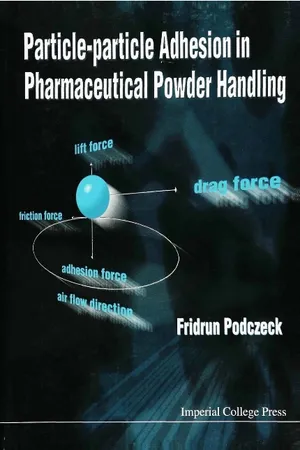
- Fridrun Podczeck(Author)
- 1998(Publication Date)
- ICP(Publisher)
CHAPTER 2 BRIEF OVERVIEW OF THE THEORY OF Friction 2.1 Definition and Importance of Friction Forces Surfaces in contact to each other are held by forces directed normally to the interface (adhesion) and tangentially to the interface (Friction). The latter be-come manifested if a relative displacement of the contacting surfaces is forced (Deryaguin et al. 1978a, pp. 380-381). This makes the Friction phenomenon important for all powder handling processes, where particles move along a sur-face (for example powder flow through a hopper) or change their position in a powder bed (for example during mixing). It has been estimated, that about 5 % of the gross national product in the developed countries is wasted due to uncontrolled Friction and wear (Persson 1995). However, Friction can be advantageous, for example, when driving a car, where the design and the sur-face profile can influence the Friction properties and hence the safety of driving (Tabor 1994). Friction should therefore not always be considered negatively. The Friction force expresses itself as a force directed to oppose the velocity vector of the moving solid body. Friction forces can be divided into a static and dynamic type depending upon the absence or type of relative motion between the surfaces in contact. A finite force i. e. yield stress must be applied to initiate motion, and Friction then arises from a transfer of energy between the surfaces in contact (Yoshizawa et al. 1993). The static Friction force is very often larger than dynamic Friction forces due to sliding or rolling (Bowden and Tabor 1954, p. 105; Heslot et al. 1994). Sliding Friction is characterized by a slippage of two surfaces over each other. Rolling Friction, however, does not involve any slippage, but can be described as a series of adhesion and detachment processes (Deryaguin et al. 1978a, p. 280), which causes one of two bodies in contact to roll over the surface of the second body. eBook - PDF
Theoretical Mechanics for Sixth Forms
In Two Volumes
- C. Plumpton, W. A. Tomkys(Authors)
- 2016(Publication Date)
- Pergamon(Publisher)
CHAPTER IX Friction 9.1. The Nature of Friction In Chapter II, § 2.6, Friction was defined as the component parallel to the reacting surface of the action of one body on another in contact with it. In conformity with Newton's third law, there is an equal and opposite component of reaction of the second body on the first. If there is no Friction between two surfaces in contact, an ideal concept which cannot be realised in the physical world, the surfaces in contact are said to be smooth. The amount of Friction between two surfaces is related to the roughness of the surfaces and to the normal reaction between them. The quality of roughness between two surfaces is too imprecise to permit of accurate mathematical definition and the normal reaction between two surfaces can be increased to a point at which the nature of the surfaces in contact is changed by the pressure between them. It is not possible, therefore, to construct a mathematical model of this physical phenomenon in action which is both accurate and comprehensive. Experi-mental data, however, suggest a set of rules, to which the force of Friction approximately conforms, which we adopt as the mathematical definition of the force and which gives an approximation to observed experimental results in cases where the normal reaction between the surfaces is not ab-normally great. 9.2. The Laws of Friction (a) Friction is a variable force between surfaces in contact which, sub-ject to an upper limit on its magnitude, is of such a magnitude and acts in such a direction as to prevent the motion of one surface over the other. So long as there is no relative motion between the surfaces, the direction of 229 230 THEORETICAL MECHANICS Friction is thus opposite to that direction in which the surface of the body on which it acts would move if there were no Friction, and its line of action is the line of action of the equilibrant of the forces acting on the body.
- H. D. Ram, A. K. Chauhan(Authors)
- 2015(Publication Date)
- Cambridge University Press(Publisher)
2 Friction 2.1 Introduction Friction is a kind of natural force. It develops between two surfaces in contact when either there is a tendency of relative motion or a relative motion works between them. Friction is not a reaction force. It has got numerous applications in day to day life. It is the Friction, which makes walking possible on the earth. There are situations where Friction is undesirable. For example, bearings, fluid transmission pipes, power screws, etc. There are many engineering applications where Friction is very much desirable like brakes, clutches, power transmission devices, etc. Frictional forces can be classified in following categories: (i) Dry Friction (ii) Wet Friction Dry Friction: The Friction between two solid surfaces is called dry Friction. Wet Friction: The Friction in thin film of liquid layer sandwiched between two solid surfaces is called wet Friction. Dry Friction is generally large compared to wet Friction. Lubricants are introduced to reduce the Friction between two solid surfaces. In this chapter, we shall confine the discussion to dry Friction only. Dry Friction can be further classified as: • Sliding Friction: The Friction between two plane surfaces, which slip or slide over each other, is called sliding Friction. • Rolling Friction: The Friction between rolling surfaces is called rolling Friction. Sliding Friction occurs when both the surfaces in contact are plane, whereas rolling Friction occurs when at least one of the surfaces is curved. 2.2 Nature of sliding Friction (i) Frictional force always tries to retard the relative motions between the surfaces in contact. Friction | 83 Suppose bodies A and B are in contact and are moving relative to each other (Figure 2.1a). Body B is moving to the right of A. The relative motion between two surfaces can be retarded by applying a force on A so that it moves towards left as shown in Figure 2.1b. eBook - PDF
- John Williams(Author)
- 2005(Publication Date)
- Cambridge University Press(Publisher)
4 The Friction of solids 4.1 The genesis of solid Friction 4.1.1 The laws of Friction Friction is the resistance encountered when one body moves tangentially over another with which it is in contact. The work expended against Friction is often redundant, that is, it makes no useful contribution to the overall operation of the device of which the bodies are part, and ultimately must be dissipated as waste heat. Consequently, in most tribological designs our aim is to keep these Frictional forces as small as possible. Of course there are exceptions to this general rule, occasions when sufficient Friction is essen-tial to continued progress and there are many practical devices which rely on the Frictional transmission of power: automobile tyres on a roadway, vehicle brakes and clutches, as well as several of the variable-speed transmis-sion systems now finding wider application. When two objects are to be held together, the only alternative to methods which rely on Friction is the forma-tion of some sort of chemical or metallurgical bond between them. The development of this sort of technique—adhesives and 'superglues', and even welding and brazing—are relatively recent; 'traditional' forms of fixing rely almost exclusively on Friction. A nail hammered into a piece of wood is held in place by Frictional effects along its length; if the Frictional interaction were substantially reduced, the nail would be squeezed out. Similarly, the grip between a nut and a bolt depends on adequate Friction between them. Any woven or knitted fabric depends on the Friction between adjacent threads — there are no glues or adhesives; it would be impossible to knot together two pieces of very-low-Friction string. As children we soon learn some of the qualitative laws of Friction. That, for example, it is much easier to slide a light object across a horizontal floor than a very much heavier one.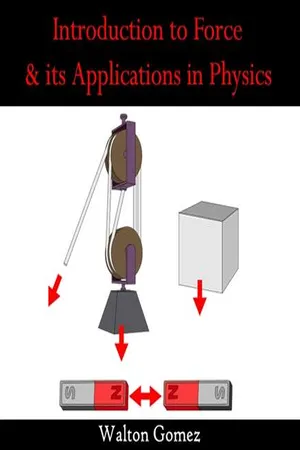 No longer available |Learn more
- (Author)
- 2014(Publication Date)
- Learning Press(Publisher)
Another important consequence of many types of Friction can be wear, which may lead to performance degradation and/or damage to components. Friction is a component of the science of tribology. Friction is not a fundamental force but occurs because of the electromagnetic forces between charged particles which constitute the surfaces in contact. Because of the complexity of these interactions Friction cannot be calculated from first principles, but instead must be found empirically. History Several famous scientists and engineers contributed to our understanding of dry Friction. They include Leonardo da Vinci, Guillaume Amontons, John Theophilus Desaguliers, Leonard Euler, and Charles-Augustin de Coulomb. Nikolai Pavlovich Petrov and Osbo-rne Reynolds later supplemented this understanding with theories of lubrication. ________________________ WORLD TECHNOLOGIES ________________________ Basic properties Basic properties of Friction have been described as laws: • Amontons' 1st Law : The force of Friction is directly proportional to the applied load. • Amontons' 2nd Law : The force of Friction is independent of the apparent area of contact. • Coulomb's Law of Friction : Kinetic Friction is independent of the sliding velocity. Amontons' 2nd Law is an idealization assuming perfectly rigid and inelastic materials. For example, wider tires on cars provide more traction than narrow tires for a given vehicle mass because of surface deformation of the tire. Dry Friction Dry Friction resists relative lateral motion of two solid surfaces in contact. The two regimes of dry Friction are static Friction between non-moving surfaces, and kinetic Friction (sometimes called sliding Friction or dynamic Friction) between moving surfaces. Coulomb Friction, named after Charles-Augustin de Coulomb, is an approximate model used to calculate the force of dry Friction. eBook - PDF
Engineering Science N2 Student's Book
TVET FIRST
- MJJ van Rensburg(Author)
- 2016(Publication Date)
- Troupant(Publisher)
150 M O D U L E Friction 6 Setting the scene 1. In a Frictionless world, how would you start the fire for your Saturday afternoon braai? 2. Give two advantages and two disadvantages of Friction in a motor car. 3. Does a higher speed have any effect on the Friction generated in an engine? Figure 6.1: When the match is struck on the striking surface of the box, the Friction produces enough heat to start a chemical reaction Objectives and overview When you have completed Module 6, you should be able to: • Define static Friction, kinetic Friction and the coefficient of Friction, and state the laws of Friction. • Name the advantages and disadvantages of Friction as well as applications of Friction in practice. • Represent all the forces acting on a body subject to Friction, on both horizontal and inclined planes, by means of a diagram. • Define the angle of rest. • Indicate and apply the relationship between the coefficient of Friction and the angle of Friction, and represent the angle of Friction diagrammatically. • Apply and manipulate the applicable formulae in order to calculate the coefficient of Friction, angle of Friction, weight components and the effective upward and downward pulling forces. Introduction Friction is a force that exists between any two surfaces that are in contact with each other. A Frictional force opposes motion when the surface of one object moves across another surface or makes an effort to move across it. A smooth surface will result in less Friction, while a rough surface will result in more Friction. The force of gravity aggravates (worsens) the effect of Friction, as will be seen later in this module. 151 There are two types of Friction, kinetic Friction and static Friction : • Kinetic Friction (also called sliding Friction) opposes the movement of a body that is already in motion. The air resistance experienced by a runner is a form of kinetic Friction. • Static Friction prevents an object from moving when it is at rest. eBook - PDF
Friction and Wear
Calculation Methods
- I V Kragelsky, M N Dobychin, V S Kombalov(Authors)
- 2013(Publication Date)
- Pergamon(Publisher)
Chapter 5 DRY A N D BOUNDARY Friction BASIC DEFINITIONS Surface Friction is an energy dissipative process vdiich takes place with relative tangential displacement of contacting solids in zones of real contact between them formed by the action of an external load. Depending on the type of displacement (Fig. 1), it is possible to distinguish three types of Friction, i.e. sliding Friction, rotating Friction, and rolling Friction (this is not discussed in this Chapter). The concept of Friction force Τ is introduced for quantitative evaluation of Friction. The Friction force is the resultant of the tangential resistance forces arising at real contact points when one body slides along the surface of another, and is a non-potential force. Rotating Friction is characterized by a Friction force moment. In passing from rest to sliding, there is a preliminary displacement region (i.e. section OA in Fig. 2) . Ihe tangential resistance under preliminary displacement conditions is called the inconnplete Friction force, although a better name would be the adhesion force, since it is partially potential in character.* The full stationary Friction force corresponds to a transition fron preliminary displacement to sliding (point A) , and is conditionally called static Friction. After preliminary displacement stable sliding starts, characterized by a sliding Friction force (line AiB) . Depending on the problem posed, Friction can be evaluated by a force or a moment. Friction on inpact is characterized by a change in the quantity of motion. In engineering practice Friction is evaluated by means of three dimensionless quantities: (1) The coefficient of sliding Friction, vdiich is the ratio of the Friction force to the normal load / = T/N In certain cases such adhesion is called leading or creep Friction, but this is undesirable since Friction is a dissipative process, and leading Friction is partially characterized by processes occurring during elastic deformation. 156 eBook - PDF
Surface Physics
Theoretical Models and Experimental Methods
- Marina V. Mamonova, Vladimir V. Prudnikov, Irina A. Prudnikova(Authors)
- 2016(Publication Date)
- CRC Press(Publisher)
In Friction, mechanical, thermal, electrical and chemical processes occur at the same time. Friction strengthens or softens the material, damages the surface of materials in the Friction pair, followed by an increase in Friction and wear or is a self-organizing process in which the transfer of material from one surface to another causes, on the contrary, decreased wear and Friction with the improvement in the overall tribological characteristics of the section [47]. Research and development of the theory of Friction and wear cover a long period of time (the history of studies of Friction dates to the days of $ULVWRWOH DQG /HRQDUGR GD 9LQFL 'HVSLWH WKH IDFW WKDW WKH ZRUG µIULFWLRQ¶ is known to everyone, even the experts often have difficulty in explaining this phenomenon. By the nature of the relative motion there is sliding Friction and rolling Friction. Sometimes both types of Friction occur together, when rolling is accompanied by sliding, for example, in gear–screw transmissions or between wheels and rails. It is necessary to distinguish between the internal Friction as the resistance of the same body to relative displacement, and the external Friction of solids, or simply Friction, which will now be considered. From everyday experience we know that if two bodies are in contact with each other, their relative displacement requires some tangential force. When this force increases from zero up to a certain magnitude, the contact zone shows having micro-displacements called preliminary displacement . 242 Surface Physics Preliminary displacement, due to deformation of the body, primarily deformation of the irregularities of their surfaces under the influence of shearing force, preceeds the relative macrodisplacement of bodies. But the bodies themselves remain motionless until the tangential force does not reaches the limiting value, called the static Friction force F s (Fig. 8.1). eBook - PDF
- Ping YI, Jun LIU, Feng JIANG(Authors)
- 2022(Publication Date)
- EDP Sciences(Publisher)
Chapter 5 Friction Objectives Examine characteristics of Friction. Solve equilibrium problems involving Friction force. Understand the concept of rolling resistance. 5.1 Characteristics of Friction Prior to this chapter, we always assume that the contacting surface is smooth and the Friction is neglected. This is because for many engineering problems, the effect of Friction is often very small and can be neglected. However, sometimes Frictional forces play an important role. For example, a car brake just utilizes the Friction force to stop the car; for a gravity dam or a retaining wall, the Friction force is an important factor to hold the dam or the slope in equilibrium, figure 5.1. For these cases, the Friction cannot be neglected. FIG. 5.1 – Engineering cases in which Friction plays an important role. DOI: 10.1051/978-2-7598-2901-9.c005 © Science Press, EDP Sciences, 2022 Friction can be defined broadly as a resistance that occurs between two surfaces in contact when they tend to move relative to each other. Based on the relative movement between the two surfaces, there are two kinds of Friction. When the two contacting bodies tend to slide relative to each other, figure 5.2a, there is sliding Friction; whereas when they tend to roll relative to each other, figure 5.2b, rolling resistance occurs. This chapter will mainly discuss sliding Friction and give a brief introduction to rolling resistance. Friction can also be classified as fluid Friction and dry Friction. If the contacting surfaces are separated by a thin layer of liquid or gas, it is fluid Friction; whereas dry Friction occurs when there is no lubricating fluid between the contacting surfaces. In this book only the effects of dry Friction will be considered. 5.1.1 Laws of Sliding Friction A simple experiment is used to discuss sliding Friction. The block having weight P rests on the rough horizontal ground and horizontal force F is exerted on the block, as shown in figure 5.3a.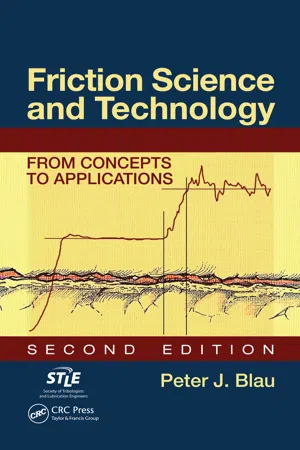 eBook - PDF
Friction Science and Technology
From Concepts to Applications, Second Edition
- Peter J. Blau(Author)
- 2008(Publication Date)
- CRC Press(Publisher)
Immediately adjacent to the surface of the solid, the fluid assumed a regular, crys-talline structure, but this was disrupted during slip events. Experimental plots of Friction force per unit area versus time exhibited extremely uniform, “classical” stick-slip appearance. Once slip occurs, all the kinetic energy must be reconverted Simple interferometer Bent tungsten wire with sharp tip Plane of the specimen surface FIGURE 4.10 Principle of the atomic force microscope used by McClelland et al. (Adapted from McClelland, G.M., Mate, C.M., Erlandsson, R., and Chiang, S., Adhesion in Solids , Materials Research Society, Pittsburgh, PA, 1988.) 2.0 1.0 0.0 Friction force (10 − 7 N) 0.0 5.0 10.0 Sample position (nm) Normal force 5.6 × 10 − 5 N FIGURE 4.11 Atomic-scale periodicity of the Friction force. (Adapted from McClelland, G.M., Mate, C.M., Erlandsson, R., and Chiang, S., Adhesion in Solids , Materials Research Society, Pittsburgh, PA, 1988.) Fundamentals of Sliding Friction 135 into potential energy. In subsequent papers 28,29 the authors used this argument to calculate the critical velocity v c below which the stick-slip occurs: c S c M F 1 2 / (4.7) where σ is the lattice constant of the wall, F S the static Friction force, M the mass of the moving wall, and c a constant. Friction might simply be defined as the resistance to relative motion between two contacting bodies parallel to a surface that separates them . Motion at the atomic scale is invariably unsteady. One struggles to define the physical boundaries of the “surface that separates them.” In nanocontact, accounting for the tangential com-ponents of thermal vibrations of the atoms thus affects our ability to clearly define “relative motion” between surfaces. Furthermore, under some conditions it may be possible to translate the surface laterally while the adhesive force between the probe tip and the opposite surface exceeds a small externally applied tensile force.
Index pages curate the most relevant extracts from our library of academic textbooks. They’ve been created using an in-house natural language model (NLM), each adding context and meaning to key research topics.

