Physics

Hertzsprung-Russell Diagrams
Hertzsprung-Russell diagrams are graphical representations of stars' luminosity and temperature. They plot stars on a graph with luminosity on the y-axis and temperature on the x-axis, allowing astronomers to classify stars into different categories based on their position on the diagram.
Written by Perlego with AI-assistance
Related key terms
1 of 5

8 Key excerpts on "Hertzsprung-Russell Diagrams"
 eBook - ePub
Burnham's Celestial Handbook, Volume One
An Observer's Guide to the Universe Beyond the Solar System
- Robert Burnham(Author)
- 2013(Publication Date)
- Dover Publications(Publisher)
THE H-R DIAGRAM or color-magnitude diagram is a graph upon which stars are plotted by spectral type and actual luminosity. It is named for the two scientists Russell and Hertzsprung who first used it in 1913 in one of the early attempts to arrange the many types of stars into a meaningful system. A typical H-R Diagram is shown on the following page. The vertical coordinate represents absolute magnitude or actual luminosity in terms of the Sun, with the most luminous stars near the top and the faintest near the bottom. The horizontal coordinate represents color, temperature, or spectral type, all of which are naturally interrelated. The hottest stars are at the left, and the coolest toward the right.The stars plotted on this diagram represent a fairly typical selection of the various stellar types. They include the majority of the stars within a few hundred light years for which the necessary information has been obtained. The most evident fact is that the plotted points are not distributed randomly over the graph, but appear to be restricted to certain definite areas. The main feature is a long band running across the graph from upper left to lower right, demonstrating the existence of a large “family” of stars which range from blue, hot, and bright, down to red, cool, and faint. This band is called the “Main Sequence ” and includes all the stars which are operating primarily on the hydrogen-to-helium nuclear reaction. Thus the position of a Main Sequence star depends upon its mass, the more massive stars being naturally hotter and more luminous. Stars in the upper left portion of the graph are thus rather massive objects, in some cases ranging up to 60 or more solar masses. In contrast, any star which falls near the lower right end of the Main Sequence is probably an extreme lightweight among stars, containing less than 10 percent the mass of the Sun.The HERTZSPRUNG-RUSSELL DIAGRAM. This color-magnitude graph shows the various types of stars which exist within a few hundred light years of the Sun. (For explanation, refer to the text.) eBook - ePub
Investigating Life in the Universe
Astrobiology and the Search for Extraterrestrial Life
- Christopher K. Walker(Author)
- 2023(Publication Date)
- CRC Press(Publisher)
Boltzmann 1884 ). It relates three fundamental properties of black bodies: luminosity, temperature, and size. In the case of stars, the temperature can be inferred from their spectral class and the luminosity determined from knowledge of their apparent brightness and distance.4.5 The Hertzsprung–Russell (H–R) Diagram
The next step in understanding the true nature of stars began by comparing the spectral classification and brightness of stars located at the same distance from Earth. This was first done in a paper by Hans Rosenberg in 1910, where he made an x–y plot of the apparent brightness of members of the Pleiades star cluster as a function of spectral type as determined from the strength of their hydrogen and calcium absorption lines (see Figure 4.5 ). Looking at the plot, the first thing he noticed was that the brightness of the stars was “a pure function” of their spectral type. Since members of the cluster are effectively at the same distance from the Earth, this meant that the power output, i.e., luminosity, of each star was also a function of spectral type. Shortly after, a more well-known paper showing similar results for both the Pleiades and Hyades star clusters was published by Ejnar Hertzsprung (Hertzsprung 1911 ).FIGURE 4.5First plot of Stellar Brightness vs. Spectral Class. The dots represent members of the Pleiades star cluster. Since they are at approximately the same distance, their brightness can be compared directly. A clear correlation between brightness and spectral class can be seen. Image: adapted from Rosenberg 1910 .While observing stars in clusters provides a means of assessing the relative properties of stars within a cluster without knowledge of the actual distance to the cluster, the true absolute magnitude and therefore the luminosity of stars remains unknown. However, by the spring of 1913, the distances to several hundred stars had been determined using the parallax technique described in Figure 3.5 . These distance determinations together with the associated stellar classifications allowed Henry Russell to make the first “modern” diagram of stellar absolute magnitude versus spectral type (Russell 1913 ; see Figure 4.6 ). This diagram, now referred to as the Hertzsprung–Russell or H–R diagram, will turn out to be as important for understanding stellar evolution as Hubble’s diagram (Figure 3.14 eBook - PDF
The Drake Equation
Estimating the Prevalence of Extraterrestrial Life through the Ages
- Douglas A. Vakoch, Matthew F. Dowd(Authors)
- 2015(Publication Date)
- Cambridge University Press(Publisher)
Even so, he cautioned that his derivation was preliminary because he had assumed that the variation of absorption in latitude was independ- ent of longitude and that the decrease in density was constant anywhere in the galaxy in a direction perpendicular to the plane. Through the rest of the 1930s, van Rhijn’s followers, including Willem J. Luyten, worked to refine the luminosity function. Van Rhijn’s application of Robert Trumpler’s open cluster studies, dating from the late 1920s, brought to bear another descriptive correlative tool that had been articulated first by Ejnar Hertzsprung using mean proper motion data and then independently by Henry Norris Russell using parallax data, known today as the H–R diagram (DeVorkin 1978; 2000). Indeed, since its discovery in the first decades of the century, what was called at first the Russell diagram and then the H–R diagram has become a powerful tool for exploring the stellar universe, specifically theories of how stars are born and live their lives. Equating the intrinsic brightness of stars against their observed colors (interpreted as temperature), they found that the vast majority of stars occupy a diagonal band called the main sequence, from bright blue stars at the upper left to dim red stars at the lower right. But there were a few stars, both blue and red, that were all intrinsically bright. Astronomers soon adopted these two sequences as two classes of stars, distinguished by size: the main sequence contained the “dwarfs” and the bright ones were the “giants.” Moreover, the H–R diagram demonstrated that the vast majority of stars were associated in a definite sequence that to both Russell and Hertzsprung had evolu- tionary significance. Russell, more explicitly, viewed it as evidence that stars began their lives as red giants, and under gravitational contraction heated to the Rate of formation of stars suitable for intelligent life, R*, pre-1961 31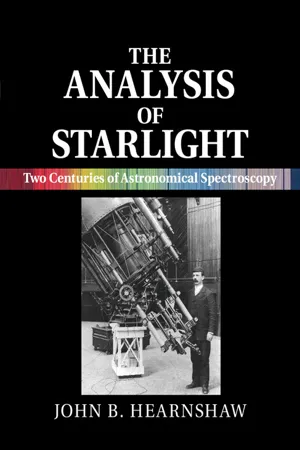 eBook - PDF
The Analysis of Starlight
Two Centuries of Astronomical Spectroscopy
- John B. Hearnshaw(Author)
- 2014(Publication Date)
- Cambridge University Press(Publisher)
The Russell diagram employed Harvard spectral types for the temperature-related parameter. It is quite possible that Pickering, who had met Russell at the April 1908 meeting of the Astronomical and Astrophysical Society, had himself suggested that Russell use the Harvard classifications in the interpretation of the stars on Russell’s parallax programme [19]. It is interest- ing to note that both Hertzsprung and at first Russell (at the London RAS meeting) 4 had plotted absolute magni- tude (i.e., luminosity) on the horizontal scale. However, in Atlanta this diagram was now shown rotated clockwise through 90 ◦ but not inverted. Astronomers traditionally have ever since plotted these diagrams with the absolute magnitude decreasing towards the top. Russell acknowledged Hertzsprung’s work at this time when discussing the division between dwarf and giant stars. He wrote: ‘All I have done in this diagram is to use more extensive observational material’ [16]. In any event, both Hertzsprung’s and Rosenberg’s colour-magnitude diagrams for clusters continued to be relatively neglected, while the diagram of the Princeton astronomer became widely known as the ‘Russell diagram’. This designation stuck for two decades, until Hertzsprung’s earlier work was once again rescued and properly acknowledged, this time by a young fellow Dane, Bengt Strömgren, who first used the title ‘Hertzsprung–Russell diagram’ in a lecture at a meeting of the Astronomische Gesellschaft in Göttingen in August, 1933 [20]. Hertzsprung’s modesty was unaffected by this belated recognition. He is quoted as saying: ‘Why not call it the colour-magnitude diagram? Then we would all know what it is about’ [21]. 3 In December 1908 Schwarzschild referred to some stars as ‘Giganten’ when discussing Hertzsprung’s work in a lecture to the Wissenschaftliche Verein in Berlin [17]. 4 Reference [16] contains no diagrams; but these were presented at the RAS meeting and described by Russell in the published text. eBook - ePub
- Cesare Barbieri, Ivano Bertini, Elena Fantino(Authors)
- 2020(Publication Date)
- CRC Press(Publisher)
From the Stefan–Boltzmann law, we expect that stars can have any combination of radius and temperature, so that the distribution of stars in the plane (log L, log T) or in any of the equivalent planes (M bol, log T), (M bol, B–V), (M v, B–V) should be a uniform one. We shall refer in the following to any of those planes as a Hertzsprung–Russell (H–R) diagram. Observations prove instead that uniform distribution is not the case: stars are preferentially found in well-defined regions of the H–R diagram. Given the temperature, the radius assumes specific values only, for reasons that must be intrinsic to the equilibrium structure of the star. This behavior is represented in Figure 16.10. Figure 16.10a shows the diagram obtained by using data of the Hipparcos astrometric satellite; this sample of stars is therefore within approximately 50 parsec of the Sun. GAIA has obtained data of higher precision on a larger number of stars, but on a different photometric system. Therefore, for consistency with the previous discussion, we retain here the Hipparcos data, as sufficiently representative of the basic considerations. See “Notes” section for a further discussion of the GAIA data. Figure 16.10b shows the theoretical H–R diagram, which can be obtained from the Stefan–Boltzmann law; the diagonal lines are lines of equal radii in units of the solar radius. Stars do not uniformly fill the plane, and they preferentially populate a main sequence, two high radii sequences (giants and supergiants, at 100 and 1000 solar radii) and a low radius sequence (white dwarfs, at 0.01 solar radius). FIGURE 16.10 (a) The position of nearby stars in the (M v, B–V) plane, from Hipparcos data. (b) Observational data superimposed to the theoretical H–R diagram; the diagonal lines are lines of equal radii in units of the solar radius. The observational data represented by the two-color and H–R diagrams are at the very basis of all theories of stellar structure and evolution eBook - PDF
- David Martínez-Delgado(Author)
- 2013(Publication Date)
- Cambridge University Press(Publisher)
In the case of the CMD, Russell called it in private the “Russell diagram,” but this was not accepted in public, as the contribution by Hertzsprung (unlike Rosen- berg’s) was well and widely known. Russell pored over the astronomical journals and was well aware of Hertzsprung’s results. We know he read the Astronomischen Nachrichten systematically, as one of the leading journals of the time, and that he was well aware of Hertzsprung’s papers, just as was his mentor, E. C. Pickering, who received them and wrote to Hertzsprung discussing several issues in spectral classification. Russell wrote to Hertzsprung on September 27, 1910, thanking him for sending copies of his papers (Hearnshaw, 1986). Hertzsprung’s (1911) paper contained the CMDs of the Hyades and the Pleiades, citing explicitly the previous -and pioneering-work by Rosenberg (1910). 1 A translation into English is available at Leos Ondra’s website www.leosondra.cz/en/ first-hr-diagram. 192 Tutorial: The analysis of color-magnitude diagrams 193 With the rising influence of European (mostly Dutch) astronomers in the United States, the issue of the proper acknowledgment became very serious and created frictions and debate within the community. After two decades, the “Russell diagram” became known as the Hertzsprung-Russell diagram, thanks in part to the influential conference delivered in 1933 by B. Str¨ omgren at the meeting of the Astronomische Gesellschaft, but much to the irritation of many, including Russell himself who even refused to acknowledge that Hertzsprung had found (and coined the terms) “giant” and “dwarf” stars (Smith, 1977). The (proper) renaming of the diagram was a long battle that lasted till the late 1940s, when S. Chandraskhar, advising the Astrophysical Journal and tired of the controversy, decided that the standard nomenclature would be the “H–R Diagram” (Devorkin, 2000). eBook - ePub
- James Lequeux(Author)
- 2013(Publication Date)
- WSPC(Publisher)
Figure 2.4 shows the HR diagram of stars in a cluster aged 4 billion years, M 67.Figure 2.2.Left, the Hertzprung–Russell diagram (HR diagram) obtained with the HIPPARCOS satellite for the brightest stars of the sky: © ESA. It contains 4 907 stars whose distance is known to better than 5%. The colours indicate the representative points for which there are more than one star. To identify the different types of stars see Fig. 2.3 . Right, the HR diagram for 1090 stars contained in a small volume around the Sun: from Jahreiss, H. & Gliese, W. (1993) IAU Symposium 156, 107. It gives a better idea of the proportions of the different types of stars. Notice in particular the small number of giants and the large quantity of white dwarfs.The B–V, Mv diagram can be transformed into a diagram where L is plotted as a function of Teff . We obtain in this way the theoretical HR diagram, which can be easily compared to the predictions of models of stellar evolution.The mass of stars can only be determined accurately by observation of eclipsing binary stars, for which one of the components passes alternatively in front and behind the other, producing variations in the light received from the system: in this case, the Earth is approximately in the plane of the orbit. After measuring the radial velocity of the components by spectroscopy using the Doppler–Fizeau effect, we apply Kepler’s laws to obtain the masses of the individual stars.1 The comparison of the masses obtained in this way with luminosities give a remarkable result: for main sequence stars, mass is closely related to luminosity (Figure 2.5 ). The more massive the star, the more luminous it is. We derive from this an important property: the lifetime on the main sequence is shorter for more massive stars. Indeed, this lifetime goes like the ratio of the mass (the reservoir of energy) with luminosity (the rate of consumption of this energy). The lifetime of the Sun is of the order of 10 billion years, but that of a 10 M eBook - ePub
The Scientific Companion, 2nd ed.
Exploring the Physical World with Facts, Figures, and Formulas
- Cesare Emiliani(Author)
- 2008(Publication Date)
- Trade Paper Press(Publisher)
Massive stars have relatively short lives because they burn their fuel very fast. They may last only 10 million to 100 million years, compared with 10 billion years for a “regular” star like the sun. Because the universe was created 15 billion years ago, many generations of massive stars have come and gone, continuously enriching the universe in the heavier elements. Stars that were formed when the universe was young have 100 to 1000 times less iron and other heavy elements than the solar system. The earth is rich in these elements because the solar system was born “only” 4.5 billion years ago, when the universe was already more than 10 billion years old.THE HERTZSPRUNG – RUSSELL DIAGRAM
The evolution of stars, large and small, can be followed by plotting the stars on a luminosity-versus-surface temperature graph, called the Hertzsprung – Russell diagram (Figure 5.5 ). Luminosity is the total power produced by a star. In order to determine the luminosity of a star, we must know its distance. The brightness of a star (how bright it looks to us) depends on distance. A star may appear bright only because it is relatively close. After all, the sun itself is a star of average luminosity. It looks very bright only because it is very close to us.There are many methods of determining the distance of a star from Earth, none of which is very accurate. But once the distance is known, at least approximately, the star’s luminosity can be determined by measuring the energy received and applying the inverse square law.The inverse square law is based on the formula for the surface of a sphere.S = 4πr 2where S is the surface; π (= 3.14159 . . .) is the ratio of the circumference of a circle to its diameter (π, pronounced pie, is the Greek letter for p ); and r is the radius of the sphere. Consider, for instance, the sun. Its mean distance from the earth, called astronomical unit, is 149,597,870,700 m. The surface S of a sphere having this radius will beFIGURE 5.5 The Hertzsprung – Russell diagram. In this diagram are plotted stars of known luminosity and surface temperature. The wavy band of stars, running from top left (high temperature-high luminosity) to bottom right (low temperature-low luminosity) is the main sequence. Mass increases from bottom right to top left along the main sequence. Mass is the most fundamental characteristic of a star, determining its life-style and longevity. Stars spend most of their lives in the main sequence. Stars with cores below the Chandrasekhar limit evolve into red giants → red supergiants → white dwarfs → dark dwarfs. Stars with cores above the Chandrasekhar limit evolve into red giants → supernovae. M• = solar mass. (Emiliani C. 1987, Dictionary of the Physical Sciences , p. 99, Oxford University Press, New York, modified from Rigutti M. 1984, A Hundred Billion Stars
Index pages curate the most relevant extracts from our library of academic textbooks. They’ve been created using an in-house natural language model (NLM), each adding context and meaning to key research topics.

