Physics

Classification of Stars
Classification of stars is a system of categorizing stars based on their spectral characteristics. The classification is based on the temperature, color, and spectral lines of a star. The most commonly used classification system is the Morgan-Keenan (MK) system.
Written by Perlego with AI-assistance
Related key terms
1 of 5

12 Key excerpts on "Classification of Stars"
 eBook - PDF
- Kristine M. Larsen(Author)
- 2007(Publication Date)
- Greenwood(Publisher)
18 Cosmology 101 THE Classification of Stars Although many people are under the impression that all stars are white, a careful survey of the night sky will convince them that this is really not the case. Some stars appear yellowish, like our sun, while others exhibit varying intensities of blue, orange, or red. As we have already seen, the color of stars is determined by their surface temper- ature, through Wien’s law. Stars also differ in size and true brightness (luminosity or absolute magnitude), with these properties related to the temperature through the Stefan–Boltzmann law. Astronomers use these properties to classify stars into various groupings, and then utilize this information to study their lives and deaths. It bears repeating that most of what astronomers learn about stars is achieved by studying their spectra. This includes composition and mo- tion. In this vein, Annie Jump Cannon lauded the universe’s “Patient light! Shining down on humanity these countless centuries until man became clever enough to wrest from its vibrations the secrets so closely concealed” (1941, 56). It is therefore natural to ask if stars exhibit differ- ent types of spectra and if so, what inherent properties are responsible for these differences. The answer was first noted by Fraunhofer himself around 1814. Not only did he study the spectral lines of the sun, but he found that some bright stars had similar spectra, while others had spectra with differing appearances. The first significant classification sys- tem was done by Jesuit priest and astronomer Father Angelo Secchi in the 1860s. His equipment was crude by modern standards, and he was limited to making drawings at the eyepiece (as Fraunhofer had done), but he was still able to divide stellar spectra into five basic classes. Type I stars, including Sirius, were bluish-white in color (and therefore hot- ter than the sun). eBook - PDF
- James Binney, Michael Merrifield(Authors)
- 2021(Publication Date)
- Princeton University Press(Publisher)
After the system has been defined and the classification carried out, one then calibrates the system in terms of physical parameters, such as stellar temperature luminosities, compositions, and so on. Quantitative estimates of these parameters are derived for each spectral type by performing a de-tailed spectrum analysis on a typical member of that type. At that point one can say that, if some star has a certain spectral type, then the temperature, 90 Chapter 3: The Properties of Stars luminosity, or other property appropriate to that type can be assigned to it without further analysis. The spectral type thus gives a concise description of both the spectrum and the physical properties of a star. In practice, classification is normally done by visual inspection of spec-tra of moderate dispersion, and can be carried out for large numbers of stars. Pioneering work in spectral classification was done in the 1860s by A. Secchi, who divided stars into four broad spectral classes. Parallel efforts were made at about the same time by W. Huggins and H.C. Vogel. The first great steps toward our present system were made at Harvard College Observa-tory in 1890. Under the direction of E.C. Pickering, Williamina P. Fleming published a catalog of 10,000 stars grouped into a system of spectral types denoted by the letters A, B, C, and so on. In 1888, Antonia C. Maury, without benefit of astrophysical data (which were almost nonexistent at the time), rearranged these spectral types into the order that has been used ever since, solely by studying the progression of line patterns observed in the spectra. Subsequently, Annie J. Cannon introduced decimal subdivi-sions of the spectral types, and, in the four years from 1911 she classified ~ 225 000 stars on this system - these classifications were published as the classical Henry Draper Catalog [Cannon & Pickering (1918-1924), Cannon (1925-1936), Cannon & Mayall (1949) - see Appendix B]. eBook - PDF
- Carlos Jaschek, Mercedes Jaschek(Authors)
- 1990(Publication Date)
- Cambridge University Press(Publisher)
Part 1 1 Stellar taxonomy Taxonomy, according to the dictionary, is the classification of objects into ordered categories. All natural sciences - botany, zoology, geology - classify the objects of their study: in a certain sense, taxonomy is the backbone of everything else. The classiGcation can be done on the basis of a single observable property of the objects, or a combination of properties. For instance, Linnaeus used plants' flowers for his botanical classification system, but modern authors use a variety of plant characteristics. In astronomy, the main difficulty consists in that the objects are far away and we can study certain properties only for a rather small number of objects. Whereas for a plant, an animal or a rock we can search leisurely for those parameters which are best for classification purposes, and then measure the parameters in all plants of a certain type, such an operation is impossible in astronomy. In fact the astronomer must use those parameters which are available for a large number of stars, even if they might turn out not to be the best for classification. Stellar parameters that can be estimated or measured are temperature, color, spectral type, proper motion, radial velocity, radius, magnetic field, rotational velocity, chemical composition and so on. It is obvious that one essential condition for classification is that the parameter used should be known for a large number of objects. Table 1.1 summarizes for how many stars these parameters are known; the numbers are taken from compilations existing at the Centre de Donnees Stellaires (CDS). For comparative purposes let us recall that the number of stars brighter than visual magnitude V = 9 is about 5.5 x 10 5 . Obviously, only the first three parameters in the table are potentially useful for stellar taxonomy, because all the others are known for comparatively few stars. We then have to drop proper motion from our list because the information it No longer available |Learn more
- (Author)
- 2014(Publication Date)
- University Publications(Publisher)
________________________ WORLD TECHNOLOGIES ________________________ Chapter- 9 Stellar Classification In astronomy, stellar classification is a Classification of Stars based on their spectral characteristics. The spectral class of a star is a designated class of a star describing the ionization of its chromosphere, what atomic excitations are most prominent in the light, giving an objective measure of the temperature in this chromosphere. Light from the star is analyzed by splitting it up by a diffraction grating, subdividing the incoming photons into a spectrum exhibiting a rainbow of colors interspersed by absorption lines, each line indicating a certain ion of a certain chemical element. The presence of a certain chemical element in such an absorption spectrum primarily indicates that the temperature conditions are suitable for a certain excitation of this element. If the star temperature has been determined by a majority of absorption lines, unusual absences or strengths of lines for a certain element may indicate an unusual chemical composition of the chromosphere. Most stars are currently classified using the letters O , B , A , F , G , K , and M (usually memorized by astrophysicists as Oh, be a fine girl/guy, kiss me), where O stars are the hottest and the letter sequence indicates successively cooler stars up to the coolest M class. According to informal tradition, O stars are called blue, B blue-white, A stars white, F stars yellow-white, G stars yellow, K stars orange, and M stars red, even though the actual star colors perceived by an observer may deviate from these colors depending on visual conditions and individual stars observed. The current non-alphabetical scheme developed from an earlier scheme using all letters from A to O ; the old letters were retained but the star classes were re-ordered in the current temperature order when the connection between the stars' class and temperatures became clear. eBook - ePub
Investigating Life in the Universe
Astrobiology and the Search for Extraterrestrial Life
- Christopher K. Walker(Author)
- 2023(Publication Date)
- CRC Press(Publisher)
Boltzmann 1884 ). It relates three fundamental properties of black bodies: luminosity, temperature, and size. In the case of stars, the temperature can be inferred from their spectral class and the luminosity determined from knowledge of their apparent brightness and distance.4.5 The Hertzsprung–Russell (H–R) Diagram
The next step in understanding the true nature of stars began by comparing the spectral classification and brightness of stars located at the same distance from Earth. This was first done in a paper by Hans Rosenberg in 1910, where he made an x–y plot of the apparent brightness of members of the Pleiades star cluster as a function of spectral type as determined from the strength of their hydrogen and calcium absorption lines (see Figure 4.5 ). Looking at the plot, the first thing he noticed was that the brightness of the stars was “a pure function” of their spectral type. Since members of the cluster are effectively at the same distance from the Earth, this meant that the power output, i.e., luminosity, of each star was also a function of spectral type. Shortly after, a more well-known paper showing similar results for both the Pleiades and Hyades star clusters was published by Ejnar Hertzsprung (Hertzsprung 1911 ).FIGURE 4.5First plot of Stellar Brightness vs. Spectral Class. The dots represent members of the Pleiades star cluster. Since they are at approximately the same distance, their brightness can be compared directly. A clear correlation between brightness and spectral class can be seen. Image: adapted from Rosenberg 1910 .While observing stars in clusters provides a means of assessing the relative properties of stars within a cluster without knowledge of the actual distance to the cluster, the true absolute magnitude and therefore the luminosity of stars remains unknown. However, by the spring of 1913, the distances to several hundred stars had been determined using the parallax technique described in Figure 3.5 . These distance determinations together with the associated stellar classifications allowed Henry Russell to make the first “modern” diagram of stellar absolute magnitude versus spectral type (Russell 1913 ; see Figure 4.6 ). This diagram, now referred to as the Hertzsprung–Russell or H–R diagram, will turn out to be as important for understanding stellar evolution as Hubble’s diagram (Figure 3.14 No longer available |Learn more
- (Author)
- 2014(Publication Date)
- Learning Press(Publisher)
________________________ WORLD TECHNOLOGIES ________________________ Chapter-7 Stellar Classification In astronomy, stellar classification is a Classification of Stars based on their spectral characteristics. The spectral class of a star is a designated class of a star describing the ionization of its chromosphere, what atomic excitations are most prominent in the light, giving an objective measure of the temperature in this chromosphere. Light from the star is analyzed by splitting it up by a diffraction grating, subdividing the incoming photons into a spectrum exhibiting a rainbow of colors interspersed by absorption lines, each line indicating a certain ion of a certain chemical element. The presence of a certain chemical element in such an absorption spectrum primarily indicates that the temperature con-ditions are suitable for a certain excitation of this element. If the star temperature have been determined by a majority of absorption lines, unusual absences or strengths of lines for a certain element may indicate an unusual chemical composition of the chromosphere. Most stars are currently classified using the letters O , B , A , F , G , K and M (usually memorized by astrophysicists as O be a fine girl, kiss me), where O stars are the hottest and the letter sequence indicates successively cooler stars up to the coolest M class. According to an informal tradition, O stars are blue, B blue-white, A stars white, F stars yellow-white, G stars yellow, K stars orange, and M stars red, even though the actual star colors perceived by an observer may deviate from these colors depending on visual conditions and individual stars observed. This non-alphabetical scheme has been developed from an earlier scheme using all letters from A to O , but the star classes were reordered to the current one when the connection to the star's temperature became clarified, and a few star classes were omitted as duplicate of others.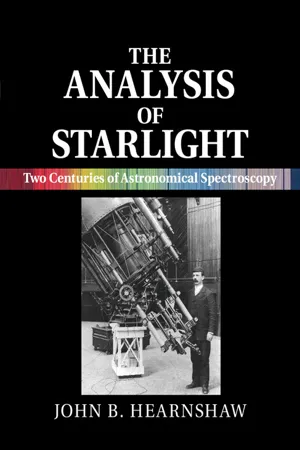 eBook - PDF
The Analysis of Starlight
Two Centuries of Astronomical Spectroscopy
- John B. Hearnshaw(Author)
- 2014(Publication Date)
- Cambridge University Press(Publisher)
7 • The interpretation of stellar spectra and the birth of astrophysics 7.1 S O M E E A R L Y T H E O R I E S O F S T E L L A R E V O L U T I O N At the end of the nineteenth century the two main branches of stellar spectroscopy were spectral classification and radial-velocity measurements. The latter department was still in its relative infancy, but classification, thanks mainly to the energy of Pickering at Harvard, was a major activity. Classification had become closely related to theories of stel- lar evolution and these two aspects could hardly be disentan- gled in, for example, the classification devised by Lockyer [1], which involved first rising and then falling temperatures of stars over their life cycles, and which had some theoretical support from the work of Jonathan Homer Lane (1819–80) and August Ritter on the gravitational collapse of gaseous spheres. The classification schemes used by Antonia Maury and Annie Cannon were also implicitly evolutionary theories, but with the direction of evolution being from the ‘earlier’ to ‘later’ spectral types. Rival theories to Lockyer’s were then proposed for stellar evolution in the early years of the nineteenth century, with the Harvard spectral types as their basis, notably by Sir Arthur Schuster (1851–1934) in Great Britain [2] and by George Ellery Hale (1868–1938) in the United States [3]. Schuster’s scheme involved grav- itational collapse and cooling of gaseous masses on the so- called Kelvin–Helmholtz timescale. Although the Harvard classification was generally believed to be a temperature sequence with stars evolving from the hot Orion-type stars to the cooler solar types, Schuster nevertheless maintained that composition changes at the surface as the evolution pro- ceeded accounted for the differences in the line spectrum from star to star [2]. eBook - PDF
- A. J. Meadows(Author)
- 2013(Publication Date)
- Pergamon(Publisher)
CHAPTER 1 The Characteristics of Stars Classification The study of stellar evolution has much in common with the study of evolution in biology. Indeed, research work in these two quite different fields started at about the same time — in the latter half of the last century. The approach is the same in both cases. First of all the characteristics of as large a number of plants (or animals, or stars) as possible are studied. Then certain of these characteristics are selected and a system of classification is built up using them as a basis. The most important step, of course, lies in selecting the right characteristics, so that the resulting classification has some physical significance. The next stage is only slightly less important. This consists of using these characteristics to provide a systematic order. For example, you might decide that a significant characteristic of plants is whether they shed their leaves, or retain them throughout the winter. You might then choose this as the first way of dividing plants into two groups. Each group could then be examined again and further subdivided on the basis of other significant characteristics, until the whole supply of significant characteristics has been used. The series of groups with which you end then form the core of your system of classification. So far there is no question of evolution. In fact, the process of classification presupposes that the objects classified do not change their properties. However, it has been found both in biology and in astronomy that there are always a few objects which do not fit satisfactorily into any grouping. They exist untidily some-where in between. The study of these odd objects — the so-called 1 2 Stellar Evolution 'missing links' — is an important part of astronomy, as of biology. They are indications that a static picture of the Universe is wrong; we must seek instead for gradual changes in characteristics.
- Britannica Educational Publishing, Erik Gregersen(Authors)
- 2009(Publication Date)
- Britannica Educational Publishing(Publisher)
In stars of spectral type F, the lines of neutral atoms are weak relative to those of ionized atoms. The hydrogen lines are stronger, attaining their maximum intensities in A-type stars, in which the surface temperature is about 9,000 K. Thereafter, these absorption lines gradually fade as the hydrogen becomes ionized.The hot B-type stars, such as Epsilon Orionis, are characterized by lines of helium and of singly ionized oxygen, nitrogen, and neon. In very hot O-type stars, lines of ionized helium appear. Other prominent features include lines of doubly ionized nitrogen, oxygen, and carbon and of trebly ionized silicon, all of which require more energy to produce.In the more modern system of spectral classification, called the MK system (after the American astronomers William W. Morgan and Philip C. Keenan, who introduced it), luminosity class is assigned to the star along with the Draper spectral type. For example, the star Alpha Persei is classified as F5 Ib, which means that it falls about halfway between the beginning of type F (i.e., F0) and of type G (i.e., G0). The Ib suffix means that it is a moderately luminous supergiant. The star Pi Cephei, classified as G2 III, is a giant falling between G0 and K0 but much closer to G0. The Sun, a dwarf star of type G2, is classified as G2 V. A star of luminosity class II falls between giants and supergiants; one of class IV is called a subgiant.BULK STELLAR PROPERTIESWhen a star is considered as a whole, its properties reveal much of interest. From a star’s temperature to how it interacts with a companion star, the consideration of bulk stellar properties has been and will continue to be a major part of astronomical studies.STELLAR TEMPERATURESTemperatures of stars can be defined in a number of ways. From the character of the spectrum and the various degrees of ionization and excitation found from its analysis, an ionization or excitation temperature can be determined.A comparison of the V and B magnitudes yields a B − V eBook - ePub
- Herbert Dingle(Author)
- 2014(Publication Date)
- Routledge(Publisher)
luminosity-class relation. Once again, the relation depends somewhat on chemical composition.Fig. 9. Luminosity— spectral class diagram . Shading shows schematically the portions of the diagram containing the majority of points representing actual stars, m , main sequence; wd , white dwarfs; g , giants; sg , supergiants; c , cepheid variables. The doubly shaded region contains the most abundant main sequence stars. The effective temperature indicates the spectral class.Main Sequence Stars
If the luminosity is plotted against the spectral class for all stars for which these have been observationally determined, the resulting diagram reveals a remarkable phenomenon. Allowing for accessibility to observation, about 90 per cent of the stars in the region of space concerned are represented by points crowded into a single belt stretched obliquely across the diagram. Hence the great majority of stars belong to a single family: it is called the main sequence . A curve drawn in the diagram to lie centrally along the sequence defines an empirical luminosity-class relation to which all members conform to within a certain degree of scatter. The Sun is a fairly average member of the sequence. (See Fig. 9 .)Fig. 10. Mass-luminosity diagram . Values for a number of actual stars are shown by dots for main-sequence and giant stars and by crosses for white dwarfs. Average values for main-sequence stars are shown by open circles.Again, if luminosity is plotted against the mass for all main sequence stars for which observational values are available, this new diagram reveals another remarkable phenomenon: the stars are again represented by points scattered near to a single curve. This defines an empirical mass-luminosity relation . (See Fig. 10 eBook - ePub
- John S. Lewis(Author)
- 2004(Publication Date)
- Academic Press(Publisher)
Fig. II.7 .Figure II.7 The Hertzsprung–Russell diagram. The temperature (spectral class) and absolute magnitude (luminosity) of each of the 10,000 apparent brightest stars seen from Earth are compared. The large majority of the stars lie on the hydrogen-burning Main Sequence (MS).The most prominent feature of the H–R diagram is the diagonal strip of stars known as the Main Sequence (MS). A large majority of all the stars near the Sun lie on the Main Sequence, and those stars that are not in the MS lie in very restricted regions of the H–R diagram.Some stars, usually found enveloped in gas and dust clouds, are too red for their luminosity, compared with the MS. These stars, called T Tauri stars after their prototype, lie parallel to but slightly above the MS. A number of other very luminous stars are much too red for their luminosities relative to the MS (or much too luminous for their temperatures). Such stars achieve their enormous luminosities by having very large surface areas: the total luminosity is proportional to the surface area as well as dependent on the temperature. Such large stars are referred to as giants and supergiants.We have already seen that the Planck function for a black body emitter,Bλ, has a shape given by Eq. (II.41) and that the wavelength at whichBλis a maximum is dependent on temperature in accordance with Eq. (II.44) . Now we need to know how the total luminosity of a black body depends on its temperature, that is, to evaluate the integral ofBλover λ. To forestall the necessity of evaluating the integral directly, note from Fig. II.8 that the productBλ· λ is proportional to the area underBλ. ThusFigure II.8 The total energy emitted from a Planckian source. Hereλmis the wavelength at whichBλ eBook - ePub
Chemistry in Space
From Interstellar Matter to the Origin of Life
- Dieter Rehder(Author)
- 2011(Publication Date)
- Wiley-VCH(Publisher)
3.1b ); track 2: expansion to a red giant by H fusion in the star’s shell; track 3: recontrac- tion after He fusion in the core has ceased; track 4: AGB, the second red giant state by He fusion in the shell; track 5: mass loss (PN); track 6: final stage (development toward a white dwarf). See text for additional details.Once formed, stars evolve, and path and speed of the evolution of a star very much depend on its initial mass. The present situation of the various states of development of visible stars, snapshot in present time, is represented by the Hertzsprung-Russel (HR) diagram in Figure 3.2 , In this depiction, the "magnitude" or "luminosity" of a star is plotted against its surface temperature as a measure of the star’s overall activity and hence its overall mass. The surface temperature is correlated to the color as it appears in the visible range: high surface temperature stars appear bluish, low surface temperature stars reddish. According to their surface temperature (or color index; see below), the stellar classes O (very hot), B, A, F, G, K, and M (relatively cold) are distinguished, sometimes further extended to L and T. The mnemonic "Oh Be A Fine Girl (or Guy), Kiss Me" may be employed to memorize this sequence. Table 3.1 provides an overview of properties associated with these spectral classes, Some chemical characteristics of type M dwarfs and type L and T subdwarfs supposedly have certain properties in common with exoplanets of the categories "hot Jupiters" and "super- Jupiters," and will briefly be dealt with in Chapter 6. The steps between the spectral classes are further subdivided by 10, for example, G0-G9, with G0 being the hottest within the G class. Our Sun is a G2 type star. The "color index" indicates the difference in magnitude at short and long wavelengths, viz. ultraviolet minus blue (U-B index) or blue minus green-yellow (B-V index; V for visible). The smaller the color index, the more pronounced is the contribution of shorter wavelengths.1) For the B-V
Index pages curate the most relevant extracts from our library of academic textbooks. They’ve been created using an in-house natural language model (NLM), each adding context and meaning to key research topics.

