Physics

Monopole vs Dipole
A monopole is a theoretical particle with only one magnetic pole, either north or south, while a dipole has two magnetic poles, north and south. In physics, monopoles have not been observed, while dipoles are common and are found in magnets and electromagnets. The distinction between monopoles and dipoles is important in understanding the behavior of magnetic fields.
Written by Perlego with AI-assistance
Related key terms
1 of 5

8 Key excerpts on "Monopole vs Dipole"
 No longer available |Learn more
- (Author)
- 2014(Publication Date)
- Learning Press(Publisher)
Usually such equations are des-cribed by spherical harmonics, but they look very different. A circular polarized dipole is described as a superposition of two linear dipoles. Magnetic monopole A magnetic monopole is a hypothetical particle in particle physics that is a magnet with only one magnetic pole. In more technical terms, a magnetic monopole would have a net magnetic charge. Modern interest in the concept stems from particle theories, notably the grand unification and superstring theories, which predict their existence. The magnetic monopole was first hypothesized by Pierre Curie in 1894, but the quantum theory of magnetic charge started with a paper by the physicist Paul A.M. Dirac in 1931. In this paper, Dirac showed that the existence of magnetic monopoles was consistent with Maxwell's equations only if electric charges are quantized, which is always observed. Since then, several systematic monopole searches have been performed. Experiments in 1975 and 1982 produced candidate events that were initially interpreted as monopoles, but are now regarded as inconclusive. The detection of magnetic monopoles is an open problem in experimental physics. Within theoretical physics, some modern approaches predict the existence of magnetic monopoles. Joseph Polchinski, a prominent string-theorist, described the existence of monopoles as one of the safest bets that one can make about physics not yet seen. These theories are not necessarily inconsistent with the experimental evidence. In some theoretical models, magnetic monopoles are unlikely to be observed, because they are too ________________________ WORLD TECHNOLOGIES ________________________ massive to be created in particle accelerators, and also too rare in the Universe to enter a particle detector with much probability. Some condensed matter systems propose a structure superficially similar to a magnetic monopole, known as a flux tube.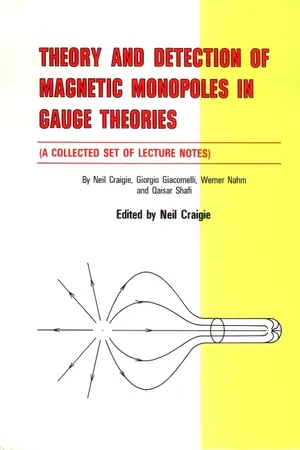 eBook - PDF
- Giorgio Giacomelli, Werner Nahm, Qaisar Shafi(Authors)
- 1986(Publication Date)
- World Scientific(Publisher)
Chapter 7 THE EXPERIMENTAL DETECTION OF MAGNETIC MONOPOLES Giorgio Giacomelli Dipartimento di Fisica dell' Universita 'di Bologna I.N.F.N. Sezione di Bologna 408 7.1 Introduction. The concept of magnetic monopole is an old one, and could be traced back to the origin of magnetism. The first scientific account of magnetic materials appears in a letter written by the French military engineer Petrus Peregrinus De Maricourt, who described the lines of force around a lodestone and noted that they started and terminated at two points, which he called the north and south poles. All subsequent observations conflnned that all magnetic objects are dipoles. But some physicbts continued speaking of isolated poles, often for pedagogical reasons. At the beginning of the 19th century there were discussions (and experiments) concerning the magnetic content of matter and some speculations about the possible existence of isolated magnetic charges. In 1931 Dirac introduced the magnetic monopole in order to explain the quan- 409 tization of the electric charge (Dirac-1931). In his reasoning the quantization of electric charge follows from the existence of at least one free magnetic charge. Dirac established the basic relation between the elementary electric charge e and the mag-netic charge g. The existence of magnetic charges and of magnetic currents would symmetrize in form Maxwell's equations, but the symmetry would not be perfect, since the smallest magnetic charge is predicted to be much larger than the smallest electric charge. These were the reasonings for introducing what we may now call the classical magnetic monopole. In this formulation there was no prediction for the monopole mass. A kind of rule of thumb was instead established, assuming that the classical electron radius be equal to the classical monopole radius from which one has m M c* 0£>m e /e* ca 4700m e ^ 2.4 GeV. From 1981 many experimenters searched for these classical Dirac monopoles*. No longer available |Learn more
- (Author)
- 2014(Publication Date)
- Academic Studio(Publisher)
________________________ WORLD TECHNOLOGIES ________________________ Chapter 3 Magnetic Monopole A magnetic monopole is a hypothetical particle in particle physics that is a magnet with only one magnetic pole. In more technical terms, a magnetic monopole would have a net magnetic charge. Modern interest in the concept stems from particle theories, notably the grand unification and superstring theories, which predict their existence. The magnetic monopole was first hypothesized by Pierre Curie in 1894, but the quantum theory of magnetic charge started with a paper by the physicist Paul A.M. Dirac in 1931. In this paper, Dirac showed that the existence of magnetic monopoles was consistent with Maxwell's equations only if electric charges are quantized, which is always observed. Since then, several systematic monopole searches have been performed. Experiments in 1975 and 1982 produced candidate events that were initially interpreted as monopoles, but are now regarded as inconclusive. The detection of magnetic monopoles is an open problem in experimental physics. Within theoretical physics, some modern approaches predict the existence of magnetic monopoles. Joseph Polchinski, a prominent string-theorist, described the existence of monopoles as one of the safest bets that one can make about physics not yet seen. These theories are not necessarily inconsistent with the experimental evidence. In some theoretical models, magnetic monopoles are unlikely to be observed, because they are too massive to be created in particle accelerators, and also too rare in the Universe to enter a particle detector with much probability. Some condensed matter systems propose a structure superficially similar to a magnetic monopole, known as a flux tube. The ends of a flux tube form a magnetic dipole, but since they move independently, they can be treated for many purposes as independent magnetic monopole quasiparticles.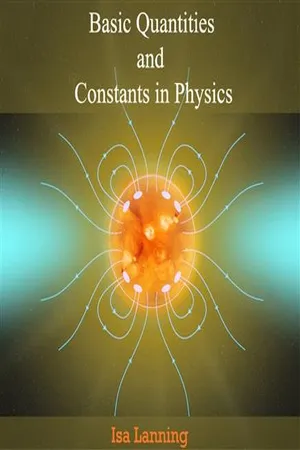 No longer available |Learn more
- (Author)
- 2014(Publication Date)
- Orange Apple(Publisher)
________________________ WORLD TECHNOLOGIES ________________________ Chapter- 3 Magnetic Monopole A magnetic monopole is a hypothetical particle in particle physics that is a magnet with only one magnetic pole. In more technical terms, a magnetic monopole would have a net magnetic charge. Modern interest in the concept stems from particle theories, notably the grand unification and superstring theories, which predict their existence. The magnetic monopole was first hypothesized by Pierre Curie in 1894, but the quantum theory of magnetic charge started with a paper by the physicist Paul A.M. Dirac in 1931. In this paper, Dirac showed that the existence of magnetic monopoles was consistent with Maxwell's equations only if electric charges are quantized, which is always observed. Since then, several systematic monopole searches have been performed. Experiments in 1975 and 1982 produced candidate events that were initially interpreted as monopoles, but are now regarded as inconclusive. The detection of magnetic monopoles is an open problem in experimental physics. Within theoretical physics, some modern approaches predict the existence of magnetic monopoles. Joseph Polchinski, a prominent string-theorist, described the existence of monopoles as one of the safest bets that one can make about physics not yet seen. These theories are not necessarily inconsistent with the experimental evidence. In some theoretical models, magnetic monopoles are unlikely to be observed, because they are too massive to be created in particle accelerators, and also too rare in the Universe to enter a particle detector with much probability. Some condensed matter systems propose a structure superficially similar to a magnetic monopole, known as a flux tube. The ends of a flux tube form a magnetic dipole, but since they move independently, they can be treated for many purposes as independent magnetic monopole quasiparticles. No longer available |Learn more
- (Author)
- 2014(Publication Date)
- White Word Publications(Publisher)
________________________ WORLD TECHNOLOGIES ________________________ Chapter 8 Magnetic Monopole A magnetic monopole is a hypothetical particle in particle physics that is a magnet with only one magnetic pole. In more technical terms, a magnetic monopole would have a net magnetic charge. Modern interest in the concept stems from particle theories, notably the grand unification and superstring theories, which predict their existence. The magnetic monopole was first hypothesized by Pierre Curie in 1894, but the quantum theory of magnetic charge started with a paper by the physicist Paul A.M. Dirac in 1931. In this paper, Dirac showed that the existence of magnetic monopoles was consistent with Maxwell's equations only if electric charges are quantized, which is always observed. Since then, several systematic monopole searches have been performed. Experiments in 1975 and 1982 produced candidate events that were initially interpreted as monopoles, but are now regarded as inconclusive. The detection of magnetic monopoles is an open problem in experimental physics. Within theoretical physics, some modern approaches predict the existence of magnetic monopoles. Joseph Polchinski, a prominent string-theorist, described the existence of monopoles as one of the safest bets that one can make about physics not yet seen. These theories are not necessarily inconsistent with the experimental evidence. In some theoretical models, magnetic monopoles are unlikely to be observed, because they are too massive to be created in particle accelerators, and also too rare in the Universe to enter a particle detector with much probability. Some condensed matter systems propose a structure superficially similar to a magnetic monopole, known as a flux tube. The ends of a flux tube form a magnetic dipole, but since they move independently, they can be treated for many purposes as independent magnetic monopole quasiparticles. eBook - PDF
- Gerard 'T Hooft(Author)
- 2005(Publication Date)
- World Scientific(Publisher)
For many relevant particulars, references to the original literature are provided. 1. Introduction “ Under these circumstances one would be surprised if Nature had made no use of it. ” P. A. M. Dirac (1931) The homogeneous Maxwell equations ∇ · B = 0 , ∇ × E + ∂ B ∂t = 0 , have no source terms, reflecting the plain fact that isolated magnetic poles or magnetic currents have never been observed in nature. The experimen-tal limit for observing heavy (non-relativistic) monopoles in cosmic rays is presently well below 10 − 15 cm − 2 sr − 1 sec − 1 , whereas on the other hand ac-celerator searches have not produced any candidate up to masses of well over 500 GeV/c 2 . From a theoretical point of view this is surprising because the absence of monopoles introduces an asymmetry in the equations for which there does not appear to be any intrinsic reason. On the contrary, when Dirac in his seminal 1931 paper [1], introduced the magnetic monopole and studied the consequences of its existence in the context of ordinary quan-tum mechanics he did the striking discovery that the product of electric and 272 F. A. Bais magnetic charges had to be quantized (with = c = 1), eg = 2 πn , implying that the existence of a single monopole would explain the observed quantization of all electric charges. In his paper he introduces the magnetic “Dirac” potential, e A D ( r ) = eg 4 π a ˆ n ( r ) a ˆ n ( r ) = ˆ r × ˆ n r (1 − ˆ r · ˆ n ) (1) which has, besides the obvious singularity at the origin, also a string sin-gularity extending from the origin out along the ˆ n direction. It is the re-quirement that physical charges should not be able to detect the string that enforces the quantization condition.
- Eric Vieil(Author)
- 2012(Publication Date)
- CRC Press(Publisher)
256 200 Understanding Physics and Physical Chemistry Using Formal Graphs The phenomenon that makes the two poles of a dipole dependent on each other without exchang-ing entities but using system constitutive properties is called influence . This chapter first presents the main features of this phenomenon and then gives a series of case studies of dipoles. Most of these case studies illustrate the role of space in the influence through space-reduced properties. Finally, it will be demonstrated that the strong link between system constitutive properties and influence leads to the formulation of the mathematical operators representing the capacitance and the conductance. Table 7.1 lists the case studies of dipoles involving an influence phenomenon given in this chap-ter. (See also Figure 7.1 for the position of the dipoles along the complexity scale of Formal Objects.) 7.1 INTERACTION BETWEEN POLES Interactions between two poles is of two kinds: influence and exchange . Influence occurs when the interaction relies on the system constitutive properties (capacitance, inductance, or conductance) that allow the system to store or dissipate energy. Exchange is the means for a dipole to ensure a circulation of entities (basic quantities or impulses) between poles, independent of the system con-stitutive properties. In the case of a conductive dipole, which does not possess its own entities, they must be provided by at least one storing dipole associated to the conductive dipole. (In other words, conductive dipoles alone have zero values for their effort and flow.) Influence being a more complex phenomenon than exchange, it requires a longer discussion that will be developed at the end of this chapter in order to establish the generalized capacitive relationship (modeling the dependence of the basic quantity with the effort). eBook - PDF
Theory of Electric Polarization
Dielectrics in Static Fields
- Bozzano G Luisa(Author)
- 2012(Publication Date)
- Elsevier Science(Publisher)
We then have: m = le. (1.2) Therefore, the electric moment of a system of charges with zero net charge is generally called the electric dipole moment of the system. A simple case is a system consisting of only two point charges +e and — e at a distance I. Such a system is called a (physical) electric dipole, its moment is equal to el, the vector / pointing from the negative to the positive charge. In theoretical organic chemistry the dipole vector is generally taken as pointing from the positive to the negative charge. We prefer to use the physical definition given above. A mathematical abstraction derived from the above defined physical dipole is the ideal or point dipole. Its definition is as follows: the distance / between two point charges + e and — e is replaced by l/n and the charge e by en. The limit approached as the number η tends to infinity is the ideal dipole. The equations derived for ideal dipoles are much simpler than those obtained for non-ideal dipoles. Many neutral molecules are examples of charge systems with a non-ideal electric dipole moment, since in most types of molecule the centres of gravity of the positive and negative charge distributions do not coincide. Apart from these permanent or intrinsic dipole moments, a temporary or induced dipole moment arises when a particle is brought into an external electric field. Under the influence of this field the positive and negative charges in the particle are moved apart: the particle is polarized. In general, these induced dipoles can be treated as ideal; permanent dipoles, however, may generally not be treated as ideal when the field at molecular distances is to be calculated (see section 2). ELECTRIC DIPOLES AND MULTIPOLES 11 The values of molecular dipole moments are usually expressed in Debye units. The Debye unit, abbreviated as D, equals 1 0 1 8 electrostatic units (e.s.u.). The permanent dipole moments of non-symmetrical molecules generally lie between 0.5 and 5D.
Index pages curate the most relevant extracts from our library of academic textbooks. They’ve been created using an in-house natural language model (NLM), each adding context and meaning to key research topics.

