Physics

MOSFETs
MOSFETs, or Metal-Oxide-Semiconductor Field-Effect Transistors, are semiconductor devices used for amplifying or switching electronic signals. They consist of three terminals: source, gate, and drain. By applying a voltage to the gate terminal, the conductivity between the source and drain can be controlled, allowing MOSFETs to function as efficient switches or amplifiers in electronic circuits.
Written by Perlego with AI-assistance
Related key terms
1 of 5
12 Key excerpts on "MOSFETs"
- Mike Golio, Janet Golio, Mike Golio, Janet Golio(Authors)
- 2018(Publication Date)
- CRC Press(Publisher)
18 Metal-Oxide-Semiconductor Field-Effect Transistors (MOSFETs) Julio Costa Mike Carroll G. Ali Rezvani Tom McKay RF Micro Devices 18.1 Introduction .............................................. 18 -2 18.2 A Brief History of the MOSFET ........................ 18 -3 18.3 Moore’s Law .............................................. 18 -5 18.4 The Metal-Oxide-Semiconductor Interface ............ 18 -6 Donors and Acceptors • The MOS Surface Charge Q s and Surface Potential ψ s • The Capacitance–Voltage Characteristics of the MOS Stack 18.5 The 1-Dimensional Long-Channel MOSFET I–V Model ................................................ 18 -13 The MOSFET Threshold Voltage V TH 18.6 The Long-Channel MOSFET Current–Voltage Model ..................................................... 18 -14 The Subthreshold Region • Short-Channel Effects in Modern MOSFETs 18.7 MOSFET Fabrication Section ........................... 18 -19 Introduction to MOSFET Fabrication • Example CMOS Device Cross Section • Example CMOS Layout • Modern RFCMOS Front-End Process Flow • CMOS Back-End Process Flow • MIM Capacitors • Resistors • Silicon on Insulator Processes References ....................................................... 18 -40 18 -1 18 -2 RF and Microwave Passive and Active Technologies 18.1 Introduction The Metal-Oxide-Semiconductor Field-Effect Transistor (MOSFET) is today the most utilized electronic semiconductor device in the world, covering a vast range of electronic applications. Its usage ranges from simple single transistor designs to complex high-speed very large-scale integration (VLSI) cir-cuits containing tens of millions of transistors, integrated on the same monolithic silicon die, covering a wide range of analog and digital applications. eBook - PDF
Power Microelectronics
Device and Process Technologies
- Yung C Liang, Ganesh S Samudra;;;(Authors)
- 2009(Publication Date)
- WSPC(Publisher)
POWER METAL-OXIDE-SEMICONDUCTOR FIELD-EFFECT TRANSISTOR 4.1. Introduction The operational principle of the metal-oxide-semiconductor field-effect tran-sistor (MOSFET, or sometimes called MOS in short) devices originates from the field-effect concept by Lilienfeld in the 1930s. When the industry even-tually learned how to grow the good-quality gate dielectric with acceptable charges, the n-MOS technology and the later CMOS technology took off in a fast path. Today, MOS device technology, namely CMOS or BiCMOS pro-cess, becomes prevalent and dominant in integrated circuit (IC) development. At the same time, power MOSFET devices began to emerge and were intro-duced in 1970s. So far, many structures for power MOSFET devices have been proposed, such as the double-diffusion MOSFET (or DMOS), V-groove MOSFET (or VMOS), and trenched-gate UMOS. Due to many processing difficulties related to the gate dielectrics and the enhanced electric field at the tip of the V-groove (Holmes and Salama, 1973), the VMOS structure is seldom used in production. Instead, the DMOS structure is a preferred choice. For the UMOS structure, it is seen as the preferred choice to provide a low on-state resistance. The introduction of power MOSFET brought about the prediction of the extinction of the bipolar power transistor. However, this prediction did not happen immediately as cost and reliability plagued the power MOSFET. The bipolar power transistor continued to be used in many high-voltage and high-current applications. Only in the mid-1980s, the bipolar power transistor finally met the most critical rival with the introduction of the insulated-gate bipolar transistor (IGBT), which will be described in Chapter 5. 141 142 Power Microelectronics The high gate impedance is a primary feature of the power MOSFET that greatly simplifies its gate-drive circuitry. The negative temperature coefficient of the drain current, i.e. eBook - ePub
Power Microelectronics: Device And Process Technologies (Second Edition)
Device and Process Technologies
- Yung C Liang, Ganesh S Samudra;Chih-Fang Huang;;(Authors)
- 2017(Publication Date)
- WSPC(Publisher)
OWER METAL –OXIDE –SEMICONDUCTOR FIELD -EFFECT TRANSISTOR4.1.Introduction
The operational principle of the metal–oxide–semiconductor field-effect transistor (MOSFET, or sometimes called MOS in short) devices originates from the field-effect concept by Lilienfeld in the 1930s. When the industry eventually learned how to grow the good-quality gate dielectric with acceptable charges, the n-MOS technology and the later CMOS technology took off in a fast path. Today, MOS device technology, namely CMOS or BiCMOS process, becomes prevalent and dominant in integrated circuit (IC) development. At the same time, power MOSFET devices began to emerge and were introduced in 1970s. So far, many structures for power MOSFET devices have been proposed, such as the double-diffusion MOSFET (or DMOS), V-groove MOSFET (or VMOS), and trenched-gate UMOS. Due to many processing difficulties related to the gate dielectrics and the enhanced electric field at the tip of the V-groove (Holmes and Salama, 1973), the VMOS structure is seldom used in production. Instead, the DMOS structure is a preferred choice. For the UMOS structure, it is seen as the preferred choice to provide a low on-state resistance. The introduction of power MOSFET brought about the prediction of the extinction of the bipolar power transistor. However, this prediction did not happen immediately as cost and reliability plagued the power MOSFET. The bipolar power transistor continued to be used in many high-voltage and high-current applications. Only in the mid-1980s, the bipolar power transistor finally met the most critical rival with the introduction of the insulated-gate bipolar transistor (IGBT), which will be described in Chapter 5 .The high gate impedance is a primary feature of the power MOSFET that greatly simplifies its gate drive circuitry. The negative temperature coefficient of the drain current, i.e. the drain current reduces when temperature goes up, in power MOSFET also provides an additional advantage over their bipolar counterparts. In a sense, the bipolar transistor is very susceptible to thermal run-away but not the case for power MOSFET. However, the power MOSFET suffers a higher on-state conduction loss as compared to the bipolar power transistor of similar die sizes because of the absence of conductivity modulation in power MOSFET. In spite of this, the trend of higher switching frequency to increase power density in power electronic system continues, therefore, the choice of using power MOSFET over conventional power bipolar switching transistor is evident. eBook - PDF
- Behzad Razavi(Author)
- 2021(Publication Date)
- Wiley(Publisher)
MOSFETs are electronic devices that can operate as voltage-dependent current sources. • A MOSFET consists of a conductive plate (the “gate”) atop a semiconductor sub- strate and two junctions (“source” and “drain”) in the substrate. The gate controls the current flow from the source to the drain. The gate draws nearly zero current because an insulating layer separates it from the substrate. • As the gate voltage rises, a depletion region is formed in the substrate under the gate area. Beyond a certain gate-source voltage (the “threshold voltage”), mobile carriers are attracted to the oxide-silicon interface and a channel is formed. • If the drain-source voltage is small, the device operates a voltage-dependent resistor. Problems 301 • As the drain voltage rises, the charge density near the drain falls. If the drain voltage reaches one threshold below the gate voltage, the channel ceases to exist near the drain, leading to “pinch-off.” • MOSFETs operate in the “triode” region if the drain voltage is more than one thresh- old below the gate voltage. In this region, the drain current is a function of V GS and V DS . The current is also proportional to the device aspect ratio, W∕L. • MOSFETs enter the “saturation region” if channel pinch-off occurs, i.e., the drain voltage is less than one threshold below the gate voltage. In this region, the drain current is proportional to (V GS − V TH ) 2 . • MOSFETs operating in the saturation region behave as current sources and find wide application in microelectronic circuits. • As the drain voltage exceeds V GS − V TH and pinch-off occurs, the drain end of the channel begins to move toward the source, reducing the effective length of the device. Called “channel-length modulation,” this effect leads to variation of drain current in the saturation region.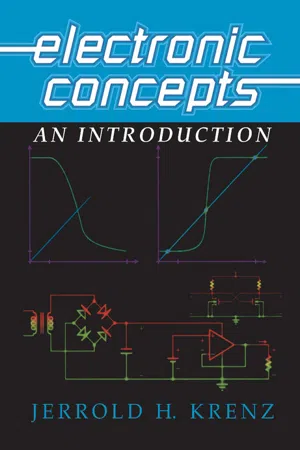 eBook - PDF
Electronic Concepts
An Introduction
- Jerrold H. Krenz(Author)
- 2000(Publication Date)
- Cambridge University Press(Publisher)
An understanding of the physical operation of a MOSFET device is neces-sary to devise suitable equivalent circuit models. These models will then be used to develop an understanding of several commonly used MOSFET circuits. It is these circuits, when combined in very-large-scale integrated circuits, that have revolutionized the diversity and complexity of modern electronic systems. 4.1 FIELD-INDUCED CARRIERS: THE PHYSICS OF A MOSFET DEVICE Although a quantitative description of a MOSFET device premised on a detailed understanding of semiconductor physics is beyond the scope of an introduc-tory text, a qualitative description of the key physical mechanisms involved is desirable. The device of Figure 4.7, a device with a p-type substrate in which free electrons are the current carriers, will be considered. Because the carriers of the MOSFET device are free electrons that form a channel between the source and drain, an ra-channel designation is used. To simplify the analysis, a common 4.1 FIELD-INDUCED CARRIERS: THE PHYSICS OF A MOSFET DEVICE 221 Si 3 t ox = oxide thickness, m e ox = permitivity of oxide, F/m IJL n = surface mobility of free electrons, m 2 /V-s C ox = gate capacitance, eox/tox, F/m 2 Vj = threshold voltage, V Figure 4.7: Metal-oxide field-effect transistor configuration. connection for the source and substrate will be assumed; the effect of a source-to-substrate bias will be treated later. Complementary devices with an «-type substrate in which holes are the current carriers, that is, a p-channel MOSFET device, are also widely used. It is the gate-to-substrate capacitance, the result of the thin silicon dioxide dielectric that separates the gate and substrate, that plays a pivotal role in the behavior of the device. For a zero gate-to-substrate bias (Figure 4.8(a)), the sub-strate, except in the vicinity of the w-type regions, tends to have a uniform dis-tribution of holes, and the hole density is approximately equal to the acceptor doping density. eBook - PDF
Silicon, From Sand to Chips, Volume 1
Microelectronic Components
- Alain Vignes(Author)
- 2024(Publication Date)
- Wiley-ISTE(Publisher)
6 The MOSFET Transistor Research on the effect of an electric field on the conductivity of a doped semiconductor wafer, by William Shockley as early as 1945, led to the demonstration of a direct field effect as early as 1947 by John Bardeen and Walter (see Chapter 3, section 3.1.2.2). But due to the problem of “surface states” (traps), it was not until 1959 that the first silicon MOSFET was produced by Martin Atalla and Dawon Kahng of Bell Labs. It was the qualities of silicon oxide that led to the development of the silicon-based MOSFET transistors. The first commercial transistors appeared in 1964. The MOSFET transistor became the preferred component for computer logic circuits and memories in 1970, because of its low power consumption and miniaturization capacity. Miniaturization by a factor of 1,000 has been achieved in 50 years, which means a reduction in the switching time by a factor of 1,000 and therefore an increase in operation speed. The miniaturization of transistors has posed acute problems in terms of manufacturing processes, dielectric and electrode materials for the gate, source and drain, and electrical connections. This chapter presents: – the transistor operation (in static regime); 176 Silicon, From Sand to Chips 1 – the functions: switching and amplification; – the CMOS component; – the development history of the MOSFET transistor; – the evolution of MOSFET transistor materials imposed by miniaturization (Moore’s law). 6.1. Features and functions 6.1.1. Introduction The field effect (presented in Chapter 3, section 3.1.1) consists of the polarization (conductivity inversion and/or modulation) of a thin surface layer of a wafer or thin film of a doped semiconductor, induced by the application of an electrostatic field perpendicular to the semiconductor surface via a flat electrode close to and parallel to the wafer surface. eBook - PDF
Fundamentals of Solid-State Electronics
Solution Manual
- Chih-Tang Sah(Author)
- 1996(Publication Date)
- WSPC(Publisher)
FUNDAMENTALS OF SOUD-STATE ELECTRONICS - SOLUTION MANUAL 71 Chapter 6 METAL-OXIDE-SEMICONDUCTOR AND OTHER FIELD-EFFECT TRANSISTORS Chapter 6 METAL-OXIDE-SEMICONDUCTOR AND OTHER FIELD-EFFECT TRANSISTORS OBJECTIVES • Review and selection of concise device acronym. • Definition of device structure terms. • Quality discussion of device characteristics and physical origin • Delineation of four basic device characteristics • Sample fabrication steps • Elementary analysis based on conductivity modulation model • Charge-control analysis based on conductivity modulation model • High-frequency response - Transconductance cutoff frequency - Gain-bandwidth product • Switching properties - Intrinsic delay - Power-delay product • Extrinsic delay - charging and discharging capacitance loads • Circuit applications of MOSFET - Circuit symbol evolution and choice - DRAM cell - MOS inverter circuits -SRAM - Nonvolatile random access MOS memories 72 FUNDAMENTALS OF SOLID-STATE ELECTRONICS-SOLUTION MANUAL Chapters METAL-OXIDE-SEMICONDUCTOR AND OTHER FIELD-EFFECT TRANSISTORS Note: Many new problems were added during fall-1993 when Sah taught the course again which did not appear in chapter 6's problem section 699 of the 1991 edition of FSSE. These were assigned to the students and solutions were given out which are collected herein. F610.1 Draw the three-dimensional figure of a pMOST with a doped channel similar to that of Fig. 610.1 (which is an induced channel nMOST) using Fig. 623.1 as a guide. Label all parts of the pMOST structure and describe each part in analogous to the description given in Fig. 610.1. Description of the Doped-Channel pMOST (following Fig. 610.1) Coordinate System Same as Fig. 610.1. y-axis length direction (longitudinal direction of channel current flow). x-axis depth direction into the silicon body (direction transverse to current). x-axis in the oxide film (oxide electric field controls the channel current). No longer available |Learn more
- (Author)
- 2014(Publication Date)
- University Publications(Publisher)
____________________ WORLD TECHNOLOGIES ____________________ Chapter- 9 MOSFET Two power MOSFETs in the surface-mount package D2PAK . Operating as switches, each of these components can sustain a blocking voltage of 120 volts in the OFF state, and can conduct a continuous current of 30 amperes in the ON state, dissip ating up to about 100 watts and controlling a load of over 2000 watts. A matchstick is pictured for scale. ____________________ WORLD TECHNOLOGIES ____________________ A cross section through an nMOSFET when the gate voltage V GS is below the threshold for making a conductive channel; there is little or no conduction between the terminals source and drain; the switch is off. When the gate is more positive, it attracts electrons, inducing an n -type conductive channel in the substrate below the oxide, which allows electrons to flow between the n -doped terminals; the switch is on. Result for formation of inversion channel (electron density) and attainment of threshold voltage (IV) in a nanowire MOSFET. Note that the threshold voltage for this device lies around 0.45V. The metal–oxide–semiconductor field-effect transistor ( MOSFET , MOS-FET , or MOS FET ) is a device used for amplifying or switching electronic signals. The basic principle of this kind of transistor was first proposed by Julius Edgar Lilienfeld in 1925. In MOSFETs, a voltage on the oxide -insulated gate electrode can induce a conducting channel between the two other contacts called source and drain. The channel can be of n-type or p-type , and is accordingly called an nMOSFET or a pMOSFET (also commonly nMOS, pMOS). It is by far the most common transistor in both digital and analog circuits, though the bipolar junction transistor was at one time much more common. The 'metal' in the name is now often a misnomer because the previously metal gate material is now often a layer of polysilicon (polycrystalline silicon). eBook - PDF
- Marc Thompson(Author)
- 2006(Publication Date)
- Newnes(Publisher)
241 CHAPTER 9 Introduction to MOSFET Devices and Basic MOS Amplifiers Some Early History of Field-Effect Transistors The invention of the metal-oxide semiconductor field-effect transistor (MOSFET) pre-dates the bipolar transistor. An excerpt from one U.S. patent granted in 1933 to Dr. Julius Lilienfeld is shown in Figure 9-1 . In three patents, Dr. Lilienfeld gave structures of the MOSFET, MESFET and other MOS devices, but he wasn’t able to build any working FETs, underscoring the difficulty in fabricating practical semiconductor devices at that time. In fact, it was not until the 1960s that the first commercially successful FET devices were manufactured. In This Chapter f We next take a detour from the world of bipolar transistors and enter the world of metal-oxide semiconductor field-effect (MOSFET 1 ) transistors. The basic signal MOS gate is discussed, followed by a discussion of MOS amplifiers. The incremental model of the MOS transistor is shown, and it is used in a design example where gain and bandwidth are calculated for a MOS amplifier. 1 W e will not cover the JFET (junction field-effect transistor). 2 Lilienfeld had three patents in succession covering basic MOS transistor structures. They are U.S. patent #1,745,175 (filed 10/8/26, granted 1/18/30); U.S. patent #1,877,140 (filed 12/8/28, granted 9/13/32) and U.S. patent #1,900,018 (filed 3/28/28, granted 3/7/33). Figure 9-1: Excerpt from Lilienfeld’s U.S. patent 1,900,018 2 (1933) showing two different versions of the MOSFET. In Figure 1 from the patent, terminal #16 is the source, terminal #15 is the drain and terminal #20 is the gate connection. Chapter 9 242 Qualitative Discussion of Basic MOS Devices A basic N-channel lateral MOS gate is shown in Figure 9-2 . This is a lateral device because current flow is in the –x direction laterally across the surface of the device. 3 An N-channel MOS device starts with a lightly doped p- substrate. eBook - PDF
Technology Computer Aided Design
Simulation for VLSI MOSFET
- Chandan Kumar Sarkar(Author)
- 2018(Publication Date)
- CRC Press(Publisher)
137 Basic Semiconductor and Metal-Oxide-Semiconductor (MOS) Physics When.the.electric.field.in.the.channel.is.increased,.due.to.high.energetic. hot.electrons,. avalanche breakdown .occurs.in.the.channel.at.the.drain.end . .This. increases.the.flow.of.current . .The.electrons.are.attracted.by.the.drain,.while. the.holes.enter.the.substrate.to.form.part.of.the.parasitic.substrate.current . There.is.also.parasitic.bipolar.action.taking.place . .The.region.between.the. source.and.the.drain.can.act.like.the.base.of.an.n-p-n.transistor,.with.the. source.playing.the.role.of.the.emitter.and.the.drain.that.of.the.collector . .Holes. generated.by.the.avalanche.breakdown.move.from.the.drain.to.the.substrate. underneath.the.inversion.layer . .The.hole.current.forward.biases.the.source-body.p-n.diode . .Also.if.the.holes.coming.from.avalanche.are.collected.by. the.source.and.the.corresponding.hole.current.creates.a.voltage.drop.in.the. substrate.material.of.the.order.of.0 .6V, .the.normally.reverse.biased.substrate. source.p-n.junction.will.conduct.appreciably . .The.electrons.are.also.injected. as.the.minority.carriers.into.the.p-type.substrate.underneath.the.inversion. layer.from.the.forward.biased.junction,.similar.to.the.injection.of.electrons. from.the.emitter.to.the.base . .They.can.obtain.enough.energy.as.they.move. toward.the.drain.to.create.new.e-h.pairs . .These.electrons.arrive.at.the.drain. and. create. further. electron-hole. pairs. through. the. avalanche multiplication . . The.positive.feedback.between.the.avalanche.breakdown.and.the.parasitic. bipolar. action. results. in. breakdown. at. lower. drain. voltage . .The.process.is. shown.in.Figure 2 .69, .and.the.steps.are.as.follows: Process 1 :.Hot.carriers.having.sufficient.energy.to.overcome.the.oxide-Si.barrier.are.injected.from.the.channel.to.the.gate.oxide.(process.1). causing.the.gate.current.to.flow . .Trapping.of.some.of.this.charge.can. eBook - PDF
- Marian K. Kazimierczuk(Author)
- 2015(Publication Date)
- Wiley(Publisher)
Only a drift current flows through the device during the on-state conduction. The positive gate-to-source voltage v GS in an n-channel MOSFET repels the majority carrier holes and attracts the minority carrier electrons. For v GS > V t , the p-type region is inverted into n-type region, forming an n-channel between the drain and the source. The conducting n-channel is formed in a MOSFET when v GS > V t is applied and the electron density exceeds the hole density below the gate and the p-type semiconductor is inverted into the n-type inversion layer, connecting the drain to the source. The application of v GS above V t causes a build-up of free electrons in the inversion layer in direct proportion to the excess of v GS above V t . The enhancement-mode MOSFET is a normally-off device. The MOSFET threshold voltage V t can be reduced by reducing the oxide thickness t ox and the p-well doping concentration N A because V t is proportional to t ox and √ N A . The conductivity of the MOSFET channel is controlled by the gate-to-source voltage v GS applied across the metal–oxide–semiconductor (MOS) capacitor. When the drain-to-source voltage v DS increases at a fixed gate-to-source voltage v GS , the drain current i D initially increases, and then it saturates once the channel is pinched off near the drain end. The mobility of current carriers is the ratio of the average drift velocity to the applied electric field intensity, n = E∕v n . The silicon hole mobility is about one-third of the silicon electron mobility. The charge carrier mobility in the MOSFET channel is lower than that in the semiconductor bulk because of channel surface roughness scattering. A MOSFET channel should be wide and short to conduct large drain current. The mobility of electrons decreases as the doping concentration, temperature, and electric field increase. eBook - PDF
- Chih-Tang Sah(Author)
- 1991(Publication Date)
- WSPC(Publisher)
582 FUNDAMENTALS OF SOLID-STATE ELECTRONICS by Chih-Tang Sah Chapter 6. Metal-Oxide-Semiconductor and Other Field-Effect Transistors New York, has a channel length of about 0.1 /#m, a channel width of 0.5 #m, an oxide thickness of about 50A, a mobility of 100cm 2 /V-s, and an operating voltage of about 1.0 V. The intrinsic delay is 111(6x5/50*) = 1.33ps, the oxide capacitance is C o ZL=0.345fF, and the intrinsic power-delay product is 600x[20/(50x40x5 2 ) = 0.24O. However, circuit loading capacitances to be discussed in the next section, can increase these values by an order of magnitude or more. For short channels, the longitudinal electric field in a portion of the channel near the drain junction will be so high to cause drift velocity saturation due to optical phonon scattering discussed in chapter 3. The channel or drain current stops increasing with increasing drain voltage before the drain current reaches the low-field saturation current value, I DS of (643.6), caused by carrier depletion at the point QN(yd)=0 or V(y d )=V G -V GT . In the preceding estimates, drift velocity saturation is neglected. Its inclusion would increase the transit time since v drift in (661.4) is limited to 0^* 10 7 cm/s. The channel current will be lower for a given drain or gate voltage so that the power dissipation is smaller. The power-delay product will remain about the same due to the opposite changes of the power dissipation and the intrinsic delay. Three numerical examples on the figure-of-merit are given in Table 662.1. These are the medium geometry MOSFET described in section 654 with a 5/t#m channel length which is listed on the left column, a current production one-micron MOSFET listed in the middle column, and the 0.1-micron MOSFET. The 0.1-micron channel length is a recent (~ 1990) theoretical limit estimated by IBM which must be operated at low temperatures (77K liquid nitrogen temperature). Current thought is to immerse the 0. l*#m Si MOS CPU chips in a small closed-cycle liquid nitrogen refrigerator in order to realize the higher performance or speed from Si MOSTs. High-performance workstations for 3-d real time graphics and mainframe supercomputers using liquid nitrogen
Index pages curate the most relevant extracts from our library of academic textbooks. They’ve been created using an in-house natural language model (NLM), each adding context and meaning to key research topics.

