Physics

Orbiting Objects
Orbiting objects are celestial bodies that move around a central mass due to gravitational attraction. This motion follows a specific path, known as an orbit, which can be elliptical, circular, or parabolic. The orbiting object's velocity and distance from the central mass determine its orbit shape and period. Examples of orbiting objects include planets revolving around the Sun and moons orbiting planets.
Written by Perlego with AI-assistance
Related key terms
1 of 5
7 Key excerpts on "Orbiting Objects"
 No longer available |Learn more
- (Author)
- 2014(Publication Date)
- University Publications(Publisher)
________________________ WORLD TECHNOLOGIES ________________________ Chapter- 6 Orbit Two bodies of different mass orbiting a common barycenter. The relative sizes and type of orbit are similar to the Pluto–Charon system. In physics, an orbit is the gravitationally curved path of an object around a point in space, for example the orbit of a planet around the center of a star system, such as the solar system. Orbits of planets are typically elliptical. Current understanding of the mechanics of orbital motion is based on Albert Einstein's general theory of relativity, which accounts for gravity as due to curvature of space-time, with orbits following geodesics; though in common practice an approximate force-based theory of universal gravitation based on Kepler's laws of planetary motion is often used instead for ease of calculation. History Historically, the apparent motions of the planets were first understood geometrically (and without regard to gravity) in terms of epicycles, which are the sums of numerous circular motions. Theories of this kind predicted paths of the planets moderately well, until Johannes Kepler was able to show that the motions of planets were in fact (at least approximately) elliptical motions. In the geocentric model of the solar system, the celestial spheres model was originally used to explain the apparent motion of the planets in the sky in terms of perfect spheres ________________________ WORLD TECHNOLOGIES ________________________ or rings, but after the planets' motions were more accurately measured, theoretical mechanisms such as deferent and epicycles were added. Although it was capable of accurately predicting the planets' position in the sky, more and more epicycles were required over time, and the model became more and more unwieldy. The basis for the modern understanding of orbits was first formulated by Johannes Kepler whose results are summarised in his three laws of planetary motion. No longer available |Learn more
- (Author)
- 2014(Publication Date)
- College Publishing House(Publisher)
________________________ WORLD TECHNOLOGIES ________________________ Chapter 10 Orbit Two bodies of different mass orbiting a common barycenter. The relative sizes and type of orbit are similar to the Pluto–Charon system. In physics, an orbit is the gravitationally curved path of an object around a point in space, for example the orbit of a planet around the center of a star system, such as the solar system. Orbits of planets are typically elliptical. Current understanding of the mechanics of orbital motion is based on Albert Einstein's general theory of relativity, which accounts for gravity as due to curvature of space-time, with orbits following geodesics; though in common practice an approximate force-based theory of universal gravitation based on Kepler's laws of planetary motion is often used instead for ease of calculation. History Historically, the apparent motions of the planets were first understood geometrically (and without regard to gravity) in terms of epicycles, which are the sums of numerous circular motions. Theories of this kind predicted paths of the planets moderately well, until Johannes Kepler was able to show that the motions of planets were in fact (at least approximately) elliptical motions. In the geocentric model of the solar system, the celestial spheres model was originally used to explain the apparent motion of the planets in the sky in terms of perfect spheres ________________________ WORLD TECHNOLOGIES ________________________ or rings, but after the planets' motions were more accurately measured, theoretical mechanisms such as deferent and epicycles were added. Although it was capable of accurately predicting the planets' position in the sky, more and more epicycles were required over time, and the model became more and more unwieldy. The basis for the modern understanding of orbits was first formulated by Johannes Kepler whose results are summarised in his three laws of planetary motion. No longer available |Learn more
- (Author)
- 2014(Publication Date)
- College Publishing House(Publisher)
________________________ WORLD TECHNOLOGIES ________________________ Chapter 6 Orbit Two bodies of different mass orbiting a common barycenter. The relative sizes and type of orbit are similar to the Pluto–Charon system. In physics, an orbit is the gravitationally curved path of an object around a point in space, for example the orbit of a planet around the center of a star system, such as the solar system. Orbits of planets are typically elliptical. Current understanding of the mechanics of orbital motion is based on Albert Einstein's general theory of relativity, which accounts for gravity as due to curvature of space-time, with orbits following geodesics; though in common practice an approximate force-based theory of universal gravitation based on Kepler's laws of planetary motion is often used instead for ease of calculation. History Historically, the apparent motions of the planets were first understood geometrically (and without regard to gravity) in terms of epicycles, which are the sums of numerous circular motions. Theories of this kind predicted paths of the planets moderately well, until Johannes Kepler was able to show that the motions of planets were in fact (at least approximately) elliptical motions. ________________________ WORLD TECHNOLOGIES ________________________ In the geocentric model of the solar system, the celestial spheres model was originally used to explain the apparent motion of the planets in the sky in terms of perfect spheres or rings, but after the planets' motions were more accurately measured, theoretical mechanisms such as deferent and epicycles were added. Although it was capable of accurately predicting the planets' position in the sky, more and more epicycles were required over time, and the model became more and more unwieldy. The basis for the modern understanding of orbits was first formulated by Johannes Kepler whose results are summarised in his three laws of planetary motion.
- Ranjan Vepa(Author)
- 2019(Publication Date)
- Cambridge University Press(Publisher)
2 Space Vehicle Orbit Dynamics 2.1 Orbit Dynamics: An Introduction All space vehicle flights occur under the influence of the gravitational force of a multitude of planetary objects in the Solar system. In particular, the motion of an artificial Earth satellite is primarily influenced by the gravitational pull of the Earth and the gravitational forces exerted on it by the Moon and the Sun. Given that the Moon is at distance of 384,440 km (semi-major axis), orbits the Earth in a near circular orbit (eccentricity, e = 0.0549), and has a mass of only 0.01226 of the Earth’s mass, it is conceivable that for artificial Earth satellites orbiting the Earth at a distance of less than approximately 38,444 km the influence of the Moon can be neglected. Furthermore, the Sun is at a distance of 149, 599 10 3 km, which is 400 times further away than the Moon, although it is 332,952 times heavier than the Earth. For an artificial satellite orbiting the Earth at a distance of less than approximately 38,440 km, the influence of the Sun can be assumed to be no different than its influence on the Earth. 2.2 Planetary Motion: The Two-Body Problem As far as motion around the Earth is concerned, any orbiting artificial satellite and the Earth may be considered in isolation as two interacting independent celestial bodies as long as the artificial satellite is sufficiently close to Earth. This leads to the classical two-body approximation problem that serves as a valuable paradigm for developing the theory of planetary motion. The key question is: How close is sufficiently close? That is a question we shall not seek to answer yet, although it is indeed a fundamental one. 2.2.1 Kepler’s Laws The German astronomer Johann Kepler (1571–1630) formulated three empirical laws of planetary motion based on astronomical data provided to him by the Danish astronomer Tycho Brahe in the late 1590s.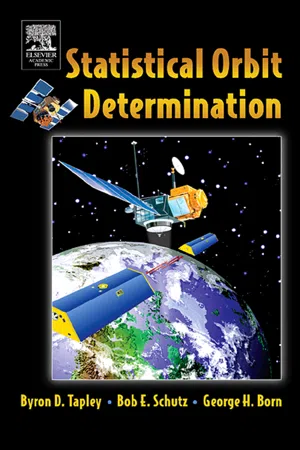 eBook - PDF
- Bob Schutz, Byron Tapley, George H. Born(Authors)
- 2004(Publication Date)
- Academic Press(Publisher)
Chapter 1 Orbit Determination Concepts 1.1 INTRODUCTION The treatment presented here will cover the fundamentals of satellite orbit determination and its evolution over the past four decades. By satellite orbit de-termination we mean the process by which we obtain knowledge of the satellite’s motion relative to the center of mass of the Earth in a specified coordinate system. Orbit determination for celestial bodies has been a general concern of astronomers and mathematicians since the beginning of civilization and indeed has attracted some of the best analytical minds to develop the basis for much of the fundamen-tal mathematics in use today. The classical orbit determination problem is characterized by the assumption that the bodies move under the influence of a central (or point mass) force. In this treatise, we focus on the problem of determining the orbits of noncelestial satellites. That is, we focus on the orbits of objects placed into orbit by humans. These objects differ from most natural objects in that, due to their size, mass, and orbit charateristics, the nongravitational forces are of significant importance. Further, most satellites orbit near to the surface and for objects close to a central body, the gravitational forces depart from a central force in a significant way. By the state of a dynamical system, we mean the set of parameters required to predict the future motion of the system. For the satellite orbit determination problem the minimal set of parameters will be the position and velocity vectors at some given epoch. In subsequent discussions, this minimal set will be expanded to include dynamic and measurement model parameters, which may be needed to improve the prediction accuracy. This general state vector at a time, t , will be denoted as X ( t ) . The general orbit determination problem can then be posed as follows. 1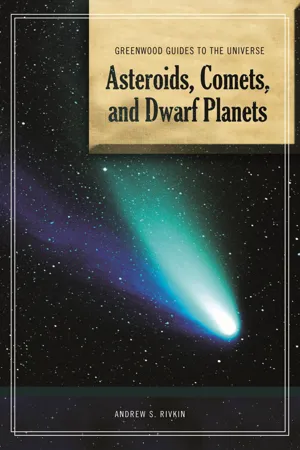
- Andrew S. Rivkin(Author)
- 2009(Publication Date)
- Greenwood(Publisher)
3 The Orbits and Dynamics of Small Bodies This chapter will discuss the places in the solar system where populations of small bodies can be found. Some of those populations are still speculative, with varying amounts of evidence for their existence. Other populations are unquestionably real. To understand the places that asteroids and comets are found, we will need to understand how to characterize their paths around the Sun, and the forces that affect them. ORBITS The paths followed by small bodies as they travel around the Sun are called orbits. In the 1600s, Johannes Kepler showed that objects orbiting the Sun travel in elliptical paths, and move most quickly when they are closest to the Sun and more slowly the farther away from the Sun they are. In addi- tion, he showed that the time it takes an object to travel around the Sun (or its orbital period) was related in a predictable way to its average distance from the Sun (or its semi-major axis length). The semi-major axis is one of six orbital elements that are used to fully describe and uniquely distinguish an orbit. Two other important orbital elements for our purposes are the eccentricity , or how noncircular the orbit is, and inclination, or how the plane of an object’s orbit differs from the plane of the Earth’s orbit. The plane of the Earth’s orbit is also called the ecliptic plane. The point in an orbit closest to the Sun is called the perihelion (also called q), the farthest 27 point the aphelion (also called Q). The positions of these points relative to the Sun can be calculated as follows: where a is the semi-major axis of the orbit and e is the orbit’s eccentricity. Semi-major axis is usually measured in astronomical units or AU, where 1 AU is equal to the mean distance from the Earth to the Sun. Inclination is measured in degrees; eccentricity has no units. eBook - PDF
Satellite Geodesy
Foundations, Methods, and Applications
- Günter Seeber(Author)
- 2008(Publication Date)
- De Gruyter(Publisher)
The effects of perturbations on satellite orbits are also treated [3.2.4]. A section on the integration and representation of orbits [3.3] follows because algorithms for orbit improvement are included in modern software packages for applied satellite geodesy. The appropriate use of satellite ephemerides is discussed together with the corresponding observation methods (e.g. [7.1.5]). 3.1 Fundamentals of Celestial Mechanics, Two-Body Problem In celestial mechanics we are concerned with motions of celestial bodies under the influence of mutual mass attraction. The simplest form is the motion of two bodies ( two-body problem ). For artificial satellites the mass of the smaller body (the satellite) usually can be neglected compared with the mass of the central body (Earth). The two-body problem can be formulated in the following way: Given at any time the positions and velocities of two particles of known mass moving under their mutual gravitational force calculate their posi-tions and velocities at any other time. Under the assumption that the bodies are homogeneous and thus generate the grav-itational field of a point mass the orbital motion in the two-body problem can be 3.1 Fundamentals of Celestial Mechanics, Two-Body Problem 63 described empirically by Kepler’s laws [3.1.1]. It can also be derived analytically from Newtonian mechanics [3.1.2]. The two-body problem is one of the few problems in celestial mechanics that has a complete solution. Other subjects of celestial mechanics are the three-body and the multi-body problem, i.e. motions of three and more celestial bodies under the influence of their mutual gravitation. These problems have no general solution. Orbit perturbations [3.2], orbit determination [3.3] and ephemeris computation are also treated in celestial mechanics. Orbit determination refers to orbital parameters derived from observations [3.3.1].
Index pages curate the most relevant extracts from our library of academic textbooks. They’ve been created using an in-house natural language model (NLM), each adding context and meaning to key research topics.

