Physics

Particle Model of Matter
The Particle Model of Matter is a scientific concept that describes matter as being composed of tiny particles, such as atoms and molecules, which are in constant motion. It explains the behavior of solids, liquids, and gases based on the arrangement and movement of these particles. This model helps to understand and predict the properties and interactions of different forms of matter.
Written by Perlego with AI-assistance
Related key terms
1 of 5
7 Key excerpts on "Particle Model of Matter"
 eBook - PDF
- SachchidaNand Shukla(Author)
- 2023(Publication Date)
- Arcler Press(Publisher)
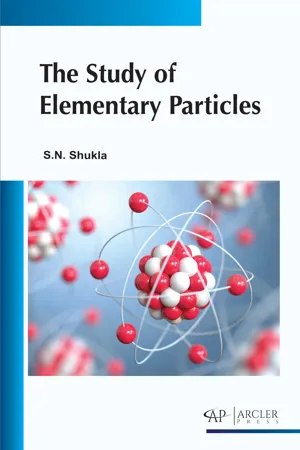
In this state, they behave like a single super atom. This enables one to conduct fundamental checks of their quantum mechanical behavior. 1.4. PARTICLES According to physical sciences, particles are defined as small localized objects that have been ascribed various chemical or physical properties. Some of these properties include mass, density, or volume. Particles may vary in quantity or size. There are subatomic particles which include the electron, microscopic particles such as molecules and atoms, macroscopic particles such as powders and granular materials (Amsler et al., 2008). Particles have been used in several experiments to create scientific models of large objects. Particles used in creating these models are chosen depending of their density. The term particle is generally used in various though its definition is refined according to the scientific field. The term particulate is used to refer to any object made up of particles (Figure 1.8). Basic Constituents of Matter 13 Figure 1.8. Particles are formed through combination of subatomic particles. Source: https://www.livescience.com/65427-fundamental-elementary-particles. html. Fundamental particle or elementary particle is a term used in particle physics to refer to a subatomic particle that is not composed of other particles. Some of the particles assumed to be elementary include antimatter particles, fundamental bosons, matter particles and fundament fermions. Examples of fundamental fermions include leptons, antileptons, quarks, and antiquarks. Higgs boson and gauge bosons are fundamental bosons and are force particles involved in the mediation of interactions between fermions. A composite particle is on that has two or more elementary particles. Naturally, matter contains atoms. The atoms were once presumed to be elementary particles. The Greek term atomos was used to mean that it is unable to cut.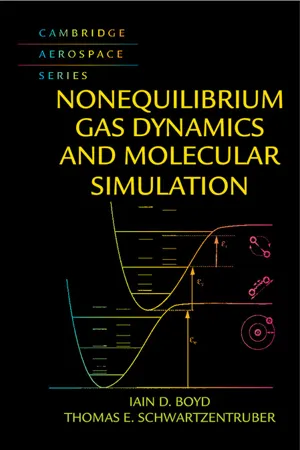
- Iain D. Boyd, Thomas E. Schwartzentruber(Authors)
- 2017(Publication Date)
- Cambridge University Press(Publisher)
We then employ these concepts later in the chapter to analyze a number of different gas flow situations. 3 4 Kinetic Theory Molecular Macroscopic no gradients ρ, p, T Figure 1.1 Macroscopic and molecular views of a gas at rest. 1.2.1 Particle Model The particle is the fundamental unit in kinetic theory and we will use this term generically to refer to atoms and molecules. Each particle has the following properties: Mass (typically around 10 −26 to 10 −25 kg) Size (typically a few 10 −10 m) Position, velocity, and internal energy The mass of a particle is simply the sum of the masses of its constituent atoms. Position is the center of mass location of the constituent atoms and velocity is the center-of-mass velocity of those atoms. For molecules, atomic motion relative to the center of mass (i.e., rotation and vibration) contributes to the internal energy of the particle. The sources of internal energy that a particle of a particular chemical species can possess will be treated in detail using quantum mechanics in Chapter 2. In our introductory treatment of kinetic theory, we will ignore the internal energy for now. In addition, to fix ideas, let us focus on a simple gas, i.e., one in which all particles are of the same species. Particle mass is a well-defined quantity, size is not so clear. An atom con- sists of a nucleus, composed of neutrons and protons, surrounded by orbit- ing electrons, so how large is it? This is an important question, as parti- cle size determines the nature of intermolecular collisions. In real collisions, particles interact through the field that is formed as a result of the electro- static Coulomb forces that act between the elementary charges, the protons and electrons, of the interacting bodies. Figure 1.2 shows an example of the potential energy acting between two argon atoms as a function of their dis- tance of separation. eBook - PDF
Physics of Continuous Matter
Exotic and Everyday Phenomena in the Macroscopic World
- B. Lautrup(Author)
- 2011(Publication Date)
- CRC Press(Publisher)
A material particle will always contain a large number of molecules but may in the continuum description be thought of as in-finitesimal or point-like. From the preceding analysis we know that material particles cannot be truly infinitesimal, but represent the smallest bodies that may consistently be considered part of the continuum description within the required precision . Continuum physics does not “on its own” go below the level of the material particles. Even if the mass density may be determined by adding together the masses of all the molecules in a material particle and di-viding the sum by the volume of the particle, this procedure falls, strictly speaking, outside continuum physics. Although we normally think of material particles as being identical in different types of matter, it is sometimes necessary to go beyond the continuum approximation and look at their differences. In solids, we may with some reservation think of solid particles as containing a fixed collection of molecules, whereas in liquids and especially in gases we should not forget that the molecules making up a fluid particle at a given instant will shortly be replaced by other molecules. If the molecular composition of the matter in the environment of a material particle has a slow spatial variation, this incessant molecular game of “musical chairs” may slowly change the composition of the material inside the particle. Such diffusion processes driven by spatial variations in material properties lie at the very root of fluid mechanics. Even a spatial velocity variation will drive momentum diffusion, causing internal (viscous) friction in the fluid. 1. CONTINUOUS MATTER 11 1.4 Reference frames Physics is a quantitative discipline using mathematics to relate measurable quantities ex-pressed in terms of real numbers. eBook - ePub
Science Learning and Instruction
Taking Advantage of Technology to Promote Knowledge Integration
- Marcia C. Linn, Bat-Sheva Eylon(Authors)
- 2011(Publication Date)
- Routledge(Publisher)
4
PARTICULATE STRUCTURE OF MATTER
A Case Study
Introduction
In this chapter we discuss a case study of curriculum reform that revealed some promising patterns for high school physical science. The case study involves helping students understand the structure of matter and was conducted by Eylon and her colleagues in Israel (Ben-Zvi, Eylon, & Silberstein, 1986a, 1988; Linn, Songer, & Eylon, 1996; Margel, Eylon, & Scherz, 2008).Structure of Matter
Materials has always been a central topic in junior high school science studies and usually includes the following topics: the particulate nature of matter; states of matter; changes in the state of matter; atoms and molecules; elements, compounds, and mixtures; the structure of the atom; and the relationship between the structure and properties of materials. Many of the traditional curriculum approaches (Dory et al., 1989; Zilag et al., 1980) are based on declarative definitions of the scientific concepts and on confirmatory experiments. In particular, in many textbooks the ideas about the particulate nature of matter are presented as postulates: that matter consists of particles that are too small to be seen; that particles are in intrinsic motion; that there is empty space between the particles. The structure of matter is one of the most fundamental topics in science. A meaningful understanding of this topic is essential for developing a solid basis for further scientific studies. It is revisited in high school chemistry courses but not all students take these courses so middle school physical science is often the first and last time that students encounter this topic. eBook - PDF
Interpreting Bodies
Classical and Quantum Objects in Modern Physics
- Elena Castellani(Author)
- 2020(Publication Date)
- Princeton University Press(Publisher)
Anything else can not be called understanding; it would be scarcely more than looking up the table of data, and theoreticians at least should not be content with that. 4. Philosophical Problems Taking this point of view, I am now going to discuss the philosophy that, whether consciously or unintentionally, has determined the direc-tion of particle physics. For 2,500 years philosophers and scientists have pondered the questions: What happens if one tries to divide matter again and again? What are the smallest particles of matter? Different philoso-phers have given very different answers, all of which have influenced the history of natural science. The best-known answer is that of the philoso-pher Democritos: in the attempt to divide again and again one finally ends up with indivisible, unchangeable units, called atoms, of which all matter is composed. The positions and motions of the atoms determine the qualities of matter. For Aristotle and his medieval successors, on the other hand, the con-cept of the smallest particle is not so well defined. It is true that for every kind of matter smallest particles are assumed—further division would change the characteristic qualities of the substance—but these smallest particles can be changed continuously like the substances themselves. Mathematically the substances can be divided ad infinitum. Matter is taken as continuous. The clearest position against Democritos was taken by Plato. In his opinion the attempt to divide again and again results in mathematical forms: the regular bodies of stereometry, defined by their symmetry, and the triangles of which they are composed. These forms are not matter themselves, but they make up matter. For the element earth, for exam-ple, the characteristic body is the cube; for fire, the tetrahedron. What all these philosophies have in common is the attempt to deal with the antinomy of the infinitely small, which was discussed extensively by Im-manuel Kant. eBook - PDF
Introductory Chemistry
An Active Learning Approach
- Mark Cracolice, Edward Peters, Mark Cracolice(Authors)
- 2020(Publication Date)
- Cengage Learning EMEA(Publisher)
9. If matter is indeed conserved, how can you explain the fact that a glass of water left alone on a kitchen counter will eventually empty? The outside of a glass of cold water typically becomes wet. What substance wets the glass, and where does it come from? Questions, Exercises, and Problems Solutions for blue-numbered questions are at the end of the chapter. Questions other than those in the General Questions and More Challenging Problems sections are paired in consecutive odd–even number combinations; the odd-numbered questions are blue, and the even-numbered questions are black in these pairs. Section 2.2: Representations of Matter: Models and Symbols 1. Identify the following samples of matter as macroscopic, microscopic, or particulate: (a) a human skin cell; (b) a sugar molecule; (c) a blade of grass; (d) a helium atom; (e) a single-celled plant too small to see with the unaided eye. 2. Classify each of the following as macroscopic, micro- scopic, or particulate: (a) a cell membrane; (b) a silver atom; (c) iron filings. 3. Suggest a reason for studying matter at the particulate level, given that it is too small to see. 4. How does a chemist think about particles that are so small that they are impossible to see with the naked eye or with even the most powerful optical microscope? Section 2.3: States of Matter 5. Using spheres to represent individual atoms, sketch particulate illustrations of a substance as it is heated from the solid to the liquid and to the gaseous state. 6. Describe a piece of ice at the particulate level. Then describe what happens to the ice as it is heated until it melts and eventually boils. Copyright 2021 Cengage Learning. All Rights Reserved. May not be copied, scanned, or duplicated, in whole or in part. Due to electronic rights, some third party content may be suppressed from the eBook and/or eChapter(s). Editorial review has deemed that any suppressed content does not materially affect the overall learning experience. eBook - PDF
- John Mcgervey(Author)
- 2012(Publication Date)
- Academic Press(Publisher)
C H A P T E R The Atomic Nature of Matter and Electricity All of modern physics is based upon the analysis of matter by reference to its elementary constituents— molecules, atoms, and elementary particles. But the atomicity of matter is not at all obvious, and the student may well wonder how we can place so much confidence in our analysis when our observations of these particles are necessarily so indirect. Therefore, it is the aim of this chapter to show how it is possible to obtain a surprising amount of information about the atomic structure of matter even with relatively simple apparatus. This information leads us into an investigation of the electrical properties of atoms and a study of the a t o m of electricity—the electronic charge. We shall find that the atomic nature of electricity provides us with a great deal of our evidence for the atomic nature of matter. 1 2 THE ATOMIC NATURE OF MATTER AND ELECTRICITY 1.1 KINETIC THEORY OF GASES Observations of gases provided the earliest clues to the atomicity of matter. Around 60 B.C. Lucretius observed that the random motion of dust particles in the air could be explained by assuming that it was caused by the impact of smaller, invisible particles of which the air itself was composed. He said: It is meet that you should give greater heed to those bodies which are seen to tumble about in the sun's rays, because such tumblings imply that motions also of matter latent and unseen are at the bottom. Motion moves up from the first-beginnings (atoms) and step by step issues forth to our senses, so that those bodies also move, which we can discern in the sunlight, though it is not clearly seen by what blows they so act. Similar movements of microscopic particles suspended in a liquid were ob-served eighteen hundred years later by the botanist Brown, and the motion became known as Brownian motion.
Index pages curate the most relevant extracts from our library of academic textbooks. They’ve been created using an in-house natural language model (NLM), each adding context and meaning to key research topics.

