Physics

Solar Terrestrial Physics
Solar Terrestrial Physics is the study of the interactions between the Sun and the Earth's atmosphere and magnetic field. It involves the investigation of phenomena such as solar flares, coronal mass ejections, and the aurora borealis. The goal of this field is to understand the effects of these interactions on our planet and to develop ways to mitigate any potential harm.
Written by Perlego with AI-assistance
Related key terms
1 of 5
6 Key excerpts on "Solar Terrestrial Physics"
- Timothy H. Kindervatter, Fernando L. Teixeira(Authors)
- 2022(Publication Date)
- Wiley-IEEE Press(Publisher)
For example, electrons may be blown around by wind, or they may respond to the Earth’s magnetic field. These so-called transport effects are responsible for a number of anomalous phenomena that are relevant to radiowave propagation, many of which are discussed in Section 6.4. Due to their importance, thorough derivations of a few major transport effects are presented in Section 5.5. 5.2 Solar-Terrestrial Relations The Sun is by far the most prominent source of ionization in the Earth’s atmosphere. Photons from across the electromagnetic spectrum are produced by the Sun, and those with sufficiently high energy are capable of knocking electrons loose from gas particles in the atmosphere, ionizing them. The Sun also ejects high energy particles (such as high-velocity electrons and protons), which are also capable of ionizing atmospheric gases in a process called corpuscular ionization. In order to provide context for the ionization processes which form the cor- nerstone of this chapter, we will briefly discuss some of the important aspects of the solar-terrestrial environment. The regions of interest along the path between the Sun and the Earth are: the Sun, the interplanetary medium, the Earth’s magnetosphere, and the Earth’s atmosphere. Each of these regions plays a role in the production and transmission of electromagnetic waves and energetic particles from the Sun to the Earth. These topics are incredibly deep and complex in and of themselves, so only a cursory examination of them will be provided. The interested reader may consult [71] for further details. 5.2.1 The Sun Nuclear Fusion The Sun is classified as a main sequence star – middling in size, temperature, and luminosity as compared with other stars. It has a radius of 695,990 km, a mass of 1.989 × 10 30 kg, and is made up almost entirely of Hydrogen (70%) 5.2 Solar-Terrestrial Relations 165 and Helium (28%). eBook - PDF
- Claude Nicollier, Volker Gass(Authors)
- 2015(Publication Date)
- EPFL PRESS(Publisher)
Space weather encompasses not only the phenomena witnessed during the Carrington event but also all other manifestations related to the speed and density of the solar wind, to the interplanetary magnetic field, and to the behavior of Earth’s magnetic shield, the magnetosphere (see Figure 3.11). Geomagnetic storms, the energization of the Van Allen radiation belts, ionospheric disturbances and scintillation, and aurora and geomagnetically in- duced currents at the Earth’s surface are among the most frequent manifesta- tions of space weather (see Figure 3.12). That term also refers to perturbations in the upper atmosphere where UV solar radiation and high-energy particles affect its chemical composition, especially ozone concentration. Understand- ing and even forecasting these phenomena therefore requires a proper under- standing and the continuous monitoring of solar variability, how the Earth responds to it, and the economic and societal impacts. Disturbances in our fragile magnetic shield, the magnetosphere The magnetosphere is the region of space surrounding the Earth where its magnetic field dominates the interplanetary magnetic field (see Figure 3.11). Its shape is continually buffeted by the solar wind whose pressure compress- es the Earth’s field on the dayside, confining it to within about 10 Earth radii from the center of Earth and stretching it into a long “magnetotail” on the night side, out to hundreds of Earth radii, well beyond the orbit of the Moon. The boundary layer between the solar wind and the Earth’s magnetic field, called the magnetopause, shields us to some extent from these solar wind bursts, but it is a very fragile structure fluttering in the solar wind like a thin veil of silk. Energy, mass, and momentum may cross through this shield and be transferred inside the magnetosphere, creating various concentrations of fields, plasmas, and currents such as the Van Allen radiation belts.
- A.K. Oppenheim(Author)
- 2013(Publication Date)
- Pergamon(Publisher)
The International Magnetospheric Study JUAN G. ROEDERER Professor of Physics, Department of Physics and Astronomy, University of Denver, Denver, Colorado 80210, U.S.A. (Received 12 October 1973) Abstract —During the past 15 years, the study of the earth's rnagnetosphere—man's immediate plasma and radiation environment—has undergone a successful stage of discovery and exploration. We have obtained a morphological description of the magnetospheric field, the particle population embedded in it, and its interface with the solar wind, and we have identified and are beginning to understand many of the physical processes involved. Quite generally, the rnagnetosphere reveals itself as a region where we can observe some of the fundamental plasma processes at work that are known to occur elsewhere in the universe. Time has come now for a transition from the exploratory stage to one in which satellite missions and ground-based, aircraft, balloon, and rocket observations are planned with the specific objective of achieving a quantitative understanding of the physical processes involved. Some of the principal targets of current research are: the electric field in the rnagnetosphere, the dynamics of the two main plasma reservoirs (plasmasphere and plasmasheet) and their boundaries, the interaction between trapped particles and waves, the transfer of particles, energy and momentum from the solar wind to the rnagnetosphere and from there into the ionosphere, and the development of a fundamental instabil-ity, the magnetospheric substorm. It is expected that the International Magnetospheric Study 1976-78 will solve many of the problems involved, particularly those related to the timing of dynamical changes during substorms, the identification of spatial locations for these changes, the nature of magnetospheric boundaries and the energy budget in the solar wind-magnetosphere-iono: phere system. eBook - PDF
- David Alexander, Timothy F. Slater, Lauren V. Jones, Timothy F. Slater, Lauren V. Jones(Authors)
- 2009(Publication Date)
- Greenwood(Publisher)
These tools employ a wealth of solar monitoring instrumentation, computer modeling, and human experi- ence to safeguard the various resources that we have placed within the Earth’s space environment. Current space weather efforts concentrate on the potential for solar storms to be geo-effective, namely how likely an event on the Sun is to significantly affect the Earth’s magnetic environment. Future proposed space endeavors include the establishment of a permanent base on the Moon and the human exploration of Mars, and the tools devel- oped for the near-Earth space environment need to be modified for these new regimes—long stays on the Moon’s surface with little or no natural protection from solar radiation, and extended voyages to Mars, lasting as long as twenty-six months, with full exposure to the Sun the whole way. The interaction of the solar wind and solar disturbances with the Earth’s magnetosphere presents its own set of unique problems and challenges for our understanding of space weather and, in particular, our ability to fore- cast impending geomagnetic storms. For instance, the orientation of the magnetic field embedded in the incoming plasma is critical to how geo- effective the event is. For missions to the Moon, Mars, or during long-dura- tion transit, the relative luxury of protection by the Earth’s magnetospheric shield is not available. Continued exposure to potentially harmful solar radiation is a key factor in the planning and preparation for missions to the Moon and Mars involving manned spacecraft. Solar energetic particles (SEP) with energies as high as 1 GeV per nucleon are produced by the Sun in association with large flares and CMEs. Very large particle events with large fluxes of high-energy particles are called solar proton events (SPE). An SPE has a precise definition such that the flux of protons with energy above 10 MeV must be greater than 10 particles 154 THE SUN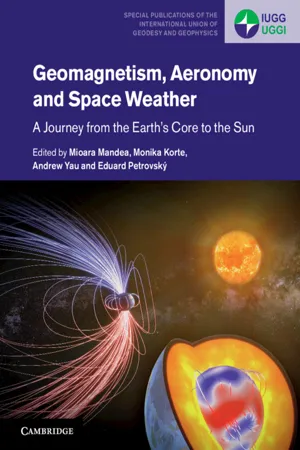 eBook - PDF
Geomagnetism, Aeronomy and Space Weather
A Journey from the Earth's Core to the Sun
- Mioara Mandea, Monika Korte, Andrew Yau, Eduard Petrovsky(Authors)
- 2019(Publication Date)
- Cambridge University Press(Publisher)
PART IV Space Weather 14 Physical Processes of Space Weather The Sun–Earth interaction is a complex system of multi- scale processes. The spatial scales of interest vary from the mega-meter size of solar corona structures to the few hun- dred kilometres of the terrestrial magnetopause and even less when kinetic effects need to be considered. The temporal variations also span a wide range of scales, from thousands of years for the hydrological ocean cycles driven by the total solar radiation to scales of minutes and below for particle acceleration in magnetic reconnection. In this chapter we introduce the building blocks of the Sun–Earth system and briefly describe its important components. Solar disturbances such as solar flares and coronal mass ejection (CME) have the largest impact on geomagnetic activ- ity, especially magnetic storms. Magnetic storms are respon- sible for large depressions in the horizontal (H) component of the Earth’s surface magnetic field. The strength of a storm is quantified by the D st index, which is a local time average of the depression measured along the magnetic equator. The depression during a storm is caused by a ring current around the Earth with additional contributions from the magneto- pause and tail currents. We review recent developments of empirical prediction algorithms for the D st index using obser- vations made upstream of the Earth, and alternative proce- dures based on the same concept including neural networks and the NARMAX method. Future improvements in empiri- cal prediction will require more data from extreme events, additional physical insight to identify the role of other pro- cesses, and better measurements of the inputs to the system. 14.1 The Sun–Earth Connection Bogdan Hnat The Sun’s impact on Earth is difficult to overstate.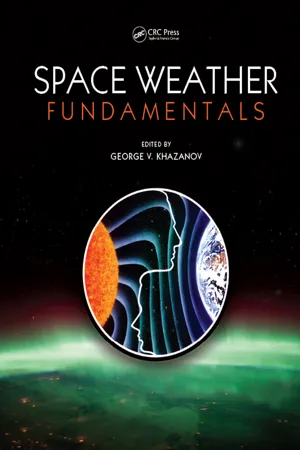 eBook - ePub
- George V. Khazanov(Author)
- 2016(Publication Date)
- CRC Press(Publisher)
Introduction George V. Khazanov“Space weather” refers to conditions on the Sun and in the solar wind, magnetosphere, ionosphere, and thermosphere that can influence the performance and reliability of space-borne and ground-based technological systems and can endanger human life or health. Adverse conditions in the space environment can cause disruption of satellite operations, communications, navigation, and electric power distribution grids, leading to a variety of socioeconomic losses. This book provides a comprehensive overview of our current knowledge and theoretical understanding of space weather formation and covers all major topics of this phenomena starting from the Sun to the Earth’s ionosphere and thermosphere.This book benefits from the material presented by 29 authors. All authors are very well-known researchers in the field of space science, and most of them have a very distinguish level of accomplishment in space weather studies. The predictive nature of space weather research, however, distinguishes it from conventional space physics research, but the conventional space physics research is the basis of space weather fundamentals. Now without further ado, we introduce the team of the authors and provide a short description of each chapter.Drs. Judith Karpen, chief of the Space Weather Laboratory, and Spiro Antiochos, senior scientist for space weather and an American Geophysical Union (AGU) fellow [both at Goddard Space Flight Center (GSFC), the National Aeronautics and Space Administration (NASA), Greenbelt, Maryland], wrote Chapter 1 titled “The Sun.” The Sun is the ultimate source of all space weather in the solar system. Specifically, the twisting of the Sun’s magnetic field from the deep interior through the photosphere, its visible surface, transfers the energy generated by fusion from the core to the plasma and the magnetic field of the solar corona. Both slow and fast drivers of space weather originate in the corona and then prop agate and evolve throughout the heliosphere. This chapter discusses the primary phenomena driving space weather on long (day-to-month) and short (second-tominute) timescales, and the associated mechanisms of radiative and mechanical forcing. Slow drivers include corotating interaction regions in the solar wind, which originate at the interface between closed and open magnetic fluxes on the rotating Sun. On similar timescales, the emergence and evolution of solar active regions, localized regions of strong magnetic flux that wax and wane with the solar cycle, cause significant fluctuations of emissions across the electromagnetic spectrum; enhancements in ultraviolet radiation and X-rays are particularly relevant to space weather because of their profound impact on planetary ionospheres. Explosive energy release in the corona, commonly ascribed to magnetic reconnection, produces massive eruptions of magnetic field and plasma (coronal mass ejections) as well as intense bursts of electromagnetic radiation and energetic particles (flares). This impulsive activity generates the most destructive space weather events in the heliosphere, with complex consequences for planetary magnetospheres, ionospheres, neutral atmospheres, and life and technology in space and on planetary surfaces. Chapter 1
Index pages curate the most relevant extracts from our library of academic textbooks. They’ve been created using an in-house natural language model (NLM), each adding context and meaning to key research topics.

