Physics

Spring-Block Oscillator
A spring-block oscillator is a system consisting of a mass attached to a spring, which oscillates back and forth. The mass experiences a restoring force from the spring, causing it to oscillate with a specific frequency determined by the mass and the spring constant. This system is often used to study simple harmonic motion and oscillatory behavior in physics.
Written by Perlego with AI-assistance
Related key terms
1 of 5
7 Key excerpts on "Spring-Block Oscillator"
 eBook - ePub
Oscillations and Waves
An Introduction, Second Edition
- Richard Fitzpatrick(Author)
- 2018(Publication Date)
- CRC Press(Publisher)
CHAPTER 1Simple Harmonic Oscillation
1.1 INTRODUCTIONThe aim of this chapter is to investigate a particularly straightforward type of motion known as simple harmonic oscillation, and also to introduce the differential equation that governs such motion, which is known as the simple harmonic oscillator equation. We shall discover that simple harmonic oscillation always involves a back and forth flow of energy between two different energy types, with the total energy remaining constant in time. We shall also learn that the linear nature of the simple harmonic oscillator equation greatly facilitates its solution. In this chapter, examples are drawn from simple mechanical and electrical systems.1.2 MASS ON SPRINGConsider a compact mass m that slides over a frictionless horizontal surface. Suppose that the mass is attached to one end of a light horizontal spring whose other end is anchored in an immovable wall. See Figure 1.1 . At time t, let x(t) be the extension of the spring; that is, the difference between the spring’s actual length and its unstretched length. x(t) can also be used as a coordinate to determine the instantaneous horizontal displacement of the mass.The equilibrium state of the system corresponds to the situation in which the mass is at rest, and the spring is unextended (i.e., x = ẋ = 0, where ̇. ≡ d/dt). In this state, zero horizontal force acts on the mass, and so there is no reason for it to start to move. However, if the system is perturbed from its equilibrium state (i.e., if the mass is displaced horizontally, such that the spring becomes extended) then the mass experiences a horizontal force given by Hooke’s law,f(1.1)( x )= − k x .FIGURE 1.1 Mass on a spring.Here, k > 0 is the so-called force constant of the spring. The negative sign in the preceding expression indicates that f(x) is a so-called restoring force that always acts to return the displacement, x, to its equilibrium value, x = 0 (i.e., if the displacement is positive then the force is negative, and vice versa). Note that the magnitude of the restoring force is directly proportional to the displacement of the mass from its equilibrium position (i.e., | f | ∝ x). Hooke’s law only holds for relatively small spring extensions. Hence, the mass’s displacement cannot be made too large, otherwise Equation (1.1) ceases to be valid. Incidentally, the motion of this particular dynamical system is representative of the motion of a wide variety of different mechanical systems when they are slightly disturbed from a stable equilibrium state. (See Sections 1.5 No longer available |Learn more
- Tai L. Chow(Author)
- 2013(Publication Date)
- CRC Press(Publisher)
199 © 2010 Taylor & Francis Group, LLC Harmonic Oscillator Harmonic oscillators, along with damped and driven oscillators, will be treated in considerable detail in this chapter not merely because harmonic motion is a good approximation of many physi-cal processes but also because a thorough understanding of this process aids comprehension of the other types of oscillations. By Fourier analysis, complicated oscillations often may be regarded as consisting of a number of simple harmonic oscillations. Simple harmonic motion (SHM) arises whenever a system vibrates around an equilibrium posi-tion. It is caused by a force that is directed toward the equilibrium position and that is proportional to the displacement of the particle from the equilibrium position, which causes its motion. Examples of simple harmonic motions are found in the motion of a weight on the end of a perfect elastic spring, the bob of a simple pendulum swinging through a very small arc, atoms in a crystal lattice, the nuclei of atoms in molecules, and so on. 7.1 SIMPLE HARMONIC OSCILLATOR We first consider two examples of simple harmonic motion. 7.1.1 M OTION OF M ASS M ON THE E ND OF A S PRING The spring has a natural length b and spring constant k when the system is in equilibrium (i.e., when the particle hangs motionless); the weight of the particle is exactly balanced by the restoring force of the spring where d is the extension of the spring (Figure 7.1): mg = kd . (7.1) Suppose the particle has been set into vertical vibration at the instant when the displacement of the particle is x ; the extension of the spring is then d + x . eBook - ePub
Classical Mechanics
From Newton to Einstein: A Modern Introduction
- Martin W. McCall(Author)
- 2011(Publication Date)
- Wiley(Publisher)
models , exemplars of many oscillatory systems in physics. The analogue is exact for many electrical circuits wherein the ideas discussed find wide application. Even when the analogue is not perfect the results can still be effective – electrons in atoms are not really connected to the nuclei by springs, but a classical oscillator model provides a fair description.3.2 Prototype Harmonic OscillatorWe begin with what is essentially the problem analysed in Section 2.10 of the previous chapter. Consider the prototype oscillator model shown in Figure 3.1 . The mass, resting on a frictionless surface, is connected to a rigid support via a spring. When drawn to the right the distance from its equilibrium position is identified as x . Since it is not too far from equilibrium, the elastic limit is not exceeded and therefore the restoring force acting to the left is given by (−kx ), where k is the spring constant (units N m−1 = kg s−2 ). Applying Newton’s second law, the equation of motion ism+ kx =0 or, dividing through by the mass and defining ω 0 2 ≡ k/m,(3.1)Figure 3.1prototype mass−spring harmonic oscillator.Note that the parameter ω 0 has been introduced to emphasise that the motion depends on just one number, and since k/m is definitely positive we make it the square of this parameter. The physical significance of ω 0 will be clear once we have solved the equation of motion, Equation (3.1 ). Equation (3.1 ) is the equation of Simple Harmonic Motion (SHM), but in order to solve it rigorously, we need to know some facts about differential equations.3.3 Differential Equations The sorts of differential equations (DE’s) we are considering are of the form(3.2)where there is only one dependent variable (space) and only one independent variable (time). For coupled oscillators we will relax the condition of only one dependent variable, but the results quoted below will still hold. The fact that there is only one independent variable means that we are dealing with ordinary (as opposed to partial) differential equations. We further assume that the coefficients (a,b,c )are independent of time, although d is either zero or time-dependent.1 eBook - PDF
Ocean Waves and Oscillating Systems: Volume 8
Linear Interactions Including Wave-Energy Extraction
- Johannes Falnes, Adi Kurniawan(Authors)
- 2020(Publication Date)
- Cambridge University Press(Publisher)
CHAPTER TWO Mathematical Description of Oscillations In this chapter, which is a brief introduction to the theory of oscillations, a simple mechanical oscillation system is used to introduce concepts such as free and forced oscillations, state-space analysis and representation of sinusoidally varying physical quantities by their complex amplitudes. In order to be some- what more general, causal and noncausal linear systems are also looked at and Fourier transform is used to relate the system’s transfer function to its impulse response function. With an assumption of sinusoidal (or ‘harmonic’) oscillations, some important relations are derived which involve power and stored energy on one hand and the parameters of the oscillating system on the other hand. The concepts of resonance and bandwidth are also introduced. 2.1 Free and Forced Oscillations of a Simple Oscillator Let us consider a simple mechanical oscillator in the form of a mass–spring– damper system. A mass m is suspended through a spring and a mechanical damper, as indicated in Figure 2.1. Because of the application of an external force F , the mass has a position displacement x from its equilibrium position. Newton’s law gives m ¨ x = F + F R + F S , (2.1) where F S is the spring force and F R is the damper force. If we assume that the spring and the damper have linear characteristics, then we can write F S = −Sx and F R = −R ˙ x, where the ‘stiffness’ S and the ‘mechanical resistance’ R are coefficients of proportionality, independent of the displace- ment x and the velocity u = ˙ x. Thus, we have the following linear differential equation with constant coefficients: m ¨ x + R ˙ x + Sx = F , (2.2) where an overdot is used to denote differentiation with respect to time t. 6 2.1 FREE AND FORCED OSCILLATIONS OF A SIMPLE OSCILLATOR 7 Figure 2.1: Mechanical oscillator in the form of a mass–spring–damper system.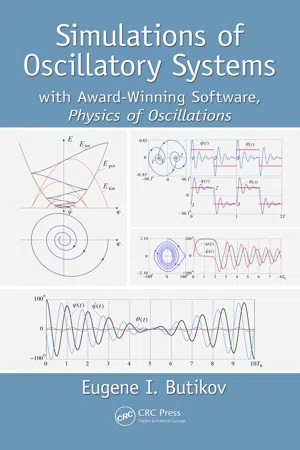 eBook - PDF
Simulations of Oscillatory Systems
with Award-Winning Software, Physics of Oscillations
- Eugene I. Butikov(Author)
- 2015(Publication Date)
- CRC Press(Publisher)
In the case of unforced (free, or natural) oscillations of an isolated system, motion is initiated by an external influence acting before a particular instant. This influence determines the mechanical state of the system, that is, the displacement and the velocity of the oscillator, at the initial instant. These in turn determine the amplitude and phase of subsequent free oscillations. Frequency and damping of such oscillations are determined by the physical properties of the system. On the other hand, the characteristics of forced oscillations generated by a periodic external influence depend not only on the initial conditions and physical properties of the oscillator but also on the nature of the external disturbance, that is, on its amplitude and (primarily) on frequency. 3.1.2 Discussion of the Physical System To study forced oscillations in a linear system excited by a sinusoidal external force, we consider here the same torsion spring pendulum described in Chapter 1 (which is devoted to free oscillations), namely, a balanced flywheel attached to one end of a spiral spring. The flywheel turns about its axis of rotation under the restoring torque of the spring, much like the devices used in mechanical watches. However, unlike the situation of free oscillations in which the other end of the spring is fixed, now this end is attached to an exciter, which is a rod that can be turned back and forth about an axis common with the axis of rotation of the flywheel. A schematic diagram of the driven torsion oscillator is shown in the left-hand panel of Figure 3.1. The right-hand panel of Figure 3.1 shows an oscillatory LCR -circuit with al-ternate input voltage. This circuit can be regarded as an electromagnetic analog of the mechanical device. Both systems are described by identical differential equa-tions and thus are dynamically isomorphic. eBook - PDF
Design of CMOS Phase-Locked Loops
From Circuit Level to Architecture Level
- Behzad Razavi(Author)
- 2020(Publication Date)
- Cambridge University Press(Publisher)
1 Oscillator Fundamentals At the heart of every phase-locked loop lies an oscillator, playing a critical role in the performance that can be achieved. For this reason, we devote five chapters of this book to oscillator design. This chapter aims to build a solid foundation for general oscillator concepts before we delve into high-performance design in Chapters 3-6. We begin with basic concepts and discover how a negative-feedback system can oscillate. We then extend our view to ring and LC oscillators. 1.1 Basic Concepts If we release a pendulum from an angle, it swings for a while and gradually comes to a stop. The “oscillation” begins because the original potential energy turns into kinetic energy as the pendulum reaches its vertical position (Fig. 1.1), allowing it to continue its trajectory to the other extreme angle (position 3), at which the Figure 1.1 A pendulum acting as an oscillatory system. Hinge Potential Energy Energy Kinetic Potential Energy Position 1 Position 2 Position 3 energy is again in potential form. The oscillation stops because the friction at the hinge and the air resistance convert some of the pendulum’s energy to heat in every oscillation period. In order to sustain the oscillation, we can provide external energy to the pendulum so as to compensate for the loss caused by the hinge and the air. For example, if we give the pendulum a gentle push each time it returns to position 1, it will continue to swing. If the push is too weak, we undercompensate, allowing the oscillation to die; if the push is too strong, we overcompensate, forcing the swing amplitude to increase from one cycle to the next. We also note that the period of oscillation is independent of the amplitude. eBook - ePub
Flow-induced Vibrations: an Engineering Guide
IAHR Hydraulic Structures Design Manuals 7
- Eduard Naudascher, Donald Rockwell(Authors)
- 2017(Publication Date)
- CRC Press(Publisher)
CHAPTER 2 Body oscillators 2.1 OVERVIEW AND DEFINITIONSBecause the writers’ main goal is to identify the variety of mechanisms by which flow-induced vibrations are excited, the structural dynamics are presented in the simplest way possible throughout this monograph. In most cases, this means representing the vibrating structure or structural part as a discrete mass, free to oscillate with one degree of freedom, linearly damped, and supported by a linear spring (Figures 2.1 and 2.2 ). The following sections contain a brief review from the field of mechanical vibrations concerning these simple body oscillators that is sufficient for the understanding of the monograph. A method of generalization is presented, finally, by which simple-oscillator concepts become applicable to more complex systems with continuous or distributed masses such as beams, plates, and shells.Any vibration is describable in terms of sinusoidal functions. The simplest vibration is a harmonic motion of the formx =x ocos ω t , ω = 2 π f(2.1) where x = body deflection from its time-mean position, xo= amplitude, t = time, ω = circular frequency, and f = frequency in cycles per second or Hertz. One of the most useful ways of describing simple harmonic motion is obtained by regarding it as the projection on the horizontal axis of a vector of length xorotating counterclockwise with uniform angular velocity ω (Figure 2.1 ). This rotating-vector description is commonly represented by the complex exponential functionx ( t ) =x oe=i ω tx o( cos ω t + i sin ω t )(2.2) for which Ox is the ‘real’ and Oy is the ‘imaginary’ axisFigure 2.1. Definition sketch, (a) Simple undamped body oscillator, (b) Histogram of harmonic motion, (c) Vector respresenlation of harmonic motion.(. Thus, the real part of this expression may be considered the horizontal projection and the imaginary part the vertical projection; and again, it is the former which represents the harmonic motion or vibration. In Figure 2. lb , T = 1/f denotes the period of vibration.i ≡)− 1
Index pages curate the most relevant extracts from our library of academic textbooks. They’ve been created using an in-house natural language model (NLM), each adding context and meaning to key research topics.

