Politics & International Relations

Anthony Crosland
Anthony Crosland was a British Labour Party politician and author who served as a Member of Parliament and held various ministerial positions. He is known for his influential book "The Future of Socialism" which argued for a revisionist approach to socialism, emphasizing the importance of equality of opportunity and social justice rather than the traditional focus on nationalization and state control.
Written by Perlego with AI-assistance
Related key terms
1 of 5

4 Key excerpts on "Anthony Crosland"
 eBook - ePub
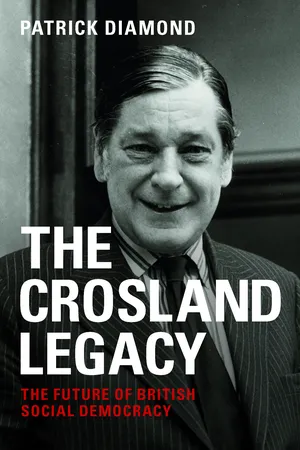
The Crosland legacy
The Future of British Social Democracy
- Diamond, Patrick, Patrick Diamond(Authors)
- 2016(Publication Date)
- Policy Press(Publisher)
TWO Crosland: the socialist theoretician as hero The difficulty lies, not in the new ideas, but in escaping from the old ones. (J.M. Keynes, 1936 1) The party appears to the outside observer to be less prepared in spirit for the many awkward problems which it will have to face as soon as it reaches office than it was even in 1945, when its whole task was enormously simplified by the existence of a comprehensive set of wartime controls and a lot of civil servants sitting ready in their offices with long experience of working them. (Andrew Shonfield, 1960 2) The revisionist case against more statist versions of socialism was not new: its combination of reason, passion, and parliamentary gradualism had been present within the British Labour Party from the start, for passion could as well inspire parliamentary gradualism as anti-parliamentarianism. (Brian Harrison, 2009 3) Introduction Anthony Crosland has been an iconic figure for generations of British social democrats; next to Aneurin Bevan he was ‘the most exciting Labour politician of the twentieth century’. 4 His writings conveyed the qualities of political relevance and intellectual élan that were in short supply in the British Labour party. Crosland had exceptional abilities ensuring that he stood out as Labour’s pre-eminent ‘scholar-politician’. This chapter charts the highs and lows of his career against the rise and fall of British social democracy. There were prolonged periods in which Crosland’s career stagnated, particularly following Wilson’s ascent to the leadership in 1963. During the 1970s, Croslandite social democracy was imperilled: its political economy was disintegrating in the face of global financial pressures; revisionism had little to say about the surge of Celtic nationalism and the incipient crisis of the British state eBook - ePub
- Kevin Theakston(Author)
- 2004(Publication Date)
- Routledge(Publisher)
1Oliver J. Daddow
Anthony Crosland’s career as Foreign Secretary has generally received peremptory attention, inviting comparison with one of his Labour predecessors, Herbert Morrison. 2 This should not surprise us for a number of reasons. It reflects first of all Crosland’s own political agenda which, like Morrison’s, was geared more to the development of socialist ideology and Labour’s economic policy, most notably through his 1956 publication The Future of Socialism and follow-ups The Conservative Enemy and Socialism Now. 3 Writing at the time of his death, his close friend Dick Leonard observed that ‘it is almost certainly as a thinker and writer that Crosland will be most remembered’, 4 an opinion that over 20 years on has been upheld in a populist newspaper article that labels him ‘one of the great socialist intellectuals of his generation’. 5 Second, and again like Morrison, Crosland had little time to make his mark at the Foreign Office, but whereas the former was the victim of an electoral swing to conservatism the latter was unluckier, dying from a stroke.Finally, he was not at the helm during a period of crisis or revolution in Britain’s external relations, either of which would have sparked historiographic interest in his policy. In this respect, he differed from Morrison who is forever connected with Britain’s policy towards the Schuman Plan and European unity. Crosland, by contrast, took office just after one of the most divisive issues in British foreign policy, the European referendum, had been resolved at enormous costs to the long-term cohesion of the Labour Party. 6 Furthermore, the Vietnam War had ended; ‘PLP [Parliamentary Labour Party] v. quiet on Foreign Affairs’, noted one adviser, 7 eBook - ePub
The University and Public Education
The Contribution of Oxford
- Harry Judge(Author)
- 2013(Publication Date)
- Routledge(Publisher)
Anthony Crosland: intellectual and politician Maurice KoganAnthony Crosland was one of the formative politicians of his generation. Yet there is a discernible gap between the power and impact of his writing, which effected mainly in the decade or so after leaving Oxford, his statement of policies, and then his ability or perhaps even his motivation to put precept into full policy practice. This may be a deficit to which all politicians, even the best, are heirs. We take note of it as we identify his conspicuous contributions to and achievements in policy-making.He is rightly credited with providing the intellectual foundations of ‘revisionism’ (e.g. Lipsey, 1981; Crosland, S., 1982; Radice, 2002) which eventually emancipated the Labour Party from its traditional belief in nationalisation as the way to greater equality, and provided the theoretical foundations of a more participative and liberal society. He was an active party leader and highly successful minister within a wide range of departments, including Education and Science.Educated as an economist, Crosland took a first in philosophy, politics and economics, although he had been admitted as a scholar to Trinity College, Oxford, to read Greats. For much of his political life he was engaged in economics as an intellectually active author, as a back bencher, or in the Shadow Cabinet, or as a Minister in the ill-fated Department of Economic Affairs and the Board of Trade. He was Secretary of State for Local Government and Regional Planning and later the Department of the Environment. At his death in February 1977 he was Foreign Secretary.Although on becoming education minister in 1965,1 eBook - PDF
Labour's Thinkers
The Intellectual Roots of Labour from Tawney to Gordon Brown
- Kevin Hickson, Matt Beech(Authors)
- 2007(Publication Date)
- I.B. Tauris(Publisher)
11 In addition, these trends had been identified by pre-war Labour thinkers such as Douglas Jay and Evan Durbin, although they formed only a minor part of their arguments. 12 This was a controversial thesis involving both a quantitative assessment of the ownership patterns of industry and a qualitative assertion of the social responsibility of management. Not surprisingly, both aspects of this argument were questioned. 13 Third, there had been a transfer of power from owners to workers. This was largely in the form of organised labour, which had become more powerful partly as a result of legislation enacted by the Attlee Government but mainly due to the increase in trade union membership after the war. This had increased the collective bargaining power of labour, particularly in the full employment conditions of the 1950s. A final development noted by Crosland was the transformation in British politics, particularly in the C.A.R. CROSLAND 148 Conservative Party. 14 The Conservatives had rejected the earlier free market stance in favour of the welfare state and mixed economy. Although this was largely due to the pressures of electoral competition and the shock of losing in 1945, Crosland thought that a future Conservative government was unlikely to undo the social and economic reforms of the Attlee Administration. These changes were fundamental and irreversible and Crosland questioned the extent to which the contemporary economy was still capitalist. He suggested in 1952 that the new form of economic relations was ‘statist’ 15 but in The Future of Socialism rejected this term: “I once rashly joined in the search for a suitable name, and in New Fabian Essays called the new society ‘statism’. But it was, on reflection, a bad choice… Having had no better idea since then, I have no intention of trying again.
Index pages curate the most relevant extracts from our library of academic textbooks. They’ve been created using an in-house natural language model (NLM), each adding context and meaning to key research topics.

