Politics & International Relations

One-Nation Conservatism
One-Nation Conservatism is a political philosophy that emphasizes social cohesion and seeks to bridge the gap between different social classes. It advocates for a mixed economy, social welfare, and a sense of national unity. This approach aims to address social inequalities and promote a more inclusive society through government intervention and support for traditional values.
Written by Perlego with AI-assistance
Related key terms
1 of 5
10 Key excerpts on "One-Nation Conservatism"
 eBook - PDF
The Politics of Nationhood
Sovereignty, Britishness and Conservative Politics
- P. Lynch(Author)
- 1999(Publication Date)
- Palgrave Macmillan(Publisher)
This was coupled with the popularization of conservative state patriotism through the myths and symbols of monarchy, Empire and national history. (2) A One Nation political strategy looking to national unity rather than sectional politics, rejecting alternative strategies such as a reactionary defence of landed interests staunchly opposing social and economic change. An integrative politics of nationhood would broaden Conservative support and counter democracy’s radical impetus, while allowing the party in office to defend the existing social structure and balance of power. (3) The identification of Conservative strategy and populist patriotism with imperialism, 10 Politics of Nationhood offering the prospect of UK-wide domestic benefits and potent myths of imperial mission. (4) Support for the territorial integrity of the Union and opposition to Home Rule. Though the Conservative’s support and ethos were largely English, party statecraft looked to the successful management of the multinational UK state rather than to the Conservatives as an English national party. One Nation Politics and Conservative State Patriotism Disraeli utilized and developed the Burkean account of the nation in his early work, portraying the Tory Party as the national party and criticizing the development of ‘two nations’ in British society. 29 In his 1872 speeches at Manchester and Crystal Palace, Disraeli identified the upholding of national institutions, the ‘elevation of the condition of the people’ and imperialism as the party’s ‘three great objects’. 30 The politics of nationhood had a leading place within this One Nation political strategy. One Nation politics aimed to locate the Conservative defence of the constitution and existing distribution of power and property within the new political, eco- nomic and social circumstances of Britain’s emerging democracy.
- David Seawright(Author)
- 2009(Publication Date)
- Continuum(Publisher)
The use of the term One Nation clearly matters for Conservative Party politics; for nigh on 200 years, an impression has been disseminated that only the Conservative Party puts “Nation” before any sectional interest and that, only the Conservative Party, as the national party, has the ability to assuage and balance the plurality of competing interests on behalf of the whole nation. Thus, the power and longevity of such a concept as One Nation is crucial to any understanding of the success of the Conservative Party, and as we shall see it is because of this long and success-ful utilization of the term One Nation that so many within the party are so keen to lay claim to it. This book examines such competing claims to One Nation Conservatism while emphasizing the centrality of One Nation to any fundamental understand-ing of Conservative Party politics. In so doing, it analyzes both the conceptual 2 BRITISH CONSERVATIVE PARTY AND ONE NATION POLITICS use of the term and, with the formation of the One Nation group of Conservative MPs in 1950, its incarnation. This dual analytical approach delivers the theoreti-cal insights and the empirical focus that facilitates an exposition of how and why a party that makes such emphatic claims to enduring values has such a proclivity to generational change. The Chapters and the Thesis Students of Conservative Party politics are no doubt well aware of Lord Kilmuir’s (David Maxwell-Fyfe) dictum of loyalty being the “secret weapon” of the Conservative Party. 4 Indeed, Andrew Gamble in the 1970s could state that “the Conservative party is renowned for its unity and cohesion, the absence of factions in its ranks and loyalty to its leaders.” 5 Gamble made this assertion with regard to his explanatory thesis of Conservative Party politics, namely, how the politics of support is successfully converted to the politics of power. eBook - ePub
Clear Blue Water?
The Conservative Party and the Welfare State since 1940
- Page, Robert M., Robert M. Page(Authors)
- 2016(Publication Date)
- Policy Press(Publisher)
tradition can be traced back to Disraeli’s stark observation about the two ‘strangers’ (the rich and the poor) in British society whose only common reference point was their ‘inhabiting’ of the same terrain. It places great emphasis on the need to maintain social unity within an economically unequal society. The pursuit of this goal has led One Nation Conservatives to accept the case for economic interventionism and state welfare.Another ‘contemporary’ classification scheme has been provided by Peter Dorey (2011) in his study of British Conservatism and inequality. Dorey distinguishes between One Nation Conservatism, neo-liberal Conservatism and post-Thatcherite Conservatism. In terms of the second of these categories, Dorey equates ‘neo-liberalism’ with ‘those Conservatives (both in the party itself and among their intellectual acolytes among what became known, during the 1970s, as the New Right) who were free market fundamentalists’. They believed that the ‘market and individual or private endeavour were the only viable or feasible means of wealth creation and resource allocation, and were therefore inclined to attribute most economic problems not to “market failure” but to governmental refusal to allow “the market” to operate naturally free from political interference’ (p 111). The ‘new’ Conservatism that has emerged in the post-Thatcher era is seen as having a stronger civic element. According to Dorey (2011), ‘the new Conservative narrative depicts Thatcherism as over-relying on “the market” to tackle social problems, while (New) Labour looks first and foremost to the state for solutions. The New Conservatism, though, purports to look to society itself, as constituted by a multiplicity of families, communities, voluntary bodies, charities and social enterprises, to tackle societal problems and thereby re-establish One Nation’ (p 166).In this volume, which covers the period from 1940 to the present day, an adapted version of Dorey’s typology will be followed. Four strands of modern Conservatism will be examined: One Nation Conservatism (1950-64), modern technocratic Conservatism (1965-74), neo-liberal Conservatism (1974-97) and progressive neo-liberal Conservatism (2005-15). As will be discussed in Chapters Two and Three, the insights of One Nation Conservatism were particularly influential in relation to the party’s approach to the welfare state in the period from the late 1940s to the mid-1960s. Following a brief interregnum in the period from 1965-74 in which a modern technocratic Conservatism held sway (Chapter Three), neo-liberal Conservatism came to prominence, though its influence on Conservative debates about the welfare state has deeper historic roots. The seeds of the final ‘tradition’, progressive neo-liberal Conservatism (PNLC), were sown during the party’s years in opposition from 1997 to 2010 but only came to fruition after David Cameron was elected as party leader in 2005. Although drawing on the insights of both progressive One Nation and neo-liberal Conservatism, the PNLC approach can lay claim to being a distinctive hybrid in Conservative political thought.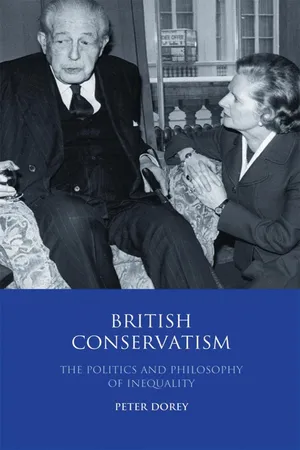 eBook - PDF
British Conservatism
The Politics and Philosophy of Inequality
- Peter Dorey(Author)
- 2010(Publication Date)
- I.B. Tauris(Publisher)
One Nation Conservatism 83 or were not forthcoming in the first place. They were always concerned to maintain a balance – a middle way – between individual endeavour and central direction, and between private initiatives and political interven-tion, and One Nation Conservatives did not accept that if they occasionally criticised the state for having been extended too far, or claimed that tax levels had been raised too high, that this somehow signalled a dilution or abandonment of their commitment to materially assisting and supporting the poorest and weakest in society. They still remained fully committed to elevating the condition of the people through a judicious blend of private and public measures, and with the intention always being to ‘level up’ the poor, not ‘level down’ the rich (as Labour was accused of wanting to do in pursuit of equality). However, another reason for the seemingly circumspect character of One Nation’s approach to social reform, and its intimation that things had already gone too far, was the eclecticism of its authors, for as we have already noted, some of them later became closely associated with the Conservative neo-liberal backlash against One Nation Conservatism, and as such, the eclecticism which existed in the One Nation Group from the outset meant that publications such as One Nation invariably enshrined something of a compromise between its members, while also seeking to strike ‘a balance between a qualified acceptance of the state’s role in social provision, and the need to foster greater competition and freedom in order to generate the wealth that could pay for that provision’ (Walsh, 2000: 194). In this important respect, One Nation was broadly consistent with the progressive philosophy enshrined three years’ earlier in The Industrial Charter , for both tracts sought to pilot a ‘middle way’ between laissez-faire and collectivism (Garnett and Hickson, 2009: 30).
- Arthur Aughey(Author)
- 2001(Publication Date)
- Pluto Press(Publisher)
Major’s personal qualities, though generally acknowledged, were treated as irrelevant to political reportage. A different age meant that the old conceptions could no longer suffice. It would be wrong to give the impression that things used to be unproblematic. That is recent myth-making by those on the Left and and those within the Conservative Party who opposed Thatcher. The relationship between Englishness and Britishness or between nationhood and statehood in traditional Conservative politics has never been a particularly easy one. The truth of this has only recently come to qualify the assumptions of earlier work on Conservatism (Francis and Zweiniger-Bargielowska 1996, p. 6). The Conservative nation revealed neither complete self-assurance nor an uncompli-cated identity. The party has always had intimations of disaster. Radical critics have tended to credit Conservatives with a self-confidence which was not there. How might one characterise the Conservative nation given the fluidity of both British identity and of ‘England’s interests’? The Conservative Nation 67 THE MAKING OF THE CONSERVATIVE NATION In the late nineteenth century, the Conservative Party reinvented itself as the party of the empire, the party of the Union, and as the patriotic party. It has been one of the claims of Conservative politi-cians ever since that their party is a ‘national party or it is nothing’. It is the true people’s party because it expresses the interests of ‘One Nation’. This Delphic term can be understood in two senses. First, it was taken to mean that the Conservatives had a definite view on the ‘condition of England’ question. In short, the Conservative Party was the party of class harmony and understood its task to unite the ‘Two Nations’, the rich and the poor. This was not to be done according to the alien nostrums of liberal radicalism or revolutionary socialism, but in accordance with the venerable procedures of the British con-stitution. eBook - PDF
The Politics of Sex and Other Essays
On Conservatism, Culture and Imagination
- R. Grant(Author)
- 2000(Publication Date)
- Palgrave Macmillan(Publisher)
Hence conservatism is often described as essentially pragmatic. Conservatism: an Outline 5 Conservatism is particularist and context-specific. Its concern is always with this society and these values. Hence it is as various in its content and priorities as the societies in which it appears. Nevertheless, conservatives everywhere prize what may be called ‘natural’ patriotism (including that of rival nations), but generally despise the ideological nationalisms concocted by parvenu dictatorships. They may, however, find themselves seriously at odds with their own state, if the state is at odds with society and culture. The underlying intuition is that the indi- vidual, even to himself, is strictly inconceivable apart from those things, a fact which must give him the strongest possible motive to pre- serve them (as his property does to defend the state which protects it). Abstracted from society and culture, he becomes the atomic, undiffer- entiated individual of liberal theory, who lacks the definitive unique- ness of real-life individuals, and whose universal ‘rights’ are matched by no substantive duties, since every historic context in which they might disclose themselves (and rights be meaningful and effective) has been discounted a priori. Conservatives believe in ‘my station and its duties’ rather than in Kant’s ‘duty for duty’s sake’ (F.H. Bradley’s distinction). With Hume and Burke, they associate duty less with reason than with sentiment, and wherever possible seek political recognition for the immediate attachments which (in their view) provide the individual with his deep- est fulfilment and sense of purpose. Among them are his attachments to country, locality, family, class, role, profession, religion, friendships and wider voluntary associations. Each, in the normal case, is a source of security and an object of duty and loyalty, and each, accordingly, is more or less imbued with personality, in other words, is conceived in moral terms. eBook - PDF
The Foundations of the British Conservative Party
Essays on Conservatism from Lord Salisbury to David Cameron
- Bradley W. Hart, Richard Carr, Bradley W. Hart, Richard Carr(Authors)
- 2013(Publication Date)
- Bloomsbury Academic(Publisher)
A central tenet of Conservatism since the term came into common use in the 1830s was the recognition of ‘change in order to preserve’. Rigid rejection of any reform would simply stoke up pressure and force the advocates of change to adopt more extreme panaceas and more dangerous tactics, and it was, therefore, unrealistic and counterproductive. Conservatism did not seek a frozen or fossilized society; ‘on the contrary, its empirical approach to political problems predicates change’. 53 Furthermore, as one of the founders of the One Nation Group pointed out, ‘Conservatives believe in variety rather than uniformity, and innovation is essential to the maintenance of variety’. 54 Of course, Conservatives should not rush to embrace change before its need was clearly demonstrated (which was a regular grass-roots and backbench criticism of Conservative leaders, including Peel in 1845, Disraeli in 1867, Baldwin in the mid-1920s, Macmillan in the early 1960s and Heath in 1972–74), and in this respect, issues of timing and tactics were also issues of principle. While most Conservatives would not go quite as far as the concept expressed in the title of the One Nation Group’s mid-1950s’ publication Change Is Our Ally , 55 to varying degrees (more so on the left wing, of 52 Lord H. Cecil, Conservative Ideals , National Union leaflet 2184 (1923), 2. 53 Boyd-Carpenter, Conservative Case , 10. 54 Maude, Common Problem , 285; Alport, About Conservative Principles , 14. 55 Conservative Political Centre, Change is our Ally (1954). The Principles of British Conservatism 27 course, and least so on the ‘diehard’ right), they accepted that from time to time change had to occur and that it was far better that this should be managed in the safe hands of Conservatives. For Conservatives, statesmanship lay in recognizing the facts of a situation and steering a course which was guided by principles in its aims and methods, but which adapted these to circumstances as they actually existed. eBook - PDF
The Modern State
Theories and Ideologies
- Erika Cudworth, Timothy Hall, John McGovern(Authors)
- 2020(Publication Date)
- EUP(Publisher)
CHAPTER EIGHT Conservatism: Authority in the Modern State John McGovern Its more thoughtful adherents have always recognised and, indeed, lauded the ideological paucity of conservatism. For Roger Scruton, ‘conservatism is a stance that may be defined without identifying it with the policies of any party’. Rather than aiming to remake political arrangements in the light of fixed principles, he has insisted, ‘the conservative attitude seeks above all for gov-ernment’. In characterising conservatism in this way, Scruton’s implicit claim is that neither socialists nor a fortiori liberals seek to govern in the sense of ruling. Despite the indisputable fact that, historically, conservative political practice and liberal ideals have converged, Scruton considers liberalism ‘the principal enemy of conservatism’. The reason he gives for this is that ‘for the conser-vative, the value of individual liberty is not absolute, but stands subject to another and higher value, the authority of established government’. Regarding ‘no citizen as possessed of a natural right that transcends his obligation to be ruled’, the essential feature of conservative politics, on Scruton’s account, is ‘an ideal of author-ity’ (Scruton 1980: 15–16, 19). Context Although there were more European monarchies in 1914 than a century earlier, during the nineteenth century their supremacy 188 was steadily undermined by the forces of liberalism, nationalism and socialism. In the words of Norman Davies, they survived only ‘by profoundly modifying the nature of the bond between rulers and ruled’ (Davies 1997: 802). Political liberalism, with its urgent emphasis upon government by consent, the rule of law, constitu-tional procedure, religious toleration, universal human rights and individual liberty opposed hereditary prerogative in Church and State.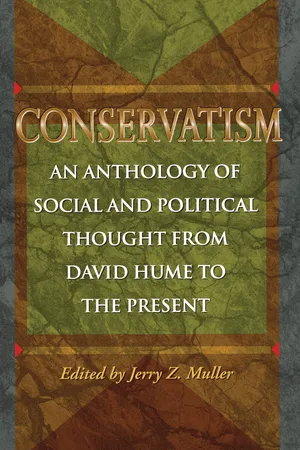 eBook - PDF
Conservatism
An Anthology of Social and Political Thought from David Hume to the Present
- Jerry Z. Muller(Author)
- 2020(Publication Date)
- Princeton University Press(Publisher)
INTRODUCTION • WHAT IS CONSERVATIVE SOCIAL AND POLITICAL THOUGHT? An intuitive procedure for defining conservatism is to begin by listing the institutions which conservatives have sought to conserve. That will not get us very far. For conservatives have, at one time and place or an-other, defended royal power, constitutional monarchy, aristocratic pre-rogative, representative democracy, and presidential dictatorship; high tariffs and free trade; nationalism and internationalism; centralism and federalism; a society of inherited estates, a capitalist, market society, and one or another version of the welfare state. They have defended religion in general, established churches, and the need for government to defend itself against the claims of religious enthusiasts. There are, no doubt, self-described conservatives today who cannot imagine that conserva-tives could defend institutions and practices other than those they hold dear. Yet they might find, to their surprise, that conservatives in their own national past have defended institutions which contemporary con-servatives abhor. And were they to look beyond their own national bor-ders, they might find that some of the institutions and practices they seek to conserve are regarded as implausible or risible by their conserva-tive counterparts in other nations. In one of the most perceptive scholarly analyses of the subject, Samuel Huntington argued that conservatism is best understood not as an inherent theory in defense of particular institutions, but as a positional ideology. When the foundations of society are threatened, the conser-vative ideology reminds men of the necessity of some institutions and the desirability of the existing ones, Huntington suggested. 1 Rather than representing the self-satisfied and complacent acceptance of the in-stitutional status quo, ideological conservatism arises from the anxiety that valuable institutions are endangered by contemporary develop-ments or by proposed reforms. eBook - ePub
One Nation Britain
History, the Progressive Tradition, and Practical Ideas for Today’s Politicians
- Richard Carr(Author)
- 2016(Publication Date)
- Routledge(Publisher)
Partly the Conservative gripe with Labour was that they represented sectional interests, which took the public form of alleging that they were doing the bidding of the Soviet Union (played to great effect in the Conservative landslide of 1924). But there was also the very notion that grandiose ‘ideas’ were un-Conservative. As Baldwin noted in 1936:I am not among those who think that until you have a high-sounding Plan with a capital P, you cannot have a Purpose. We had our own ideas as to how National Recovery could be achieved, and by proceeding steadily ahead on all fronts, I venture to say that we have made far greater and far more rapid progress than we should have done had we set to work in an attempt to revolutionise our economic life in the way advocated by irresponsible theorists.43This accounted for the interwar political dreamers – Lloyd George, Macmillan, pre-fascist Oswald Mosley – being pushed to the side, in the latter case probably no bad thing. But it also tells us something about One Nation. People may deride Ed Miliband’s attempts to flesh the concept out to date, but he has already gone a lot further on the specifics than the usual One Nation Conservative. As one such politician of the 1980s, Norman St John Stevas notedThe Tory Party has never, save for brief periods, been a doctrinaire party; it has always been a comprehensive one based on broad principles, of which the most important is the unity of the nation. It is certainly no part of the Tory purpose to recreate two nations, north against south, rich against poor.44Some would argue this was precisely the situation in the interwar period. The Prime Minister of that time, Stanley Baldwin, believed there was ‘little that a Government can do … reforms [and] revolutions must come from the people themselves’ – a policy illustrated by Baldwin writing an open letter to The Times in August 1928 asking 150,000 employers to take on displaced and out of work miners.45 One Nation in its modern conception must involve greater dynamism from the state than that.To a significant degree what was portrayed as ‘One Nation’ between the wars was repudiated in subsequent decades even by ‘One Nation’ Tories. In the 1920s and 1930s a plethora of young Tory MPs were elected to parliament for the first time. Such men had often served alongside the poor in the trenches of the First World War (7 in 10 new Tory MPs born between 1875 and 1900 fitting this description) and returned home determined, in a sometimes muddled way, to ameliorate their former comrades’ poverty. These included famous names who would dominate the Conservative Party after 1945 – including Anthony Eden, Harold Macmillan, and Oliver Stanley. Such men not only grumbled against Baldwin as young men, but sought to base post 1945 Conservatism as an antidote to what the interwar period had wrought: industrial strife, high unemployment, and a consequent inability for the working and lower-middle classes to obtain consumer goods. When Labour largely solved the former issues from 1945, the Tory Party then pointedly referred to the latter. So as Labour propaganda in the late 1940s told young voters to ‘ask your dad’ about interwar depression, the Tory message became ‘ask your mum’ – in reference to contemporary post-war rationing and queues.
Index pages curate the most relevant extracts from our library of academic textbooks. They’ve been created using an in-house natural language model (NLM), each adding context and meaning to key research topics.

