Politics & International Relations

Establishment Clause
The Establishment Clause is a provision in the First Amendment of the United States Constitution that prohibits the government from establishing an official religion or favoring one religion over others. It ensures the separation of church and state and protects religious freedom by preventing the government from promoting or endorsing any specific religious beliefs or practices.
Written by Perlego with AI-assistance
Related key terms
1 of 5

12 Key excerpts on "Establishment Clause"
 eBook - ePub
- Peter Radan, Denise Meyerson, Rosalind F. Atherton(Authors)
- 2004(Publication Date)
- Routledge(Publisher)
2
The Establishment Clause of the United States Constitution
Russell L. WeaverIntroduction
The First Amendment to the United States Constitution contains two religion clauses: the ‘Establishment Clause’—‘Congress shall make no law respecting an establishment of religion’—and the ‘Free Exercise Clause’—‘or prohibiting the free exercise thereof’.While the Establishment Clause applies, by its own terms, only to the federal government, the Supreme Court has held that the Fourteenth Amendment makes the Clause binding on the states.1 As a result, neither the federal government, nor the states, are allowed to ‘establish’ a religion.The Establishment Clause clearly prohibits certain types of governmental activities that were once common in Europe:• the establishment of a national (or, for that matter, a state) church; • laws requiring individuals to go to or remain away from church against their will; • laws forcing individuals to profess a belief or disbelief in any religion.The difficulty is that few Establishment Clause cases involve governmental conduct of that character. In US history, there have been no attempts to declare a national religion.Most Establishment Clause litigation focuses on whether certain lesser acts, such as school prayer, financial aid to religious organisations, and the posting of the Ten Commandments in public places, constitute an ‘establishment’ of religion. Because these ‘lesser’ acts do not clearly violate the First Amendment, the Supreme Court has struggled to define the term ‘establishment’.Early cases
A frequent source of Establishment Clause litigation involves governmental attempts to provide financial benefits to religion or religious organisations. In its early decisions, the Court struggled to find a balance in this area of the law. The Court tried to avoid exhibiting hostility towards religion while at the same time avoiding entangling relationships between the state and religion. eBook - PDF
- Andrew Koppelman(Author)
- 2013(Publication Date)
- Harvard University Press(Publisher)
46 — 2 — Corruption of Religion and the Establishment Clause Has American neutrality any deeper point than political compro-mise and accommodation? Do the state’s efforts to minimize religious remainders, to avoid taking sides on any live theological contro-versy, show any aspiration that is not hostage to shifting patterns of political power? This chapter will show that there is such an aspiration—one that antedates the founding, that animated the framers of the First Amend-ment, and that has had a powerful influence on the Supreme Court when it laid the foundations of contemporary doctrine. This is the idea that religion can be corrupted and degraded by state control. It entails that even overwhelmingly large religious majorities should not attempt to have the state endorse their views. Two accounts of the purposes of the Establishment Clause dominate contemporary theory. One of these, whose leading proponent was Chief Justice Warren Burger, focuses on political division. The other, princi-pally articulated by Justice O’Connor, focuses on alienation. Doubtless these concerns are among those that underlie the religion clauses; those clauses have multiple purposes. 1 But it is a fatal mistake to place either at the center. Burger argued that a state program could be unconstitutional because of its “divisive political potential.” This mattered because “political divi-sion along religious lines was one of the principal evils against which the First Amendment was intended to protect.” Such division consti-tuted a “threat to the normal political process” and could “divert atten-tion from the myriad issues and problems that confront every level of government.” 2 The argument has often been invoked in Supreme Court Corruption of Religion and the Establishment Clause 47 opinions, though it is unclear that it has done any analytical work in deciding cases.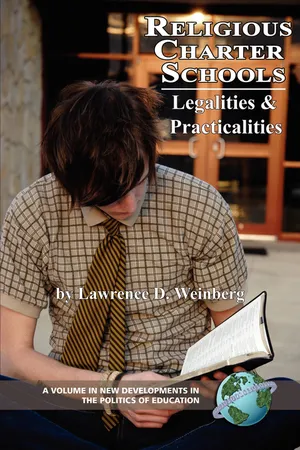 eBook - PDF
Religious Charter Schools
Legalities and Practicalities
- Lawrence D. Weinberg(Author)
- 2007(Publication Date)
- Information Age Publishing(Publisher)
Regardless of politicians’ use of religious rhetoric or appealing to the devout for votes, the separation between church and state is ultimately defined by the Supreme Court. The Court has the power to interpret the Constitution ( Marbury v. Madison , 1803), and is the final arbiter of the boundaries of the rights the Constitution endows to the people ( City of Boerne v. Flores , 1997). In Lemon v. Kurtzman (1971 the Court described the meaning of the Establishment Clause, explaining that it does more than prevent an “establishment” of religion. A law may be one ‘respecting’ the forbidden objective while falling short of its total realization. A law ‘respecting’ the proscribed result, that is, the establishment of religion, is not always easily identifiable as one violative of the Clause. A given law might not establish a state religion but nevertheless be one ‘respecting’ that end in the sense of being a step that could lead to such establishment and hence offend the First Amendment. (403 U.S. 602, 612) Unfortunately, it is difficult to succinctly describe the Court’s interpreta-tion of the “blurred, indistinct, and variable barrier” that separates church and state ( 403 U.S. 602, 614). The Establishment Clause requires that the state be neutral toward reli-gion. The state can neither advance nor inhibit religion ( Rosenberger v. University of Virginia , 1995). Thus, each state is limited in its relationship with religious schools and may not encourage or discourage their forma-tion or influence their operation. Nor may states promote or disparage religion in public schools. There is, however, a precarious balance between the “high wall of separation” and the need for some association between the state and churches. And so far as interference with the ‘free exercise’ of religion and an ‘estab-lishment’ of religion are concerned, the separation must be complete and unequivocal . eBook - ePub
- Andrew Koppelman(Author)
- 2013(Publication Date)
- Harvard University Press(Publisher)
2 Corruption of Religion and the Establishment ClauseHas American neutrality any deeper point than political compromise and accommodation? Do the state’s efforts to minimize religious remainders, to avoid taking sides on any live theological controversy, show any aspiration that is not hostage to shifting patterns of political power?This chapter will show that there is such an aspiration—one that antedates the founding, that animated the framers of the First Amendment, and that has had a powerful influence on the Supreme Court when it laid the foundations of contemporary doctrine. This is the idea that religion can be corrupted and degraded by state control. It entails that even overwhelmingly large religious majorities should not attempt to have the state endorse their views.Two accounts of the purposes of the Establishment Clause dominate contemporary theory. One of these, whose leading proponent was Chief Justice Warren Burger, focuses on political division. The other, principally articulated by Justice O’Connor, focuses on alienation. Doubtless these concerns are among those that underlie the religion clauses; those clauses have multiple purposes.1 eBook - PDF
The Constitution of Religious Freedom
God, Politics, and the First Amendment
- Dennis J. Goldford(Author)
- 2012(Publication Date)
- Baylor University Press(Publisher)
Government under the Establishment Clause cannot endorse religion not just because someone may feel bad or disfavored but government. In other words, the religion clauses as I understand them provide that for those who are religiously oriented, individuals, not government, may bear ultimate responsibility to their Creator. Yet, at the same time, the organization’s view of political community holds that “[t]he mutual obligation of citizens and public officials exhibits a covenantal charac-ter, pointing us to the accountability of government and citizens to God.” Then again, what the website calls the second implication of the principles of political community states, “A political community should not be fashioned as a community of faith, whether of Christian faith, secularist faith, or a general civil-religious faith. Rather, our republic should be constituted as a community of citizens that does not discrimi-nate against anyone for reasons of faith.” My argument is concerned to uphold this latter point against what I see as the probably inconsistent claim of the former point, as well as the claim elsewhere on the website (at http://www.cpjustice.org/content/ government) that “[w]hile government and citizens hold one another accountable under the law and to the law, the ultimate accountability of both is to God.” This is precisely the point raised by Justice Scalia’s reference in McCreary to the desire of the American people to give thanks to God as a people , which I have challenged by arguing that the claim that basic decisions as to religious orientation rest with the individual and not the majority requires that the U.S. as a corporate body, as a political order, have itself neither a religious identity nor a religious mission. Finally, what the website calls the first implication of its points about religious freedom is that “neither a particular religion nor secularism may be established in public life. eBook - PDF
Constitutional Debates on Freedom of Religion
A Documentary History
- Gerald Long, John J. Patrick(Authors)
- 1999(Publication Date)
- Greenwood(Publisher)
The Es- tablishment Clause, unlike the Free Exercise Clause, does not depend Constitutional Prohibition of Establishment of Religion 163 upon any showing of direct governmental compulsion and is violated by the enactment of laws which establish an official religion whether those laws operate directly to coerce nonobserving individuals or not. This is not to say, of course, that laws officially prescribing a particular form of religious worship do not involve coercion of such individuals. When the power, prestige and financial support of government is placed behind a particular religious belief, the indirect coercive pressure upon religious minorities to conform to the prevailing officially approved re- ligion is plain. But the purposes underlying the Establishment Clause go much further than that. Its first and most immediate purpose rested on the belief that a union of government and religion tends to destroy gov- ernment and to degrade religion. The history of governmentally estab- lished religion, both in England and in this country, showed that whenever government had allied itself with one particular form of reli- gion, the inevitable result had been that it had incurred the hatred, dis- respect and even contempt of those who held contrary beliefs. That same history showed that many people had lost their respect for any religion that had relied upon the support of government to spread its faith. The Establishment Clause thus stands as an expression of principle on the part of the Founders of our Constitution that religion is too personal, too sacred, too holy, to permit its ‘‘unhallowed perversion’’ by a civil mag- istrate. Another purpose of the Establishment Clause rested upon an awareness of the historical fact that governmentally established religions and religious persecutions go hand in hand. . . . MR. JUSTICE STEWART, dissenting. * * * With all respect, I think the Court has misapplied a great constitutional principle. eBook - PDF
The Distinctiveness of Religion in American Law
Rethinking Religion Clause Jurisprudence
- Kathleen A. Brady(Author)
- 2015(Publication Date)
- Cambridge University Press(Publisher)
8 Others argue, I believe more accurately, that the Estab- lishment Clause also had a substantive dimension that was intended to reinforce these limitations on federal power. 9 However, the problem for the originalist is that even assuming that the Establishment Clause had a substantive dimension, there was no clear agreement in the founding era on what its substantive content was. Certainly, the federal government was prohibited from establishing a national church; James Madison described the purpose of the Establishment Clause this way in the debates in the House during the drafting process, and no one disagreed that a national church was prohibited. 10 However, whether the Establishment Clause also 7 Thomas J. Curry, The First Freedoms: Church and State in America to the Passage of the First Amendment 208 (1986). As James Madison argued, there is “not a shadow of right in the general government to intermeddle with religion.” 3 The Debates in the Several State Conventions on the Adoption of the Federal Constitution 330 (J. Elliot 2d ed. 1836) (June 12, 1788). 8 E.g., Akhil Reed Amar, The Bill of Rights 32–42 (1998); Steven D. Smith, Foreordained Failure: The Quest for a Constitutional Principle of Religious Freedom 17–34 (1995). 9 E.g., 2 Greenawalt, supra note 5, at 26–33; Douglas Laycock, Theology Scholarships, the Pledge of Allegiance, and Religious Liberty: Avoiding the Extremes but Missing the Liberty, 118 Harv. L. Rev. 155, 241–42 (2004). 10 Arlin M. Adams & Charles J. Emmerich, A Nation Dedicated to Religious Liberty: The Constitutional Heritage of the Religion Clauses 17–18 (1990); John Witte Jr., Religion and the American Constitutional Experiment: Essential Rights and Liberties 66–67 (2000). Introduction 11 prohibited support for religion that was generally available to multiple denomina- tions such as existed in New England, or even required strict separation, is less clear. eBook - ePub
A Standard for Repair
The Establishment Clause, Equality, and Natural Rights
- T. Jeremy Gunn(Author)
- 2023(Publication Date)
- Routledge(Publisher)
Part I The Establishment Clause Passage contains an image
Chapter 1 Introduction: Religion and the Constitution
DOI: 10.4324/9781315047799-2A. The Centrality of the Constitution
WHETHER by default, deference, or design, Americans invoke the United States Constitution as the ultimate arbiter of the relationship between religion and government. Whether the Constitution’s primacy derives from its self-proclamation as “the supreme law of the land,”1 from its relative longevity in a world of revolutions, or from the crypto-mythic reverence paid to the founders of our nation, few dispute its role as the fundamental law of the land. Scholars, pundits, preachers, and jurists acknowledge not only that the Constitution does govern the relationship between religion and the state, but that it ought to govern that relationship as well.This reverence for the Constitution is not a new phenomenon in American history. Thomas Paine observed, in the eighteenth century, that the Constitution was “a political bible.”2 The most prolific constitutional scholar of our own century, Edward S. Corwin, noted in 1920 that the United States had produced a “cult of the Constitution.”3 Woodrow Wilson thought Americans were guilty of “an undiscriminating and almost blind worship of its principles.”4 Max Lerner, writing as an iconoclast in 1937 in the midst of a constitutional battle over the role of the Supreme Court, observed:1 United States Constitution, Article VI, clause 2.2 Thomas Paine, The Rights of Man in The Writings of Paine, ed. David Edwin Wheeler (New York, 1915) 4:269.3 Edward S. Corwin, “The Worship of the Constitution,” in Corwin on the Constitution, ed. Richard Loss (Ithaca, 1981), 1:47—55. See also, Edward S. Corwin, “The Constitution as Instrument and as Symbol,” American Political Science Review 30 (1936): 1071-85.4 Woodrow Wilson, Congressional Government
- Shlomo Slonim(Author)
- 1990(Publication Date)
- Praeger(Publisher)
Nonetheless, history does "divulge a broad philosophy of church- state relations." 29 One tenet that emerges most clearly is that a central purpose of the Establishment Clause (as well as of the free exercise clause) was to protect religious liberty—to prohibit the coercion of religious practice or conscience, 30 a goal that remains paramount today. 31 "Cruel persecutions," observed the Court in its first major Establishment Clause decision, "were the inevitable result of government established reli- gions." 32 As Justice Brennan concluded in his influential examination of the religion clauses, "[the establishment and free exercise clauses], al- though distinct in their objectives and their applicability, emerged to- gether from a common panorama of history. The inclusion of both restraints.. . show unmistakably that the Framers of the First Amend- ment were not content to rest the protection of religious liberty exclu- sively upon either clause." 33 The practice perceived by the framers as perhaps the most serious infringement of religious liberty sought to be corrected by the establish- ment clause was forcing the people to support religion by the use of compulsory taxes for purely sectarian purposes.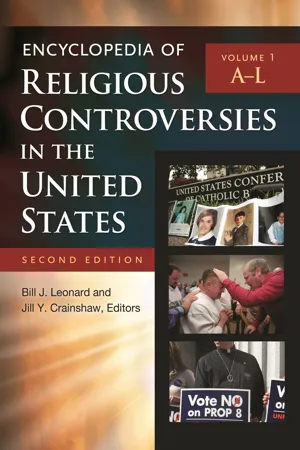 eBook - ePub
- Bill J. Leonard, Jill Y. Crainshaw, Bill J. Leonard, Jill Y. Crainshaw(Authors)
- 2012(Publication Date)
- ABC-CLIO(Publisher)
Neither can pass laws which aid one religion, aid all religions, or prefer one religion over another. Neither can force nor influence a person to go to or to remain away from church against his will or force him to profess a belief or disbelief in any religion. No person can be punished for entertaining or professing religious beliefs or disbeliefs, for church attendance or non-attendance. No tax in any amount, large or small, can be levied to support any religious activities or institutions, whatever they may be called, or whatever form they may adopt to teach or practice religion. Neither a state nor the Federal Government can, openly or secretly, participate in the affairs of any religious organizations or groups and vice versa. In the words of Jefferson, the clause against establishment of religion by law was intended to erect “a wall of separation between church and State.” Remember that Jefferson used this phrase to describe the combined effect of both of the First Amendment’s religion clauses—the establishment and free exercise clauses. In the Everson opinion, however, the Court severed its connection to the free exercise clause. Subsequent Courts generally used the phrase in the same way. In the 1960s and 1970s, the Supreme Court struck down school-sponsored prayer and Bible readings and a variety of forms of government aid for religious elementary and secondary schools under the Establishment Clause. Its basic reasoning in cases like these was the state lacked jurisdiction to sponsor religious expression or subsidize pervasively religious institutions. According to the Court, these actions violated the government’s obligation to remain neutral in religious matters and threatened to undermine religion with state regulation and dependence
- Gerard V. Bradley(Author)
- 2012(Publication Date)
- Cambridge University Press(Publisher)
So modern inter- preters have missed the connection between the Establishment Clause and the “problem of the church.” Conversely, it has seemed natural to view the Establishment Clause as a response to the prescription and the antici- pated development of secularism or secular government. In this new hermeneutical framework, the Establishment Clause comes to be viewed as a provision regulating the relation between government and religion – with churches simply being one concrete manifestation of that social phenomenon. And if the clause was meant to separate gov- ernment from religion, then it has seemed inexorably to follow that the provision constitutes a requirement that government remain “secular” 48 – meaning, now, not religious. So government is limited to acting for pur- poses that are not “religious” (whatever that means) and is forbidden to support “religion” or to endorse “religion” or to act on the basis of religious grounds or judgments. 49 The overwhelming evidence that the founding generation did not understand the clause to mean any such thing is dismissed, typically with the comment that the framers evidently 47 For further discussion, see Steven D. Smith, “The Pluralist Predicament: Contemporary Theorizing in the Law of Religious Freedom,” Legal Theory10 (2004): 51, 55–69. 48 See, by way of comparison, Lemon v. Kurtzman, 403 U.S. 602, 612–13 (1971). 49 For example, these constraints are taken as virtually axiomatic in Kent Greenawalt’s recent opus on the Establishment Clause: Greenawalt, Religion and the Constitution, 57, 92–93, 190, 195, 492–93, 523–24. For my critical response, see Steven D. Smith, “Discourse in the Dusk: The Twilight of Religious Freedom?” Harvard Law Review 122 (2009): 1869. Smith 18 failed to think through the implications of what they had done. 50 Or perhaps they were merely being hypocritical or opportunistic, as politi- cians are wont to be. eBook - PDF
- Helen Norton(Author)
- 2019(Publication Date)
- Cambridge University Press(Publisher)
These include governmental decisionmakers’ descriptions of their own motives, the historical background and specific series of events leading up to the government’s expressive choice, and the availability of other explanations for the government’s choice. The Supreme Court first applied the neutrality principle to the government’s religious speech in the 1960s. Engel v. Vitale involved an Establishment Clause challenge brought by parents who objected to their local school board’s choice to start the school day with a prayer composed by the New York State Board of Regents: “Almighty God, we acknowledge our dependence upon Thee, and we beg Thy blessings upon us, our parents, our teachers and our Country.” 45 The Court found that the board sought to advance religion with its expressive choice, and thus held that it violated the Clause apart from any coercive effect (the school board’s policy permitted students who objected to the prayer to remain silent or be excused): When the power, prestige and financial support of government is placed behind a particular religious belief, the indirect coercive pressure upon religious minorities to conform to the prevailing official approved religion is plain. But the purposes underlying the Establishment Clause go much further than that. Its first and most immediate purpose rested on the belief that a union of government and religion tends to destroy government and to degrade religion. 46 44 Note that both the nonendorsement principle and the neutrality principle might be understood as parts of, or refinements to, the test for Establishment Clause violations more generally announced in Lemon v.
Index pages curate the most relevant extracts from our library of academic textbooks. They’ve been created using an in-house natural language model (NLM), each adding context and meaning to key research topics.

