Politics & International Relations

Supremacy Clause
The Supremacy Clause is a provision in the United States Constitution that establishes the Constitution, federal laws, and treaties as the supreme law of the land, overriding any conflicting state laws. This clause ensures that federal law takes precedence over state law in the event of a conflict, thereby maintaining the authority of the federal government within the constitutional framework.
Written by Perlego with AI-assistance
Related key terms
1 of 5

6 Key excerpts on "Supremacy Clause"
 eBook - PDF
- Michael J. Glennon(Author)
- 2020(Publication Date)
- Princeton University Press(Publisher)
It is bound to the faithful execution of these as of all other laws, internal and external, by the nature of its trust and the sanction of its oath. . . . m The Supremacy Clause. The word supreme may appear unqualified, but in the evolved lexicon of American constitutionalists, some supreme laws of the land are more supreme than others. The Constitution is the most supreme law, prevailing over all treaties, federal and state statutes, and principles of federal and state common law. Next come federal statutes and treaties, which are of 125 U.S. Const, art. II, § 3. 126 B. Poore, The Federal and State Constitutions, Colonial Charters and Other Organic Laws of the United States 1335 (2d ed. 1878) ( T h a t it shall be the duty of the governor . . . to take care that the laws are faithfully executed to the best of his a b i l i t y . ) . 127 See id. at 1521, 1528, 1545, 1863, 1871 (setting forth parallel provisions of Pennsylvania and Vermont constitutions). 128 2 Farrand, supra note 121, at 158. 129 Id. at 171. 130 H. Syrett, ed., 15 The Papers of Alexander Hamilton 38 (1961-79). 131 2 Writings of James Madison 107 (G. Hunt ed. 1906). 248 CHAPTER 7 equal status domestically, 132 then federal common law, 133 and finally state stat-utory and common law. 134 This hierarchy is generally accepted today, but in 1789, it was hardly manifest. The Supremacy Clause itself gives no hint of any hierarchy; even the Constitution is given no primacy. It is not surprising, therefore, that the hierarchical position of international law is somewhat ob-scure. Yet the concept of supreme law of the land traces to the Magna Carta 135 and was familiar to the colonists and the Framers. For example, the colonial charters made English statutory and common law the supreme law of the col-onies. 136 In structuring the Constitution, however, the Framers devoted their attention to the notion of supremacy primarily in the context of federal-state relations. eBook - PDF
The Supremacy Clause
A Reference Guide to the United States Constitution
- Christophe R. Drahozal(Author)
- 2004(Publication Date)
- Praeger(Publisher)
Dulles told a bar asso- ciation audience in Louisville, Kentucky, that treaties are "more supreme than ordinary laws for congressional laws are invalid if they do not conform to the Constitution, whereas treaty law can override the Constitution."256 He continued by citing examples of ways in which treaties could "override the Constitution": "Treaties . . . can take powers away from the Congress and give them to the Pres- ident; they can take away powers from the States and give them to the Federal Government or to some international body, and they can cut across the rights given the people by their constitutional Bill of Rights." Although Dulles did not cite the basis for his view that "a treaty can override the Constitution," his remarks suggest that he relied on the text of the Supremacy Clause itself. While the Clause makes the "Constitution, and the Laws of the United States which shall be made in Pursuance thereof the "supreme Law of the Land." it includes "all Treaties made, or which shall be made, under the Authority of the United States^ as supreme law (emphasis added). 257 This difference in word- ing— with treaties not required to be made "in Pursuance" of the Constitution — has given rise to "a myth" (reflected in Dulles' remarks) "that treaties are equal in authority to the Constitution and not subject to its limitations." 258 This myth—which is no more than a myth—persists in any number of circles even today.
- John Bell, Claire Kilpatrick, John Bell, Claire Kilpatrick(Authors)
- 2006(Publication Date)
- Hart Publishing(Publisher)
It explicitly reconfirms that the fundamental constitutional structures of the Member States constitute an important ele-ment of the identity which is to be respected. Construed from a national perspective, this provision could deliver arguments supporting the position of a conditional approval of Union law supremacy. Its objective seems to be to reserve a sphere for the national political/constitutional identities of the Member States that should not be affected by the integration process. Thus, it could even be interpreted as authorising national courts to set aside pro-visions of Union law that disrespect the national constitutional identity. Does the Codification of the Principle of Supremacy Matter? 69 47 See Draft Constitutional Treaty Art I–11(1)–(2). However, the provision is open to interpretation and could give rise to a new set of constitutional tensions between the Union and its Member States. Who is vested with the competence to define what constitutes a part of a national identity inherent in a nation’s constitutional structure? A. The Effects of a Political Confirmation of Supremacy Codification of supremacy has great symbolic importance for a Treaty that claims to establish a ‘Constitution’ for a group of states. However, from a political and legal point of view it certainly has more than a symbolic value. The most important effect of the proposed codification of the principle of supremacy is that, if finally ratified by the Member States, it will consti-tute a confirmation of a political acceptance of the principle. To date, it has been hard to certify to what extent this judge-made principle has gained full political support among the Member States. Member States can only over-turn a decision by the ECJ on the interpretation of the Treaty through a Treaty amendment, which requires unanimity. Accordingly, as long as one Member State supports the principle of supremacy as formulated by the ECJ, it will be immune to political attacks.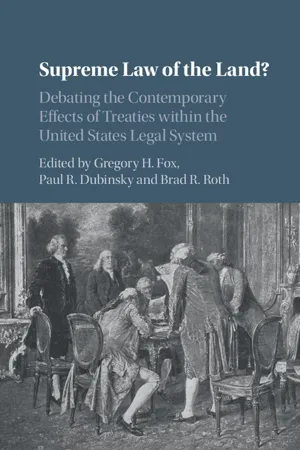 eBook - PDF
Supreme Law of the Land?
Debating the Contemporary Effects of Treaties within the United States Legal System
- Gregory H. Fox, Paul R. Dubinsky, Brad R. Roth(Authors)
- 2017(Publication Date)
- Cambridge University Press(Publisher)
137 Sutherland argued that while the Constitution divided the power to enact statutes between the federal government and the several states, it granted the federal government unlimited sovereign power to enact treaty obligations. 138 However, the superiority of treaties to state law was not a view shared by all commentators. Henry St. George Tucker, a former Virginia Congressman and law professor, published an article in 1914 attacking the claim that California’s attempt to prevent the purchase of land by Chinese noncitizen residents violated the United States’ treaty obligations. 139 Tucker argued that the Supremacy Clause indeed provides the federal government with the ability to overrule state legislation, but only in those areas of the law in which the federal government was delegated authority. Tucker was evidently more con- cerned with states’ rights and issues of race than international law when he wrote on the treaty-making power. For example, two years later at the Storrs Memorial Lecture at Yale, Tucker explained that women’s suffrage should not be forced upon the individual states by constitutional amendment because it would infringe on states’ rights to self-government. 140 The importance race played in Tucker’s agenda can be inferred from his comments during the Storrs Lectures that suggested it was unwise to have forced the Fifteenth Amendment on the South without popular approval. 141 Tucker’s arguments are not dissimilar to the arguments made by Roger Taney some eighty-five years earlier in his opinions as Attorney General and Chief Justice. 142 Both held that the Supremacy Clause allows treaty provisions 135 Ibid. 136 Selden Bacon, Territory and the Constitution, 10 YALE L.J . 99 (1901). 137 George Sutherland, The Internal and External Powers of the National government, 191 N. AM. REV. 373 (1910). 138 Ibid. at 374. 139 Henry St. George Tucker, The Treaty-Making Power under the Constitution of the United States, 199 N. eBook - PDF
The Tea Party
Three Principles
- Elizabeth Price Foley(Author)
- 2012(Publication Date)
- Cambridge University Press(Publisher)
In addition to this brief recognition of a power to legislate to punish offenses against the law of nations, the Constitu- tion contains two additional important provisions relating to the power to make and enforce treaties. Article II, section 2, 89 The Tea Party: Three Principles indicates that the president has the power “by and with the advice and consent of the Senate, to make treaties, provided two thirds of the senators present concur.” Article VI – the Supremacy Clause – then reads: “This Constitution, and the laws of the United States which shall be made in pursuance thereof; and all treaties made, or which shall be made, under the authority of the United States, shall be the supreme law of the land; and the Judges in every State shall be bound thereby, anything in the Constitution or laws of any State to the contrary notwithstanding.” Taken together, these two provisions allow treaties to be made by the president with the “advice and consent” of two-thirds of the Senate present, and then deem such treaties to be “supreme law of the land” if they are made “under the authority of the United States.” In Federalist No. 75, Alexander Hamilton explained to the American people why the treaty power was divided between the president and the Senate as follows: The essence of the legislative authority is to enact laws, or, in other words, to prescribe rules for the regulation of the society; while the execution of the laws, and the employment of the common strength, either for this pur- pose or for the common defense, seem to comprise all the functions of the executive magistrate. The power of making treaties is, plainly, neither the one nor the other. It relates neither to the execution of the subsisting laws, nor to the enaction of new ones; and still less to an exer- tion of the common strength. Its objects are contracts [caps in original] with foreign nations, which have the force of law, but derive it from the obligations of good faith. eBook - PDF
The Powers of War and Peace
The Constitution and Foreign Affairs after 9/11
- John Yoo(Author)
- 2008(Publication Date)
- University of Chicago Press(Publisher)
3 Due to the president’s constitutionally superior position, the Supreme Court has consistently “recognized ‘the generally accepted view that foreign policy [is] the province and responsibility of the Executive.’ ” 4 This foreign affairs power is exclusive: it is, in the words of Curtiss-Wright, “the very delicate, plenary and exclusive power of the President as sole organ of the federal government in the field of interna-tional relations—a power which does not require as a basis for its exercise an act of Congress.” 5 These principles support what the constitutional text suggests: that the treaty power remains fundamentally executive in nature. First, by locating the Treaty Clause in Article II, the Constitution defines the treaty power as executive, except for any specific exceptions, such as the Senate’s partic-ipation as an advisory council. It is the president who makes treaties, not the Senate and not the Senate and president. Second,Article II’s structure confirms that executive power in this area is broader than the authorities listed in Article II, Section 2 . Simply because the Treaty Clause does not specifically detail the location of relevant corollary powers does not mean that such powers lie in the hands of the Senate. Rather, these powers must remain within the president’s general executive power. Third, Article II’s Vesting Clause requires that we construe any ambiguities in the allocation 184 • chapter six 1 2 3 4 5 6 7 8 9 10 11 12 13 14 15 16 17 18 19 20 21 22 23 24 25 26 27 28 29 30 31 32 33 34 35 36 37 [184], (3) Lines: 26 t o ——— 0.0pt P g ——— Normal Pa g PgEnds: T E X [184], (3) of executive power in favor of the president. If Article II, Section 2 fails to allocate a specific power, then Article II, Section 1 ’s general grant of the executive power serves as a catch-all provision that reserves to the president any remaining federal foreign affairs powers.
Index pages curate the most relevant extracts from our library of academic textbooks. They’ve been created using an in-house natural language model (NLM), each adding context and meaning to key research topics.

