Politics & International Relations

Expansion of Presidential Power
The expansion of presidential power refers to the increase in authority and influence wielded by the President of the United States over time. This expansion has been driven by factors such as changes in public opinion, shifts in the balance of power between branches of government, and responses to national crises. It has led to debates about the appropriate limits and checks on presidential authority.
Written by Perlego with AI-assistance
Related key terms
1 of 5

6 Key excerpts on "Expansion of Presidential Power"
 eBook - ePub
The Power of the Presidency
Concepts and Controversy
- Robert S. Hirschfield(Author)
- 2017(Publication Date)
- Routledge(Publisher)
varies , with any President’s capacity to influence or control the course of national or international affairs being dependent at any given time on five major factors: 1) the meaning currently attributed to the formal, constitutional sources of executive authority; 2) the state of the political system in which the specific Presidency is operating; 3) the personal attributes and attitudes of the incumbent President; 4) the particular set of circumstances, conditions, and events presently confronting the nation; 5) the popularity of the incumbent President and the degree to which he enjoys the public’s trust and confidence. All of these factors change from time to time and from President to President. They are constantly in flux, and since the power of the Presidency is the product of interaction among all of them, the dimensions of that power are continually changing. As a result, no absolute definition of presidential power is possible, because that power is always in the process of being defined.Presidential Power and the Constitutional System
When Professor Woodrow Wilson said “the President is at liberty, both in law and conscience, to be as big a man as he can,” he indicated the range of possibilities open to a President in attempting to exercise power and emphasized that the essential attribute of the constitutional office is its flexibility. For the Presidency under the Constitution is only potentially, not necessarily, powerful. That document’s executive provisions, even more than the others, are general, indefinite, and ambiguous. The basic characteristics of the office—its unitary form, independent functions, and national purview—are clear enough. But Article II provides at best only a hint of the Presidency’s potential for power. In fact, those cryptic provisions raise more questions than they answer. The President is “commander-in-chief of the army and the navy of the United States.” But does this make him only the nation’s “first general and admiral,” as Hamilton insisted, or does it empower him to use the armed forces in such a way as to commit the nation to war? Does his authority to make treaties by and with the advice and consent of two thirds of the Senate require a sharing of power in the formulation and control of foreign policy, or does it mean, as the Supreme Court once stated, that the President is America’s “sole organ of government” in the field of international relations? The President is to “take care that the laws be faithfully executed,” but faithful according to what standard? Congressional intention? Judicial rulings? His own determination of constitutionality or political expediency? The very first words of Article II read: “The Executive power shall be vested in a President of the United States of America.” But is this simply an introductory statement, or is it a grant of inherent power to act in any way the President deems necessary to protect the national interest? eBook - PDF
The Presidency and the Constitution
Cases and Controversies
- M. Genovese, R. Spitzer(Authors)
- 2005(Publication Date)
- Palgrave Macmillan(Publisher)
Bush in a decision that astounded court watchers and stretched the bounds of credulity to the near-breaking point. Yes, the courts are political. One becomes a judge through political appointment, judges do take politics into account (even though they usually deny it), and judicial rulings often have profound political and policy consequences. If politics played little or no role in court decisions, presidents and governors would not be as concerned with getting ideological soul mates onto the courts. This book examines presidential power as defined, and redefined, by the Supreme Court. The presi- dency was designed over two hundred years ago as an office of limited power, based on the rule of law within a constitutional framework. In the last two centuries, many questions dealing with the scope and limita- tions of presidential power have come before the courts for resolution, and in recent decades, most important political controversies have made their way to the courts. From interbranch struggles for power to presidential selection, to campaign financ- ing, to executive privilege, to war powers, hardly an issue arises for the modern presidency that does not eventually find itself framed as a legal problem to be addressed by the courts. This book offers to you, the reader, a “case-law” examination of the presidency. We recognize at the outset, however, that this approach does not provide a complete or definitive examination of the American presidency, as much of what composes presidential power extends well beyond that which is dealt with by the courts. Yet much of what comprises the modern strong presidency arises from, or is legit- imized by, favorable court rulings. Further, because both institutional legitimacy and politics arise from the law, this case-law look at the presidency provides an institutional view of the office and its powers 2 THE PRESIDENCY AND THE CONSTITUTION that we consider the gateway to understanding the modern American chief executive. eBook - ePub
- Alan Grant(Author)
- 2003(Publication Date)
- Routledge(Publisher)
The history of the executive branch has been one of aggrandisement as people have turned to presidential initiatives to get things done, and the President has filled the power vacuum left by the inertia or inaction of Congress, the states, or private enterprise. The growth of the presidency has not been at a consistent pace – there were reactions to Lincoln’s temporary autocracy and to governmental control in the First World War. The major expansion has undoubtedly taken place since the 1930s and the excesses of the Nixon presidency came as a culmination of 40 years of executive development. Expectations of the presidency increased during this period without an equivalent increase in his constitutional authority. We have already seen how Congress in the 1970s introduced new laws and reformed its procedures in order to reassert its position vis-à-vis the presidency. By the end of that decade many observers were sounding new alarms about the modern-day version of congressional government. It became clear that when a President is unable to exercise authority and leadership it is difficult if not impossible for anyone else to do so with anything like the necessary drive and purpose. The presidency seemed perilously weakened and political scientists were talking about the ‘Impaired’ or ‘Imperilled Presidency’ rather than the ‘Imperial Presidency’. After Nixon had resigned in disgrace, his appointed VicePresident, Gerald Ford, was left with little political power and only his veto as leverage against an increasingly assertive Congress eBook - PDF
- Daniel A. Farber(Author)
- 2011(Publication Date)
- University of Chicago Press(Publisher)
23 As we have seen, the text and history of Article II fail to offer decisive guidance regarding presidential power (even for those inclined to take it). The result has been a long debate through the course of our history about presidential authority during a crisis. At one extreme, Woodrow Wilson wrote (as a professor, not as president) that the Framers “seem to have thought of the President as what the stricter Whig theorists wished the king to be: only the legal executive, the presiding and guiding authority in the application of law and the execution of policy.” At the other ex-treme, Richard Nixon claimed that the president had unlimited power to take actions on grounds of national security or a “threat to internal peace and order of significant magnitude.” Although perhaps an unfortunate spokesman for this view, he did not speak merely for himself. In survey-ing these debates, scholars have distinguished five main arguments for Presidential Power { 127 inherent executive authority. Each has both appealing features and signifi-cant shortcomings. 24 The first argument for extensive crisis authority posits the existence of extraconstitutional powers, vested in the president not by the Constitution but by the very nature of his position as chief executive of a nation. If there are essential powers that go with nationhood and cannot be effec-tively exercised by other organs of government, then the mere act of cre-ating a nation might be thought to convey these powers, without the need for any specific constitutional language. Locke is often cited as support for this doctrine because he argued that the executive had inherent power to take steps to preserve society. This approach seems to be in tension with the whole idea of a written Constitution, at least as applied to domestic matters rather than foreign policy. It also begs the question of just what specific executive prerogatives are inherent in the nature of things.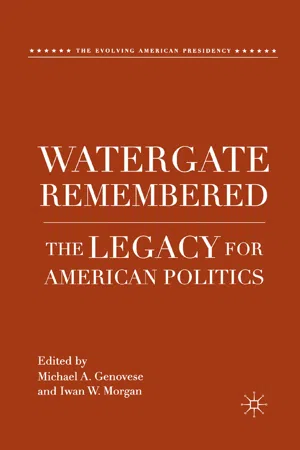 eBook - PDF
Watergate Remembered
The Legacy for American Politics
- M. Genovese, Iwan W. Morgan, M. Genovese, Iwan W. Morgan(Authors)
- 2012(Publication Date)
- Palgrave Macmillan(Publisher)
As recognized in Federalist 64 and 75, the Constitution endowed the president with inherent advantages in foreign policy. Alongside commander-in-chief status, Article II granted general executive power that gave the president free rein to exploit his institu- tional advantages of "unity, secrecy, decision, dispatch, superior sources of information." 18 This endowed him with enhanced authority to defend the nation in an emergency. The more acute the crisis, the more power would consequently flow to his office. In this regard, the Cold War's mutation from temporary emergency into prolonged struggle allowed exceptional presidential powers associated with wartime to become "authority claimed by presidents as constitutionally inherent in the presidential office." 19 Schlesinger also detected domestic structural factors in the imperial presidency's rise. The New Deal had institutionalized presidential respon- sibility for economic management, marginalizing Congress in this policy domain. Meanwhile, decay of the traditional political party system left the presidency standing alone as the "central focus of political emotion, the ever more potent symbol of national community." 20 The rise of radio and television enhanced the president's capacity to speak to and for the American people, giving him greater power to rally public support than any other political actor. Finally the larger, politicized presidential staff offered greater control over the executive branch. These developments weakened presidential accountability to other institutional actors in the political system. 21 In Schlesinger's assessment, the effect was to establish a plebi- scitary presidency subject to the sole constraint of quadrennial national elections. 22 Revisiting Arthur Schlesinger's The Imperial Presidency 33 Schlesinger was dismayed at elite and popular tolerance of the imperial presidency's overt challenge to longstanding constitutional doctrine. eBook - PDF
Striking First
The Pre-emption and Preventive War Doctrines and the Reshaping of US Foreign Policy
- B. Glad, C. Dolan, B. Glad, C. Dolan(Authors)
- 2016(Publication Date)
- Palgrave Macmillan(Publisher)
Over the next two centuries, however, a number of incidents helped expand the president's power to make war over the formal power of Congress to declare war. 126 I LOUIS FISHER Presidential Power Expands Aside from Polk's initiatives in Mexico and Lincoln's emergency actions during the Civil War, the power of war in the nineteenth century remained basically in the hands of Congress. Presidents recognized the rule oflegislative supremacy in matters of going to war. Congress declared war against Spain in 1898 and again in World Wars I and II. In 1936, the Supreme Court issued United States v. Curtiss-Wright Corp., a decision that did much to elevate the president as an independent force in foreign affairs. The Court was asked to decide whether Congress could delegate more broadly when legis- lating for international affairs. The issue was never the existence of independent presi- dential power. But the author of Curtiss- Wright, Justice George Sutherland, decided to use a delegation case to discover inherent powers for the president. He claimed that the exercise of presidential power does not depend solely on an act of Congress because of the "very delicate, plenary and exclusive power of the president as the sole organ of the federal government in the field of international relations." 16 The magic term "sole organ'' suggests that when it comes to foreign policy, the President is the exclusive poli- cymaker. The language carries special weight because John Marshall used it in a speech in 1800 while serving in the House of Representatives. In fact, Sutherland wrenched Marshall's statement from context to imply a position Marshall never advanced. The full context of the debate in 1800 makes dear that Marshall argued that foreign policy is formulated and announced through a collective effort by the executive and legislative branches (by treaty or by statute), and only afrer that point does the president emerge as the "sole organ'' in implementing national policy.
Index pages curate the most relevant extracts from our library of academic textbooks. They’ve been created using an in-house natural language model (NLM), each adding context and meaning to key research topics.

