Politics & International Relations

Executive Privilege
Executive privilege is the power of the President of the United States and other executive branch officials to withhold information from Congress, the courts, and the public. It is based on the idea that the President needs to be able to have candid conversations with advisors and make decisions without fear of public scrutiny. However, it is not an absolute power and can be challenged in court.
Written by Perlego with AI-assistance
Related key terms
1 of 5
10 Key excerpts on "Executive Privilege"
 eBook - PDF
Madison's Nightmare
How Executive Power Threatens American Democracy
- Peter M. Shane(Author)
- 2009(Publication Date)
- University of Chicago Press(Publisher)
The bizarre scope of the Administration’s as-serted entitlement to secrecy appeared dramatically in a November 1, 2001 executive order, also presumably in development well before September 11, concerning the government’s handling of presidential records from prior Administrations. The Bush Administration’s treatment of executive privi-lege illustrates beautifully the impoverished presidentialist version of the rule of law. Executive Privilege is understood most easily as an umbrella term cov-ering a variety of legal claims regarding sensitive government information. At the core of the concept is the so-called state secrets privilege, which shields the executive from demands to disclose information whose release would work serious harm to our national security. The Administration’s efforts to bolster Executive Privilege focused chiefly, however, on the forms of Executive Privilege that are the most general and furthest reaching—the Form over Accountability • 123 presidential communications privilege and the so-called deliberative privilege. The first covers documents prepared by or for the President, and the second supposedly shields from mandatory disclosure any documents that would shed light on the internal deliberations of the executive branch preliminary to deciding any final matter of policy. The “deliberative privi-lege” operates on communications at every level of the executive branch and, according to its defenders, whether or not the particular records at issue are actually sensitive in any respect. In its 1974 United States v. Nixon decision, the Supreme Court inter-preted the Constitution as giving the President a qualified privilege to with-hold from the public his private communications while in offi ce. The Court underscored the importance of confidentiality in securing full and frank advice. eBook - ePub
White House Confidential
The Little Book of Weird Presidential History
- Gregg Stebben, Austin Hill(Authors)
- 2016(Publication Date)
- Skyhorse(Publisher)
11EXECUTIVE PRIVILEGE (S )!Executive Privilege n. The principle that members of the executive branch of government cannot legally be forced to disclose their confidential communications when such disclosure would adversely affect the operations or procedures of the executive branch.—from the American Heritage ® Dictionary of the English Language, Fourth EditionExecutive Privilege(s)™ n.—from Gregg Stebben and Austin Hill, "a couple of jealous smart-asses" When the President (and His Lawyers) Hide behind “Executive Privilege,” It’s Often a Butt-Covering Move of Dramatic ProportionsThe principle that members of the executive branch of government, and their families and friends, cannot be expected to live by the same rules that folks like the rest of us do … because hey, this is the president and his friends and family we’re talking about!A nd to you, our faithful reader, the two words Executive Privilege should be the sign of some wonderfully entertaining, fast-talking, fast-changing, history-revising, buck-passing madcap adventures to come from the White House.After all, if you were the president and you knew you did nothing wrong, why would you bother invoking Executive Privilege?Birds do it, bees do it … but not all presidents do it * * * Just in case you’re wondering, there has been at least one president who lost not a single staff member or member of his administration to an indictment or scandal-related resignation. Ironically, it was FDR, who also served almost twice as long as any other president.SELFISH SECRETS VS . SELFLESS eBook - ePub
Reining in the Imperial Presidency
Lessons and Recommendations Relating to the Presidency of George W. Bush
- John C. Conyers(Author)
- 2009(Publication Date)
- Skyhorse(Publisher)
A. Formal Assertions of Executive Privilege“Executive Privilege” is an assertion made by the president of the United States as grounds for refusing to produce information or documents, or for witnesses refusing to answer questions, in response to a request or subpoena. The concept of “Executive Privilege” is not mentioned in the Constitution, but is grounded in the separation of powers doctrine. Past presidents have argued that Executive Privilege is necessary to ensure frank and candid information exchange in the Executive Branch, and have generally used it to protect conversations and information provided to or from the president or, in some very limited circumstances, top presidential advisers.Pushing the Boundaries Early On
Signs of President Bush’s broad interpretation of Executive Privilege appeared shortly after he first took office, beginning with two assertions of Executive Privilege blocking requests for Clinton-era documents. The first came in early 2001, when the conservative non-profit Judicial Watch submitted Freedom of Information Act (FOIA) requests to the Department of Justice for documents related to pardon applications considered by President Clinton. The Justice Department withheld approximately 4,300 pages of responsive documents, claiming that they were exempt from production under the presidential communications and deliberative process privileges.1298 Judicial Watch filed a lawsuit to obtain the documents and, on appeal, the court rebuked the Bush Administration’s attempt to expand the presidential communications privilege to documents that were not “solicited and received” by the president. 1299Shortly after the Judicial Watch case began, then-Chairman of the House Committee on Government Reform Dan Burton issued a subpoena to the Justice Department for memoranda relating to the Committee’s investigation of corruption allegations at the FBI’s Boston field office. The Administration resisted the subpoena, and, as characterized by Chairman Burton, “explained to the Chairman and Committee staff that the Administration wished to establish an inflexible policy to withhold from Congress all deliberative prosecutorial documents.” 1300 In December 2001, President Bush invoked Executive Privilege and directed Attorney General John Ashcroft not to produce the subpoenaed documents. Although the dispute was eventually resolved and the documents handed over to the Committee, the Committee report on the matter records that “it was clear that the Administration sought to establish a new restrictive policy regarding prosecutorial documents and that no demonstration of need by the Committee would be sufficient for the Justice Department to produce the documents.” 1301 eBook - PDF
- David Hosansky(Author)
- 2006(Publication Date)
- CQ Press(Publisher)
(For more about the Pentagon Papers and their relationship to Water-gate, see page 44.) He also said the administration would not try to invoke Executive Privilege in any matter concerning criminal con-duct. Executive Privilege refers to the right of the officials in the executive branch to refuse to turn over certain private papers or testify about certain matters. (For more about Executive Privilege, see below and page 39.) Executive Privilege Reprinted from Congressional Quarterly Weekly Report , May 19, 1973 Presidents sometimes claim “Executive Privilege” to avoid turning over certain information to Con-gress. If a president always had to share private memos, correspondence, and other information with Congress, he would find it hard to do his job. His advisors would be reluctant to share their opinions because anything they said or wrote could become public. Foreign diplomats would have trouble negotiating treaties because sensi-tive details could get leaked. For that reason, every president since George Washington has claimed Executive Privilege on occasion to pro-tect the national interest. Nixon, however, faced accusations that he used Executive Privilege to protect himself from being investigated. Under criticism, he began backing off from broad claims of executive privi-lege in May. Presidential counsel Leonard Garment May 16 characterized the President’s new execu-tive privilege guidelines as less than rigid and promised that they would not be used to cover up the Watergate scandal. The guidelines, as released May 3 by the White House, said past and present presi-dential aides questioned regarding Watergate should invoke the privilege in connection with conversations with the President, con-versations among themselves involving com-munications with the President and as to presidential papers.
- Mark J. Rozell, Clyde Wilcox, Mark J. Rozell, Clyde Wilcox(Authors)
- 2000(Publication Date)
- Georgetown University Press(Publisher)
When the Bush administration wanted to withhold infor-mation from Congress, it used a variety of terms other than Executive Privilege to justify that action. Among them were internal departmen-tal deliberations, deliberations of another agency, and the secret opinions policy (Rozell 1994, chap. 5). The chief investigator to the House Committee on the Judiciary during the Bush years said that Bush avoided formally claiming Executive Privilege and instead called it other things. In reality, Executive Privilege was in full force and effect during the Bush years, probably more so than under Reagan (Lewin interview). 90 THE CLINTON SCANDAL Executive Privilege in the Clinton Administration President Clinton used Executive Privilege elaborately. Unlike Bush, he did not conceal Executive Privilege. Like Nixon, he concealed wrongdoing—or tried to—by resorting to Executive Privilege. Like Nixon, Clinton gave Executive Privilege a bad name and made it difficult once again for a future president to reestablish the legitimacy of this constitutional doctrine. In 1994, the Clinton administration issued its own executive privi-lege procedures. In the memorandum from the special counsel to the president Lloyd Cutler stated: The policy of this Administration is to comply with congressional requests for information to the fullest extent consistent with the constitutional and statutory obligations of the Executive Branch. eBook - ePub
Secrets and Leaks
The Dilemma of State Secrecy
- Rahul Sagar(Author)
- 2016(Publication Date)
- Princeton University Press(Publisher)
29Given the absence of clarity at the constitutional level, let us consider whether there are general reasons in favor of Executive Privilege. Arguably, there are two justifications to consider here. The first is that the Executive Privilege provides a means to uphold the independence of the executive branch and to thereby maintain the separation of powers. This claim can be traced back to Attorney General William Rogers, whose testimony before Congress in 1958 drew attention to a well-known passage from Kilbourne v. Thompson (1880) to the effect that separation of powers theory requires “that the persons entrusted with power in any one of the branches shall not be permitted to encroach upon the powers confided to the others.”30 The import of this passage, Rogers argued, was that Congress could not, for instance, pry into judicial deliberations, as this would “be utterly destructive of a free judiciary.” “The same considerations,” he continued, “may be said to operate with respect to an investigation of confidential advice within the executive branch.”31This argument is not entirely convincing, though. In cases where the information subject to a claim of privilege relates to matters that lie exclusively within the ambit of the executive (e.g., the conduct of a secret military operation), the president’s interest in protecting confidentiality ought to trump Congress’s more general interest in accessing such information. But when the information in question bears on matters that call for Congress to use its constitutional powers—for instance, by funding covert action or authorizing war—then it seems that the president’s interest in protecting confidentiality cannot be conclusive; we must also account for Congress’s interest in having access to the information it needs to ascertain what laws should be passed under the circumstances.32 eBook - PDF
The Revolution, the Constitution, and America's Third Century, Vols. 1-2
The Bicentennial Conference on the United States Constitution
- American Academy of Political and Social Science(Author)
- 2015(Publication Date)
But Executive Privilege seems to be a topic hard to generalize about. There are certain circumstances in which the doctrine of executive 422 Committee IV privilege should be continued and maybe strengthened. That is when Congress wants to know about every internal memorandum within the Department of State, or any other department, or to get an inter-nal memorandum from the Supreme Court justices. Chairman: W e really have to look at Executive Privilege the way it has been left by both the push-pull of executive-legislative competi-tion and the relatively rare cases where it gets to court. When it is Executive Privilege against a grand jury, it will always go to court. Oliver: That is United States v. Nixon. Chairman: That's a bit beyond the scope of this group. When a grand jury is investigating possible criminal action involving foreign policy and thinks Executive Privilege should be waived, we really don't want to say, Sorry, you can't do it. So that means we are talking about Executive Privilege with re-spect to the Congress, which has been asserted in a variety of ways. It got an assist in Select Committee v. Nixon, 63 where due to a special act, it was subject to judicial review, and the court took a different view. There are only two ways Executive Privilege can be put to adjudication. One is prosecution under the pertinent section of the criminal code. Normally that gets to be a key issue only when you are claiming Executive Privilege at the end of an administration, and are aware that a new Attorney General will begin before the statute of limitations has run. The other way in which Executive Privilege is raised is the rela-tively rare occasion when one house of Congress cites you for con-tempt. They summon you to the bar, and then you have a trial, like an impeachment trial, only it's only the one house. Theoretically, the House can send you to jail only for the duration of the term. eBook - ePub
- Harold J Krent(Author)
- 2005(Publication Date)
- NYU Press(Publisher)
60Judges at times umpire disputes between the congressional and executive branches. Congressional demands for information ultimately may be resolved by judges attempting to balance any Executive Privilege against Congress’s right to know. For example, courts have stepped in to review and generally uphold Congress’s regulation of presidential papers.61 In the rare instances in which courts have intervened, they have treated congressional demands for information as analytically akin to a demand for information from a president in the course of civil litigation.But, despite the potential for resolution by a neutral third party, Congress’s disputes with presidents over access to information generally are played out over the broader political terrain. Such clashes may form only an irritant in comparison to other sources of tension in executive-legislative relations. The clash over Executive Privilege may become a pawn in the larger battles over policy and prerogative. As a result, the Executive Privilege claim may be sacrificed at an early stage.For instance, President Washington in 1792 discussed with his cabinet how to respond to a congressional request for information about the military fiasco of General St. Clair, whose troops had been beaten badly by Indians.62 Thomas Jefferson, who was in the cabinet, recalled that the group determined “that the Executive ought to communicate such papers as the public good would permit, and ought to refuse those, the disclosure of which would injure the public.”63 Although Washington may have articulated this view informally to Congress, he complied with Congress’s request to examine documents pertaining to St. Clair’s expedition.64 Washington, however, withheld information requested by the House relating to negotiation over the Jay Treaty, reasoning that the House had no constitutional role in treatymaking. Indeed, disclosure of such information, he stated, “might have pernicious influence on future negotiations or produce immediate inconveniences, perhaps danger and mischief to other powers.”65 Indeed, Washington explained that “the boundaries fixed by the Constitution between the different departments should be preserved, a just regard to the Constitution and to the duty of my office . . . forbids a compliance with your request.”66 President Washington, therefore, evidently was convinced of the constitutional underpinnings of his decision not to disclose secret information. Congress passed a nonbinding resolution in protest but took no further action.67 eBook - PDF
Watergate and Afterward
The Legacy of Richard M. Nixon
- Leon Friedman, William F. Levantrosser, Leon Friedman, William F. Levantrosser(Authors)
- 1992(Publication Date)
- Praeger(Publisher)
The Question of Executive Privilege 117 [Executive Privilege] is based on the Constitution." 122 Also on July 15, White wrote to Burger about Executive Privilege. While he initially agreed with Powell's earlier memo that the privilege is "rooted in the Constitution"; White cautioned, however, that "shielding a conspiracy in the making or in the process of execution carries the privilege too far." 123 On July 17, just one week before the final opinion was announced, Burger sent a draft of the "Executive Privilege" section, in "rough form," to his colleagues to ' 'expedite'' the court's ' 'undertaking." 124 It contained a few glaring errors of constitutional law and, almost immediately, on July 17, Justice Stewart sent him a memo noting these and offering a new Section A. On July 18, Brennan and Marshall wrote to Burger indicating that they liked his section with the Stewart addition. Burger had crafted a five-part privilege section. Part A examined the location of the privilege—in common law and statutes and in the Constitution—and focused on the question of reviewability of a claim of privilege. Part B reviewed Nixon's claims of absolute privilege. Burger noted that the president argued that the claim rested on two grounds: (1) Article II, Executive Powers, and the "supremacy of each branch within its own assigned area of constitutional duties"; and (2) the Separation of Powers doctrine which, according to the president, provides each coordinate branch independence in its own sphere and thus in- sulated the president from honoring the subpoena request. Burger rejected the absolutist contention: Separation of powers, without more, cannot sustain an absolute, unqualified presidential privilege of immunity.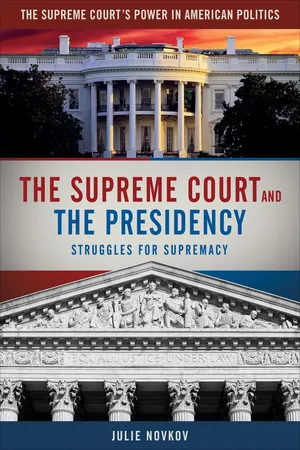 eBook - PDF
The Supreme Court and the Presidency
Struggles for Supremacy
- Julie Novkov(Author)
- 2013(Publication Date)
- CQ Press(Publisher)
Support for this kind of mischief simply cannot be spun from incantation of the doctrine of separation of powers. . . . C IRCUIT J UDGE W ILKEY , dissenting. This is not a matter of “coercing” the Executive to “obey the law”; there has never before in 184 years been any such law that the Executive could be compelled by the Judiciary to surrender Executive records to the Judiciary. This is an assertion of privilege by the Executive, not a refusal to obey a court’s interpretation of the law. This the Executive has always done, even when the Executive’s interpretation of the law was different from the court’s. . . . But also, the Executive has always been the one who decided whether the Executive Branch privilege of confidentiality of its records should be asserted, and to what extent, when confronted with demand of another Branch for such records. . . . [W]here the privilege of the Chief Executive is derived from the Constitutional principle of separation of powers, it is no more subject to weighing and balancing than any other Constitutional privilege can be weighed and balanced by extraneous third parties. . . . Source: Nixon v. Sirica, 487 F.2d 700 (D.C. App. 1973). Document 11.5 The Supreme Court Thwarts the Senate, April 2, 1974 The Senate conducted its own investigation of Watergate and issued subpoenas to President Richard Nixon. Nixon objected, and the D.C. Circuit Court of Appeals found that the Senate Select Committee on Presidential Campaign Activities’ subpoena did not provide a specific justification sufficient to override Executive Privilege. It is true, of course, that the Executive cannot, any more than the other branches of gov-ernment, invoke a general confidentiality privilege to shield its officials and employees from investigations by the proper governmental institutions into possible criminal wrong-doing.
Index pages curate the most relevant extracts from our library of academic textbooks. They’ve been created using an in-house natural language model (NLM), each adding context and meaning to key research topics.

