Politics & International Relations

First Continental Congress
The First Continental Congress was a meeting of delegates from 12 of the 13 British North American colonies that took place in 1774. It was convened to address grievances against the British government and to discuss a unified response to the Intolerable Acts. The Congress marked a significant step towards colonial unity and resistance to British rule, setting the stage for the American Revolutionary War.
Written by Perlego with AI-assistance
Related key terms
1 of 5

10 Key excerpts on "First Continental Congress"
 eBook - ePub
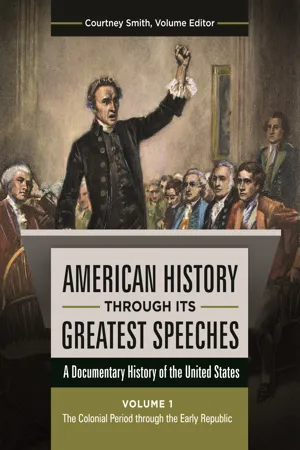
American History through Its Greatest Speeches
A Documentary History of the United States [3 volumes]
- Jolyon P. Girard, Darryl Mace, Courtney Michelle Smith, Jolyon P. Girard, Darryl Mace, Courtney Michelle Smith(Authors)
- 2016(Publication Date)
- ABC-CLIO(Publisher)
The “Declarations and Resolves” reflects the debates the delegates had during the course of the congress. It also shows both the determination and the reluctance of the delegates who gathered in Philadelphia in 1774. Instead of seeking reconciliation with Great Britain, the delegates remained determined to assert their rights and to relate how the British government systematically violated those rights. At the same time, however, the delegates remained reluctant to assert a firm declaration of independence from Great Britain. The language used in the “Declarations and Resolves” does show that the delegates had begun to think of themselves as Americans. The First Continental Congress, therefore, represented an important step in the movement toward independence. It brought delegates together from all but one of the colonies and gave the delegates an opportunity to promote collective action against Great Britain. While the delegates refrained from severing ties with Great Britain, they gained valuable experience that helped to promote a sense of “Americanness” in the colonies.Whereas, since the close of the last war, the British parliament, claiming a power, of right, to bind the people of America by statutes in all cases whatsoever, hath, in some acts, expressly imposed taxes on them, and in others, under various presences, but in fact for the purpose of raising a revenue, hath imposed rates and duties payable in these colonies, established a board of commissioners, with unconstitutional powers, and extended the jurisdiction of courts of admiralty, not only for collecting the said duties, but for the trial of causes merely arising within the body of a county:And whereas, in consequence of other statutes, judges, who before held only estates at will in their offices, have been made dependant on the crown alone for their salaries, and standing armies kept in times of peace: And whereas it has lately been resolved in parliament, that by force of a statute, made in the thirty-fifth year of the reign of King Henry the Eighth, colonists may be transported to England, and tried there upon accusations for treasons and misprisions, or concealments of treasons committed in the colonies, and by a late statute, such trials have been directed in cases therein mentioned:And whereas, in the last session of parliament, three statutes were made; one entitled, “An act to discontinue, in such manner and for such time as are therein mentioned, the landing and discharging, lading, or shipping of goods, wares and merchandise, at the town, and within the harbour of Boston, in the province of Massachusetts-Bay in New England;” another entitled, “An act for the better regulating the government of the province of Massachusetts-Bay in New England;” and another entitled, “An act for the impartial administration of justice, in the cases of persons questioned for any act done by them in the execution of the law, or for the suppression of riots and tumults, in the province of the Massachusetts-Bay in New England;” and another statute was then made, “for making more effectual provision for the government of the province of Quebec, etc.” All which statutes are impolitic, unjust, and cruel, as well as unconstitutional, and most dangerous and destructive of American rights: eBook - PDF
A World Safe for Commerce
American Foreign Policy from the Revolution to the Rise of China
- Dale C. Copeland(Author)
- 2024(Publication Date)
- Princeton University Press(Publisher)
63 3 The Origins of the War for Colonial Independence the war for American independence from Great Britain, fought from 1775 to 1783, set the foundation for much of what transpired in American foreign policy over the next two centuries. The war not only created a country whose com- mitment to ideals of liberty brought into question the legitimacy of the absolut- ist states of Europe, it also introduced to the world system a land-rich and dy- namic nation that these states knew might one day challenge them in both commercial and military power. Yet surprisingly, the War for Colonial Independence is rarely studied by international relations scholars, presumably because it seems to be a case of civil strife within a political unit rather than an “inter-national” conflict. Narrowly defined, this of course is true, since the Americans were seeking to break from an imperial realm that they had been a part of for a century and a half. Yet if we look at how the war broke out in 1775–76, this is clearly a conflict between thirteen political units (the colonies) that had seen themselves as essentially free to run their internal affairs and a power (Britain) that sought to restrict these traditional rights. Moreover, in the 1760s each of the thirteen colonies, unlike in British Canada or East and West Florida, had its own functioning political structure and elites that made deci- sions for their specific colony independent of London, even if the crown often had a final say on legislation. Hence when these elites gathered in Philadelphia in September 1774 for the First Continental Congress, they were acting as if they already had the legal power to commit their fellow colonists to a common strat- egy and to use established institutional tools to enforce the colonies’ agree- ments. No longer available |Learn more
- (Author)
- 2014(Publication Date)
- College Publishing House(Publisher)
Congress organized a boycott of British goods and petitioned the king for repeal of the acts. These measures were unsuccessful because King George III and the North ministry were determined not to retreat on the question of parliamentary supremacy. As the king wrote to Prime Minister Lord North in November 1774, blows must decide whether they are to be subject to this country or independent. Even after fighting in the American Revolutionary War began at Lexington and Concord in April 1775, most colonists still hoped for reconciliation with Great Britain. When the Second Continental Congress convened at the Pennsylvania State House in Philadelphia in May 1775, some delegates hoped for eventual independence, but no one yet advocated declaring it. Although many colonists no longer believed that Parliament had any sovereignty over them, they still professed loyalty to King George, who they hoped would intercede on their behalf. They were to be disappointed: in late 1775, the king rejected Congress's second petition, issued a Proclamation of Rebellion, and announced before Parliament on October 26 that he was even considering friendly offers of foreign assistance to suppress the rebellion. A pro-American minority in Parliament warned that the government was driving the colonists towards independence. Toward independence In January 1776, just as it became clear in the colonies that the king was not inclined to act as a conciliator, Thomas Paine's pamphlet Common Sense was published. Paine, who had only recently arrived in the colonies from England, argued in favor of colonial independence, advocating republicanism as an alternative to monarchy and hereditary rule. Common Sense introduced no new ideas, and probably had little direct effect on Congress's thinking about independence; its importance was in stimulating public debate on a topic that few had previously dared to openly discuss. eBook - PDF
A War of Religion
Dissenters, Anglicans and the American Revolution
- James B. Bell(Author)
- 2008(Publication Date)
- Palgrave Macmillan(Publisher)
Part II A New Controversy: The Political Sentiments of the Clergymen 10 The Impact of the First Continental Congress and the Local Committees of Safety Convening in Philadelphia in September and October 1774 as an advisory council for the colonies, the First Continental Congress considered action for recovery of rights forfeited under Parliament’s repressive Coercive Acts. It eventually became the central government for the provinces, however fragmentary its powers. The creation of the Continental Association by the Congress was intended to regularise procedures against dissidents in the colonies by establishing local Committees of Safety in every county, city, and town. 1 Committees were to be elected by persons able to vote for assemblymen in each province. 2 Complaints considered by the committees were to be heard and if an accused person were found guilty the details were to be pub- lished in the local newspaper. Pauline Maier has noted that provincial conventions and local committees were allowed to establish additional regulations for executing judicial procedures. 3 Persons alleged to be Loyalists or enemies of America were ‘to be complained of unto the Committee of the District or Town in which such person or persons reside’. 4 For an observer of civil events, in the autumn of 1774, the proceed- ings of the Congress seemed to be set on a path that would lead the colonies to rebellion and war with England, a circumstance that indi- cated an uncertain and uncontrollable future for the church. The delib- erations and policies adopted by the Congress generated a succession of critical essays by several prominent loyalist Anglican clergymen in the Middle Colonies and divided the opinions of members of congregations. In addition, the activity of the Congress initiated an interest in the political sentiments of the ministers by local political activists and the members of the Committee of Safety, particularly in the New England region. eBook - ePub
Protocols of Liberty
Communication Innovation and the American Revolution
- William B. Warner(Author)
- 2013(Publication Date)
- University of Chicago Press(Publisher)
3 In this chart, I have arranged the colonies top to bottom from north to south (or, as British Americans considered them, from “east to west”), starting with New Hampshire and ending with Georgia. This was the ordering used by the congress in signing all of its official documents. It reflected the colonies’ reluctance to arrange themselves by order of population, physical size, economic importance, or date of founding, any one of which would have introduced a hierarchy among the colonies. By arranging them geographically, as nature had, the congress implicitly affirmed their formal equality. This chart allows one to visualize the sequence of actions that “built” the congress. Each row, summarizing the political meetings in one colony, assumes the shape of a conceptual funnel on its side that channels the effects of decisions from left to right. In each of the thirteen colonies, local meetings were held after receipt of the news of the Boston Port Bill (column 1); they deliberated, formulated resolves, and selected delegates for thirteen provincial conventions (column 2), which, in their turn, deliberated, formulated resolves and selected delegates (column 3) for the general congress in Philadelphia.TABLE 5.1. THE GATHERING OF THE First Continental Congress OUT OF THE COMMITTEES, CONVENTIONS, AND ASSEMBLIES OF TWELVE OF THIRTEEN COLONIESa Numbers of those delegates with experience as members of committees of correspondence are in parentheses.So as to be effectively inclusive, this communication process was necessarily redundant. Like the earlier initiatives of the Boston and Virginia committees of correspondence, the calls to action in the late spring and early summer of 1774 were shaped so as to balance initiative and consultation, action by individual committees with the patience to allow as many localities as possible to participate. Robust consultation was understood to be the sine qua non of political “buy-in.”4 eBook - PDF
The Revolutionary Era
Primary Documents on Events from 1776 to 1800
- Carol Sue Humphrey(Author)
- 2003(Publication Date)
- Greenwood(Publisher)
C H A P T E R I The Reality of Independence, 1776-1781 hen the Second Continental Congress adopted the Declaration of Independence on July 4, 1776, and then had it published in the Pennsylvania Evening Post on July 6, 1776, no one really knew what it all meant. The delegates who later signed the Declaration believed that Great Britain sought to control their lives in ways that were unaccept- able. They had accepted the political philosophy of Englishman John Locke, who stated that a government should pay attention to the needs and desires of its subjects. A government's failure to listen and respond provided a rea- son for rebellion; and John Adams, Thomas Jefferson, John Hancock, and the rest of the Continental Congress believed that Britain's "tyranny" justi- fied their revolution. These men had embraced the ideas of the Enlighten- ment, an eighteenth-century philosophical outlook which emphasized man's rationality and his ability to use his mind to solve all problems. If a person gathered information and studied it carefully, the answer to any question would be obvious. The delegates to the Continental Congress be- lieved that their revolution fit this description—anyone looking at the ac- tions of Great Britain would agree that the colonies could do nothing else but revolt in order to guarantee their political rights. But believing that their actions were justified did not mean that these men knew the consequences of those actions. They could declare the colonies independent, but what exactly did that action mean? Besides the obvious fact of the need to win the war against Great Britain, the colonies would have to define what it meant to be "free and independent states" by developing a government structure and fleshing out how the previously dis- tinct and separate colonies would relate to each other and how they would face the future together as one nation. It would take decades to answer many of these questions, but many of them were discussed immediately. eBook - PDF
- Jack P. Greene, J. R. Pole, Jack P. Greene, J. R. Pole(Authors)
- 2008(Publication Date)
- Wiley-Blackwell(Publisher)
5 Support for Congress in the Colonies As the delegates left Philadelphia they were almost certainly divided in their expecta-tions. More militant members such as Sam Adams and Richard Henry Lee were certain that the efforts of Congress would not change British policy. They had argued, unsuccessfully, that Congress should instruct the colonists to prepare for war. Others – James Duane and John Dickinson are notable examples – hoped that the decisions of Congress would persuade the British that the colonists were united and determined and thus lead to a modification of govern-ment policy. The work of Congress was widely acclaimed and supported throughout the colonies. From the point of view of most Americans, the delegates had adopted a moderate but determined stand. They had rejected all proposals for military prepara-tion, had petitioned the government in respectful terms, and had invoked an embargo policy which had, apparently, proved ineffective in previous crises pro-voked by the Stamp Act and the Townshend Duties. Consequently a substantial majority of colonists determined to show their sup-port for Congress by adopting and enforc-ing its resolutions. In town, county, and provincial meetings throughout the conti-nent they approved the program adopted by the Congress, appointed committees to see to its enforcement, and took steps to ensure their economic independence from the mother country. Committees of Inspection One of the most important gauges of sup-port for the Continental Association was the swift appointment of committees. In New England the response was almost unanimous. Hundreds of committees were appointed, even in the smallest and most remote of communities. The sincerity of these community efforts is perhaps best D AVID L. A MMERMAN 200 demonstrated by the town of Sutton, Massachusetts. Noting that the punishment for violating the resolutions of Congress was social ostracization, citizens discussed the exact meaning of that term. eBook - PDF
War, Revenue, and State Building
Financing the Development of the American State
- Sheldon Pollack(Author)
- 2011(Publication Date)
- Cornell University Press(Publisher)
A Constitution for the Confederacy Recognizing the limitations of their authority and power, the leaders of the Second Continental Congress moved to establish a stronger government and more permanent political institutions. On June 7, 1776, Richard Henry Lee of Virginia introduced his celebrated motion for independence from England. 62 History has afforded the ensuing campaign for independence a central place in our national lore. No less significant, later that same day 59. Boatner, Encyclopedia of the American Revolution, 264. Others estimate that the maximum number under Washington’s command was never more than 13,000 troops. See, e.g., Duffy, The Military Experience in the Age of Reason, 1715–1789, 17: “The largest body which Washington com-manded in the field probably reached only about 13,000 troops.” 60. This number included some 30,000 “Hessian” foreign mercenaries. Of course, England had other large armies and its navy was already quite significant. But the bulk of these forces were deployed outside of North America. 61. The succession of wars fought in the eighteenth century in North America by England and France (and their proxies) were extensions of the broader struggle between the powers of Europe, rather than separate events (as they are commonly perceived on this side of the Atlan-tic Ocean). William M. Fowler, Jr., Empires at War: The French and Indian War and the Struggle for North America, 1754–1763 (New York: Walker, 2005). 62. The king’s refusal to offer any concessions convinced the delegates of the Continental Congress to issue a formal declaration of independence. According to Jack Rakove: “The dele-gates had to decide what useful purposes a formal declaration would actually serve. . . . For most intents and purposes, the Americans were already acting as if they were an independent na-tion: waging war, creating new governments, issuing money, and enacting other expedient mea-sures.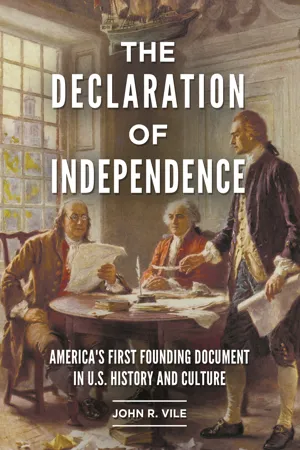 eBook - ePub
The Declaration of Independence
America's First Founding Document in U.S. History and Culture
- John R. Vile(Author)
- 2018(Publication Date)
- ABC-CLIO(Publisher)
Considerations on the Nature and Extent of Legislative Authority of the British Parliament (1774) as did John Adams in Novanglus (1775). The First Continental Congress also disputed this Act in its “Declaration and Resolves.”On June 7, 1776, Richard Henry Lee of Virginia introduced a resolution for independence before the Second Continental Congress on June 7, 1776, which “Resolved that these United Colonies are, and of right ought to be, free and independent States, that they are absolved from all allegiance to the British Crown.” In doing so, he therefore directly contradicted, and arguably mocked (Munves 1978, 9), the language of the Declaratory Act.See also Declaration and Resolves of the First Continental Congress (1774); Resolutions Introduced by Richard Henry Lee (June 7, 1776)Further ReadingChaffin, Robert J. 1974. “The Declaratory Act of 1766: A Reappraisal.” Historian 37 (November): 5–25.“The Declaratory Act.” https://uwmadison.app.box.com/s/5zwbnxqdcehyr534fsfgzuyyj1tmepqy .Morgan, Edmund S. 1968. “Colonial Ideas of Parliamentary Power, 1764–1766.” In The Reinterpretation of the American Revolution, 1763–1789, edited by Jack P. Greene, 151–180. New York: Harper and Row.Munves, James. 1978. Thomas Jefferson and the Declaration of Independence: The Writing and Editing of the Document That Marked the Birth of the United States of America. New York: Charles Scribner’s Sons.Reid, John Philip. 1991. Constitutional History of the American Revolution: The Authority to Legislate. Madison: University of Wisconsin Press.DELAWARE AND ITS SIGNERSAlthough Swedes and Dutch were the first Europeans to populate Delaware, the British eventually gained title and allowed it to serve as a proprietary colony under William Penn. Closely connected to Pennsylvania from the outset, the small colony was politically divided into upper counties, more closely associated with New York, and lower counties, which were more closely associated with Pennsylvania, but which eventually sent representatives to New Castle (Bower and Ratledge 2009, 3). Because Delaware did not have to submit its legislation to the English for approval, it exercised a degree of self-government similar to that of Connecticut and Rhode Island (Bower and Ratledge 2009, 3). eBook - PDF
Voices of the American Revolution
Stories of Men, Women, and Children Who Forged Our Nation
- Kendall Haven(Author)
- 2000(Publication Date)
- Libraries Unlimited(Publisher)
46 \ 1773 Through 1775 • What was the Continental Congress? When was it first formed? Why? By whom? How many Continental Congresses were there? What did they do? • John Hancock was a most important figure in the Continental Congress. What did he do before the war? Why and how was he elected president of the Con- gress? What did he do after the war? What signature is he most famous for? • Two Adamses were in Congress, cousins John and Sam, both from Massachu- setts. Research these two important men. What contribution to the Revolution did each make? What did they do before the Revolution and after it? • Many soldiers deserted (ran away from the army) during the winter of 1775 to 1776. Did Washington's army suffer from desertions every winter? 3. Make It Real • In the 1700s few people ever traveled more than 25 miles from their homes during their entire lives. How far from home have you been? As a class, make a list of how far each student in the class has been from home. Why do you think travel was so difficult then and is so easy now? • The Patriot army around Boston was made up of small, independent units, re- sponsible only to their individual colonial legislatures. There was no overall army commander. Units didn't have to cooperate with each other if they didn't want to. What would that situation be like? You can actually imagine some- thing very close to it at your school with the following exercise: Each class at your school follows the lead and direction of its teacher. If there were no principal, teachers could do whatever they wanted. How would the various classes decide who goes to lunch when, who gets physical educa- tion when, or when each class gets a turn to use the library? How would school-wide decisions be made? Would they ever be made, or would each class act independently? Interview several teachers and the principal and then conduct a class discussion to envision how the school would work if there were no central administration at all.
Index pages curate the most relevant extracts from our library of academic textbooks. They’ve been created using an in-house natural language model (NLM), each adding context and meaning to key research topics.

