Politics & International Relations

Political Campaigns
Political campaigns are organized efforts to influence the decision-making process within a specific political system. They are typically conducted by candidates, political parties, or interest groups to promote their agendas, gain support, and ultimately win elections. Campaigns often involve various strategies such as advertising, public relations, and grassroots mobilization to communicate their messages and persuade voters.
Written by Perlego with AI-assistance
Related key terms
1 of 5
5 Key excerpts on "Political Campaigns"
 eBook - ePub
Do Political Campaigns Matter?
Campaign Effects in Elections and Referendums
- David M. Farrell, Rüdiger Schmitt-Beck(Authors)
- 2003(Publication Date)
- Routledge(Publisher)
This book represents the first cross-national effort to take stock of the state of this sub-discipline. The nine chapters which follow examine campaign effects in a range of different national contexts, using a range of different methodologies. In this introductory chapter we set the scene for what is to follow. We start, in the first section, by outlining the field of study of campaign effects, setting out a definition of campaigning, and reviewing the types of campaigns that can be included in this area of analysis. The subsequent sections concentrate on campaigns for elections and referendums, exploring the core features of contemporary campaigns and discussing the range of likely ways in which these campaigns might be said to have some influence. Finally, we provide a short section reviewing the main trends in the study of campaign effects, before concluding with an outline of the rest of the book.The rise of campaign politics
Campaigning is a core feature of the political process in contemporary democracies. Election campaigns see parties and their candidates wage battles for votes and political office. Referendum campaigns see proponents and opponents of the relevant issue seek to steer the vote in their preferred direction. Issue-based campaigns see government agencies or interest groups attempting to have an issue or policy placed high on the political agenda, and to have it favourably framed in public debate. Image campaigns see efforts to paint the public perception of some political actor in a more favourable light. In the past few decades campaigning has assumed increasing relevance as a mode of political mediation, in part reflecting the growing volatility in the electoral process, in part also reflecting a general shift towards issue-based politics and a greater emphasis on alternative modes of political participation. If the first of these indicates a greater role for ‘policy mediation’ – consisting of top-down flows of strategic communication originating from the political elite – the second is more suggestive of a process of ‘interest mediation’, in which, in particular, the political elite face ever more competition for agenda setting from interest groups and lobbying organizations (Edelman 1985, 1988; Sarcinelli 1987, 1998; Röttger 1997; Bentde et al. 2001).Campaigns occur not only in the political realm; they are increasingly important in all walks of life: for instance, a company mounts an advertising campaign to promote its product; a charity seeks to raise money for an overseas aid programme; a city engages in ‘city marketing’ in order to attract investors and new businesses. Since the focus of this book is specifically on political eBook - PDF
- Robin T Pettitt(Author)
- 2014(Publication Date)
- Red Globe Press(Publisher)
Chapter 8 Campaigning As we have seen throughout this book, political parties are multifaceted organisations. They contain a wide range of internal actors – leaders, activists, inactive members, casual supporters, indirect members, and affiliated organisations such as trade unions. These actors will have an equally wide range of goals. Hence, parties can be geared towards any-thing from the realisation of abstract goals to the cynical pursuit of power and personal aggrandisement. However, the winning of seats in parliament must be seen as one of the central activities of any serious party organisation. Indeed, going by the definition of a party used in this book (as discussed in Chapter 1), the act of fielding candidates for pub-licly elected office is what distinguishes parties from other political organ-isations. This definition of a political party has led Farrell and Webb (2002, p. 102) to conclude that: ‘Given this symbiotic relationship between parties and elections, it is important to have a clear idea of how parties operate in elections and elections affect parties.’ This chapter will look at a number of issues connected to the relation-ship between election campaigning and parties. It will first examine the ways in which campaigning is said to have changed and some critiques/modifications to that view. It will then look at how this change has impacted on party organisations. Finally, the chapter will look at the issue of party financing, a key element in modern capital-intensive elec-tion campaigns. How campaigning has changed Election campaigning is seen by many as having gone through three eras so far (summarised in Table 8.1). Different people take slightly different views on the details of each era and use different names for each. So, Farrell (1996) refers to the ‘premodern’, ‘television revolution’, and ‘telecommunications revolution’ eras; Norris (2002) calls them the ‘pre-modern’, ‘modern’ and ‘postmodern’. eBook - PDF
- Richard S Katz, William J Crotty, Richard S Katz, William J Crotty(Authors)
- 2006(Publication Date)
- SAGE Publications Ltd(Publisher)
Election campaigns are a central feature in the life of political parties, and certainly since the onset of representative democracy, a party’s principal raison d’être . 1 Therefore, in a context in which election campaign styles have been changing, 2 it is important to get some perspec-tive on what implications this has for political parties. 3 This chapter is arranged in four sections. We start with an overview of the cam-paign literature, where it interfaces with the party politics literature, and the arguments about the nature and causes of campaign change. The next two sections explore the prin-cipal features of campaign change and their impact on political parties. The chapter con-cludes by proposing areas for further study. THE STUDY OF CAMPAIGNS In the last two decades of the 20th century the study of campaigning came into its own as a significant field of research in the political science community. Two principal factors help to explain this change in emphasis: one relat-ing to the parties literature, and another more closely associated with the electoral behavior literature. In the first case, the party literature has undergone something of a paradigm shift (Mair, 1990). The classic party studies (e.g. Duverger, 1954; Sartori, 1976) tended, on the whole, to feature a pre-eminent concern with the study of party systems. From about the 1980s onwards there was a distinct shift in focus: political scientists started looking inside the ‘black box’ of parties as entities in their own right; new studies appeared examining, in some detail, features of party organizations and their evolution or demise (e.g. Janda, 1980; Katz and Mair, 1992; Panebianco, 1986); and election campaigning emerged as a field of inquiry (e.g. Bowler and Farrell, 1992; Butler and Ranney, 1992). eBook - ePub
Political Reputation Management
The Strategy Myth
- Christian Schnee(Author)
- 2014(Publication Date)
- Routledge(Publisher)
2 Political communications management Understanding the context Political marketing When individuals, political parties or organizations deploy marketing concepts, theories and approaches to achieve objectives in a political context, we may refer to this activity as political marketing. The fundamental objectives of political marketing are addressing public perspectives and views, the propagation of political convictions, campaigning, winning majorities of the electorate, and finally, legislating with the intention to meet the expectations and hopes of particular segments of the electorate (Newman, 1999b). Newman (2002) contends that the marketing rationale helps understand why, how and to what purposes candidates, parties and government departments take strategic decisions. Hence marketing concepts appear to offer a valuable framework for a study that endeavours to grasp the degree to which strategic considerations and decisions feed into the political communications process (Harrop, 1990). Marketing strategy is described as the interface between any entity – political or not – and its surroundings, with particular regard to its key audiences (Mavondo, 2000). Lilleker et al. (2006) and Lilleker and Negrine (2006) emphasize the mutual nature of marketing in politics, which promises to satisfy both the electorate’s expectations and the organization’s needs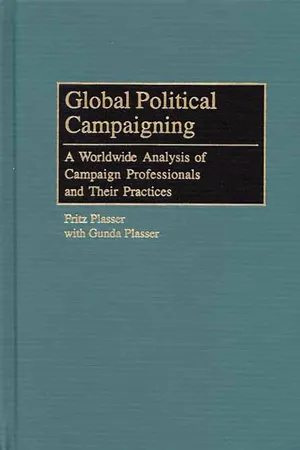 eBook - PDF
Global Political Campaigning
A Worldwide Analysis of Campaign Professionals and Their Practices
- Fritz Plasser(Author)
- 2002(Publication Date)
- Praeger(Publisher)
According to Moog and SluyterBeltrao (2001), Spanish politicians “actually break off in midsentence when they see camera links light up at political rallies, in order to deliver specially prepared soundbites” (50). Similar practices have been reported as standard practices in Brazilian, Russian, Australian and Taiwanese campaigns, and illustrate the centrality of political television as the main carrier of targeted campaign messages. Professionalization of campaign management. The cooperation with professional advertising agencies and the inclusion of external marketing and communication experts in the strategic planning process have contributed to an increased professionalization of election campaigns worldwide. But as Mancini (1999) noted and our analysis confirmed, “political professionalism seems to develop differently in different electoral and political systems and political cultures” (243). Campaigning based on surveys and focus groups. Mobilizing campaigns, centered on organization and concentrated on rallies, canvassing and direct voter contact, are increasingly turning into professionally planned, technically complex marketing and communication operations. One indicator for this development is the extraordinary importance of survey data for strategic decisions. Dense monitoring by continuous survey operations (track polling), the segmentation of the electoral market and the definition of target voter profiles, as well as the use of focus groups for message development, are meanwhile determining the campaign practices in such different countries as the United States, Russia, Italy, Brazil and South Africa. With the strategic publication of survey data the attempt is made to influence public opinion and emotions. In Latin America this process is referred to as a war with surveys (guerra de encuestas) (Njaim 1999:664–671), which is even continued until election eve with the select publication of exit polls (boca de urna).
Index pages curate the most relevant extracts from our library of academic textbooks. They’ve been created using an in-house natural language model (NLM), each adding context and meaning to key research topics.

