Politics & International Relations

Rachel Carson
Rachel Carson was an influential American marine biologist and conservationist known for her groundbreaking book "Silent Spring," which exposed the harmful effects of pesticides on the environment. Her work sparked the modern environmental movement and led to the establishment of the Environmental Protection Agency. Carson's advocacy for environmental conservation continues to have a lasting impact on global politics and policy.
Written by Perlego with AI-assistance
Related key terms
1 of 5
10 Key excerpts on "Rachel Carson"
 eBook - ePub
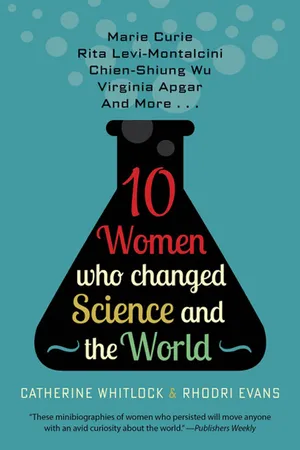
- Catherine Whitlock, Rhodri Evans(Authors)
- 2019(Publication Date)
- Diversion Books(Publisher)
2Rachel Carson
(1907–64) Alfred Eisenstaedt/Life Picture Collection/Getty ImagesRachel Carson, the biologist, environmental conservationist, and writer, was fearless in her quest to understand what was happening to the natural world around her. Her early beginnings as a writer—she published her first compositions at the age of ten—gradually merged with her interest in natural history. Working in marine biology, her combination of scientific scholarship and literary acumen resulted in the publication of four books: a trilogy about the sea, and Silent Spring. Published in 1962, “No single book on our environment has done more to awaken and alarm the world.”It was a controversial book when it was published but this passionate account of the effects of pesticides such as dichlorodiphenyltrichloroethane (DDT) is credited with opening the eyes of the world to the potential destruction of our environment. When the book was first published in 1962, Time magazine found her conclusions “patently unsound” but, forty years later, their commentary was more laudatory, acknowledging the political and personal battles Rachel had fought: “Before there was an environmental movement, there was one brave woman and her very brave book.”Rachel Carson was born on May 27, 1907, in rural surroundings, near Pittsburgh, Pennsylvania. Her mother, Maria, was smitten with her from day one, describing her third child as a “dear, plump, little blue-eyed baby . . . unusually pretty and very good.” Rachel’s siblings, Marian and Robert Jr., were already in school when Rachel was born and Maria Carson had plenty of opportunity to educate Rachel and immerse her in the world of nature around them.Maria was a studious woman. Trained as a school teacher, she was also a competent pianist and singer with a local choral group. At one of their concerts, she met the retiring company clerk Robert Carson. After they married, Maria was forced to give up teaching, as married women were not allowed to teach in Pennsylvania in the early 1890s. Robert Carson was no farmer, but he was interested in being part of the booming industrial economy of Pittsburgh. He bought sixty-five acres of land, with the intention of dividing this into lots for sale. The Carson home was a small house—two rooms downstairs and two upstairs. It was a basic set-up, with no indoor plumbing, so water was carried from a spring outside. In winter, the family huddled around the fireplace and in summer the children plunged into the local river to cool down. eBook - ePub
- Sofia Vaz(Author)
- 2017(Publication Date)
- Routledge(Publisher)
Silent Spring A legacy for sustainable developmentJosé Lima SantosRachel Carson's book on the impacts of pesticide use on humanity and nature—Silent Spring —changed the way we perceive our relationships with nature, particularly those mediated through science and technology. The aim of this chapter is to discuss Carson's book, not only as regards its success in changing the hearts and minds of her fellow citizens, but also as an important legacy for a deeper understanding of the many challenges we still face today in building a more sustainable future.The author and her personal and cultural context are introduced first, as well as the historical context of the book. The communication strategy and personal skills used by the author in writing Silent Spring are discussed as key factors in determining the book's impact on the emerging environmental movement of the 1960s and early 1970s, which led to the creation of today's environmental policy.Based on selected excerpts from the book, we identify some elements of the environmental agenda that Rachel Carson promoted with her book: (l) the role of science in helping us work with nature, as opposed to against it; (2) the type of humble science that is required to set us on (what we would today call) a path of sustainable development; (3) the public's right to know about possible health and well-being consequences of environmentally risky decisions, and to participate in these decisions; (4) the role of scientists in communicating science with the public and informing the public debate—a role that Carson played with supreme skill in the field of pesticide use and crop protection, showing the way ahead for many other environmental fields; and (5) the interplay of truth, interest and economic incentives in the daily work of scientists, when creating scientific knowledge, technical solutions and the resulting potential impacts on nature. We also underline the relevance of these issues for a deeper understanding of the major challenges we still face today when promoting sustainable development. eBook - ePub
Pesticides, A Love Story
America's Enduring Embrace of Dangerous Chemicals
- Michelle Mart(Author)
- 2015(Publication Date)
- University Press of Kansas(Publisher)
3Breakup? The Cultural Impact of Rachel Carson’s Silent Spring
Rachel Carson’s 1962 Silent Spring is one of the most famous books of the twentieth century and one of the most politically and culturally influential in American history. Often compared to the nineteenth-century antislavery novel Uncle Tom’s Cabin, which strengthened support for abolition, Silent Spring contributed to a new cultural understanding of the human place in the natural world as well as policies to clean up the environment.1 Thus, Rachel Carson deserves credit for being the godmother of the Environmental Protection Agency (EPA); the ban on DDT and other pesticides; Earth Day; the 1972 Federal Insecticide, Fungicide, and Rodenticide Act; and indeed of “environmentalism” as a philosophy and political movement. When we think about American attitudes toward pesticide use over half a century, there is probably no more important turning point than the publication of Silent Spring.Due to the pivotal political and cultural role of the book, the historiography on it and Rachel Carson is both broad and deep.2 The dominant interpretation in these works is that Carson and Silent Spring were path-breaking and influential despite the onslaught of criticism from the chemical industry and groups within the government. On the face of it, there seems little new to say about Carson or her book, yet there are apparent contradictions between the narrative about the effects of Silent Spring and environmental developments in the years that followed. DDT and other potent pesticides were banned, but overall reliance on pesticides increased after 1962 , with farm use doubling by 1994 .3 On balance, then, we can say that Rachel Carson did not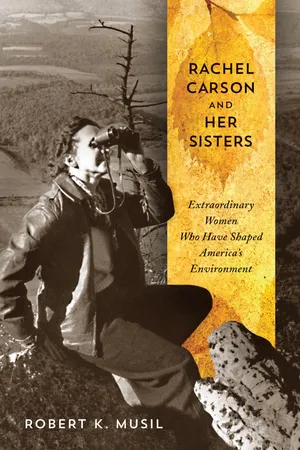 eBook - ePub
- Robert K Musil(Author)
- 2014(Publication Date)
- Rutgers University Press(Publisher)
Silent Spring were the spark that lit long-smoldering tinder. Carson expanded the conservationist movement, shaped policy, alerted a wide public, added emotional and imaginative impact to accounts of the assault on the environment, and created a cogent, compelling scientific case documenting the havoc wrought by a rain of unregulated chemicals on America’s backyards and birds. But the rousing response to a single book and its somewhat shy author had been building, largely offstage, away from the klieg lights, for a long time.In 1958, as Rachel Carson slowly and slightly reluctantly decided to write Silent Spring, she drew on and increased her wide circle of friends, colleagues, conservation and civic organizations, and government officials who cared about the environment and public health. There was already a noticeable environmental movement, even though it had been reduced during World War II, become frustrated and somewhat futile during the early Cold War years of the Eisenhower administration, and was smaller and less coherent than today’s. And much of this conservationist and environmental health movement had been founded, fueled, or fitted together by women. By 1962, as Carson continued to wrestle with difficult research material, family responsibilities, the death of her mother, a variety of ailments, and, finally, inoperable cancer, varied constituencies—from nature and scientific authors, to Audubon groups, the Sierra Club, Wilderness Society, National Women’s and Garden Clubs, and researchers inside and out of government—became aware that an author with a gift for moving large numbers of Americans was about to present them with the opportunity of a lifetime. A perfect storm of events had also been gathering and was about to burst. Nuclear testing and fallout had already begun to upset and mobilize portions of the scientific and academic communities, and the concerned public. African Americans and their moderate and liberal white supporters were increasingly demanding protection and equal rights under the law; cancer-producing chemicals were discovered in the nation’s Thanksgiving cranberries; deformed babies were born to mothers who had been prescribed the wonder morning-sickness drug thalidomide; and heavy-handed attempts to eradicate fire ants and gypsy moths with pesticides had gone awry. Domestic and social problems that had been shelved during the war could no longer be ignored. And then, in 1960, a charismatic and sympathetic young president was elected, along with a Democratic Congress. The torch, it seemed, had, indeed, been passed to a new generation. If, in politics and in life, timing is everything, Rachel Carson and Silent Spring eBook - PDF
- George Hart, Scott Slovic, George Hart, Scott Slovic(Authors)
- 2004(Publication Date)
- Greenwood(Publisher)
Those laws and programs have been effective, and Carson's cautious, skeptical at- titudes about human interventions in the environment have come to be more prevalent, if not dominant, in our culture. The species most affected by DDT, like the brown pelican, the bald eagle, and the Cal- ifornia condor, have been protected from excessive pesticide use and reintroduced into the wild. The "general readers" Carson addressed have become much more savvy about chemicals in the environment— and in their own bodies. The government and industries are much less cavalier about damaging the ecosystems around us than they were in the 1950s and 1960s. However, Rachel Carson would surely warn that the political work of environmentalists is never done. Despite the tremendous advances in environmental protection, we readers need to keep on choosing "the other road" Silent Spring sets out, for all the reasons that this powerful book examines in such excruciating scientific detail and with such profoundly lyrical description. In its final pages, Carson leaves us with the imperative that we retain a crucial awareness that we are dealing with life—with living populations and all their pressures and counter-pressures, their urges and recessions. Only by taking account of such life forces and by cautiously seek- ing to guide them into channels favorable to ourselves can we hope to achieve a reasonable accommodation between the insect hordes and ourselves. (296) In this way, humans can move beyond the "Stone Age" (297) view of the world as simply existing for our use; with Rachel Carson, we can evolve to viewing natural environments as our home and the creatures in them as our equals in the right to live and flourish. BIBLIOGRAPHY Brooks, Peter. The House of Life: Rachel Carson at Work. New York: Houghton, 1972. Carson, Rachel. Silent Spring. New York: Houghton. 1962. Davidson, H. Letter. The New Yorker. 20 & 27 Feb. 1995: 18. eBook - ePub
Why Dissent Matters
Because Some People See Things the Rest of Us Miss
- William Kaplan(Author)
- 2017(Publication Date)
- McGill-Queen's University Press(Publisher)
Chapter 4Rachel Was Right: Rachel Louise Carson“Before there was an environmental movement, there was one brave woman and her very brave book.”1 The woman was Rachel Carson, and her book was Silent Spring. Some books shake the world (Charles Darwin’s Origin of the Species, 1859), others change the world for the worse (Adolf Hitler’s Mein Kampf, 1925), but few make the world a better place. In American letters, Harriet Beecher Stowe’s Uncle Tom’s Cabin, 1852, and Silent Spring, 1962, top the list. The title of Rachel Carson’s most famous book was deliberately apocalyptic: nature is noisy; silence is terrifying. Silent Spring suggested no future for planet Earth.“Government Girl” Sounds the AlarmRachel Louise Carson was born on 27 May 1907 on a small family farm in the hamlet of Springdale, Pennsylvania. Her father, Robert Warden Carson, was a travelling insurance salesman, and her protective mother, Maria Frazier McLean, a trained teacher who followed the popular nature studies movement and its mantra, “study nature, not books.”The family was poor and the house had no indoor plumbing, but there were animals – pigs, cows, chickens, and horses – and it was surrounded by an orchard, woodlands, and rivers. Carson, the youngest of three children, began writing stories when she was ten and was published almost immediately. She loved the outdoors, learned the names of everything she saw there, and never lost her curiosity about the unknown. “If I had influence with the good fairy,” she wrote years later, “I should ask that her gift to each child be a sense of wonder so indestructible that it would last throughout life.”2In September 1925 Carson entered the Pennsylvania College for Women (now Chatham University). She enrolled first in English but switched to biology after meeting an inspirational professor. After graduating magna cum laude in 1929, she accepted a position – “beginning investigator” – at the Marine Biological Laboratory in Woods Hole on Cape Cod (and saw the sea for the very first time). Three years later, she earned a master’s degree in zoology from Johns Hopkins University – it took so long because she ran out of money and could study only parttime. A doctorate and an academic career was planned, but it was financially impossible. eBook - ePub
People Get Ready
Twelve Jesus-Haunted Misfits, Malcontents, and Dreamers in Pursuit of Justice
- Peter Slade, Shea Tuttle, Jacqueline A. Bussie, Peter Slade, Shea Tuttle, Jacqueline A. Bussie(Authors)
- 2023(Publication Date)
- Eerdmans(Publisher)
3 Their actions remind me of the cumulative power of bearing witness over time. Rachel Carson didn’t dream of becoming an activist, but her beliefs propelled her into public witness. She had everything to lose by not taking action too.When I worry about my students’ future—and that of my daughters—I yearn for a solid story to share. I don’t need a vapid inspirational tale but a strategic model of inspired persistence. I want to show them a woman who could doggedly claw at her writing and advocacy through illness, devoting her life (and her death) to the health of people and places, while marveling at the interrelationships in nature.To do that, I have to ask: How was Carson able to move beyond worry? What spiritual beliefs drove her to persist as a woman, writer, and scientist for the good of all? Most of my students only know her from excerpts they’ve read of Silent Spring in introductory environmental studies courses. But I yearn to share her voluptuous writings of the sea and her scientific observations of warming waters as early as the 1940s and 1950s. Indeed, they might have faced a different world if this poet-scientist had lived to write about the threat of rising seas, as she’d planned.4When I stare at the photo of her standing knee-deep in a tide pool, I see a woman driven by her wonder in the world, especially the sea, and her faith in the connection of all living things. Could wonder harness real worries for the good of all in an uncertain but interconnected world?Rachel Carson was paying attention. She first voiced her concerns about the widespread use of DDT in a pitch to Reader’s Digest as early as 1945 when she was working at the Bureau of Fisheries.5 eBook - PDF
The Power of the Periphery
How Norway Became an Environmental Pioneer for the World
- Peder Anker(Author)
- 2020(Publication Date)
- Cambridge University Press(Publisher)
4 It was an important moment in the nation’s environmental debate as, from then on, these concerns were framed as ecological, while they previously had only been seen as mostly aesthetic. Ecological concerns in Norway were thus imported from abroad. This meant an empowerment of the small but radically growing community of ecologists. The publication of Carson’s book marks a shift, not only toward ecology, but also toward a belief that scientists had something extra to offer in answering the question of how to best protect the environment. Silent Spring raised eyebrows and introduced Norwegians not only to ecology, but also to a more integrated approach to environmental issues. Scientists had, of course, been involved in environmental management, such as agriculture, forestry, and fishery management, yet they had hardly been active in nature conservation. What was new with Carson was the 3 Robert E. Kohler, All Creatures: Naturalists, Collectors, and Biodiversity, 1850–1950 (Princeton: Princeton University Press, 2006), p. 92. 4 Ragnhild Sundby, “Globalforgiftning,” Naturen, 89 (1965), 3–11. Rachel Carson, Silent Spring (Greenwich: Fawcett Crest, 1962); Den tause våren, Torolf Elster (trs.) (Oslo: Tiden, 1962). 32 The Power of the Periphery turn toward scientific experts, specifically ecologists, as the source for information on how to go about protecting the natural world. The initial Norwegian reaction to Carson’s book came in reviews of the original English edition in Norwegian newspapers. The fact that a foreign book was considered deserving of space was unusual. What brought the editors’ attention was her ecological analysis of “the elixir of death,” namely DDT. 5 Her book would subsequently surface in Nor- wegian debates as a rhetorical device and a measurement for environ- mental success. It was used politically to compare clean Norway to the environmentally problematic United States and Japan. eBook - ePub
Ignition
What You Can Do to Fight Global Warming and Spark a Movement
- Jonathan Isham, Sissel Waage, Jonathan Isham, Sissel Waage(Authors)
- 2012(Publication Date)
- Island Press(Publisher)
frame in today’s parlance, a brainteaser that aimed to (and did) produce conceptual change, which then led to considerable political change.Politics is also narrative in the sense that it unfolds in time and space. Thus, politics is uniquely contingent: what happens next is deeply conditioned, but seldom determined, by something that happened before . I use the term contingent (rather than, say, historical ) for an important reason: that chain of causes and effects may be hidden and hard to find, and it persistently resists being codified into simple formulas and routine technique. That’s why the strategies and pathways found in this book cannot be reduced to “Fifty Surefire Ways to Stop Global Warming.” Politics, like nature, is not that simple.If this view of politics does sound a lot like how we view ecology, it might be that the sound of the birds not singing is becoming more audible. Environmentalists, as a group, are deeply committed to contingency and relational thought through their understanding of the complexities of ecologies, but they have been remarkably unable to do politics the way they do ecological science. How, you might ask, did that happen? As you might expect, it calls for a story.The Birth of Green Politics
In natural ecosystems, environmentalists understand that interventions have consequences, not all of which are intended or are even understood to be related to the original intervention. In a political ecosystem, this deep relatedness is even more crucial. As in a classic ecosystem form, a sequence of events and conditions sets us on a path that we generally still follow. To understand how we arrived at this political moment in time for the new climate movement, with a long-delayed take-off period only now finally under way (see chapter 3), it is crucial to study the 1970s. eBook - PDF
Food Safety
A Reference Handbook
- Nina E. Redman(Author)
- 2007(Publication Date)
- ABC-CLIO(Publisher)
5 Biographical Sketches Rachel Carson (1907–1964) Rachel Carson grew up on a 65-acre parcel of land 15 miles north of Pittsburgh, Pennsylvania. Her father, an aspiring real estate developer, bought the parcel with the intention of subdividing it, but Pittsburgh grew in another direction, which kept the land mostly undeveloped. Carson spent her childhood roaming the countryside and writing stories. At the age of ten, she won a prize for a story from St. Nicholas Magazine. In college Carson majored in English until her junior year, when her love of nature won out and she switched to zoology. After college she went to work for the Bureau of Fisheries (now part of the Department of Fish and Game) writing radio scripts about fishery and marine life. In 1936, Carson took the civil service exams for Junior Aquatic Biologist. She scored higher than everyone else who ap- plied and became the first female biologist ever hired by the Bu- reau of Fisheries. She had many duties, but continued to write, eventually becoming the editor in chief of the Information Divi- sion. On the advice of her boss, Carson submitted one of the pieces she had written for the Bureau to Atlantic Monthly. The magazine accepted the story, and she began to write for publica- tion. Her first book, Under the Sea-Wind, was published in 1941. In 1945, the pesticide dichlorodiphenyltrichloroethane (DDT) became available for civilian use. It had been used during World War II in the Pacific Islands to kill malaria-causing insects and as a delousing powder in Europe. Considered a wondrous sub- stance by many, the inventor of DDT was awarded the Nobel 129 Prize. As part of the commercialization process, many DDT tests were conducted. Carson had observed a series of tests near her home in Maryland, and approached The Reader’s Digest proposing an article about the tests. The magazine did not think the subject merited an article and Carson returned to her other writing.
Index pages curate the most relevant extracts from our library of academic textbooks. They’ve been created using an in-house natural language model (NLM), each adding context and meaning to key research topics.

