Politics & International Relations

Successful Pressure Groups
Successful pressure groups are organizations that effectively influence government policies and decisions by mobilizing public support, lobbying policymakers, and using various advocacy tactics. They often have clear goals, strong leadership, and the ability to build coalitions with other groups. Successful pressure groups can bring about legislative changes, shape public opinion, and hold governments accountable.
Written by Perlego with AI-assistance
Related key terms
1 of 5
6 Key excerpts on "Successful Pressure Groups"

- Peter Joyce(Author)
- 2015(Publication Date)
- Teach Yourself(Publisher)
6 Pressure groupsDefinitionAlthough public policy often stems from political preferences as put forward by political parties at election times, there are other ways of placing ideas onto the political agenda. In this chapter we will consider the role performed by pressure groups in influencing the content of public policy. The activities performed by pressure groups may also, on occasions, be directed at the operations of commercial enterprises.
A pressure group seeks to influence policy making by directly or indirectly influencing the actions undertaken by the formal machinery of government (or on occasions by commercial organizations).Key idea (1) NGOS AND SOCIAL MOVEMENTSA pressure group (which may also be termed an ‘interest group’ or an ‘advocacy group’) is an organization with a formal structure which is composed of a number of individuals seeking to further or defend a common cause or interest. These groups operate at all levels of society. Some seek to influence the activities of local or central government. Others exist within the workplace in the form of trade unions. The factions or tendencies found within some political parties are further examples of such organizations. Many groups perform functions which are not political, for example by providing benefits or advisory services either to their members or to the general public. For the purposes of our discussion, however, we shall concentrate on those seeking to exert influence over national government policy by either seeking to promote reform or by attempting to prevent it.In addition to the role performed by pressure groups, many reforms are promoted by organizations termed Non-Governmental Organizations (NGOs) and ‘social movements’. It is not always easy to differentiate between them. eBook - ePub
Party Government
American Government in Action
- E. Schattschneider(Author)
- 2017(Publication Date)
- Routledge(Publisher)
Parties and pressure groups differ as to method, therefore, and the method used in turn dominates the objectives of these types of political organization. In its nature the method of controlling government by nominating candidates who contest elections involves total control of the government, though it may not be perfectly successful. If a party wins an election it wins general control of the policies and activities of the government. The parties play for the supreme stakes of power. On the other hand, pressure groups are not organized to take over a government in its entirety; they seek to accomplish specific, relatively narrow tasks, to influence policy at selected points, and do not aim at winning the general power to govern. Compared with the responsibilities assumed by the parties, the function of pressure groups is extremely restricted. A pressure group may content itself with bringing about a single result, the passage of one bill, the defeat of one tax increase, the reversal of a particular executive ruling, the construction of a special bridge, or the adoption of a particular tariff rate on a special commodity, though some pressure groups sponsor policies more broadly conceived than those promoted by others. If the party is a corporation which takes possession of the ship by virtue of a mandate from the owners, the pressure group is little more than a stowaway smuggled aboard with the cargo.Pressure Tactics
Before proceeding with the discussion of the implications of the fact that parties fight election campaigns and pressure groups avoid them, it is necessary to examine more closely the method of pressure politics. How is it possible to influence public policy without winning elections? The method of pressure politics, like all other political methods, must meet one fundamental requirement if it is to be adopted widely. It must work easily.How can organized minorities or groups, unable to win elections or unwilling to make the effort to do so, induce the government to adopt the policies they advocate? Obviously a pressure group might influence policy by creating a general opinion eBook - PDF
- Kenneth Newton, Jan W. van Deth(Authors)
- 2009(Publication Date)
- Cambridge University Press(Publisher)
Having a friend or ally who is a top public servant is exceedingly helpful, just as it is to have the ‘revolving door’ or the ‘descent from heaven’ provide a retired official with special knowledge and contacts on your side. State and local government • Many pressure groups deal with local matters, so their natural target is state or local government. Indirect routes Since many groups do not have good access to either elected or appointed government officials, they try more roundabout routes to gain influence (see briefing 10.3): Political parties • Aligned groups have special, friendly connections with pol- itical parties, while others try to ‘buy’ influence by contributing to cam- paign funds (see fact file 10.1). At the same time, parties that have already taken a public stand on an issue will be hard to shift, so it is best to get in early before they have thought about the matter. Public campaigns • Modern methods of advertising, desktop publishing and computer mail shots have made public campaigns more attractive, but they are still relatively expensive, time-consuming and uncertain in their effects. There are so many groups in the political arena that it is difficult for any one of them to have a big effect, but if a group has public opinion on its side then governments are more likely to treat it with respect. Lobby A popular term for pressure groups (based on the mistaken belief that pressure group representatives spend a lot of time in the ‘lobbies’ or ante-rooms of legislative chambers). Pressure groups and social movements 209 Fact file 10.1 Pressure groups • One of the first pressure groups was The Society for Effecting the Abolition of the Slave Trade, founded in 1787 in Britain by William Wilberforce, a highly effective pressure group leader (www. britannica.com/ ebc/article?eu=407999). • The number of registered Washington lobbyists is over 15,500 and their estimated expenditure in 2007 was $2.83 billion (www.opensecrets.org). eBook - PDF
An Elusive Hope
State Reform in Syria 2000—2007
- Amer Nizar Ghrawi(Author)
- 2020(Publication Date)
- De Gruyter(Publisher)
These dimen-sions define the battlefield where the different domestic pressure groups will defend their interests when they collide with the initiated changes. As mentioned above, the domestic pressure groups cannot oppose the political leadership directly, but they can still apply many indirect methods to avoid expected damages. Slow implementation of decisions, freezing the imple-mentation for administrative reasons or other excuses, and finding excep-tions are just a few examples of how pressure groups can and do hamper the implementation of the political leadership’s decisions and protect their interests. The most influential and dynamic domestic pressure group actor is the business community, as the selective economic reform steps open up op-portunities for business. The overall business community contains a variety of different groups. Two groups that are effectively practicing influence on the state reform: influential monopolists, merchants, and industrialists on the one hand, and business groups that flourished within the rent-based economy, so called ‘parasite businesses’ that benefit from breaking the law and using their relations with the political leadership, influencing party members, top administrative officials, or public employees, on the other. The first group is without doubt the more influential because of its power-ful economic capacities. There exists a remarkable support from the private sector to the president, which was clearly and sincerely expressed in the presidential referendum of 2007. This support is one type of influence com-monly applied by this essential internal pressure group. In his previous 241 5 D OMESTIC P RESSURE G ROUPS seven years in office, the president initiated the third ‘Infitah’ which was positively esteemed by the business community in general (Sottimano and Selvik 2009). No longer available |Learn more
- John Geer, Richard Herrera, Wendy Schiller, Jeffrey Segal(Authors)
- 2017(Publication Date)
- Cengage Learning EMEA(Publisher)
The intensity with which each side holds its position discourages cross-group dialogue and makes it harder for elected officials to achieve a reasonable and widely acceptable resolution of the issue. Because an interest group seeks a favorable government response on a narrowly defined issue important to that group, the group can also create imbalances that verge on inequalities. Foreign Policy and International Groups Some interest groups address cross-border concerns. Foreign policy groups form to gener- ate support for favorable U.S. policies toward one or several foreign countries. International aid groups encourage citizens to provide voluntary assistance to people in need all over the world. International groups concerned with human rights work to call attention to viola- tions in the hopes of ending oppression. Groups That Influence Foreign Policy. One of the best-known organizations that seek to influence foreign policy is the American Israel Public Affairs Committee (AIPAC). This group aims to ensure a strongly pro-Israel American foreign policy and uses public advocacy, member mobilization, and campaign contributions to influence members of Con- gress to support its goals. AIPAC first formed in the early 1950s, and it claims credit for get- ting the first aid package to Israel—$65 million to help relocate Holocaust refugees—passed by Congress in 1951. 18 Today, AIPAC has more than one hundred thousand active members and is widely considered to be one of the most influential groups of its kind in Washington. Groups That Advocate International Aid and Support for Human Rights. Religious organizations often encourage members to provide international assistance. For example, Catholic Relief Services sponsors the Global Solidarity Network, which allows college students to communicate with people living in small villages or towns in developing countries.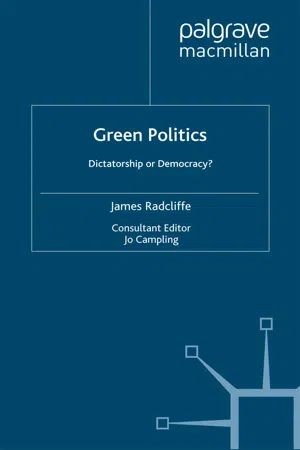 eBook - PDF
Green Politics
Dictatorship or Democracy?
- J. Radcliffe, Kenneth A. Loparo, Jo Campling(Authors)
- 2000(Publication Date)
- Palgrave Macmillan(Publisher)
10 Ecological Pressure Groups 181 Turning from those groups attached to the established parliamentary parties and the electoral system, the next to consider are those pressure groups active on environmental issues but which have no party politi- cal link. The range of such organizations is very wide and so the choice of groups discussed below is a small section of the total number in exis- tence. Some of the groups have emerged in response to the environ- mental crisis and are associated with the radical concept of ecology. Other groups discussed include ecological research groups and recent developments surrounding the anti-roads lobby and their association with life-style changes. A number of ideas emerged during a series of interviews carried out in the late 1970s which revealed a very profound set of views that have withstood the test of time. Many are still dominant within the theoret- ical literature and the publications of the pressure groups themselves. Organizational issues, philosophical debates and tactical questions revealed a strong sense of continuity in the last quarter of the twenti- eth century. As with the theoretical literature, there were various areas of debate and dispute as well as consensus and co-operation, but there were few signs of the establishment of a single view on how we can move towards an ecologically sound society. Ecological pressure groups The organizations considered under this heading are those which have the most developed sense of an ecological identity, although the Conservation Society was the one with most links to previous, less green, roots. Established in 1966, the major concern of the Conservation Society was the booming UK population and the resource depletion J. Radcliffe, Green Politics © James Radcliffe 2000 resulting from this, notably the encroachment of urban areas on agricultural land. This position broadened and developed as the envi- ronmental debate matured.
Index pages curate the most relevant extracts from our library of academic textbooks. They’ve been created using an in-house natural language model (NLM), each adding context and meaning to key research topics.

