Psychology

Characteristics of Addiction
Addiction is characterized by compulsive engagement in a behavior despite negative consequences. It involves a loss of control, continued use despite adverse effects, and withdrawal symptoms when the behavior is stopped. Additionally, individuals with addiction often experience an intense craving for the substance or behavior, leading to a cycle of dependence and difficulty in quitting.
Written by Perlego with AI-assistance
Related key terms
1 of 5
12 Key excerpts on "Characteristics of Addiction"
 eBook - ePub
The SAGE Handbook of Drug & Alcohol Studies
Social Science Approaches
- Torsten Kolind, Betsy Thom, Geoffrey Hunt, Torsten Kolind, Betsy Thom, Geoffrey Hunt, Author(Authors)
- 2016(Publication Date)
- SAGE Publications Ltd(Publisher)
4 Psychological Explanations of AddictionRobert Hill and Jennifer HarrisIntroduction
Terms such as ‘addiction’, ‘dependence’ and ‘excessive appetites’ are used to describe an individual’s overwhelming, intense desire to engage in a particular behaviour, despite the negative consequences of doing so. Addiction is typically thought of as relating to psychoactive substances but encompasses other behaviours that can become compulsive such as eating, gambling, sexual activity, exercising and shopping. While these behaviours are thought to share similar psychological processes, psychoactive substances exert an additional unique neurobiological impact on the brain, psyche and body. With repeated use, the body and mind can adapt to the substance so that, if prevented from taking the substance, they can enter a withdrawal state. This triggers the urge to use in order to gain relief and regain equilibrium. Tolerance develops so that the individual experiences the need for increasingly frequent doses of the substance to maintain biological, neurological and psychological homeostasis. Alongside the typical cycle of craving, substance-seeking and use, relief and withdrawal, there is a concomitant narrowing of interests, social contact and lifestyle in order to focus on the substance. It may seem perplexing that the behaviour continues despite the dwindling positive effects of substance use over time, together with the considerable negative impact on physical and mental health, social, financial and legal aspects of life. Moreover, substance dependence has historically been viewed in terms of a chronic relapsing condition with periods of remission and relapse. The two major psychiatric diagnostic systems, the World Health Organisation's International Classification of Mental and Behavioural Disorders (ICD-10; WHO, 1992) and the American Diagnostic and Statistical Manual of Mental Disorders, Version 5 (DSM-5; APA, 2014), clearly describe the above physiological, behavioural, cognitive and social features of excessive and dependent substance use. eBook - PDF
Addiction Neuroethics
The Promises and Perils of Neuroscience Research on Addiction
- Adrian Carter, Wayne Hall(Authors)
- 2011(Publication Date)
- Cambridge University Press(Publisher)
We begin with a brief review of common or folk understandings of addiction, and the clinical accounts of addictive behaviour that have informed these common-sense views. We then examine the impact that drug use and addic- tion has upon society and the way in which societies have typically responded to it. We conclude by analysing the two dominant models that have been used 19 to explain addiction, the medical and moral, and discuss the relevance of neuroscience research to these models. 2.2. The phenomenology of addiction Addiction is a complex and highly heterogeneous condition that encompasses an array of problematic behaviours that evolve over time in different individ- uals in different ways. This can make defining addiction difficult. It is reflected in the terminology used to describe addictive patterns of drug use, namely, ‘addiction’, ‘dependence’ or ‘substance use disorder’. Addiction is often contrasted with dependence. An individual may be physically or psychologically dependent on a drug or both. People can become physically dependent on a substance without being addicted. Physical dependence involves the compen- satory physiological changes that result from the repeated use of a drug, with the result that rebound aversive symptoms often occur when drug use is abruptly stopped. This is often called a withdrawal syndrome. Some drugs may also produce a discontinuation syndrome that occurs upon abrupt cessation of use, such as the selective serotonin reuptake inhibitors (SSRIs), without producing the drug-seeking behaviour that is characteristic of addiction (Nutt, 2003). Psychological dependence encompasses the variety of psychological changes that drive drug use or makes one feel that they need to use drugs. eBook - ePub
- George F. Koob, Michael A. Arends, Michel Le Moal(Authors)
- 2014(Publication Date)
- Academic Press(Publisher)
Chapter 1 What is Addiction? Abstract This chapter defines addiction as a chronic relapsing disorder characterized by compulsive drug seeking, a loss of control in limiting intake, and emergence of a negative emotional state when access to the drug is prevented. The definition of addiction is derived from the evolution of the concept of dependence and the nosology of addiction diagnosis. A distinction is made between drug use and substance use disorders (formerly abuse and dependence). Addiction affects a large percentage of society and has enormous monetary costs. Addiction evolves over time, moving from impulsivity to compulsivity and ultimately being composed of three stages: preoccupation/anticipation, binge/intoxication, and withdrawal/negative affect. Motivational, psychodynamic, social psychological, and vulnerability factors all contribute to the etiology of addiction, but this book focuses on the neuroadaptational changes that occur during the addiction cycle. A theoretical framework is described that derives from early homeostatic theories and subsequent opponent process theories to provide a framework for understanding the neurobiology of addiction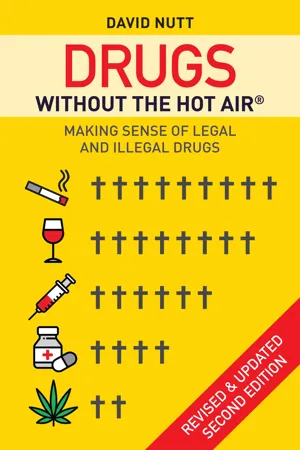 eBook - PDF
Drugs without the hot air
Making sense of legal and illegal drugs
- David Nutt(Author)
- 2020(Publication Date)
- UIT Cambridge Ltd.(Publisher)
168 Chapter 9. What is addiction? Is there an “addictive personality”? Using substances from outside the body to change our brain chem- istry is something humans have always done, and the psychoactive effects created are similar to the changes we experience when we eat nice food or take exercise. For the majority of people the majority of the time, this doesn’t lead to compulsive behaviour – we remain in control, and pretty soon our brains return to their prior state. For a minority, however, drug use leads to drug abuse and addiction, just as a minority of people become addicted to food, gambling or sex. For these people, satisfying their cravings for whatever it is they’re addicted to becomes the most powerful source of motivation in their lives, overpowering every other need and often leading them to harm themselves and others. There are three elements that affect whether a person becomes addicted to a particular drug (Figure 9.1): Figure 9.1: The three elements that affect whether a person becomes addict- ed to a particular drug. 1. Drug-related factors include how the drug reaches the brain, and what it does when it gets there. Tolerance and withdrawal also affect its addictiveness. 2. Social factors include the availability and acceptability of using the drug, the prevalence of advertising, how the drug makes groups behave, and the economic and social costs. Chapter 9. What is addiction? Is there an “addictive personality”? 169 3. Personal and biological factors are those such as age, gender and genetics. In this chapter we look at the mechanisms of addiction, tolerance and withdrawal, and why certain people seem to have “addictive per- sonalities”. (Chapter 4 has already examined some of the drug-related factors, which we explore in more detail in chapter 11, and we cover the social factors in chapter 12.) Addiction in history Our understanding of addiction has increased as more drugs have become available, and as their role in society has changed.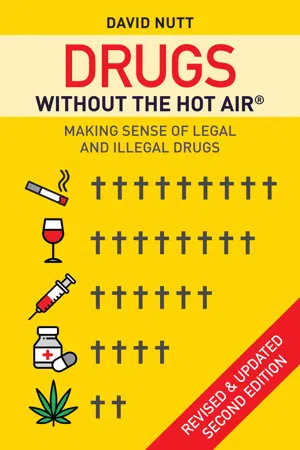 No longer available |Learn more
Drugs without the hot air
Making sense of legal and illegal drugs
- David Nutt(Author)
- 2020(Publication Date)
- UIT Cambridge(Publisher)
Chapter 9. What is addiction? Is there an “addictive personality”?
Using substances from outside the body to change our brain chemistry is something humans have always done, and the psychoactive effects created are similar to the changes we experience when we eat nice food or take exercise. For the majority of people the majority of the time, this doesn’t lead to compulsive behaviour – we remain in control, and pretty soon our brains return to their prior state. For a minority, however, drug use leads to drug abuse and addiction, just as a minority of people become addicted to food, gambling or sex. For these people, satisfying their cravings for whatever it is they’re addicted to becomes the most powerful source of motivation in their lives, overpowering every other need and often leading them to harm themselves and others.There are three elements that affect whether a person becomes addicted to a particular drug (Figure 9.1 ):Figure 9.1: The three elements that affect whether a person becomes addicted to a particular drug.1. Drug-related factors include how the drug reaches the brain, and what it does when it gets there. Tolerance and withdrawal also affect its addictiveness.2. Social factors include the availability and acceptability of using the drug, the prevalence of advertising, how the drug makes groups behave, and the economic and social costs.3. Personal and biological factors are those such as age, gender and genetics.In this chapter we look at the mechanisms of addiction, tolerance and withdrawal, and why certain people seem to have “addictive personalities”. (Chapter 4 has already examined some of the drug-related factors, which we explore in more detail in chapter 11 , and we cover the social factors in chapter 12 .)Addiction in history
Our understanding of addiction has increased as more drugs have become available, and as their role in society has changed. Until the 19th century, heavy drinking or use of other drugs wasn’t seen as a special category of behaviour, but as a sin of excess, similar to overeating – gluttony was a problem because you were eating too much , not because food itself was a bad thing. Although excessive use of drugs was seen as problematic, the majority of people usually didn’t have access to enough potent substances to have that problem. An exception was the † Gin Craze of the 18th eBook - ePub
- David M. Warburton(Author)
- 2023(Publication Date)
- CRC Press(Publisher)
Some psychologists and sociologists assert that animal studies do not model the important psychological variables governing drug use. They suggest that psychological processes critical in the etiology of use cannot be studied in animal models and/or that environmental influences important in producing use cannot be duplicated in animal studies. This position is generally untenable, and animal models have been developed that accurately represent the primary processes involved in drug “addiction”. Support for the validity of these animal models will emanate from an understanding of the characteristics and the neural basis of drug use summarized in the following sections. The arguments presented in the chapter are tenable, but they represent only one of several perspectives used in studying substance use. The terminology and even some aspects of the empirical data are the topics of scientific debate. The objective of this chapter is not to provide a balanced presentation of controversial issues, but rather to develop a unifying framework for understanding the psychobiological basis of “addiction”.CONCEPT OF ADDICTION
Before proceeding with an examination of the mechanisms underlying drug addiction, it is necessary to define the term addiction and to examine its main characteristics. Delineation of the salient attributes of a phenomenon helps to establish the criteria that must be fulfilled in a valid animal model and helps to determine what biological processes are relevant to its etiology.Issue of Terminology
Drug addiction refers to a situation where drug procurement and administration appear to govern the organism’s behaviour, and where the drug seems to dominate the organism’s motivational hierarchy. Jaffe (1975) has described addiction as“a behavioral pattern of compulsive drug use, characterized by overwhelming involvement with the use of a drug, the securing of its supply, and a high tendency to relapse after withdrawal [abstinence].”(Jaffe, 1975 ; pp. 285)This definition follows the general lexical usage of the term and is consistent with the word’s etymology (see Bozarth, 1987a ).Drug addiction is defined behaviourally; it carries no connotations regarding the drug’s potential adverse effects, the social acceptability of drug usage, or the physiological consequences of chronic drug administration (Jaffe, 1975 ). This latter point is especially important because some investigators have mistakenly used the term “addiction” to describe the development of physical dependence (see Bozarth, 1987a , 1989 ; Jaffe, 1975
- (Author)
- 0(Publication Date)
- The National Academies Press(Publisher)
Copyright National Academy of Sciences. All rights reserved. compulsive drug-seeking and drug-taking behavior, rather than tolerance, dependence, and withdrawal (see Appendix C for diagnostic criteria). However, pharmacological definitions used in the scientific literature require the latter symptoms to be present, and most opiate-addicted patients (although not cocaine-addicted patients) seeking treatment, in fact, exhibit these symptoms. Drug addiction involves a complex interplay of psychological, physiological, and social mechanisms, and various models have been put forward to account for these mechanisms (Jaffe, 1992). Figure 2.1 presents the schematic model of drug dependence developed by the World Health Organization (WHO), which emphasizes individual and social antecedents and consequences. Such a model is extremely useful, in that it offers numerous points at which interventions can be made to prevent the establishment or break the cycle of drug dependence through both individual and social means. Jaffe (1992) found it useful to modify this scheme in two ways to emphasize more clearly aspects that might affect the urge to engage in use of addictive drugs and aspects that might underlie successful treatment or cessation of drug addiction (Figures 2.2 and 2.3). Although development of effective anti-addiction medications is only one component of the multifaceted approach needed to develop an effective national strategy for drug-addiction treatment, this report focuses on the development of pharmacological interventions, so the models emphasizing biological factors are presented here. An established working model to account for drug addiction is the "brain-reward hypothesis"—i.e., a neural network is responsible for the subjective experience of pleasure (Koob, 1992; Wise and Hoffman, 1992), and drugs are abused after initial exposure because they activate the brain's reward system.
- Sharon L. Johnson(Author)
- 2003(Publication Date)
- Academic Press(Publisher)
Comprehensive, multifaceted, and interdisciplinary model from which to understand substance abuse and addiction. According to NIAAA (1993), the strongest evidence for the genetic transmission of a predisposition to substance dependence disorder exists for alcohol. However, research data exist that suggest a biochemical, if not genetic, basis for dependence on other substances. Regardless of the substance class with which an individual has an issue of substance dependency, a common if not prevalent treatment perspective includes the following: 1. The dependence is the primary disease (not a symptom of an underlying disease) with the associated factorial relationships a. genetic b. psychosocial c. environment 2. Substance dependence may be progressive and can be fatal. The cumulative impact physically, emotionally, and socially often contributes to premature death. 3. Substance dependence is a phenomenon associated with a common constellation of characteristics, which places the individual at a disadvantage and outside of mainstream functioning. 40 3. T h e D e v e l o p m e n t o f S u b s t a n c e A b u s e a n d D e p e n d e n c e C a u s a l F a c t o r s o f S u b s t a n c e A b u s e a n d D e p e n d e n c e 41 4. Impaired control (or loss of control) as evidenced by an inability to limit the amount of substance consumed, the time frame during which an episode takes place, or heed the consequences of use. 5. Preoccupation with obtaining and using substances. It becomes the primary object. The result is a disengagement from all other life concerns. 6. Experience of numerous adverse consequences associated with substance use: a. physical health (e.g., alcohol: withdrawal, liver damage, gastritis, pancreatitis, heart problems, anemia, neurological disorders) b. psychological functioning (cognitive impairment, mood changes with associated behavioral changes) c. interpersonal functioning (relationship problems, social problems, child abuse–neglect) d. eBook - PDF
- Martin Weegmann, Marcel Cohen(Authors)
- 2008(Publication Date)
- Wiley(Publisher)
The suggestions in this chapter are relevant to the management of addicted patients in general medical and paramedical settings, in hospital and in general practice, as well as in the more specialised setting of the psychiatric clinic and the drug dependence unit. Studies of the natural history of addiction show that it is a disorder that develops over a long period of time and that recovery, when it occurs, follows a protracted and fragile course. Aetiological studies do not reveal causes of addiction but predisposing factors - examples include the genet- ically determined flushing reaction to alcohol typical of Oriental people that reduces the likelihood of the development of subsequent alcoholism and the increased frequency of histories of physical and/or sexual abuse in 53 54 The Psychodynamicsof Addiction the childhoods of patients who subsequently become addicted (although increased frequency of either forms of abuse predisposes to an increased likelihood of a number of psychiatric disorders). However, observers of addicted patients will notice a number of psychological and psychodynamic features in patients who are at the early stages of seeking treatment, when they may appear unmotivated and resistant to change, such as avoidance of responsibility, hostility and inter- personal difficulties that change with the development of recovery from addiction into self-efficacy, taking responsibility and interacting with others in a more appropriate and effective way. The patient in denial displays the features of a failure to cope with the demands that life presents (when the psychoactive drug is used as an alternative, simple - but entirely ineffective - solution to life problems), with recovery involving the development of these mechanisms that occur in most other people as the transition from adolescence to adulthood is successfully negotiated. eBook - ePub
Myth of Addiction
Second Edition
- John Booth Davies(Author)
- 2013(Publication Date)
- Routledge(Publisher)
This variability creates the final dilemma. If, as seems to be the case, there is variability in severity of withdrawals as a function of time, place, expectation or whatever, then it becomes increasingly difficult to conceptualise withdrawals as the basic powerhouse or engine-room for ‘addictive’ behaviour. Furthermore, since we have argued that ‘craving’ lacks its essential property of compulsion, so ‘addiction’ becomes less monolithic and more amenable to explanation in human terms.Cures for Taking DrugsReturning to our main theme, it is suggested that the concept of ‘addiction’ might conceivably have some value if it gave emphasis to the normal and nonpathological decisions people make about drugs; but in fact it is usually employed to encapsulate certain assumptions about what drugs do to people, thereby implying a process from which the powers, wishes and intentions of the drug user are specifically excluded. The idea that the pharmacology of drugs makes people into addicts against their ‘will’ has to be contrasted with the idea that people make addicts of themselves because they choose to do so. The latter is a challenging suggestion which deserves serious consideration, and it certainly makes sense of the fact that treatment for addictions frequently seems to have more in common with procedures for attitude change, than with medical intervention.From such a standpoint, the term ‘addiction’ appears to refer not so much to some medical condition as to certain disapproved-of ways of thinking and deciding, certain acts of choice which are not qualitatively or quantitatively different from thinking, deciding and choosing in any other area of human life, but which happen to involve drugs. Because of the pharmacological action of drugs, the consequences can be disastrous to health, family and all aspects of living, but such consequences do not in themselves warrant the postulation of a special state which compels their use. Furthermore, there is no cure for drug taking because there is fundamentally nothing to be cured; no more in fact than there is a cure for rock climbing, football, or playing the violin. But if there are reasons for supposing that in a given case the rock climbing, football, or violin-playing are resulting in social and economic problems for the individual and for others, one might try to persuade him/her to reappraise the basis on which they make their decisions. eBook - PDF
- Nick Heather, Rudy E. Vuchinich(Authors)
- 2003(Publication Date)
- Pergamon(Publisher)
Environmental factors thus determine who (and how many) will develop an addiction. For instance, in relation to alcohol, it is well documented that the availability of the substance has an impact on aggregate consumption, as well as on the prevalence of heavy consumption and problem rates (Edwards et al. 1994). Secondly, drug taking behaviour is typically conformist behaviour: The likelihood that any given individual will engage in this sort of behaviour and the extent to which he is doing so very much depends on what other individuals are doing.^ Hence, a theory of addiction should not restrict itself to the agent's level of socializing, as Rachlin's theory does; it also need to take into consideration who the agent is socializing with, and in particular the drug-taking habits of these individuals. Just as loneliness under certain circumstances may foster addiction, so may strong integration into a heavy consuming sub-culture. Notes 1. This is not a reductionistic thesis, since I do not claim that we could replace all mentalistic concepts, such as values, preferences, feelings, motivations and intentions, with a purely physicalistic terminology. 2. Edwards et al. (1982) prefer the term neuro-adaption instead of physical dependence. 3. A realistic version of simultaneous inconsistency could be the following. The agent has good and noble reasons for abstaining, but stronger and less noble (in his own hierarchy) reasons for indulging. He may feel that indulgence is morally wrong, say by inflicting harm on significant others, and he may wish that he did not have the appetite (a secondary preference for abstention), but still he gives in to his lower, selfish motives. 4. Certain allergies offer an example: the clinician needs to provoke the patient's body in order to reach a definitive diagnosis. eBook - PDF
- Katherine van Wormer, Diane Davis(Authors)
- 2017(Publication Date)
- Cengage Learning EMEA(Publisher)
PART 3 The Psychology of Addiction T Copyright 2018 Cengage Learning. All Rights Reserved. May not be copied, scanned, or duplicated, in whole or in part. WCN 02-300 Copyright 2018 Cengage Learning. All Rights Reserved. May not be copied, scanned, or duplicated, in whole or in part. WCN 02-300 CHAPTER 6 LEARNING OBJECTIVES LO1 LO2 LO3 LO4 LO5 LO6 Addiction Across the Life Span Copyright 2018 Cengage Learning. All Rights Reserved. May not be copied, scanned, or duplicated, in whole or in part. WCN 02-300 246 CHAPTER 6 of the young. Although this emphasis on risk-taking behaviors by teens and college-age youth is reflected in this chapter, attention is also devoted to problems in the so-called baby boom generation of social experiences as well as longitudinal to addictive behavior that is found during the final stage of life. THE STAGES OF GROWTH AND DEVELOPMENT The behavioral problems associated with alcohol and other drugs emerge, in most peo- ple, during late adolescence and early adulthood (Agrawal, Sartor, Lynskey, et al., 2009). Identifying and understanding the course of those problems, accordingly, require a devel- opmental perspective. Many of the risk factors can already be spotted in early childhood by children’s parents, teachers, and counselors, even as early as preschool. Erik Erikson (1963) constructed a model of psychosocial development consisting of eight stages. His model, like other models of growth and development across the life span, focused on how an individual’s personality interacts with biological and social systems to affect behavior. From birth to old age, in this conceptualization, life consists of a chrono- logical series of age-related developmental stages and tasks that need to be completed. For the practitioner, knowledge of psychological milestones normally negotiated, such as during adolescence and young adulthood, is important for the overall assessment of behavior and functioning (Zastrow & Kirst-Ashman, 2013).
Index pages curate the most relevant extracts from our library of academic textbooks. They’ve been created using an in-house natural language model (NLM), each adding context and meaning to key research topics.

