Psychology

Context-Dependent Memory
Context-Dependent Memory refers to the phenomenon where our ability to remember information is influenced by the environmental and situational context in which the information was learned. This means that we are more likely to recall information when we are in the same context or environment in which we initially learned it. This concept has implications for learning and memory processes.
Written by Perlego with AI-assistance
Related key terms
1 of 5
10 Key excerpts on "Context-Dependent Memory"
 eBook - ePub
Theoretical Aspects of Memory
Volume 2
- Michael Gruneberg, Peter E Morris, Michael Gruneberg, Peter E Morris(Authors)
- 2006(Publication Date)
- Routledge(Publisher)
6 THEORETICAL PRINCIPLES OF Context-Dependent Memory
S.M.SmithINTRODUCTION
When contextual cues affect remembering, memory is said to be context-dependent. Along with memory’s dependence upon practice, similarity and temporal factors, contextual cueing represents one of the basic mechanisms used in theories of memory (e.g. Anderson and Bower 1973; Glenberg 1979; Hintzman 1988; Kintsch 1974; Raaijmakers and Shiffrin 1980; Thomson and Davies 1988). Context-Dependent Memory implies that when events are represented in memory, contextual information is stored along with memory targets; the context can therefore cue memories containing that contextual information.There are many different operational definitions of context. ‘Context’ refers to that which surrounds a target, whether the surrounding is spatial, temporal or meaningful in nature. The present chapter will be limited to considerations of incidental context—that is, spatial and temporal contexts that are not obviously related to the targets on a memory test. The literature on meaningful contexts encompasses many research domains, including encoding specificity (e.g. Tulving and Thompson 1973), depth and spread of processing (e.g. Craik and Tulving 1975), and complex representational structures, such as scripts (e.g. Schank and Abelson 1977), schemata (e.g. Thorndyke 1977) or mental models (e.g. Glenberg et al. 1987). Although meaningful contexts may adhere to the same principles as those that apply to incidental contexts, they may also give rise to other meaning-driven phenomena that are beyond the scope of the present chapter.This chapter will first briefly review empirical evidence related to incidental and Context-Dependent Memory, including environmental context- and state-dependent memory. These two research domains have found parallel patterns of results, implying that there are similar mechanisms at work. The empirical overview will be followed by a discussion of a set of principles for theories that deal with Context-Dependent Memory. eBook - ePub
- Timothy J Perfect, D Stephen Lindsay, Timothy J Perfect, D Stephen Lindsay, Author(Authors)
- 2013(Publication Date)
- SAGE Publications Ltd(Publisher)
environmental context, a representation of a place that can be instantiated by an environment that is physically present, one that is remembered, one that is cued or suggested by various stimuli (such as a photo, a video, or a virtual reality device), or an environment that is imagined. Environmental contexts have been defined operationally in many ways by various researchers, but central to the research that will be considered here are the effects of places in which experiences occur. Although stimuli such as color, type font, mood state, and associated words can be elements of episodic contexts, they are not places where experiences occur, nor do they reliably trigger mental representations of places the way that pictures or movies do. This discussion will focus on places or environments associated with events, and their effects on learning and memory.The present chapter will review a long history of investigations of effects of environmental contexts on memory, examining a variety of operational definitions of environmental contexts. Theoretical treatments of contextual influences on memory will be discussed, and some applied uses of context cues will be described, primarily in terms of education, aging, clinical applications, and eyewitness memory. Finally, some as-yet-unanswered questions about environmental context and memory will be discussed.HISTORICAL OVERVIEW: EXPERIMENTAL STUDIES OF ENVIRONMENTAL CONTEXT AND HUMAN MEMORYThe past hundred years of experimental psychology research has produced a steady trickle of studies that have examined, sometimes in colorful and imaginative ways, the effects of environmental contexts on memory. If an environmental context is a mental representation, then how can environmental context be defined operationally? Throughout the long history of studies of Context-Dependent Memory there has never been a consensus of opinion with regards to this subject. Historically, operational definitions have tended to center around global types of context, that is, contexts that are common to entire episodes of events, although there have been notable exceptions (e.g., Dulsky, 1935; Pan, 1926). The initial studies of Context-Dependent Memory began with non-human animals, an area of research that is burgeoning a century later, but interest quickly turned to studies of humans. After a brief description of a few of the early studies with non-human animals, there will be an historical review of twentieth-century research on environmental context effects on human memory.Early studies with non-human animalsSome of the earliest of the reported experiments were those done by John B. Watson (1907), who studied maze-learning in laboratory rats that had learned an experimental maze, and were given retention trials with the maze oriented in the lab the same way as it had been during learning trials, or oriented in different directions in the same lab. Although negotiating the maze involved the same learned sequence of turns in the different treatment conditions, Watson was quite surprised to find worse performance for those whose maze orientation was altered from the way it had been at learning, relative to the originally oriented maze. Even more surprising was the finding that shifts in the orientation of the learned maze relative to the laboratory had detrimental effects even on blind rats whose eyes had been surgically removed. Clearly, these pitiful creatures had learned about some subtle environmental features that became part of their mazelearning, and alterations in those features at test disrupted their memories. eBook - PDF
- Jean Delacour(Author)
- 1994(Publication Date)
- World Scientific(Publisher)
Conflicting results in previous research may prove to be straightforward and orderly when related to systems for classification of memory. From the brief sketch of some such classification systems it seems obvious that contextual effects are to be expected for some systems whereas for others they are not to be expected. Quite obvious is that contextual factors should be very potent for episodic memory, whereas for systems like procedural memory, the perceptual representation system and for semantic memory contextual factors should be less effective. Short-term memory might take an intermediate position as to the effectiveness of contextual cues. The fact that context plays a crucial role in episodic remembering is well known since long ago in the area of human learning and memory. Indeed this knowledge constitutes one of the core beliefs in theories of episodic memory. This insight has been summarized in the encoding specificity principle (Tulving k Thomson 1973), which states, in brief, that success of retrieval depends on the overlap between the information that has been stored and the information that is currently available as cues in the re-trieval information. The greater the overlap, the greater is the likelihood that a certain memory will be retrieved. The validity of this principle has been demonstrated in experiments in which subjects have been found to be able to recall items which they fail to recognize. Such a finding is rather contraintuitive since it has been commonly believed, since long, that recog-nition is easier than recall. Not only has this phenomenon of recognition failure of recallable words been obtained in a large number of studies vary-ing in several ways methodologically, but also it has been demonstrated that the experimental data adhere to a remarkable regularity first described by Tulving and Wiseman (1975). eBook - ePub
The Processing of Memories (PLE: Memory)
Forgetting and Retention
- Norman E. Spear(Author)
- 2014(Publication Date)
- Psychology Press(Publisher)
This chapter has emphasized the potential importance of contextual stimuli for retention and forgetting. A contextual stimulus is any event noticed by an organism, with the specific exclusion of the features of an episode that are required to define evidence of memory acquisition (i.e., original learning). Contextual stimuli therefore are effectively redundant to the acquisition of a memory for a particular episode, in that the organism need not attend to contextual stimuli in order to be scored as having learned. Within the present conceptual framework, however, if contextual stimuli of an episode are attended to, they will be incorporated as attributes of the memory for the episode. In this role, contextual stimuli are believed to maintain a capacity to effect retrieval of the memory for that episode.The conceptual framework presented here is based on the ancient principle that a memory will be manifested to the extent that the circumstances at testing match those at training. Hence, manipulations of contextual stimuli are expected to alter manifestation of prior learning, and in our view, through mechanisms responsible for memory retrieval.Experimental evidence in support of these contentions has fallen into two general classifications: manipulations of contemporary context or prior cueing. Four classes of contextual stimuli were considered, two in relation to the task-(episode)-to-be-learned (intratask and extratask) and two in relation to the learner (internal and external). Several cases of intratask context were shown to influence retention in animals, with conditions of reinforcement a particularly important source. Among humans, semantic context was seen to have corresponding importance for retention. Instances of similar influence by extratask context also were discussed, particularly with respect to experiments involving animal subjects.The second half of the chapter studied effects of internal stimulus context in animals and humans, the manner in which the memorial influence of such stimuli has been tested, and the principles and theories derived from those tests.Several points of a more general nature warrant further emphasis at this time, although elaborated in later chapters and elsewhere (e.g., Spear, 1976). The first point concerns the mechanism through which contextual cues may alter retention. Given control of nuisance effects on performance unrelated to retention, contextual stimuli are seen here as possibly altering retention and forgetting through any of three mechanisms. One of these involves the retrieval process: In our terms, the presence at testing of contextual stimuli represented as attributes of a memory will elicit arousal of those attributes if the respective stimuli are noticed, and ultimately retrieval of the target memory may result. Contextual stimuli are thus viewed as promoting accessibility of the target memory. eBook - ePub
Memory
Neuropsychological, Imaging and Psychopharmacological Perspectives
- Gérard Emilien, Cécile Durlach, Elena Antoniadis, Martial Van der Linden, Jean-Marie Maloteaux(Authors)
- 2004(Publication Date)
- Routledge(Publisher)
Remembering past events involves a large number of processes and their identification and interaction continues as a primary goal of today’s memory research. One major set of these processes concerns “ecphory” (recovery of stored information); another has to do with what is called episodic “retrieval mode” or REMO (Nyberg et al., 1995; Tulving, 1983). REMO refers to a neurocognitive set or state, and is a basic and pivotal necessary condition for remembering past events. Memory is an active process in which even the most concrete experiences are actually dynamic representational processes. Remembering is not merely the reactivation of an old engram. It is the reconstruction of a new neural-net profile with features of the old engram and elements of memory from other experiences, as well as influences from the present state of mind. This is particularly important for clinicians when interviewing patients about past events, including trauma. The gist of a situation may be recalled with great accuracy but the details may be more subject to bias from ongoing experiences.Considering the importance of context in memory, we may define context as information associated with a specific memory that allows differentiation of that memory from other memories. Intrinsic context refers to features that are an integral part of the stimulus itself. In a face, for example, intrinsic contextual features would be eye colour, hair length, etc. In the case of words, intrinsic context would relate to the particular meaning extracted from the word at the time of learning. Extrinsic context corresponds to those features that include time of encounter and surroundings. Studies of memory dysfunctions and amnesia have concentrated on memory for extrinsic context.Two fundamental ways of gaining access to past experiences may be distinguished: recollection of contextual details surrounding a previous encounter with a stimulus (source memory) and a general sense of familiarity that is sufficient to determine whether the stimulus was previously encountered even though contextual recollection is absent (item memory) (Atkinson & Juola, 1974; Tulving, 1985; Yonelinas, 1994). Item memory combined with source memory failure is a common experience in everyday life and plays an important role in such problems as faulty eyewitness identification, when a face perceived as familiar is assigned the wrong context. This distinction has implications for understanding the neural organisation of memory. Extensive neuropsychological research suggests that source memory can be dissociated from memory for particular items (Schacter et al., 1984; Shimamura et al., 1991). eBook - PDF
- Margaret W. Matlin, Thomas A. Farmer(Authors)
- 2016(Publication Date)
- Wiley(Publisher)
Cognitive psychology does not exist in a vacuum, but instead has the potential to inform how we understand our own internal states as well as principles that govern how our society is structured. Indeed, the purpose of this section is to foster your appreciation for the strong amount of continuity that exists between the core topics of cognitive psychology and your daily life. Here, we examine how the emotional content of information can inluence the encoding of information. We then consider the manner in which the presence of a psychological disorder—namely, an anxiety disorder—inluences retrieval ability on implicit and explicit memory tasks. We conclude by discussing the false versus recov- ered memories debate. This topic relates to autobiographical memory, and highlights one way in which research conducted by cognitive psychologists can have strong rami- ications for counseling and clinical psychologists. Research on this topic also has rel- evance for our criminal justice system. Emotions and Memory In our discussion of retrieval-related phenomena in Section 5.2, we noted that encod- ing speciicity can modify the levels-of-processing effect. In some cases, the match between encoding and retrieval is even more important than deep processing. But, the deinition of context, and what counts as context during encoding, can be pretty broad. In fact, it even extends to the emotional content of information that you encounter. Before you read further, try Demonstration 5.4. In everyday speech, we often use the terms emotion and mood interchangeably, and the terms are somewhat similar. However, psychologists deine emotion as a reaction to a speciic stimulus. In contrast, mood refers to a more general, long-lasting experi- ence (Bower & Forgas, 2000). For example, you may have a negative emotional reac- tion to the unpleasant fragrance you just smelled in a locker room, even though you may be in a relatively positive mood today. eBook - ePub
Varieties of Memory and Consciousness
Essays in Honour of Endel Tulving
- Henry L. Roediger, III, Fergus Craik(Authors)
- 2014(Publication Date)
- Psychology Press(Publisher)
Godden and Baddeley (1975) . Subjects in their experiment studied a list of words in one of two natural environments—on land or underwater—and were subsequently tested for free recall in either the same or the alternative environment. Relative to subjects whose study and test environments were held constant, those who experienced a change of context recalled, on average, almost one-third fewer words.To what is this deficit due? The obvious answer is that the world looks different when viewed from beneath than from above the sea, and that it is the loss of important visual cues that leads to the observed loss of memory. But it is also obvious that being underwater feels different from being on land, and thus it may be that what the deficit really reflects is a change in experiential instead of environmental context. Put differently, and more generally, it is possible that how well information transfers from one environment to another depends more on how similar the environments are to each other affectively rather than perceptually.The idea that place dependent memory represents a special case of mood dependent memory is approachable from a number of different experimental angles. One way to test the idea might be collect normative data on both the affective and the perceptual similarity between various pairs of environments—a church during a wedding and the same church during a funeral, for instance—and then use these data to select four particular pairs that represent the factorial combination of two variables: type of interpair similarity (affective vs. perceptual) and degree of interpair similarity (high vs. low). One member of each pair could then serve as the environment in which target items are encoded, and the other member as the environment in which retrieval of the targets it tested. If it is indeed the case that the effects of environmental context changes on memory are mediated by changes in mood, then test performance should depend primarily on the degree of affective, rather than perceptual, similarity between encoding/retrieval environments. eBook - PDF
- Elizabeth Ligon Bjork, Robert A. Bjork(Authors)
- 1996(Publication Date)
- Academic Press(Publisher)
Curiously, despite these impressive findings from the mid-1970s, the effects of physical context on memory have been difficult to replicate. Al- though there have been some successes, they have also been numerous failures. Fernandez and Glenberg (1985) conducted eight experiments ex- amining context (room) dependency, varying numerous factors across the experiments, but in none of the experiments did an effect of context depen- dency appear. In one case, the experiment was conducted in even the same locations used by S. M. Smith et al. (1978), so the failure to replicate is especially puzzling. Averaging over all experiments (weighting each equal- ly), the probability of recalling words in the same context was .29 and in the different context was .30. Saufley, Otaka, and Bavaresco (1985) capitalized on a naturally occurring context manipulation present on many university campuses. Often at large universities, students hear lectures in large halls and then are assigned to take their examinations either in the same lecture hall or in small ancillary classrooms. Saufley et al. tested Introductory Psychology students over three years at the University of California at Berkeley in just such a situa- tion, where students were randomly assigned to take their exams either in the main lecture hall (where they had been taught) or in smaller overflow rooms. Across 21 experiments in this classroom setting, they failed to find any difference between the performance of the 3613 students who took the test in the same room and the 2412 who took the test in a different room. Subjects recognized, on average, about 67% of the material in each context. Although this outcome may be comforting for students who might find themselves in this circumstance, the failure to find any effect of room dependency is disquieting, given the prior literature. eBook - ePub
Current Issues in Cognitive Processes
The Tulane Flowerree Symposia on Cognition
- Chizuko Izawa(Author)
- 2014(Publication Date)
- Psychology Press(Publisher)
3. Certain of the positive results reported may have been a consequence of the recall instructions given by the experimenter. As these experiments do not typically use single-blind testing (in which the experimenter is unaware of the subject’s experimental condition), the experimenter may sometimes be more enthusiastic and motivating in the same-context condition than in the different-context condition. Even in the case of the within-subjects designs discussed earlier, which would seem to be free of differential biasing, our experience indicates that the instructions to subjects at test must be very carefully worded. If they are not, subjects tested in a particular context can assume that they are only to recall material learned in that context, and not material learned in the other context. Recall of different-context words would then reflect intrusion errors on the part of the subject. In free-recall experiments of the within-subject type, subjects could assume that they are to begin recall with words learned in the test context, causing output interference for different-context items. Output order analyses of Richardson-Klavehn’s (1988) Experiment 1 data revealed no indication that such interference was occurring, but it must be noted that this experiment did not obtain a positive context effect.Implications for Models of MemoryAs we noted at the outset, context-dependent forgetting is a primitive assumption in many current memory models. This assumption is not often submitted to critical analysis, even though the value of such memory models as explanations of remembering and forgetting is largely predicated on its truth. The literature reviewed here suggests that our reliance on context change as the major factor explaining forgetting needs to be seriously questioned. We have argued that the range of situations under which changing incidental EC will negatively affect performance (i.e., produce forgetting) is limited, owing to the roles of outshining and mental reinstatement. Tying general explanations of forgetting to changes in incidental EC would therefore not appear to be advisable, even if EC cues are encoded and later influence retrieval under some conditions. It might be argued that changes in integral and influential context are primarily responsible for forgetting; however, this argument lacks plausibility. It is clear that large amounts of forgetting occur in situations in which no obvious changes in integral or influential context have occurred. For example, an item on a recognition test, unless highly ambiguous in meaning, is likely to be interpreted semantically in the same way as it was interpreted at study. Yet a subject might still fail to recognize that item. Change in physiological context is another often-invoked candidate in explanations of forgetting. Again, the idea that this type of context is subject to changes within an experimental session that are extreme enough to produce forgetting is simply implausible.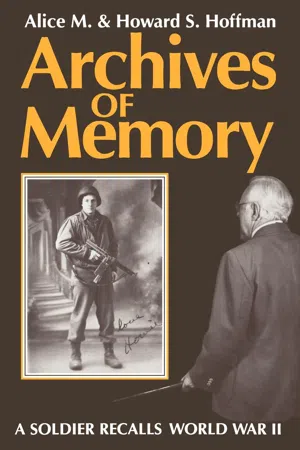 eBook - ePub
Archives of Memory
A Soldier Recalls World War II
- Alice M. Hoffman, Howard S. Hoffman(Authors)
- 2021(Publication Date)
- The University Press of Kentucky(Publisher)
Moreover, laboratory experiments typically impose a much greater interdependence upon free recall and recognition than is in reality inherent in the functioning of the memory system. This study permitted the use of a more naturalistic method to study memory. It shows that the number of items retrieved through free recall correlates neither with class size nor with recognition performance. Recognition was greater than recall. “Apparently the context serves as a mediator for retrieval of information; once the association of mediator and target item is lost, the item can no longer be retrieved for recall but can still be identified on recognition tasks.” 17 The results of this study indicate that recognition remains approximately 90 percent correct for fifteen years independent of class size and that it declines with negative acceleration to 60 percent, even up to the forty-eighth year. Moreover, social context is shown to be a powerful determinant of recall performance and less important in recognition. This study made no distinction, however, between extrinsic and intrinsic context, although social context could be assumed to be both intrinsic and extrinsic in nature. One can deduce from this study that information which is important for the subject has a high degree of validity in recall performance and that an even greater amount of material is reliably available for recognition if a context can be provided which will mediate in the retrieval process. A large proportion of the studies of memory have presented the material to be remembered to their subjects. More recently, however, psychologists have reexamined the work of F.C. Bartlett and found much to be commended in his insistence on meaningfulness as an essential concept in the study of memory
Index pages curate the most relevant extracts from our library of academic textbooks. They’ve been created using an in-house natural language model (NLM), each adding context and meaning to key research topics.

