Psychology

Emergence of Psychology as a Science
The emergence of psychology as a science refers to the historical development of psychology from a philosophical and speculative discipline to a more empirical and scientific one. This transition was marked by the adoption of scientific methods, such as experimentation and observation, to study human behavior and mental processes. Key figures in this emergence include Wilhelm Wundt, who established the first psychology laboratory in 1879.
Written by Perlego with AI-assistance
Related key terms
1 of 5
12 Key excerpts on "Emergence of Psychology as a Science"
 eBook - PDF
- Duane Schultz(Author)
- 2013(Publication Date)
- Academic Press(Publisher)
However, our discussion of the history of psychology does include the more immediate philosophical context. Psychology became a distinct and experimental science at a time when European thought was imbued with the spirit of positivism, empiricism, and materialism. The idea that the methods of science could be applied to mental phenomena is inherited from philosophical notions of the seventeenth to nineteenth centuries, and that exciting era is the starting point for our discussion of the history of modern psychology. 8 THE STUDY OF THE HISTORY OF PSYCHOLOGY psychologists took issue with Wundt's version of psychology and pro-posed their own views. As a result, by the turn of the century, several different systematic positions or schools of thought were in existence. The term school refers to a group of psychologists who became associated ideologically, and sometimes geographically, with the leader of a movement. For the most part, the members of a school worked on common problems and shared a common theoretical or systematic orientation. The emergence of different schools of thought and their subsequent decline is one of the most striking characteristics of the history of psy-chology. The phenomenon is not unique to psychology, however, for all the sciences experienced a similar period early in their respective histories when competing schools of thought divided the field of study (Kuhn, 1970). Each of these schools was a movement of protest, indeed a rebellion, against the prevailing systematic position. Each pointed out what it saw as the shortcomings and failures of the older point of view and each presented new definitions, concepts, and research strategies designed to correct the perceived weaknesses. When a new school of thought cap-tured the scientific community's attention, it resulted in the rejection of the once honored position. eBook - PDF
- Per Saugstad(Author)
- 2018(Publication Date)
- Cambridge University Press(Publisher)
Psychology is a theoretical as well as an applied science, and also a profession incor- porating a number of specialties. In a wide variety of areas it has produced knowledge useful for the solution of theoretical problems as well as problems of practical and social 2 1 Introduction life. However, so far, psychology has hardly produced comprehensive theories or scien- tifically acceptable principles of a general nature. Thus, the discipline appears highly fragmented. The Present Approach to the Study of the History of Psychology The attempt to establish psychology as an empirical science raised several questions that were not easily answered and that soon became controversial. Questions such as what is the relationship between mind and brain, between human and animal behavior, and between genetic endowment and environmental influence (nature and nurture) emerged at the inception of the discipline and have remained controversial to this day. At an early stage, disagreement arose about whether we should conceive of psychology as the study of mental experiences or the study of behavior. In what sense should we regard as mental experiences various types of nonconscious processes, such as the subconscious and the unconscious? How do society and culture influence human thinking and behavior? This last question emerged later in psychology’s history and is of central importance for the advancement of psychology as an empirical science. When controversial questions such as these have been satisfactorily answered, psy- chology will be considerably advanced. I believe a critical, historical examination of them can contribute to their conceptual clarification. For this reason, I give the study of its history a central place in the general study of psychology. eBook - ePub
Psychology in Historical Context
Theories and Debates
- Richard Gross(Author)
- 2017(Publication Date)
- Routledge(Publisher)
Chapter 2 Scientific perspectives Psychology as the study of … how?We learned a number of things about Psychology from Chapter 1 , including the following:● Its emergence as a separate discipline took place during the late 1800s, with its roots in philosophy and physiology in particular.● A number of different schools of thought or theoretical perspectives/approaches appeared between this time and the mid-1900s, often as a reaction to/against an already existing approach and often overlapping with it.● Different schools of thought have tended to be more or less dominant within particular parts of Western Europe and the US, reflecting both scientific/academic and more general social influences and traditions.● It’s more accurate to talk about the ‘histories’ of Psychology, rather than a single, universally accepted ‘history’ taken to reflect ‘what actually happened’.● These different approaches focus on different aspects of ‘human functioning’ (i.e. their subject matter); it’s almost as if human beings are being defined differently according to which theoretical lens we happen to be looking through. This relates to ontology: the branch of philosophy concerned with the fundamental characteristics of reality: what exists. According to Teo (2009), Psychology has excluded or neglected key problems or pretended they don’t exist (see Box 2.1 No longer available |Learn more
- Philip Banyard, Christine Norman, Gayle Dillon, Belinda Winder, Philip Banyard, Christine Norman, Gayle Dillon, Belinda Winder(Authors)
- 2019(Publication Date)
- SAGE Publications Ltd(Publisher)
We have devised a chapter to help you navigate some of psychology’s key moments, but please note that this is not always a linear journey. At the heart of this chapter, we consider how psychology became a science. FRAMING QUESTIONS What have been the main stages in the development of psychology as a science? How has psychology developed as a natural science and as a social science? How has the social and political landscape influenced psychology’s development over time? What does the future hold for psychology as a science? 2.2 WHAT IS A SCIENCE? To help us understand psychology as a discipline, it is important to address the meaning of science itself. Science helps us to determine our understanding of the universe and observed phenomena. It provides a collective understanding and knowledge of how the universe works. Science is not defined by the type of experimental tools used or the sub- ject matter under observation. Rather, it is the integration of scientific principles that can be applied to a particular subject matter, to help provide a further understanding of phe- nomena (Tyson, Jones & Elcock, 2011). The principles that disciplines follow in order to achieve scientific status can be referred to as the ‘scientific approach’. Modern-day psychology, as a relatively new science, has adopted the scientific approach to gain status as a scientific discipline. 2.2.1 What is the scientific approach? Objectivity is the foundation of science. The scientific approach follows three key stages: systematic observation, testable predictions and verification of scientific facts (Stanovich & Stanovich, 2013). The public perception of psychology as a science is much debated. In Sir Isaac Newton’s (1642–1727) time, the idea of determinism in science emerged and went on to be a strong influence on psychology. Determinism is the idea that the universe and its behaviour is predetermined based Systematic observation Observations of subject matter need to be empirical. eBook - PDF
Psychology
Six Perspectives
- Dodge Fernald(Author)
- 2007(Publication Date)
- SAGE Publications, Inc(Publisher)
1 An Emerging Science The Founding of Psychology A Laboratory for Research Empiricism and Rationalism The Nature of Science The Work of Psychology Scientists and Practitioners Psychology’s Dual Goals Scope of Modern Psychology Psychological Perspectives Subfields and Specialties P sychology, a wag once observed, has a long past but only a short history. Its long past extends down through the ages, ever since human beings developed the capacity to ponder their existence. Its short history refers to the relatively brief period since psychology became a modern science. According to historians, the inaugural event for modern psychol-ogy occurred in Leipzig, Germany in 1879 with the founding of the first laboratory for psychological research. It stimulated efforts toward increased precision in the study of human behavior, extending beyond everyday expe-rience and mere speculation. Human activities could be examined through 1 careful observation, description, manipulation, and control—all aimed at measuring and predicting behavior and experience. Not far from Leipzig and that inaugural event, also in 1879, a young woman reached her 21st year. Born with a silver spoon in her mouth and a riding crop in hand, Anna greatly enjoyed galloping on horseback through the woods near her home in Vienna, often in the early morning hours. This exercise gave her a sense of fulfillment and freedom—and control over her otherwise restricted life. Little did she know that soon she would be forced to abandon this spirited activity. Talented and attractive, Anna spoke several languages, played the piano, and wrote compelling poetry. She also reacted vigorously in most personal encounters, always ready with a sharp retort, especially to her brother Wilhelm, who was a year younger. They fought relentless sister-brother battles all around the house. Often obstinate, even cantankerous, Anna sometimes seemed to encourage these hostilities. eBook - PDF
Modernizing the Mind
Psychological Knowledge and the Remaking of Society
- Steven C. Ward(Author)
- 2002(Publication Date)
- Praeger(Publisher)
2 It sig- nified an attempt by proponents to make psychology as scientific and rigorous as the natural sciences and to carve out a specific domain of things that was inherently "psychological" in nature. Along the way to disciplinary formation and solidification, psychology would have to endure what Andrew Abbott (2001: 137) has called the "chaos of disciplines" and all the processes associated with group ecology, such as competition, accommodation, alliance and absorption. From psy- chology's inauspicious beginnings I want to follow some of the early links the fledgling discipline made and some of the battles it had to fight as it sought to establish itself within the university, the scientific community and already existing professions. In the first section of this chapter, I outline some of the initial attempts to make the "new psychology" special and extraordinary. Here, I look at some of the rhetoric of early advocates of the disci- pline as they sought to show competing fields the novelty of their approach and construct particular notions of mind, psyche, self, be- havior and cognition. I also explore how early psychologists sought to show competing fields that psychological knowledge did not pose a threat to their established domains. In the next section, I examine some of the initial efforts of psychologists to forge alliances with the "stronger fields" of the natural sciences and to distance themselves From a Moral Philosophy to a Science 35 from some of the relatively "weaker fields" in the humanities and the fledgling social sciences. Next, I examine some of the early efforts of psychologists to draw boundaries between legitimate and illegitimate psychological knowledge and practitioners through membership in the American Psychological Association and through professional cer- tification. eBook - PDF
- Ronald Comer, Elizabeth Gould, Adrian Furnham(Authors)
- 2014(Publication Date)
- Wiley(Publisher)
As we saw in Chapter 1, prior to the 19th century, psychol- ogy was a field based largely on philosophy, religion and even mysticism. With a rise in the popularity of animal research in the 19th century, however, scientists began to develop an increased interest in physiology and how human actions are tied to innate biological functions. Charles Darwin ’s theo- ries on evolution, along with advances in the field of biol- ogy, raised questions about the interactions between humans and their environments. Given this journey, many credit the influence of biological science for shifting psychology from a philosophy towards becoming a science (Hergenhahn, 2005). Psychology is now defined as a natural science that uses experimental methods to study mental processes and behav- iour. It does, however, differ from the physical sciences, such as biology, in key ways, including how it pursues scientific goals and its ability to influence personal and social values. Goals of Psychology All sciences share the goals of describing, explaining, pre- dicting and controlling the phenomena they study. However, the emphasis each field places on these goals varies. One key difference between psychology and the physical sciences, for example, is in the area of description. A core goal of many physical sciences is to isolate and describe the smallest ele- ments that contribute to a larger whole. Biologists look at how a cell contributes to the overall functioning of an organ- ism, for example. Chemists and physicists examine how atoms and subatomic particles make up the structure of, well, every- thing. Psychology also attempts to identify basic elements of behaviour and mental processes. However, psychologists face an additional task because behaviour is determined by so many such factors simultaneously: it is what we call multi- variate, i.e. governed or influenced by many variables at once. The basic factors that affect behaviour can be temporary or permanent parts of a person ’s life. eBook - PDF
From Soul to Mind
The Emergence of Psychology, from Erasmus Darwin to William James
- Edward S. Reed(Author)
- 2008(Publication Date)
- Yale University Press(Publisher)
Psychology in this sense preceded philosophy by at least ten years, although it tended to be housed within philosophy departments. Obviously, a great deal of jockeying for position, power, prestige, and influence took place. In the United States it was only in the 18905 that philosophers sought to organize specialized journals and started to think about founding a pro-fessional society (which did not begin functioning until 1901). In these activities they lagged at least a few years behind the psychologists, and many of the founding documents of strictly philosophical institutions explicitly refer to the successes in psychology as one of the reasons for establishing such distinc-tively philosophical entities. Small wonder that the new profes-sional philosophers latched onto the most provocative antipsy-chological methodologies available, phenomenology and logic, as defining the activity of members of their emerging discipline. 2oo/The Generation ofiSjg eBook - PDF
Contributions to a History of Developmental Psychology
International William T. Preyer Symposium
- Georg Eckardt, Wolfgang G. Bringmann, Lothar Sprung, Georg Eckardt, Wolfgang G. Bringmann, Lothar Sprung(Authors)
- 2013(Publication Date)
- De Gruyter Mouton(Publisher)
14 Thus, prior to a consideration of the present state of developmental theory, 15 some characterization of the context of the emergence of the developmental approach to human psychological study in the nineteenth century is in order. Pluralization of the social order is often accompanied by diversification in the extant world of thought; ideologies, the prevailing interpretations of the world, fragment and mingle. The assumption that a unity underlies the social and intellectual worlds is rendered proble- 248 Dixon and Lerner matic at best. Some social interpreters 16 have suggested that the resultant strain in the individual sector may be resolved through the creation of a psychological worldview. The unity of internal psychological man counteracts the amorphous plurality of the social and intellectual context. The wide variety of knowledge produced by individuals in such contexts reflects the pluralized nature of the knowl-edge-producing environment. Seldom is there immediately vived unity emerging from such diversity. Conflicting ideologies beget divergent methods of gathering knowledge and mutually exclusive criteria of what to admit as bona fide articles of knowledge. Economic and social change occurring in the context of the industrial revolution provided for a rather sudden diversification of social classes and groups. In turn, the social system assumed a dynamic pace and a relatively objective, impersonal demeanor. 17 The existing unity (primarily religious in nature) between the social order and the world of thought, gradually unravelling since at least the Copernican revolution, was further fractured by the swift advance of science an technology. Further, the medieval attitude—a striving for a universal synthesis and a monistic interpretation of life—was all but destroyed ... pluralism and pragmatism were to become the rule. 18 As Berger 19 notes, the macrolevel fragmentation resulted in a split between the private and the public on an individual level. eBook - PDF
- Robert C. Fuller(Author)
- 2016(Publication Date)
Chapter 3 The Emergence of an American Psychology It is a well known fact that mesmerism gives striking invigoration and exaltation to the intellectual and moral faculties . . . it seems scarcely possible that [it] could fail to become a moral and reli-gious engine of great power and value. —Charles Caldwell, 1842 By the mid 1840s the American mesmerists had succeeded in fully isolating themselves in a cultural no man's land. Their discoveries had led them so deeply into unchartered territories that they no longer knew where they belonged. Neither the medical nor physical sciences were prepared to embrace subjective phenomena as empirical data. The so-called facts of mesmerism weren't really facts at all. Nor were sizeable numbers of America's pragmatic middle class as yet ready to take its testimonies concerning para-normal mental powers very seriously. The testimonies simply contradicted common sense. And besides, who cared? The discoveries were of no possible use to anyone too busy to be rendered comatose by some itinerant stranger. 48 The Emergence of an American Psychology Mesmerism found itself supplying a remedy for which there was as yet no known deficiency. Which is to say it had no consumer value. The next several years in its growth in the United States reveal how very dependent theories, particularly psychological theories, are upon their ability to satisfy the conceptual needs of the general populace. Yet the subsequent directions taken by this early psychology record the initial stages of the emer-gence of our modern social sciences. For, as it turns out, the mesmerists' theories were at the forefront of the in-tellectual revolution during which religious or theologi-cal forms of self-understanding were steadily abandoned in favor of those more in keeping with a modern, secular world. The American mesmerists never fully recognized the ideological dimensions of their efforts to account for man's inner life in strictly scientific terms. eBook - PDF
- Daniel N. Robinson(Author)
- 1995(Publication Date)
- University of Wisconsin Press(Publisher)
The manifold of consciousness includes the mind's commerce with more than the objects of sense, with more than external stimuli. It em- braces feelings, images, dreams, memories, attention, and movement. And the psychology charged with the study of these processes is "experimental psy- chology," the name given by Wundt himself. The science is to be the study of mind, but by "mind," Wundt is careful to dissociate himself from that long history of metaphysical speculation: "Mind," "intellect," "reason," "understanding," etc., are con- cepts ... that existed before the advent of any scientific psychology. The fact that the naive consciousness always and everywhere points to internal experience as a special source of knowledge, may, there- fore, be accepted for the moment as sufficient testimony to the rights of psychology as science .... "Mind," will accordingly be the subject, to which we attribute all the separate facts of internal observation as predicates. The subject itself is determined wholly and exclusively by its predicates. 41 Here, in a conservative and rather woolly fashion, Wundt hands down a manifesto of Humean proportion. By "mind" the psychologist will mean no more than and only that which is directly reportable as an observation of an internal event. If the mind thinks, feels, remembers, attends, and forgets, then a science of mind can be no more than experimental inquiries into the deter- minants of thinking, feeling, remembering, etc. When its predicates are ex- hausted, there is no metaphysical residue. For Wundt, "psychology," "experimental psychology," and "physiological psychology" were three terms for the same subject. To appreciate this, it is necessary to recall how the term "physiological" was understood by Wundt, and also to recognize the place of social psychology in Wundt's writing. By physiological (physiologische) the German scientist of the late nineteenth cen- tury described an essentially scientific, law-governed approach.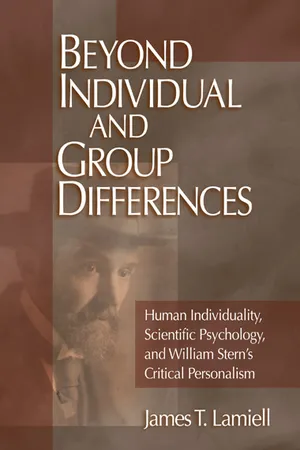 eBook - PDF
Beyond Individual and Group Differences
Human Individuality, Scientific Psychology, and William Stern′s Critical Personalism
- James T. Lamiell(Author)
- 2003(Publication Date)
- SAGE Publications, Inc(Publisher)
As it happens, differential psychologists were not alone in this regard. To the contrary, and as paradoxical as it may seem at first blush, the general/experimental psychologists whose work differential psychology was supposed to augment were themselves embrac-ing in ever increasing numbers the same statistical concepts as the fundament of their own accounts of human behavior. In the present chapter, the historical background of this profoundly important epistemic turn within scientific psychology will be examined fur-ther. How did statistical thinking make its way into the discipline? Whence came statistical thinking in the first place? On what grounds did such think-ing come to be regarded as appropriate for advancing scientific accounts both of human behavior generally and of human individuality more specif-ically? What epistemic and metaphysical commitments accompanied the investment in such thinking as the basis for a scientific psychology? These are the central questions to be taken up in the present chapter. The Restructuring of Scientific Psychology’s “Two Disciplines” In an important contribution, Danziger (1987) shed very helpful light on some of the historical developments relevant to these questions. Noting that modern investigative practices in scientific psychology have their origins in two vastly different research models, Danziger began his analysis by describing the essential features of those models and then discussed histor-ical factors leading to the disappearance of one and the transformation of the other. Guided in part by Danziger’s analysis, some insight can be gained here into the nature of the “two disciplines of scientific psychology” that Lee J. Cronbach would famously celebrate in his 1957 “Presidential Address to the American Psychological Association” (Cronbach, 1957). In the Beginning . . . Of the two models discussed by Danziger (1987), he named the first the “Wundtian” model.
Index pages curate the most relevant extracts from our library of academic textbooks. They’ve been created using an in-house natural language model (NLM), each adding context and meaning to key research topics.

