Psychology

Psychology as a Science
Psychology as a science refers to the systematic study of behavior and mental processes using empirical methods and evidence-based research. It involves the application of scientific principles to understand and explain human behavior, emotions, and cognition. By employing rigorous research methods, such as experiments and observations, psychology aims to uncover the underlying mechanisms that drive human thought and behavior.
Written by Perlego with AI-assistance
Related key terms
1 of 5
11 Key excerpts on "Psychology as a Science"
 No longer available |Learn more
- (Author)
- 2014(Publication Date)
- College Publishing House(Publisher)
______________________________ WORLD TECHNOLOGIES ______________________________ Chapter 1 Psychology Psychology is the science of mind and behavior. Its immediate goal is to understand behavior and mental processes by researching and establishing both general principles and specific cases. For many practitioners, one goal of applied psychology is to benefit society. In this field, a professional practitioner or researcher is called a psychologist, and can be classified as a social scientist, behavioral scientist, or cognitive scientist. Psychologists attempt to understand the role of mental functions in individual and social behavior, while also exploring the physiological and neurobiological processes that underlie certain functions and behaviors. Psychologists explore such concepts as perception, cognition, attention, emotion, phenomenology, motivation, brain functioning, personality, behavior, and interpersonal relationships. Some, especially depth psychologists, also consider the unconscious mind. a Psychologists employ empirical methods to infer causal and correlational relationships between psychosocial variables. In addition, or in opposition, to employing empirical and deductive methods, some—especially clinical and counseling psychologists—at times rely upon symbolic interpretation and other inductive techniques. Psychology incorporates research from the social sciences, natural sciences, and humanities, such as philosophy. While psychological knowledge is often applied to the assessment and treatment of mental health problems, it is also applied to understanding and solving problems in many different spheres of human activity. eBook - ePub
Education and Psychology in Interaction
Working With Uncertainty in Interconnected Fields
- Brahm Norwich(Author)
- 2002(Publication Date)
- Routledge(Publisher)
Psychology is an alluring, puzzling and even a mysterious field. It can be seen to contain crucial knowledge and understanding about the mind and human behaviour which can answer many of the questions about human nature which concern us all. Such answers can hold out the promise of solutions to human problems, something which is particularly relevant in a secular age when the traditional answers from religion have become less plausible and acceptable. It is seen (witness the images projected by the media) as offering those who are familiar with its secrets the potential, if not the actual power, to control and perhaps manipulate others. Psychology, focusing on the mind or the psyche, also has associations with what is not physical and material, with ghostly processes which lurk in some immaterial realm. Though there has been a significant growth of a scientific approach to psychology over the last century, and that is now the dominant mode of study, this development has not been welcomed consistently. Put briefly and simply, a scientific mode offers the authority and power associated with science in other fields where it has achieved considerable successes, such as in physics and biology. This arises from an agenda which aims to identify causal mechanisms which can be applied to the control of psychological outcomes. But this very process can also be seen to be dehumanising in denying the role of human meaning and agency. Despite this, psychology has over the last century attracted many hopes and expectations. This was recognised by William James as regards teachers and teaching, as noted in the last chapter. Currently psychology is attracting many students in Higher Education. Figures quoted by Gale (1997), for example, indicate that in the USA psychology produces the second largest number of major graduates, after business administration and management. A world-wide survey indicates a doubling of the number of qualified psychologists between 1982 and 1992. There has been a similar growth in Higher Education psychology places in the UK.Modern psychology is sometimes portrayed as a robust, if young, science which contains some explanations of key psychological phenomena and at least has the methods which have the promise to develop further and more powerful explanations and techniques. For example, Grey (1981) argued that psychology is much younger than other sciences, and that it is only a matter of time before it catches up. This commitment to a scientific approach to the study of humanity has been justified by its contribution to understanding and resolving some of our urgent and immediate problems. Science can be seen, argued Eysenck, asthe expression of reason in its highest form and science therefore is our one and only hope for survival. (Eysenck, 1972, p. xvi)Science is the tool and creation of human reason; now is the time to introduce it into human affairs as well, and base our conduct on scientific facts. (p. 323)Yet despite these confident assertions, there have been over the last half century continuing doubts about psychology’s outcomes. For example, in the 1950s the philosopher Wittgenstein, who was interested in exploring the nature of psychological concepts and attributions, stated:The confusion and barrenness of psychology is not to be explained by calling it a ‘young science’; its state is not comparable with that of physics, for instance, in its beginnings. For in psychology there are experimental methods and conceptual confusion. The existence of experimental method makes us think we have the means of solving the problems which trouble us; though problem and method pass one another by. eBook - ePub
- Guido Villa(Author)
- 2014(Publication Date)
- Routledge(Publisher)
The old-fashioned theories failed in doing this, owing to the restricted limits within which they confined the science of Psychology. Psychology, according to those systems, being only an introduction to gnosiology and metaphysics, was deprived of its most important characteristic—viz. that of being the most general, fundamental, and explanatory of the moral sciences. Nor must we be led into error by the definition given above, according to which Psychology studies the results of experience from the subjective and individual point of view. It must be understood that the term individual does not signify that the study of the mental processes is to be left to the subjective judgment of each individual, for no science could exist under such conditions. Science presupposes generalisation, is a product of processes of abstraction, and based entirely upon concepts. For this reason the term individual must be understood in a general sense. This being a contradiction in terms, it is best to use the term subjective in place of individual. Considered in this way, Psychology is the science which studies the general forms of mental processes, considered as a whole, under their objective and subjective aspects, and as manifested not in this or that particular individual, but in an abstract individual, taken as a general type. 2 The connections existing between Psychology and the natural sciences are not so apparent as between Psychology and the moral sciences, and can be reduced chiefly to questions of method. The subject-matter of science, whether physical or mental, being the same, it is possible to apply to the mental sciences the methods of the physical sciences; but their aims being quite different, the laws of Psychology must necessarily be different from those of the natural sciences. Thus cerebral processes are quite different from mental processes, notwithstanding the fact that the latter cannot be produced without the former No longer available |Learn more
- Philip Banyard, Christine Norman, Gayle Dillon, Belinda Winder, Philip Banyard, Christine Norman, Gayle Dillon, Belinda Winder(Authors)
- 2019(Publication Date)
- SAGE Publications Ltd(Publisher)
We have devised a chapter to help you navigate some of psychology’s key moments, but please note that this is not always a linear journey. At the heart of this chapter, we consider how psychology became a science. FRAMING QUESTIONS What have been the main stages in the development of Psychology as a Science? How has psychology developed as a natural science and as a social science? How has the social and political landscape influenced psychology’s development over time? What does the future hold for Psychology as a Science? 2.2 WHAT IS A SCIENCE? To help us understand psychology as a discipline, it is important to address the meaning of science itself. Science helps us to determine our understanding of the universe and observed phenomena. It provides a collective understanding and knowledge of how the universe works. Science is not defined by the type of experimental tools used or the sub- ject matter under observation. Rather, it is the integration of scientific principles that can be applied to a particular subject matter, to help provide a further understanding of phe- nomena (Tyson, Jones & Elcock, 2011). The principles that disciplines follow in order to achieve scientific status can be referred to as the ‘scientific approach’. Modern-day psychology, as a relatively new science, has adopted the scientific approach to gain status as a scientific discipline. 2.2.1 What is the scientific approach? Objectivity is the foundation of science. The scientific approach follows three key stages: systematic observation, testable predictions and verification of scientific facts (Stanovich & Stanovich, 2013). The public perception of Psychology as a Science is much debated. In Sir Isaac Newton’s (1642–1727) time, the idea of determinism in science emerged and went on to be a strong influence on psychology. Determinism is the idea that the universe and its behaviour is predetermined based Systematic observation Observations of subject matter need to be empirical.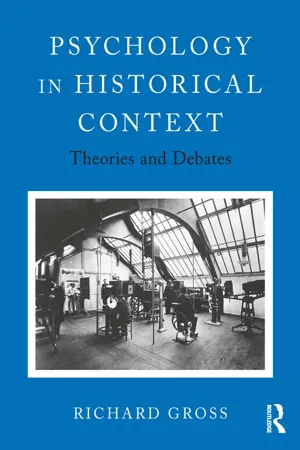 eBook - ePub
Psychology in Historical Context
Theories and Debates
- Richard Gross(Author)
- 2017(Publication Date)
- Routledge(Publisher)
Chapter 2 Scientific perspectives Psychology as the study of … how?We learned a number of things about Psychology from Chapter 1 , including the following:● Its emergence as a separate discipline took place during the late 1800s, with its roots in philosophy and physiology in particular.● A number of different schools of thought or theoretical perspectives/approaches appeared between this time and the mid-1900s, often as a reaction to/against an already existing approach and often overlapping with it.● Different schools of thought have tended to be more or less dominant within particular parts of Western Europe and the US, reflecting both scientific/academic and more general social influences and traditions.● It’s more accurate to talk about the ‘histories’ of Psychology, rather than a single, universally accepted ‘history’ taken to reflect ‘what actually happened’.● These different approaches focus on different aspects of ‘human functioning’ (i.e. their subject matter); it’s almost as if human beings are being defined differently according to which theoretical lens we happen to be looking through. This relates to ontology: the branch of philosophy concerned with the fundamental characteristics of reality: what exists. According to Teo (2009), Psychology has excluded or neglected key problems or pretended they don’t exist (see Box 2.1
- Tracy Henley(Author)
- 2018(Publication Date)
- Cengage Learning EMEA(Publisher)
Kimble (1996b) elaborated this vision of psychology as a unified science: The argument begins with a reminder that a science of psychology must obey the rules of science: it must be determin-istic, empirical, and analytic. To honor those criteria, it must be some form of behaviorism, based on stimuli and response, because the sciences are about observable reality. (p. ix) Have things improved in the 85 years or so since Heidbreder recorded her thoughts? As we saw in Chapter 1, after addressing the question of whether psychology is a science, Koch (1981, 1993) con-cluded that rather than psychology being a single discipline, it is several—some of which are scientific, but some of which are not. Koch believed that it would be more realistic to refer to our discipline as psychological studies rather than as the science of psychology. The designation psychological studies recognizes the diversity of psychology and shows a willingness to use a wide variety of methods while studying humans. Accepting Koch’s point, it still should be under-scored that some psychologists are very much scientists. In Chapter 13 we noted the close associ-ation of individuals like Hull and Stevens with the most cutting-edge conceptions of science in their day. Likewise, the physiological psychology we reviewed in Chapter 18 is clearly linked to biology and neuroscience. Currently the National Science Foundation (NSF) classifies cognitive science (Chapter 19) among its priority areas. And despite the impact of postmodernism (which we will soon consider), Robinson (1993) asserts that “psychol-ogy now seems more intolerant than ever towards modes of inquiry and analysis that are not exper-imental, not grounded in so-called observables, not reducible to quantities, and not assessable statistically” (p. 642). Staats (1989) offered this assessment of psychol-ogy as an admixture: Fields of psychology have developed as separate entities, with little or no plan-ning with respect to their relationships. eBook - PDF
- K. Hillner(Author)
- 1987(Publication Date)
- North Holland(Publisher)
For instance, virtually any action psychology using third person access has most or all o f the trappings of a science; the depth approach gen- erates a literary psychology that is best conceived as a humanity; understanding psychology can be clas- sified as either a humanity or a humanistic science. A s a consequence of this, the relationship o f psychol- ogy to the myriad other academic disciplines in large part is contingent on the particular brand of psychol- ogy used as the reference point. Psychology's compositional problem, particular- ly those aspects derivative o f the arbitrariness of its orientation, does afford the discipline the oppor- tunity to serve as a bridge between the hard sciences and the humanities. Third person access, objective psychology provides continuity with the sciences; first person access, subjective psychology does like- wise for the humanities. Historically, natural sci- ence serves as the model for psychology conceived as a social science; and psychology informs the human- ities when the discipline's subjective orientation is emphasized [Bornstein, 19841. The discipline's relation to other social sci- ences basically is a function of the irresolvability of its content of observation and the issue o f reduc- tionism. The differences between psychology and the myriad other social sciences primarily relate to units o f analysis, acceptable loci of causation, and postu- lated level o f explanatory mechanisms. Unlike its re- lation to the hard sciences o r the humanities, psy- chology's stance with respect to the other social sci- Psychology's Relation to Other Disciplines 305 ences in large part is arbitrary and idiosyncratically based: for instance, why are juvenile delinquency and criminal justice considered subspecialties o f sociolo- gy, while education and social learning primarily con- stitute psychological phenomena? The distinction between an academic and profes- sional discipline is arbitrary and merely convention- al. eBook - PDF
Psychology
Modules for Active Learning
- Dennis Coon, John Mitterer, Tanya Martini, , Dennis Coon, John Mitterer, Tanya Martini, (Authors)
- 2021(Publication Date)
- Cengage Learning EMEA(Publisher)
Even the word psychology is thousands of years old, com-ing from the ancient Greek roots psyche , meaning mind, and logos , meaning knowledge or study. Today, psychology is both a science and a profession. As scientists, some psy-chologists do research to discover new knowledge. Others apply psychology to solve problems in fields such as mental health, business, education, sports, law, medicine, and the design of machines (Bayne & Jinks, 2013). Still others are teachers who share their knowledge with students. Later, Copyright 2022 Cengage Learning. All Rights Reserved. May not be copied, scanned, or duplicated, in whole or in part. Due to electronic rights, some third party content may be suppressed from the eBook and/or eChapter(s). Editorial review has deemed that any suppressed content does not materially affect the overall learning experience. Cengage Learning reserves the right to remove additional content at any time if subsequent rights restrictions require it. 13 MODULE 2 INTRODUCING PSYCHOLOGY: PSYCHOLOGY, CRITICAL THINKING, AND SCIENCE made a choice. This made it virtually impossible that the pair in position D was actually consistently of better quality. If the shoppers were introspectively aware of the under-lying psychological processes that resulted in their choices, they surely would have identified serial position as a relevant factor. Amazingly, while serial position objectively influenced the shopper’s choice, no shopper gave serial position as a subjective reason for his or her choice. Apparently, you are not always the best judge of why you behave the way you do (Wilson, 2004). That is, even when introspection does yield information, there is no guarantee that the information is accurate. eBook - PDF
- Duane Schultz(Author)
- 2013(Publication Date)
- Academic Press(Publisher)
However, our discussion of the history of psychology does include the more immediate philosophical context. Psychology became a distinct and experimental science at a time when European thought was imbued with the spirit of positivism, empiricism, and materialism. The idea that the methods of science could be applied to mental phenomena is inherited from philosophical notions of the seventeenth to nineteenth centuries, and that exciting era is the starting point for our discussion of the history of modern psychology. 8 THE STUDY OF THE HISTORY OF PSYCHOLOGY psychologists took issue with Wundt's version of psychology and pro-posed their own views. As a result, by the turn of the century, several different systematic positions or schools of thought were in existence. The term school refers to a group of psychologists who became associated ideologically, and sometimes geographically, with the leader of a movement. For the most part, the members of a school worked on common problems and shared a common theoretical or systematic orientation. The emergence of different schools of thought and their subsequent decline is one of the most striking characteristics of the history of psy-chology. The phenomenon is not unique to psychology, however, for all the sciences experienced a similar period early in their respective histories when competing schools of thought divided the field of study (Kuhn, 1970). Each of these schools was a movement of protest, indeed a rebellion, against the prevailing systematic position. Each pointed out what it saw as the shortcomings and failures of the older point of view and each presented new definitions, concepts, and research strategies designed to correct the perceived weaknesses. When a new school of thought cap-tured the scientific community's attention, it resulted in the rejection of the once honored position. eBook - PDF
- Duane Schultz(Author)
- 2013(Publication Date)
- Academic Press(Publisher)
It is the approach taken, the techniques employed, that distinguish the older philosophy from modern psychology and denote the emergence of the latter as a separate discipline. Until the last quarter of the nineteenth century philosophers attempted to study human nature through speculation, intuition, and generalization based on their own limited experience. A major transformation occurred when they began to apply the tools and methods of science to questions about human nature, methods that had already proved successful in the 1 Introduction natural sciences. Only when researchers turned to carefully controlled observation and experimentation as the means for studying the human mind, did psychology begin to attain some degree of independence from its philosophical antecedents. To break with philosophy, the new psychology needed to develop a more precise and objective way of dealing with its subject matter. Thus, much of the history of psychology after its separation from philosophy is an account of the continual refinement of its tools, techniques, and methods of study to achieve increased precision and objectivity in both its answers and its questions. If we are to understand the complex issues that define and divide psychology today, the proper starting point for the history of the field is that time when it became a truly independent discipline, with unique methods of inquiry and theoretical rationales. We cannot deny that early scholars speculated on problems concerning the nature of the human species. Certainly they did. But their influence on the development of psychology as a separate and primarily experimental science is limited. Psychology is a product of the nineteenth and twentieth centuries, because only in the last 100 years or so have psychologists defined its subject matter and established its foundation, confirming its independence from philoso-phy. eBook - PDF
- Daniel N. Robinson(Author)
- 1995(Publication Date)
- University of Wisconsin Press(Publisher)
The manifold of consciousness includes the mind's commerce with more than the objects of sense, with more than external stimuli. It em- braces feelings, images, dreams, memories, attention, and movement. And the psychology charged with the study of these processes is "experimental psy- chology," the name given by Wundt himself. The science is to be the study of mind, but by "mind," Wundt is careful to dissociate himself from that long history of metaphysical speculation: "Mind," "intellect," "reason," "understanding," etc., are con- cepts ... that existed before the advent of any scientific psychology. The fact that the naive consciousness always and everywhere points to internal experience as a special source of knowledge, may, there- fore, be accepted for the moment as sufficient testimony to the rights of psychology as science .... "Mind," will accordingly be the subject, to which we attribute all the separate facts of internal observation as predicates. The subject itself is determined wholly and exclusively by its predicates. 41 Here, in a conservative and rather woolly fashion, Wundt hands down a manifesto of Humean proportion. By "mind" the psychologist will mean no more than and only that which is directly reportable as an observation of an internal event. If the mind thinks, feels, remembers, attends, and forgets, then a science of mind can be no more than experimental inquiries into the deter- minants of thinking, feeling, remembering, etc. When its predicates are ex- hausted, there is no metaphysical residue. For Wundt, "psychology," "experimental psychology," and "physiological psychology" were three terms for the same subject. To appreciate this, it is necessary to recall how the term "physiological" was understood by Wundt, and also to recognize the place of social psychology in Wundt's writing. By physiological (physiologische) the German scientist of the late nineteenth cen- tury described an essentially scientific, law-governed approach.
Index pages curate the most relevant extracts from our library of academic textbooks. They’ve been created using an in-house natural language model (NLM), each adding context and meaning to key research topics.

