Psychology

Emotion Research
Emotion research in psychology focuses on understanding the nature, expression, and impact of emotions on human behavior and well-being. It encompasses the study of emotional processes, such as how emotions are experienced, expressed, and regulated, as well as the role of emotions in cognition, decision-making, and social interactions. Researchers use various methods, including behavioral observations, physiological measurements, and self-report assessments, to investigate emotions.
Written by Perlego with AI-assistance
Related key terms
1 of 5
6 Key excerpts on "Emotion Research"
 eBook - PDF
- Kathleen Gilbert(Author)
- 2000(Publication Date)
- CRC Press(Publisher)
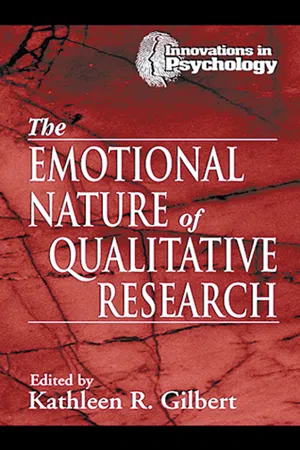
What we mean by “emotions” Some qualitative researchers believe that the ultimate goal of research is to enter the world of others in such a way as to allow the researcher to see life through their eyes. In order to do this, one cannot see this as a purely intellectual exercise, but as a process of exploration and discovery that is felt deeply — that is, research is experienced both intellectually and emotionally. But what do we mean when we speak of emotions? I found, in my initial exploration of the concept, a great deal of ambiguity and ambivalence toward emotions starting with a lack of a clear definition. Some terms that other qualitative researchers shared with me as I began to study this process include feelings, sensations, drives; the personal; that which is intimate; personally meaningful, possibly overwhelming; being touched at a deeper level; something that comes from somewhere within ourselves; and that which makes us truly human. These comments reflect an essential problem faced in efforts to incorpo-rate the emotional into the research process — the problem of a lack of clarity 10 The emotional nature of qualitative research in defining what we mean by the term “emotions.” Various authors have pointed this out including Jagger who noted the “variety, complexity, and even inconsistency of the ways in which emotions are viewed, both in daily life and in scientific contexts.” 16 The range of phenomena covered using this term is immense, as are the criteria for choosing one definition over another. 16,17 The result, according to Sarbin, is that “(t)he word ‘emotions’ has drifted into opacity at the hands of physiologists, psychologists and phenomenologists. The imagery is diffuse and not easily communicated.” 18 In Chapter 7, Harris and Huntington go into great detail on ways of approaching the concept of emotions in research and in common usage. In this volume, we approach emotions in a variety of ways.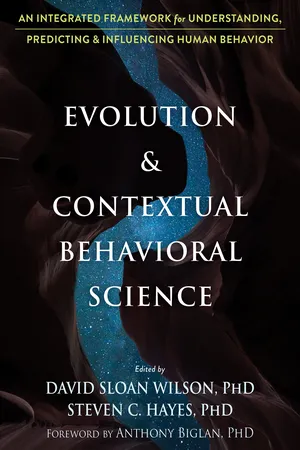 eBook - PDF
- Hayes, Steven C., Wilson, David Sloan(Authors)
- 2018(Publication Date)
- Context Press(Publisher)
CHAPTER 9 The Social and Contextual Nature of Emotion: An Evolutionary Perspective Lynn E� O’Connor Wright Institute Jack W� Berry Samford University I t has been suggested that no one can clearly define the word “emotion.” According to Joseph LeDoux, “there are as many theories of emotions as there are emotion theorists.” Even so, we all know in a general way what an emotion is: a brief psycho-physiological event that includes the subjective capacity to experi- ence what we think of as a feeling. We know what emotions are because we share them. We’re utterly dependent upon our emotions. They provide us with informa- tion and direction as we react to changes in the physical and social environment; our feelings tell us what’s going on. Traditionally—at least in academic and clinical circles—emotions have been considered intrapsychic mental phenomena (Keltner & Haidt, 1999). In the sway of our individualistic culture, with its consistent focus on the decontextualized, isolated individual, we see ourselves, first and foremost, as individuals separated enough to believe that the emotions we experience are occurring to us alone. We live in a culture in which children often grow up sleeping alone in their own bedroom, not even shared with siblings. Alone. Our western individualistic life- style has constrained our theorizing about emotions, and sent us off in numerous wrong directions. For most of human history, and in much of the world today, babies are rarely out of physical contact with their mother (Konner, 2005). The idea of putting infants to sleep in a bed, let alone a room, by themselves, is unimaginable. Evolution & Contextual Behavioral Science 150 In the era of evolutionary adaptation (EEA; Cosmides & Tooby, 2000), perhaps best understood by examining the lifestyles and customs of the few remaining hunter and gatherer cultures, people were seldom alone, and the idea of privacy was entirely foreign.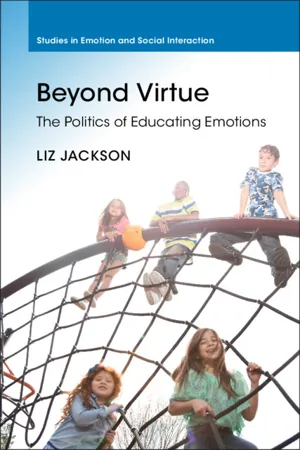 eBook - PDF
Beyond Virtue
The Politics of Educating Emotions
- Liz Jackson(Author)
- 2020(Publication Date)
- Cambridge University Press(Publisher)
I explore views related to the mor- ality of educating emotions in Chapter 3. 2.1 Psychological Views of Emotions In psychology, ‘deciding what emotions are is still a controversial issue’ (Shuman & Scherer, 2014, p. 19). There are some commonly held under- standings across the field, however, to take as a starting point. According to psychological views, emotions are episodes experienced by persons evoked by external or internal stimuli, which consist of subjective feel- ings, physiological and/or motor changes, action or behavioural tenden- cies, and some kind of judgement or appraisal (Shuman & Scherer, 2014). This is not far off from the observations of other scholars focused on understanding emotions conceptually (i.e. Roberts, 2003, 2013). What makes a psychological view of emotions distinctive from others is that emotions are framed as having functions for individuals in their environ- ments. Such functions include monitoring a situation or making meaning out of it, motivating action, communicating with others, and supporting physiological functioning. Psychologists understand emotions to have biological and evolutionary functions, as well as social and cultural value. A student is about to give a presentation. They feel a sense of anxiety. They want to do a good job and gain positive recognition from their teacher and peers. But they also feel a heightened sense of being inexper- ienced and insufficiently prepared. These feelings may be partly trig- gered by memories (or nightmares) of presentation experiences which were accompanied by stress and hectic conditions, where they were not able to achieve their goals satisfactorily. The student experiences a sensation of their heart beating rapidly, shortness of breath, and sweat- ing. They may experience a heightened sense of alertness and feel as if 2.1 Psychological Views of Emotions 25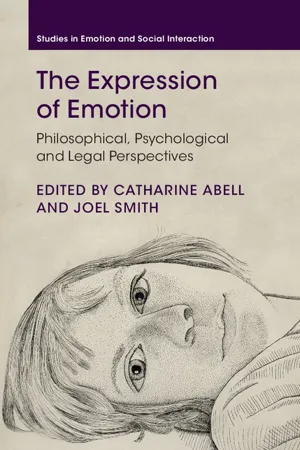 eBook - PDF
The Expression of Emotion
Philosophical, Psychological and Legal Perspectives
- Catharine Abell, Joel Smith(Authors)
- 2016(Publication Date)
- Cambridge University Press(Publisher)
Psychological work, in its turn, although paying great attention to the specific mechanisms underpinning different facial expressions, has sometimes lacked an appreciation of what it is that makes something an expression of emotion at all. Finally, work on the topic within legal and political contexts would benefit from a more substantial engage- ment with both philosophical and psychological work on the nature and communicative role of emotional expression. In the remainder of this introduction, therefore, not only do we expand on the three themes – the nature of emotion, the communica- tive role of emotion and the normative significance of emotion – we also draw connections between discussions of these issues within our three disciplines. I.1 The Nature of Emotional Expression Emotional expressions can be divided into expressions of emotion, on the one hand, and behaviour that is merely expressive of emotion, on the other. This is a distinction familiar from related discussions in aesthetics (Bennett, this volume; Davies 1994: Ch. 4; Hospers 1954–1955). As we use the term, some piece of a subject’s behaviour can be an expression Introduction: Emotional Expression 3 3 of emotion only if there is in fact some emotion that the subject is in and that bears an appropriate relation to the expression. A piece of behav- iour that is merely expressive of emotion need not meet this condition. Thus, someone may simulate joy by smiling. This may be expressive of joy, but it is not an expression of joy. So, although all emotional expres- sions are expressive of emotion, not all are expressions of emotion, since some are merely expressive. Of course, not all expression is emotional expression at all. Our utterances express our opinions, for example (see Green 2007 for an account of expression that generalises to a wide vari- ety of cases). eBook - PDF
- Sanna Jarvela(Author)
- 2011(Publication Date)
- Elsevier(Publisher)
Educational Psychology Review 18 , 307–314. Schutz, P. A. and Lanehart, S. L. (2002). Introduction: Emotions in education. Educational Psychologist 37 , 67–68. van Veen, K. and Lasky, S. (2005). Emotions as a lens to explore teacher identity and change: Different theoretical approaches. Teaching and Teacher Education 21 , 895–898. Zembylas, M. (2005). Teaching with Emotion: A Postmodern Enactment . Greenwich, CT: Information Age. Emotion in Educational Contexts 69 Cognition and Emotion F Pons, University of Oslo, Oslo, Norway M de Rosnay, University of Sydney, Sydney, NSW, Australia F Cuisinier, University of Paris Ouest, Nanterre, France ã 2010 Elsevier Ltd. All rights reserved. Introduction What is the causal impact of emotion on cognition, and of cognition on emotion? Although this question is as classi-cal as the one about, for example, the relation between nature and nurture, or consciousness and unconsciousness, it is not possible at this time to find a mapping of its possible answers within the fields of educational and psychological sciences. The investigation of the causal relation between cognition and emotion within these fields can be characterized as a disparate archipelago of research islands each somewhat isolated from the others and often covered or surrounded by an almost impenetrable fog. This article presents a representative map of this territory. Why is it important to address the nature of the causal relation between cognition and emotion? The reasons are multiple. First, this question is interesting as a fundamental concern of human psychology that has attracted relatively little empirical attention. Of more than 200 000 psychological and educational publications (articles, book chapters, and books) including in their title the terms cognition or emotion (or equivalent terms such as intelligence, intellect, reasoning, mood, feeling, or affect), less than 4% include both terms (source PsycINFO and ERIC, May 2009). eBook - PDF
- John Corrigan(Author)
- 2018(Publication Date)
- Duke University Press Books(Publisher)
Studying religion and emotion sometimes means studying its theo-logical de-emphases. With that caveat in mind, it is possible to identify several key features of the research that has shaped the study of religion and emotion over the last several decades. There is an emerging scholarly consensus that emotion in religion (1) is not mysterious; (2) can be studied; (3) is about the body and not the tran-scendence of the body; (4) is about culture but not only about culture; that (5) the distinction between rational cognition and irrational emotion in religion is unwarranted; that (6) spirituality sometimes has to do with feeling and some-times does not; and that (7) what we mean by religion is entwined with what we mean by emotion—and vice versa. Prospect The prospect for research on religion and emotion can be improved if it is shaped by several considerations. First, with regard, specifically, to the broader humanities: the study of religion and emotion as a fundamentally interdisci-plinary project within the humanities must deepen its engagements with the cutting edges of interpretation across the humanities. That means not only con-tinuously incorporating ethnicity, gender, and sexuality into research agendas but seriously engaging the critical literatures in the humanities that have arisen from recent emphases on postcolonialism, capitalism, secularity, and funda-mentalisms. Such conversations occasionally have been difficult because much 12 John Corrigan study of religion and emotion has been framed with respect to specifics of per-sonal experience and the seemingly private . The conceptual expansiveness and fluidity required to address widely varying social and cultural contexts has not been as well practiced.
Index pages curate the most relevant extracts from our library of academic textbooks. They’ve been created using an in-house natural language model (NLM), each adding context and meaning to key research topics.

