Psychology

Francis Galton
Francis Galton was a British polymath known for his contributions to psychology, particularly in the field of psychometrics. He is often referred to as the father of eugenics and is recognized for his work in the study of human intelligence and heredity. Galton's research laid the foundation for the development of standardized testing and the study of individual differences in psychological traits.
Written by Perlego with AI-assistance
Related key terms
1 of 5
11 Key excerpts on "Francis Galton"
 eBook - ePub
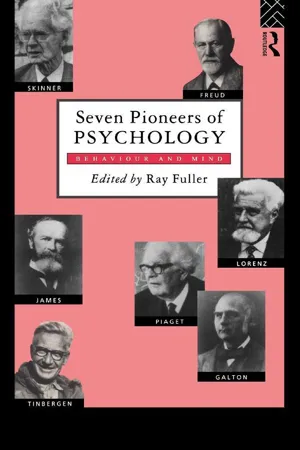
Seven Pioneers of Psychology
Behaviour and Mind
- R. Fuller(Author)
- 2005(Publication Date)
- Routledge(Publisher)
were an ideal index of personal identity (Finger Prints, 1892), and he persuaded Scotland Yard to adopt them. Galton’s psychological work extended over a period of approximately fifteen years, much of it incorporated in his Inquiries into Human Faculty and Its Development (1883). This book includes his important papers on word association and imagery, but also ranges widely over such varied topics as sensory acuity, composite portraiture, the efficacy of prayer, free will, gregariousness, and the domestication of animals. Through this work he established his reputation as the founder of individual psychology and as the originator of the mental testing movement. Galton was a prolific researcher, inventor and polymath with an output of over 340 papers and books. He served on many committees and received many awards, including the Copley Medal of the Royal Society and a knighthood. The latter part of his life was mainly devoted to the advocacy of eugenics, his own term for the selective breeding of good stock, and it was for the promulgation of related research that he bequeathed most of his fortune.Francis Galton was born in 1822 and died in 1911. He lived therefore during the period when it could be argued that individualism and liberalism were more prominent in Britain than elsewhere. Within such a Zeitgeist it is not surprising that he should have initiated the study of differences among individuals, on account of which he has long held an honoured place in the history of psychology.However, it is misleading to consider Galton as primarily a psychologist. Less than one quarter of his published output can be regarded as having psychological relevance. Some appreciation of his other interests is important, not only in understanding the man himself but also in placing his psychological work in a broader perspective. eBook - ePub
Systemic Racism and Educational Measurement
Confronting Injustice in Testing, Assessment, and Beyond
- Michael Russell(Author)
- 2023(Publication Date)
- Routledge(Publisher)
As we will see in Chapters 6 and 8, his efforts to develop methods for measuring intellect and advances to statistical methods gained widespread use only after others fully developed what his intuition produced. Two aspects of Galton’s work, however, leave an ugly stain on his legacy. The first is his overtly racist views. Galton was an ardent believer in the supremacy of White Europeans. Further, among the White population, Galton believed there were fundamental differences in the genetic qualities that distinguished society’s elite from the working class, the paupers, and “degenerates” below them. His views are expressed clearly throughout his writings and greatly influenced his work. Pushing the boundaries of science’s social value, his belief in the heritability of cognitive and psychological traits inspired Galton to develop the concept of eugenics—by far his most notorious and troubling influence on (pseudo)science during the first half of the 20th century. As explored in greater detail in Chapter 6, eugenics became a “scientific” approach to social engineering that misapplied a nascent understanding of heredity to improve the quality of future generations. Several branches of eugenics emerged in regions across the world, the most extreme applications resulting in forced sterilizations and institutionalizing of tens of thousands of people in the United States and the Holocaust in Nazi Germany. It is important to note that Galton’s vision for eugenics was far less destructive. Rather than applying eugenics to negate or eliminate from society what were believed to be “negative” human traits, Galton advocated a “positive” form of eugenics that encouraged reproduction by couples displaying “desirable” traits eBook - ePub
- L.S. Hearnshaw(Author)
- 2019(Publication Date)
- Routledge(Publisher)
CHAPTER IV Galton and the Beginning of Psychometrics 1. Sir Francis Galton (1822–1911) The philosopher who spoke of Freud as psychology’s one man of genius either overlooked Sir Francis Galton, or must have attached to him some other label than psychologist. For Galton was unquestionably a genius; and, though his genius manifested itself in most varied fields, among the most important was psychology. Galton was the first to investigate and measure individual differences in psychology; he was the first to provide evidence that psychological traits might be inherited in man; and he was the first to employ the statistical technique of correlation to assess the relationship between measured qualities. His work is fundamental to very large areas of contemporary psychology. Francis Galton, like his cousin Charles Darwin (Galton’s mother was a daughter of Erasmus Darwin), inherited sufficient worldly means to be able to live without paid employment, and like Darwin he devoted his whole life to scientific work. Both his grandfather and his father were well-to-do Birmingham manufacturers, and Francis, the last child in a family of nine, was brought up in a cultivated and lively home. He was a child of extraordinary precocity; he knew his capital letters when 12 months old; could read at the age of 2½ years, and just before his fifth birthday he could write “I am four years old, and I can read any English book. I can say all the Latin substantives and adjectives and active verbs besides 52 lines of Latin poetry. I can cast up any sum in addition and can multiply by 2, 3, 4, 5, 6, 7, 8 and 10.1 can also say the pence table. I read French a little and I know the clock.” 1 On the basis of evidence of this sort Terman has estimated Galton’s I.Q. as 200! In spite of this precocity Galton’s school and university career was undistinguished, and his most important work was not carried out until he was in his sixties eBook - PDF
Brain Death of an Idea
The Heritability of Intelligence
- Manfred Velden(Author)
- 2014(Publication Date)
- V&R Unipress(Publisher)
The study of the topic in the narrow sense of a science, which requires measurement techniques for mental traits as well as statistical procedures, be- gins with Galton, a cousin of Darwin’s. Due to his manifold contributions to science, to statistics and inheritance in particular, he is seen by many as a giant in mental history, hardly of lesser importance than his still more famous cousin. Admired greats of intellectual history usually have accomplished great things, of course, but their elevation into the Olympus has not rarely had its downside in Research on the heritability of intelligence 26 that critics have often not dared to speak out, which is understandable given they were dealing with gods. In this way Aristotle, for example, rather more hindered than helped progress in physics with his writings. Let us therefore view Galton not as hovering in the clouds of Olympus but as a common mortal who touched the earth with his feet. As such he was sent to Cambridge by his wealthy father in order to study medicine, and, at his own request, mathematics. In mathematics he did not excel but looked admiringly at those who did (Richards, 1987, p. 170). He finally managed to get a bachelor’s degree (A.B., artium baccalaureus) after which he carried on with his medical studies, which he gave up, however, having earned poor grades in medicine in his A.B. exam. As Richards (1987) comments on Galton’s achievements at university and his later near obsessive dealing with genius as an inherited capacity “For one who had failed to achieve eminence at university, the doctrine that genius had biological roots and could not be earned in schoolboy labor must have had an appeal” (p. 171). His interest in mathe- matics endured in the form of an interest in statistics, however. It eventually led him to find the regression effect. This is generally seen as a great scientific achievement accomplished in combination with his later dominant interest, the study of inheritance. eBook - ePub
Historical and Conceptual Foundations of Measurement in the Human Sciences
Credos and Controversies
- Derek C. Briggs(Author)
- 2021(Publication Date)
- Routledge(Publisher)
I propose in this memoir to give a new instance of psychometry, and a few of its results. They may not be of any very great novelty or importance, but they are at least definite, and admit of verification; therefore I trust it requires no apology for offering them to the readers of this Journal, who will be prepared to agree to the view, that until the phenomena of any branch of knowledge have been submitted to measurement and number, it cannot assume the status and dignity of a science. (Galton, 1879b, 148, emphasis added) In this and the next chapter, we will come to understand how Galton’s approach to measurement paved the way for the quantitative study of individual differences as taken up at the turn of the 20th century by Karl Pearson and Charles Spearman in England and by James Cattell and Edward Thorndike in the United States. The next two sections of this chapter (3.2 and 3.3) provide context with respect to Galton’s background and three important ideas in the 19th-century context of mathematics and statistics that shaped his interests in interindividual differences and their measurement. Sections 3.4 and 3.5 then focus attention on Galton’s use of the normal distribution as a method of “relative” measurement and the distinctions he made between relative and absolute measurement. In the next chapter, we turn to Galton’s efforts to promote an all-encompassing instrumental approach to human measurement for social study through the development of anthropometric laboratories, and his discoveries of the statistical phenomena of regression and correlation. We then reflect on the overarching ambition that tied together Galton’s many inquiries and investigations over the roughly 40 years during the second half of his life, the study of eugenics. Galton’s discovery of regression and correlation is rightfully considered one of the great triumphs in the history of statistics (Stigler, 1999) eBook - PDF
The Science of Human Perfection
How Genes Became the Heart of American Medicine
- Nathaniel Comfort(Author)
- 2012(Publication Date)
- Yale University Press(Publisher)
Five years later, some of the most distinguished physicians in America arrived at similar conclusions. Galton was among the first to try seriously to tease out the hereditary component of complex disease. 16 In most ways, though, Galton was a world apart from the medical perspective. His emphasis on the population drained him of compassion for individuals. Statistically, individual variation was noise that had to be filtered in order to discover the pure underlying truth of general trends. And philosophically, reason, not sentiment or virtue, was for him the proper infrastructure of Utopia. A reasoned solution to a social problem would be free from favoritism or sentiment and would therefore do the greatest good for the greatest number. In his mind, eugenics was a means of achieving a “great society.” Interviewed by the Jewish Chronicle in 1910, he claimed that persecution could strengthen a race by selecting for the hardiest, most resilient individuals. When asked whether this was not rather immoral, he denied the charge, calling his position “unmoral” instead. It is common for a scientist to claim that scientific objectivity excuses him from, or indeed precludes, considering the moral implications of his work. And yet it is not hard to believe that to an emotionally distant man such as Galton, eugenics would seem an expression of kindness. “It is the aim of eugenics,” he continued, “to supply many means by which the effects of these drastic and not always successful aids to race culture [that is, persecution] may be produced in a more scientific and kindly way.” Eugenics, in other words, would have all the biological benefits of persecution, without the unpleasant moral odor. eBook - PDF
Beyond Individual and Group Differences
Human Individuality, Scientific Psychology, and William Stern′s Critical Personalism
- James T. Lamiell(Author)
- 2003(Publication Date)
- SAGE Publications, Inc(Publisher)
In their view, the interindividual variations in intelligence (and, by extension, character) that so preoccupied them 6 had emerged in homo sapiens according to the princi-ples of natural selection set forth in the theory of evolution formulated by Galton’s cousin, Charles Darwin (1809-1882). This is the conceptual backdrop for Pearson’s observation: It is almost impossible to study any type of life without being impressed by the small importance of the individual . . . . Evolution must depend upon substan-tial changes in considerable numbers and its theory therefore belongs to that class of phenomena which statisticians have grown accustomed to refer to as mass phenomena. (Pearson, 1901-1902, p. 3) It is surely one of the great ironies of 20th century scientific psychology that the statistic named for the author of this passage would become the “sacred coin of the realm” (Bem & Allen, 1974, p. 512) within that subdiscipline of 118 —— Statistical Thinking in Post-Wundtian Psychology the field specifically devoted to an understanding of individuality. One of the major burdens of this discussion is to provide some insight into this historic irony and the enormous implications it has carried for our understanding of what it means to scientifically address the “problem of individuality.” Part of the story that is relevant here has already been told, for it was shown in Chapter Three that the Galtonian model was assigned an impor-tant niche in Stern’s early, but broad, vision of differential psychology. Specifically, Stern proposed in his 1911 Methodological Foundations text that the measurement and statistical analysis procedures proper to the Galtonian model should guide those subdisciplines of differential psychol-ogy devoted to the study of attributes in terms of their variation and covari-ation (correlation) across persons within populations. eBook - ePub
Intelligence, Destiny and Education
The Ideological Roots of Intelligence Testing
- John White(Author)
- 2006(Publication Date)
- Routledge(Publisher)
When he turned to psychology at Oxford, Burt was impressed by work of Pearson’s on anthropometry and soon met him personally, Pearson’s son being among the group of schoolboys Burt was testing (Burt 1952: 60). Pearson was a main influence on Burt’s early work on statistical aspects of mental testing (ibid.: 61, 62); and it was he who, along with Galton and others, drew up a scheme, finally accepted by the London County Council, for adding an educational psychologist to the inspectorate, the post which Burt was the first to occupy (ibid.: 63).Karl Pearson, like Galton, was of Quaker stock on his father’s side. His son and biographer mentions his many visits to the Yorkshire Dales, where ‘he loved to mix more serious work at statistics with walks along the tracks and bridlepaths between the dale-side farms where his Quaker ancestors had lived and died’ (Pearson 1938: 2).Like Galton – and indeed like both men’s Quaker ancestors – Pearson, despite his generally secular stance, saw science and religion fundamentally not as opponents but as collaborators. His section on ‘eugenics as a religious faith’ in Pearson (1914–30, Vol. IIIA: 87ff) not only describes Galton’s views, but also expresses his own. Religion, he writes,A few pages later, in his approving comments on Galton’s idea of eugenics as a national religion, Pearson states that the application of the laws of heredity and environment:from the earliest times has been the guardian of tribal custom in regard to marriage, birth and death. It has therefore concerned itself with matters which from our present knowledge of the laws of natural selection and heredity we recognise as bearing on human evolution. It is impossible – and this the Church is now beginning to recognise – to place the scientific doctrine of evolution and the moral conduct of man as inspired by religious belief in separate water-tight compartments.(ibid.: 88–9)to the progressive evolution of the race will become the religion of each nation. Such is the goal of Galtonian teaching, the conversion of the Darwinian doctrine of evolution into a religious precept, a practical philosophy of life. Is this more than saying that it must be the goal of every true patriot? eBook - PDF
Biometric State
The Global Politics of Identification and Surveillance in South Africa, 1850 to the Present
- Keith Breckenridge(Author)
- 2014(Publication Date)
- Cambridge University Press(Publisher)
1 (1824): 210. 109 Robert Knox, The Races of Men: A Fragment (London: H. Renshaw, 1850), 65–6. 110 Stephen J. Gould, ‘The Geometer of Race’, Discover (November 1994): 65–9; Knox, ‘Inquiry into the Origin and Characteristic Differences of the Native Races Inhabiting the Extra-Tropical Part of Southern Africa’; Galton, An Explorer in Tropical South Africa, 232, 250. Science of empire 58 the present day’. 111 The difference, of course, was Darwinism – Galton only began to formulate his arguments about hereditary ability after the publication of Origin of Species in 1859. This delay created the space for Galton’s eugenic fantasy, but in most other respects the two men shared a common imperial politics. (Knox’s account of the AmaXhosa people of the Eastern Cape, with whom Britain had been at war for a gener- ation, was considerably more sympathetic than Galton’s description of the unfamiliar Ovaherero and Ovambo peoples.) 112 Galton’s African experience was important in the development of his biometric statistics, but it was also much more significant in the develop- ment of racism than scholars have yet recognised. In all of his important works, with the exception of Natural Inheritance, Galton relied heavily on the evidence of his travels in South Africa to build his case for eugenic reform. The operations of the normal curve, decades before he had worked out the mathematics, were established using claims based on his African travels. More importantly, Galton inserted an entirely new con- ceptual weapon into the politics of race. The hereditary, and statistical, concept that Galton first developed in his discussion of regression, with its flexible present but ineluctable biological centre of gravity in the past and the future, broke with the older physiological, linguistic and geo- graphical definitions of race. It is important to notice that this argument about the normal distri- bution of racial qualities began very early in Galton’s work.
- Tracy Henley(Author)
- 2018(Publication Date)
- Cengage Learning EMEA(Publisher)
Individuals differ in their competence in such things as mathe-matics, language, and music. Such abilities are called Copyright 2019 Cengage Learning. All Rights Reserved. May not be copied, scanned, or duplicated, in whole or in part. Due to electronic rights, some third party content may be suppressed from the eBook and/or eChapter(s). Editorial review has deemed that any suppressed content does not materially affect the overall learning experience. Cengage Learning reserves the right to remove additional content at any time if subsequent rights restrictions require it. 294 C H A P T E R 1 0 Spearman’s Legacy. Spearman’s legacy can be seen in two main ways. His hereditarian notion of one underlying factor of intelligence ( g ) remains with us even today and represents one pole in an ongoing debate about the nature of intelligence. Binet represents the other end of the spectrum, asserting that intelligence was multifaceted and modifiable by experience. We will see this debate continue in the remainder of this chapter. Like Pearson, Spearman was a pioneer in the area of statistics that are used by psychologists. His early version of factor analysis forms the basis of many modern techniques, and he also developed a nonparametric alternative to Pearson’s correlation. Interestingly, given their mutual debt to Galton, their shared interests, and that both were at the same university, the two men were rivals and not friends. Sir Cyril Burt Cyril Lodowic Burt (1883–1971) was born in London, the son of the Galton family physician, and young Cyril was exposed to Galton’s ideas about eugenics at an early age. He was a student of William McDougall (and later Külpe) and worked with both Spearman and Pearson at the University of London. Burt accepted Spearman’s concept of g and believed education should be stratified accord-ing to a student’s natural intelligence. eBook - PDF
Statistics on the Table
The History of Statistical Concepts and Methods
- Stephen M. Stigler(Author)
- 2002(Publication Date)
- Harvard University Press(Publisher)
Even with dogs this was true: “If a man breeds from strong, well-shaped dogs, but of mixed pedigree, the puppies will be sometimes, but rarely, the equals of their parents. They will commonly be of a mongrel, nondescript type, because ancestral peculiarities are apt to crop out in the offspring” (Galton, 1869, p. 64). In 1869 Galton only vaguely approached the concept in its verbal form, but he was unable to formulate in a precise way how the accidental “cropping out” of “ancestral peculiarities” might be encompassed in a theory. Still the question kept gnawing at him; over the years 1874–1888 he revisited this problem repeatedly, and, bit by bit, he overcame it in one of the grand triumphs of the history of science. The story is an exciting one, involving science, experiment, mathematics, simulation, and one of the great thought experiments of all time, related in outline here. In the years 1874–1877, Galton launched his first assault upon this conundrum: how and why was it that talent or quality once it occurred tended to dissipate rather than grow. He never lost interest in the study of the inheritance of human genius, but he realized early on that intellec-tual quality was not an area that permitted either easy measurement on a wide scale or active experimentation. And so he fell back upon studies of other measurable qualities, particularly stature—height—in humans, and he began a series of experiments involving the measurement in suc-cessive generations of the diameter of sweet peas. And while considering these experiments, he invented a wonderful machine, the Quincunx, that was to serve as an analogue for hereditary processes and provide the key insight to the solution. Galton had been puzzled by how to reconcile the standard theory of errors with what he observed and knew to be true from experiments. The theory of errors held that a normal population distribution would
Index pages curate the most relevant extracts from our library of academic textbooks. They’ve been created using an in-house natural language model (NLM), each adding context and meaning to key research topics.

