Psychology

Free Will and Self-Actualisation
Free will refers to the ability of individuals to make choices and decisions independently, without external coercion. Self-actualization is the process of realizing one's full potential and achieving personal growth and fulfillment. In psychology, these concepts are often interconnected, as the pursuit of self-actualization is seen as facilitated by the exercise of free will in making choices that align with one's authentic self.
Written by Perlego with AI-assistance
Related key terms
1 of 5

5 Key excerpts on "Free Will and Self-Actualisation"
 eBook - PDF
- Christian List(Author)
- 2019(Publication Date)
- Harvard University Press(Publisher)
What Is Free Will? Free will, on a first gloss, is an agent’s capacity to choose and control his or her own actions. Sometimes this is also called “freedom of action” or “freedom of choice,” but I will use “free will” as the conventional term. According to the Oxford Dictionaries website, it is “the power of acting without the constraint of necessity or fate; the ability to act at one’s own discretion.” 1 Common sense suggests that, as human beings, we all have this capacity. When you go to a café, it is your free choice to have one kind of drink (say, cofee) rather than another (say, tea or orange juice). Similarly, if you have time tonight, it will be your free choice whether to switch on the radio or not. More significantly, we think that our own free will is involved, at least to some extent, when we choose a partner, a career, or a travel destination. In each of these examples, there is a sense in which our choice is at least partly up to us, and we could have chosen otherwise. Of course, our choices are often constrained by our means and resources, our social context, and our history and commitments. Choosing otherwise may be costly, sometimes too costly to be feasible in practice. Think of the resident of an authoritarian country who con-siders criticizing the regime but then refrains from doing so for fear of retribution. Notwithstanding this, there is some leeway for free will in many situations. Even the most rigid circumstances leave our choices 1 Free Will 16 Why Free Will Is Real open at least in trivial matters: whether to sleep on our left side or our right, whether to walk a few additional steps, or whether to drink an ad-ditional glass of water. Of course, we would like our freedom to go well beyond such trivial choices. To get a feel for the idea of free will, try the following. In a few sec-onds’ time, perform a specific movement—say, the movement of a finger, a leg, or an eyelid. Decide which movement you wish to perform. And now do it. eBook - ePub
- Ian Fairholm(Author)
- 2012(Publication Date)
- Bloomsbury Academic(Publisher)
Chapter 8 Determinism and Free WillDo you have free will? Ask most people and they will probably say they do, or at least that they feel they do. In this chapter we will be addressing one of the trickiest and most long-lasting debates of all: whether humans are free to choose how they think and behave, or whether their thoughts and behaviours are determined by things beyond their control.This is a tricky debate, partly because it threatens something that nearly all of us experientially believe to be true – that our personal will determines the choices we make and the actions we perform. Many psychologists have questioned this notion and in this chapter we’ll address the basis for their arguments. But first we need to define some terminology.Definition of the problem – are we really free?We’ll start off by attempting to define free will, which is perhaps not as easy as it sounds. Free will is essentially the notion that humans respond freely, voluntarily and actively to events around them, that when they encounter or are presented with stimuli, choices or options they have the freedom to choose which to select, or in fact may choose not to select any of them at all. Ultimately it assumes that we’re free to select our own course of action, behave in unconstrained ways, make our own decisions and determine our own lives.One of the potential problems with this notion of pure free will is related to science. Science fundamentally looks for causes and as psychology attempts to promote itself as a science it needs to be able to identify causes for thoughts and behaviours. So what causes a person’s thoughts and behaviours? You might want to answer, ‘obviously the person causes them’, but that doesn’t help much because psychology acknowledges that people are complicated, so what aspect of the person actually does the choosing and what causes them to make a particular choice? Different psychologists tend to highlight different factors, as you might expect, and we’ll identify where the five main approaches covered in this book stand on this issue throughout the rest of the chapter. eBook - PDF
- Atle Ottesen Søvik(Author)
- 2016(Publication Date)
- De Gruyter(Publisher)
4 Free Will The time has come to explain what it means to say that humans have free will. We have already seen the basic definition of free will: that it is up to us what we choose among alternatives and that the source of the choice is in us. Different scholars disagree on how to understand the parts of the definition, how the concept of free will should be used, and which definitions refer to a kind of free will that actually exists. For most of them, the goal is to find a coherent defini-tion of free will and to find out how free the human will is. This is also my goal and, having considered the topics of causality and the self, I now have the re-sources to explain in much greater detail who chooses, what it means to choose among alternatives , and how the choice makes the agent the source or the cause of the choice. I shall start by defining “free will” and argue that we have free will when (but not only when) the autobiographical self is the cause of the desire that makes us choose one alternative as opposed to another. In order to explain why we have free will when the autobiographical self is the cause of the desire that causes the choice, I must explain what I mean by alternative possibilities and then discuss the question of determinism. I can then explain how the autobio-graphical self becomes what it becomes and why we have free will when the autobiographical self causes the desire that causes the choice. But we have free will and responsibility not only when an independent autobiographical self causes the choices we make. After explaining what I mean by responsibility, I argue that free will is a matter of inner-directedness and exists to different de-grees along a continuum. I present and discuss different degrees of free will along this continuum and in the final chapter of the book I discuss various test cases and counterarguments to see how well I can explain typical difficult cas-es. eBook - PDF
- Roy F. Baumeister, Kathleen D. Vohs, Roy Baumeister, Kathleen D. Vohs(Authors)
- 2007(Publication Date)
- SAGE Publications, Inc(Publisher)
The core idea behind free will is that people can choose to act in different ways. The opposite belief is determinism, which holds that every action is fully caused (determined) by prior events. Think of something you did recently, even perhaps picking up this entry to read. Is it possible that you could have done something differently? Or was it an inevitable result of forces and pressures operating on you, including both the current situation and past experiences and lessons? You may have felt as though you made a decision to read this, but then again that feeling might be an illusion. Strict determinists think that it was inevitable that you read this and that you really could not have done anything else. In contrast, if you have free will, then you might well have done something different. The “will” part of free will presents additional problems for some philosophers and psychologists. It implies that there is such a thing as a will, as a part of the human mind, possibly located somewhere in the brain. Many experts believe that the will is just a metaphor or a convenient way of talking about human mental processes, rather than being something real. Those experts hence reject the term free will and pre-fer to talk about freedom of action. Some of them think that freedom is real and the will is not real. For most, however, the issue is whether freedom really exists, and the “will” part is not the controversial part. Opposition to Free Will Social psychologists who reject the idea of free have several main reasons for doing so. One is a simple act of faith. Many psychologists believe that, as scientists, they must believe that there is a cause for everything and that determinism is the only suitable assumption for scientific research. Most agree that determinism cannot be proven true, but they believe that it is nec-essary for scientists to assume that it is true. Some regard free will as an obsolete religious idea.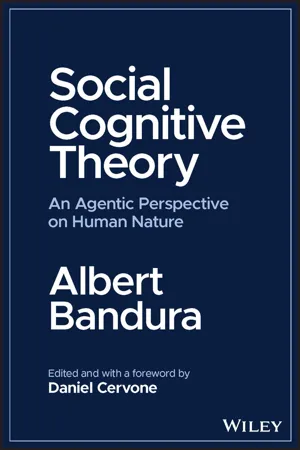 eBook - PDF
Social Cognitive Theory
An Agentic Perspective on Human Nature
- Albert Bandura, Daniel Cervone(Authors)
- 2023(Publication Date)
- Wiley(Publisher)
Cognitive processes also are a means of creat- ing and altering the physical environments one encounters. When viewed from a social cognitive perspective, freedom is not construed merely as the absence of constraints and coercion in choice of action. Rather, it is viewed proactively as the exercise of self-influence in the service of selected goals and desired futures. For example, people have the freedom to vote, but whether they persuade them- selves to vote and the level and form of their political engagement depends, in large part, on the self-influence they bring to bear. Through the social influence of collective action, they change political and other social systems. In addition to regulating their actions, people also live in an intrapsychic environment largely of their own making. In this environment, the self-management of their inner lives frees them from disturbing trains of thought (Bandura, 1997). Because per- sonal influence is an interacting part of determining conditions, people are par- tial authors of the past conditions that developed them as well as the future course their lives take. The development of agentic capabilities adds concrete substance to abstract discourses about freedom and determinism. People who develop their competen- cies, self-regulatory skills, and enabling self-beliefs can create and pursue a wide array of options that expand their freedom of action (Bandura, 1986). They are also more successful in realizing desired futures than those with less-developed agentic capabilities. The development of strategies for exercising control over he eeeloomen of Agency 13 perturbing and self-debilitating thinking is also intrapsychically liberating. There is no absolute freedom. Paradoxically, to gain freedom, individuals have to nego- tiate collectively rules of behavior for certain activities that require them to relin- quish some autonomy.
Index pages curate the most relevant extracts from our library of academic textbooks. They’ve been created using an in-house natural language model (NLM), each adding context and meaning to key research topics.

