Psychology

Innate Releasing Mechanisms
Innate releasing mechanisms (IRMs) are pre-programmed neural circuits that trigger instinctive behaviors in response to specific stimuli. These mechanisms are thought to be genetically determined and are present in many animal species, including humans. IRMs are important for survival and reproduction, and they help animals respond quickly and appropriately to environmental cues.
Written by Perlego with AI-assistance
Related key terms
1 of 5

3 Key excerpts on "Innate Releasing Mechanisms"
 eBook - PDF
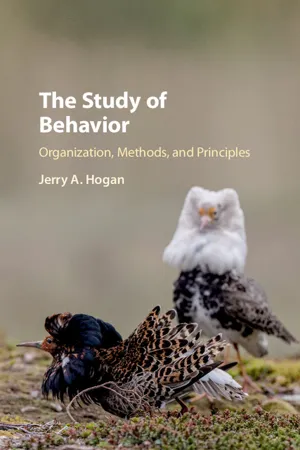
The Study of Behavior
Organization, Methods, and Principles
- Jerry A. Hogan(Author)
- 2017(Publication Date)
- Cambridge University Press(Publisher)
A releasing mechanism is a group of neurons in the central nervous system that is responsible for analyzing, evaluating, and summating the different attributes of an object, and that can release a specific response. The word ‘release’ implies disinhibition of a motor mechan- ism that has certain motivational properties, and I discuss this implica- tion in Chapter 3. A more neutral term might be ‘object recognition mechanism’ or ‘object detector’, but for the time being, I will continue to use the word ‘releasing’. Each response must have its own releasing mechanism because the most effective stimulus is different for each response. For example, herring gulls not only retrieve eggs, they also eat them. They do not eat eggs in their own nest (unless they become broken), but they do eat any eggs they can grab from another gull’s nest. Experimental tests have shown that small, red eggs are preferred for eating, whereas large, green eggs are preferred for retrieval (Baerends, 1982). I should also mention here that in the older etholo- gical literature, this concept was termed ‘das angeborene auslo ¨sende Figure 2.3 Supernormal stimulus. Herring gull choosing to retrieve a large, green, speckled egg rather than its own smaller, brown egg. Courtesy of Gerard Baerends. Structure of Behavior 31 Schema’ by von Uexku ¨ ll and by Lorenz, and was translated into English by Tinbergen as ‘innate releasing mechanism’. Since some releasing mechanisms and many equivalent neural structures are learned or are at least influenced by learning, as I discuss in Chapters 6 and 7, and because the word ‘angeboren’ or ‘innate’ has dubious scientific mean- ing, most modern authors now omit the word innate. Baerends & Kruijt (1973) presented a model of a releasing mechanism that is shown in Figure 2.4. eBook - ePub
Dependence in Man
A Psychoanalytic Study
- Henri Parens, Leon Joseph Saul(Authors)
- 2019(Publication Date)
- Routledge(Publisher)
Our interest in the respective roles instinctive mechanisms and experience play in determining the early psychic development in the altricial young leads us to a review of recent ethological studies. Psychoanalysis has already found it useful to apply to man what ethologists have learned from observing animals. For example, Spitz (1965b), Jacobson (1964), and Schur (1960) agree that Innate Releasing Mechanisms (IRMs) (Lorenz, 1935, 1937) play a significant part in human development. Then too, there has been the clarification stemming from the discussion of Bowlby’s theory of the nature of the child’s tie to its mother (A. Freud, 1960; Spitz, 1960; Schur, 1960; Jacobson, 1964), an issue directly relevant to the role played by dependence in the development of object relations in the human child. In the first (1958) of a series of thought-provoking papers, Bowlby hypothesized that the nature of this tie is determined by instinctive behavioral responses that lead to attachment of the child to the mother. Using an instinct model (energized by hydrodynamic principles) that does not take into account the interdigitating influence not only of instinctual drives, but also of the environment, Bowlby attempted to delineate the dynamics of the objectai tie.We hope to show that there is considerable evidence to support Schur’s (1960) suggestion, earlier stated by Freud with regard to neurosis and development (1937a; see Spitz, 1965b) and by Lorenz (1937, p. 151; 1935), that a complemental series of “innate versus acquired” factors best explains phylogenetic concepts of the development of the child and of his object relations. Schur observed that the higher one climbs the ladder of phylogeny, the greater the capacity for and the role of learning (“acquired”) in adaptation to life, and that in man, the factor of instinctive (“innate”) response patterns is greatly diluted and shadowed by learning. eBook - ePub
- Paul & Iliffe Halmos, Halmos, Paul & Iliffe, Alan(Authors)
- 2013(Publication Date)
- Routledge(Publisher)
Such a view is in many ways typical of a trend in more recent psychological literature. The importance of evolutionary continuity which was so typical of McDougall's writing has been less emphasized because, while it may be conceded that innate patterns of response may exist in human beings, their contribution to adult behaviour, in comparison with the many acquired features, is often held to be relatively small. Clinical studies often demonstrate that unusual aggressiveness or curiosity is due to maladjustment in the present or recent life of the individual. To attribute the abnormal condition to an over-strong instinct of "Combat" or "Pugnacity" or of "Curiosity", would be regarded by the clinician as a desertion both of his diagnostic and of his general scientific obligations. Certainly, such an explanation could lead to little constructive, remedial treatment. Similarly, the explanation of juvenile delinquencies in terms of over-strong instincts of "Pugnacity", "Acquisition" or "Reproduction" could be associated with a denial of clinical responsibility. A detailed aetiology and positive, curative results in such cases are usually achieved by a most careful examination of the life-history of the individual and, in particular, the immediate context of his personal relationships. Excessive forms of fear and anxiety and curiosity have been dissipated through psychoanalysis. Small wonder, then, that in the explanations of human behaviour, more attention in recent years has been directed to the life-history of the individual, relationships within the family and levels of aspiration within the social and cultural context; but there is the nagging scientific obligation to in vestigate all possible causal contributions to behaviour, however small, and the implication in all writings on instinct has been that instinct in the sense of an innate response to particular stimuli or groups of stimuli is much more relevant to explanations of animal behaviour.Implications from More Recent Work
The very definite attempts to discover some of these innate patterns of response to specific stimuli for particular animal species have been partly summarized by Tinbergen (1951) . A vast amount of work still remains to be done in this field but some interesting patterns of reaction have been established. Tinbergen uses the phrase "Innate Releasing Mechanism" which derives from das angeborene auslösende Schema employed by Lorenz and von Uexkuell for the particular neurosensory organization which, like McDougall, he infers must exist and which releases a specific reaction when stimulated by particular signs or stimuli. The one important difference is that, writing some thirty years later, Tinbergen can point to particular experimental investigations to support his hypothesis and many of them are interesting in themselves.Observation of the spring fighting by male sticklebacks, for example, suggests that the attacks are stimulated by the red nuptial markings of other males. Ter Pelkwijk and Tinbergen (1937) tested this hypothesis by exposing models which were crude imitations of a fish in shape but had a red belly. Others were accurate models of the sticklebacks in shape but had no colouring. The fish were found to react to the red colour. Similarly, Lack (1943) found that the male robin during the breeding season will attack another male robin coming into his territory. He will also attack a piece of red wool or a cluster of red feathers much more readily than an accurate model of a robin, but without red colouring. Newly hatched chicks of the herring gull peck at the tip of the bill of the parent bird who then regurgitates food onto the ground, picks up a portion of it in the bill and presents it to the young. Tinbergen (1951)
Index pages curate the most relevant extracts from our library of academic textbooks. They’ve been created using an in-house natural language model (NLM), each adding context and meaning to key research topics.

